-
-
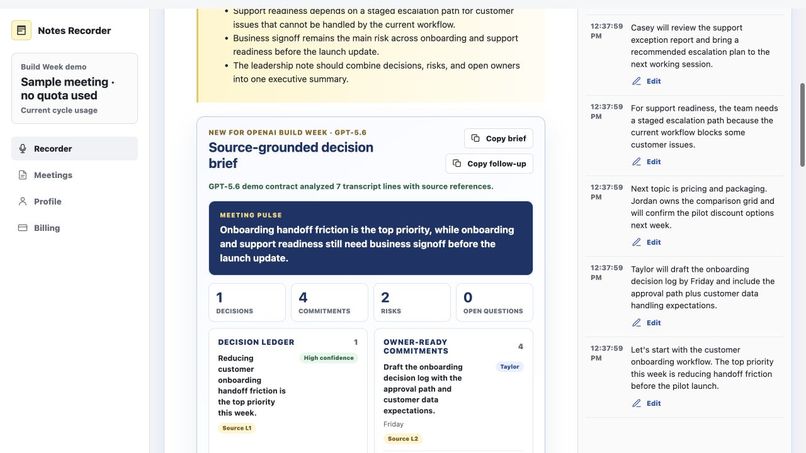
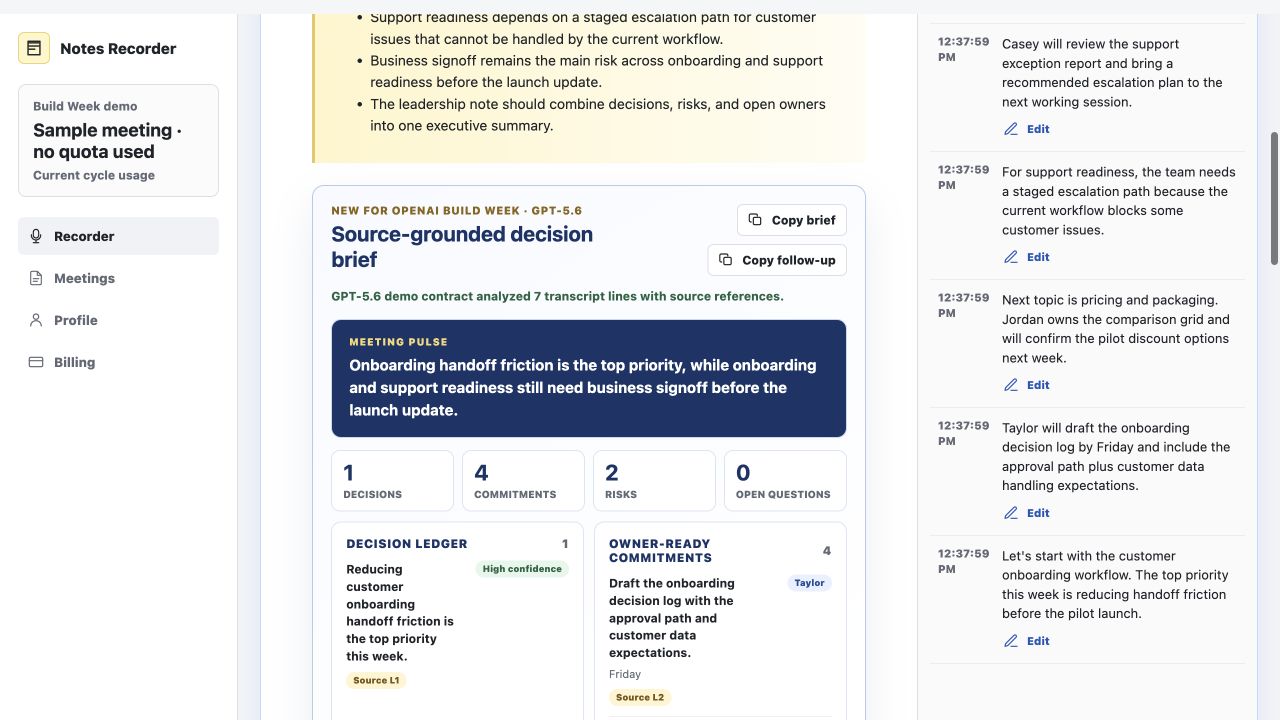
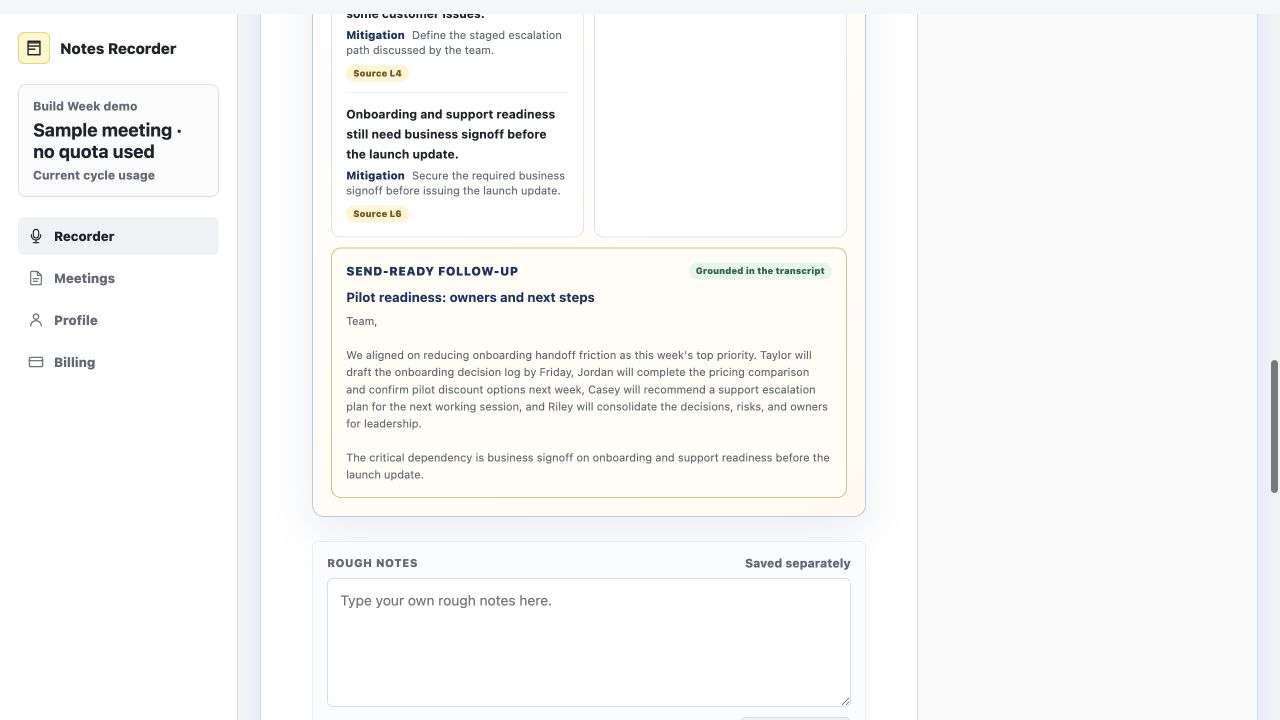
The source-backed brief keeps GPT-5.6 outputs connected to exact transcript lines.
-
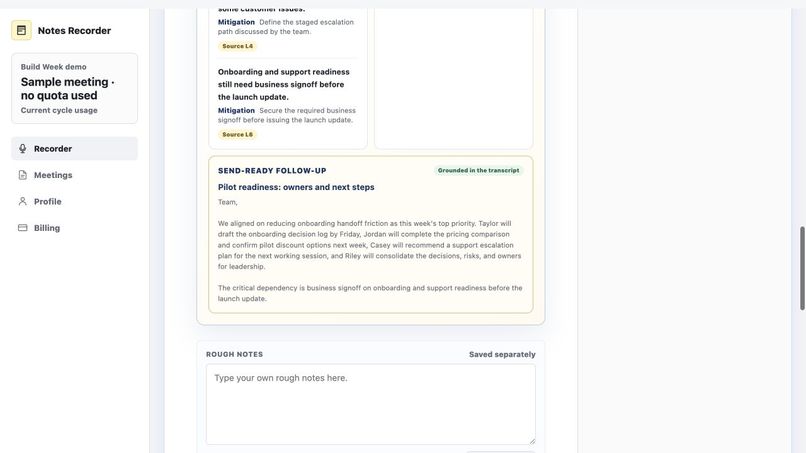
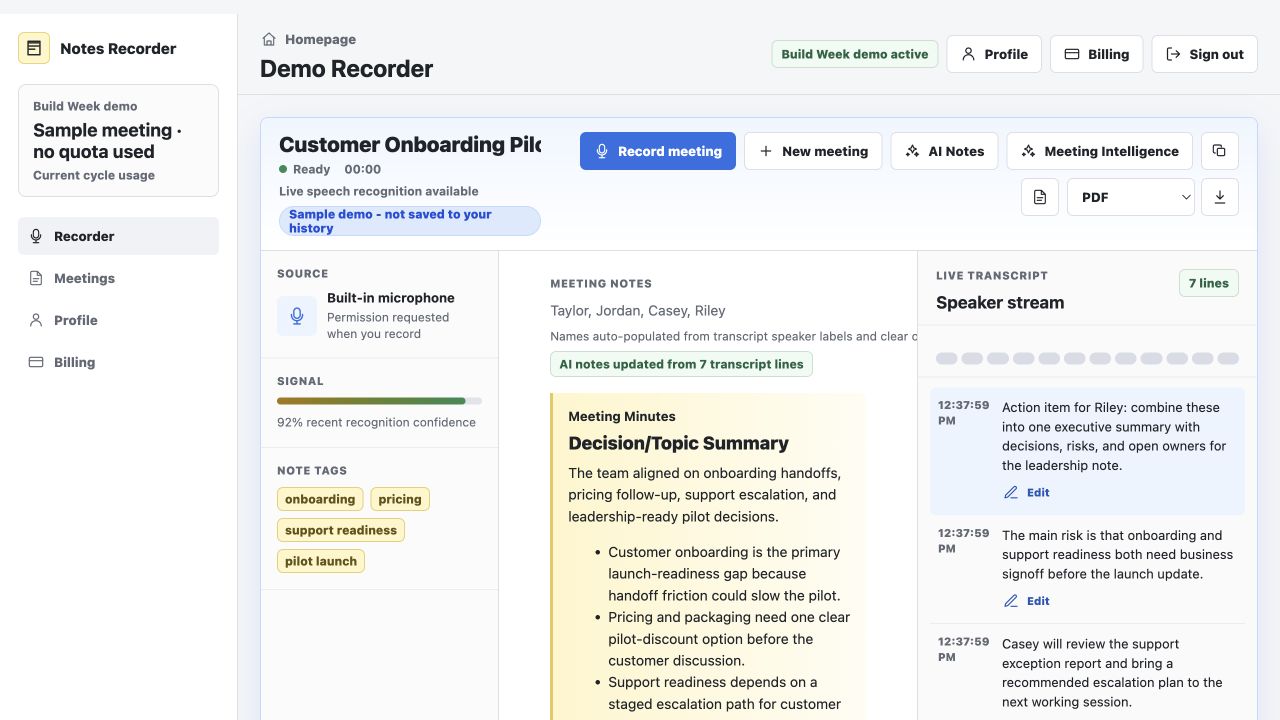
The real Notes Recorder judge workspace with the built-in customer-onboarding fixture.
-
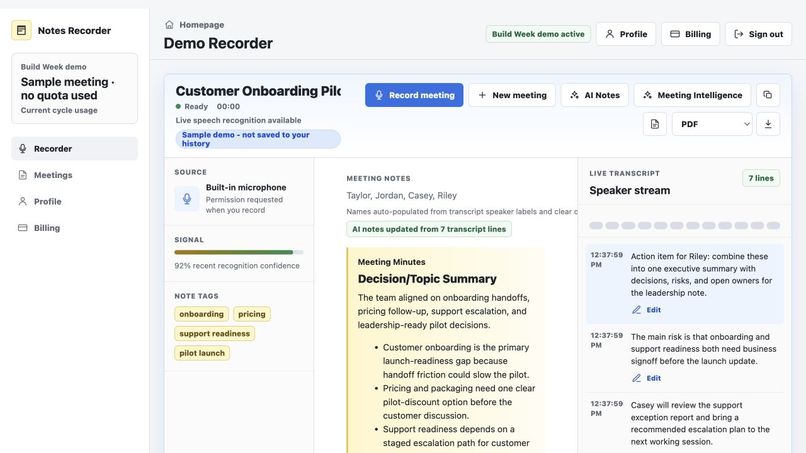
Meeting Intelligence turns transcript evidence into decisions, commitments, risks, and open questions.
Inspiration
What it does
How we built it
Challenges we ran into
Accomplishments that we're proud of
What we learned
What's next for Notes Recorder — Meeting Intelligence
Inspiration
Meeting notes often capture what was said but miss what matters next: what was decided, who committed to what, what could block progress, and which questions are still unresolved. I built Meeting Intelligence to turn a Notes Recorder transcript into an evidence-backed operating brief that people can trust and act on.
What it does
Notes Recorder is an existing product for recording, transcribing, and organizing meetings. On July 18, 2026, I extended it for OpenAI Build Week with Meeting Intelligence, a new full-stack workflow that produces:
- Key decisions with confidence.
- Commitments with owners and timing.
- Risks and transcript-supported mitigations.
- Open questions.
- A concise meeting pulse.
- A send-ready follow-up message.
- Exact transcript line references supporting every extracted claim.
The normal production workflow requires an entitled signed-in account. A deterministic public judge fixture makes the complete feature easy to evaluate without exposing private meeting data or depending on API quota.
How I built it
The responsive frontend calls POST /api/intelligence/analyze. Normal signed-in requests use GPT-5.6 through the OpenAI Responses API with a strict structured-output schema. The server validates every evidence line reference before returning the result. Only the exact built-in public fixture can use the cached demo contract; any other anonymous transcript is rejected.
Codex with GPT-5.6 was my primary development environment. It helped me inspect the existing production architecture, define a safe feature boundary, implement the authenticated endpoint and responsive interface, add deterministic regression coverage, verify the live production behavior, and assemble this submission.
Primary Codex session ID: 019f75f6-215f-7043-9db8-95460aee5d65
Qualifying implementation commits: ae9b23e and c718b6c. Submission documentation commit: 59f82fb.
Challenges
The hardest problem was making AI output useful without presenting guesses as facts. The feature had to fit an existing application, preserve its authentication boundary, remain visually consistent, and return structured results whose cited transcript lines could be checked instead of blindly trusted.
Accomplishments that I'm proud of
Meeting Intelligence goes beyond generating another meeting summary. It creates an actionable brief, connects claims to transcript evidence, provides a polished follow-up draft, includes a safe deterministic judging path, and is covered by targeted and full-product regression tests. The live demo preserves the real Notes Recorder interface rather than replacing it with a contest-only mockup.
What I learned
Structured output is only the beginning of trustworthy AI product design. The strongest results came from pairing GPT-5.6 with a narrow schema, explicit evidence requirements, server-side validation, and an interface that keeps the original transcript close to the generated intelligence.
What's next for Notes Recorder — Meeting Intelligence
Saved intelligence reports, richer follow-up exports, team-level action tracking, configurable meeting templates, and longitudinal views showing which commitments were completed or carried into future meetings.
Try it
Built With
- codex
- css
- gpt-5.6
- html
- javascript
- node.js
- openai
- responses

Log in or sign up for Devpost to join the conversation.