-
-
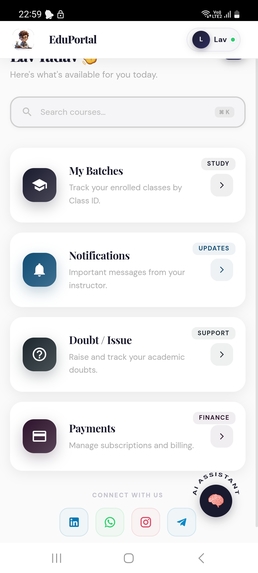
Landing page after login
Inspiration
NoteNova was inspired by a simple problem: students often have to navigate through multiple pages to find the right course, understand concepts, get their doubts solved, and decide what to learn next. We wanted to build an education platform where an AI assistant could understand a student's needs and actively help throughout their learning journey.
Instead of building just another chatbot, we wanted the AI to interact with the actual platform — understanding available courses, recommending relevant learning content, assisting with purchases, and providing payment-related information when needed.
What it does
NoteNova is an AI-powered education platform that brings learning, course discovery, and intelligent assistance together.
Students can:
- Ask the AI assistant educational questions and get context-aware answers.
- Discover courses and batches based on their learning goals.
- Get personalized course recommendations.
- Receive relevant upsell and cross-sell recommendations.
- Ask questions about their payment status.
- Purchase courses through Razorpay.
- Get assistance when a payment fails.
The platform also includes an AI-powered Revenue Recovery system:
Payment Failure → Recovery Signal → AI Reasoning → Policy Gate → Recovery Action / Human Escalation → Audit Trail
The agent operates within configurable boundaries such as maximum retries, retry cooldown, maximum discount, and an auto-approval ceiling.
How we built it
We built NoteNova as a full-stack application using React, Node.js/Express, MongoDB, and Razorpay.
The frontend provides the learning platform, course catalogue, chatbot, purchasing experience, and Revenue Recovery dashboard. The backend manages authentication, courses, purchases, payment processing, webhooks, AI workflows, and recovery signals.
For payments, Razorpay webhooks securely detect payment events. Failed payments are converted into recovery signals that can be analyzed by the AI agent.
The AI proposes an appropriate recovery action, while a deterministic Policy Gate checks whether that action is allowed. This prevents the AI from directly performing unrestricted financial operations.
Every important agent decision and execution result is recorded in an Audit Trail, making the workflow traceable and explainable.
Challenges we ran into
One of our biggest challenges was integrating AI into an existing full-stack education platform without disrupting the existing learning and payment workflows.
We faced challenges around:
- Connecting the AI assistant with real course and application data.
- Integrating Razorpay payments and securely handling webhooks.
- Tracking payment attempts and failed-payment states correctly.
- Preventing duplicate purchases and payment processing.
- Designing safe boundaries around autonomous AI decisions.
- Handling uncertain AI decisions through human escalation.
- Making AI actions explainable through an audit trail.
- Moving from initially seeded data used for development/testing to actual payment integration.
- Connecting payment intelligence with the chatbot so it can answer payment-related questions using available payment information.
The biggest challenge was making all these components work together as one end-to-end system, rather than having isolated AI, payment, and education features.
Accomplishments that we're proud of
We are especially proud of turning a traditional education platform into an AI-powered application with real operational workflows.
Some highlights are:
- Built an AI educational assistant integrated with the actual platform.
- Integrated Razorpay payment processing and server-side verification.
- Built real payment-failure detection using Razorpay webhooks.
- Created an autonomous Revenue Recovery workflow.
- Added configurable AI policy boundaries and safety controls.
- Added human escalation for cases outside the agent's authority.
- Built an Audit Trail showing the agent's reasoning, proposed action, gate decision, and execution result.
- Added payment-aware chatbot capabilities.
- Added course recommendations, upselling, and cross-selling.
- Built a dashboard to monitor recovery signals and recovered revenue.
- Added simulation capabilities to test recovery workflows without repeatedly creating real payment failures.
What makes us most proud is that the AI isn't limited to generating text — it can reason about real application events and interact with real platform workflows while remaining bounded by deterministic rules.
What we learned
Building NoteNova taught us that building a useful AI application is much more than connecting an LLM API to a chatbot.
We learned how to:
- Integrate AI with real application data and workflows.
- Build AI agents with deterministic safety boundaries.
- Work with Razorpay payments, signatures, and webhooks.
- Handle payment state and idempotency.
- Design human-in-the-loop workflows.
- Make AI decisions auditable and explainable.
- Build reliable full-stack integrations around AI.
- Think about AI in terms of actions, guardrails, failures, and measurable outcomes, not just responses.
Most importantly, we learned that a powerful AI system should not simply answer — it should be able to understand context, interact with real application capabilities, take appropriate actions, and know when it should stop and ask a human.
Built With
- agents
- ai
- api
- authentication
- chatbot
- cloudinary
- express.js
- gateway
- javascript
- jwt
- llm
- mongodb
- mongoose
- node.js
- payment
- rag
- razorpay
- react
- recovery
- render
- rest
- revenue
- webhooks
- webmcp

Log in or sign up for Devpost to join the conversation.