-
-
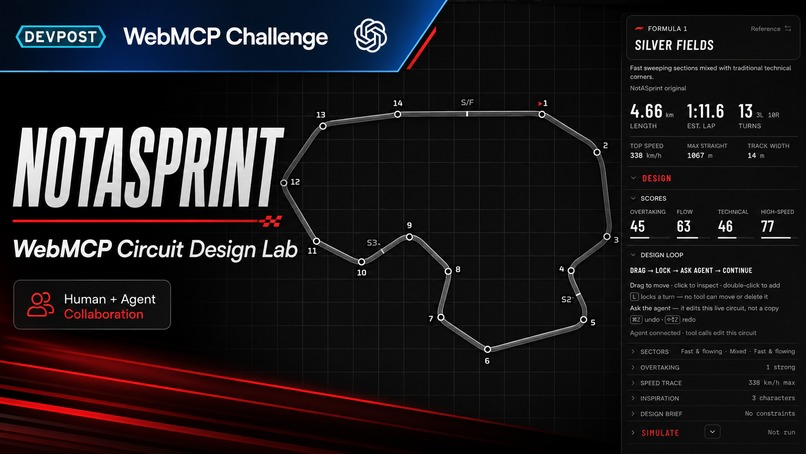
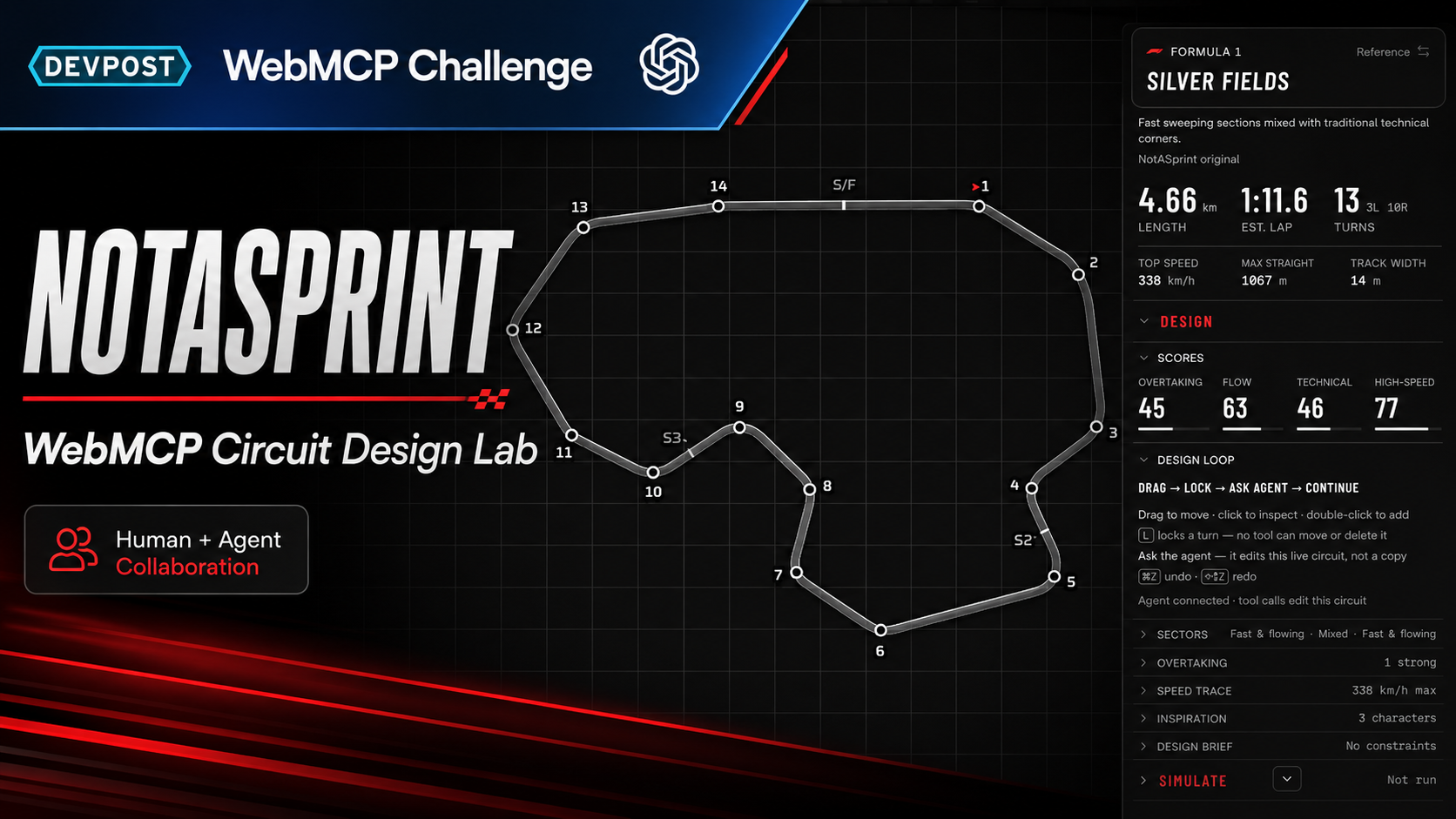
NotASprint Thumbnail
-
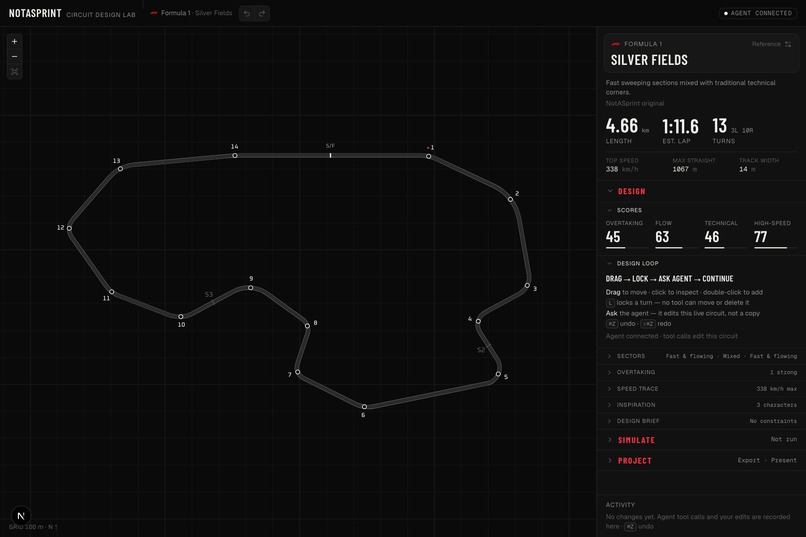
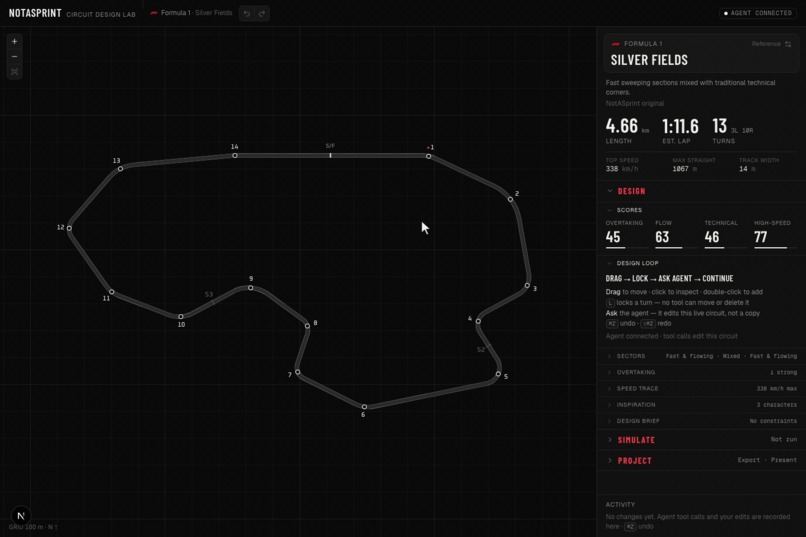
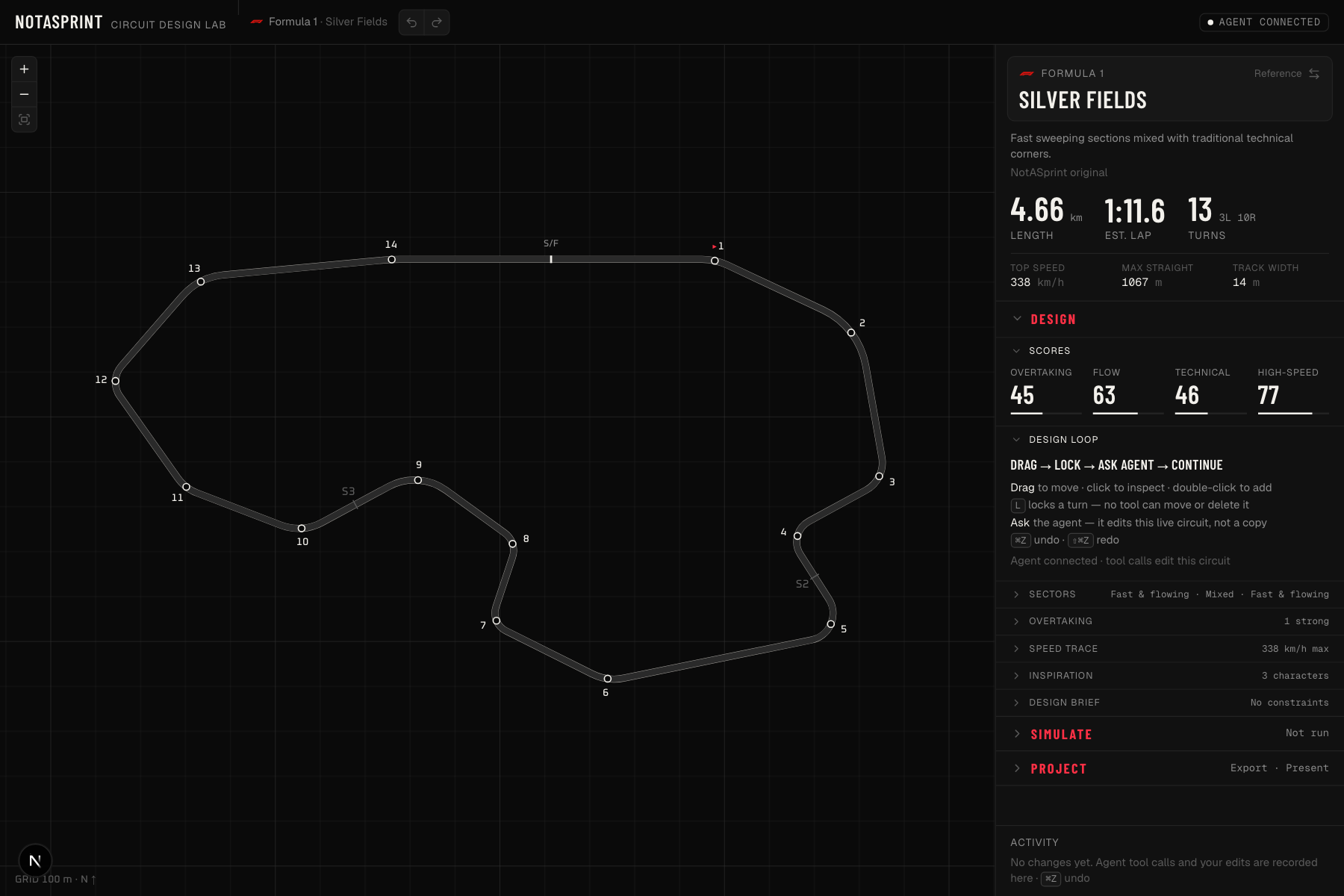
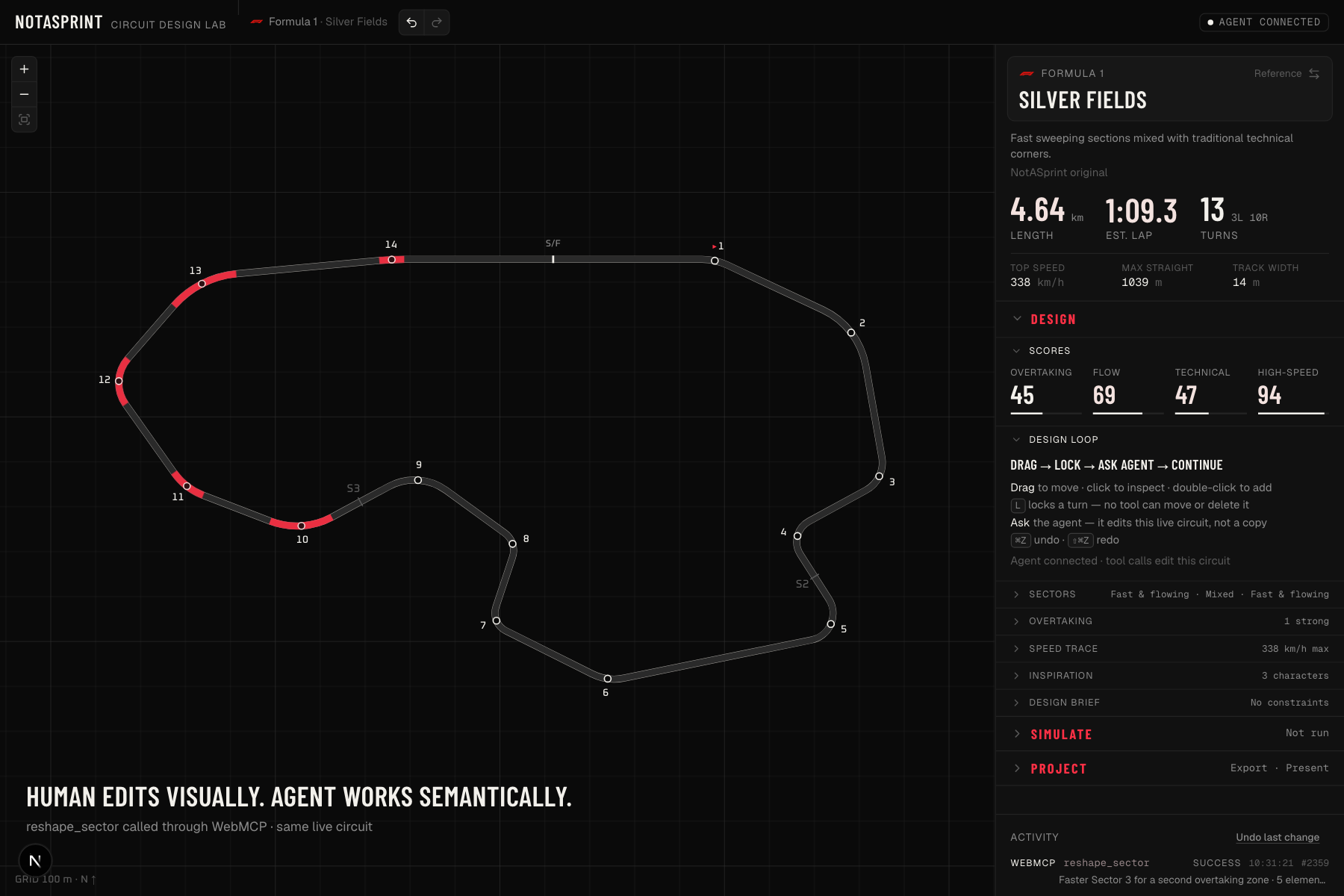
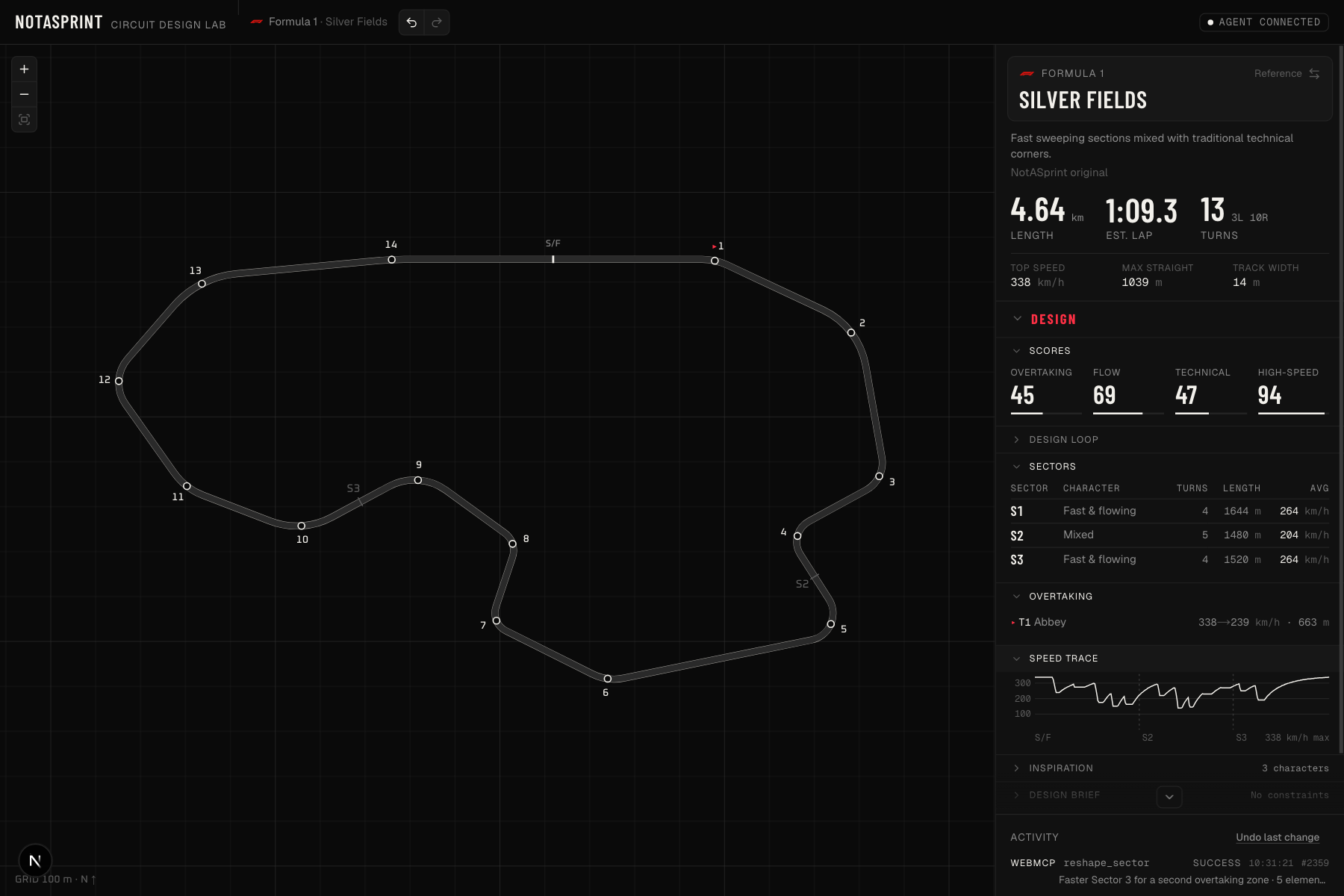
NotASprint — a WebMCP-native circuit design lab. Live canvas, telemetry panel, Formula 1 reference loaded.
-
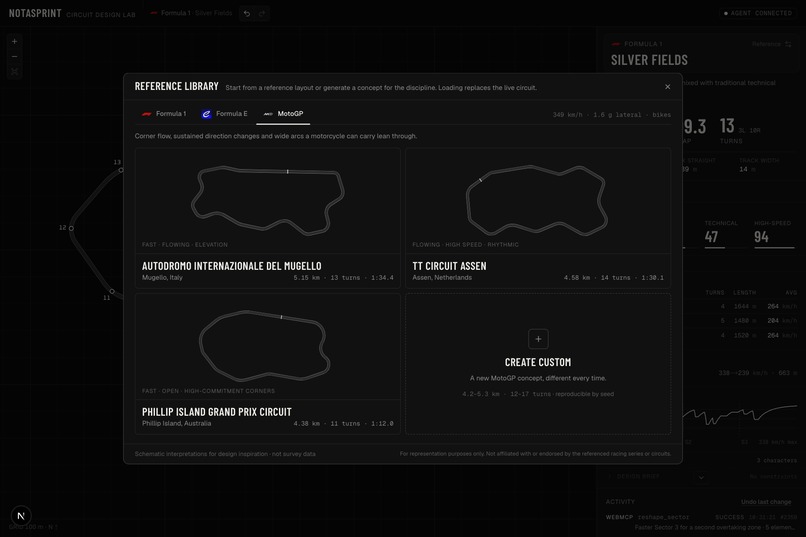
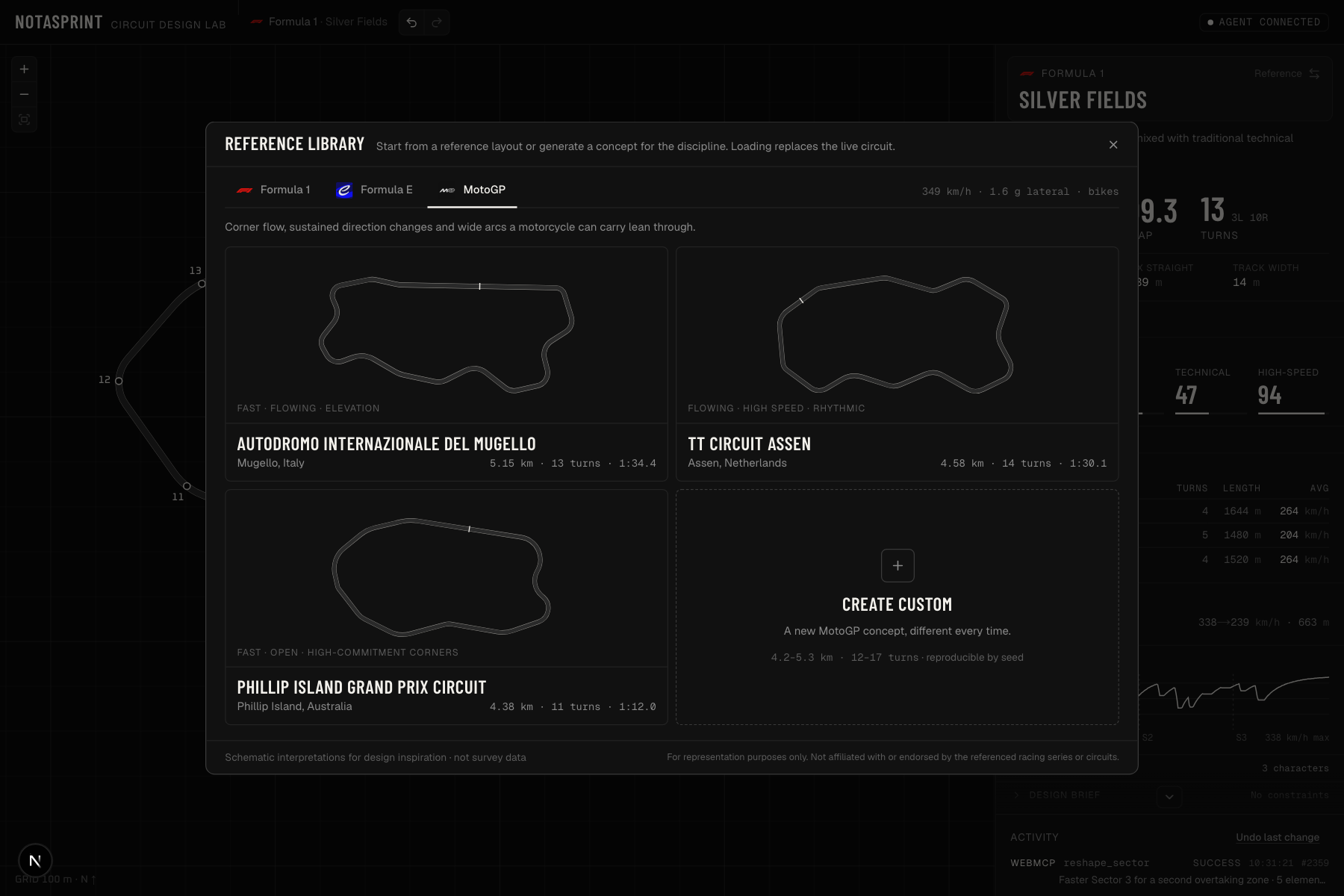
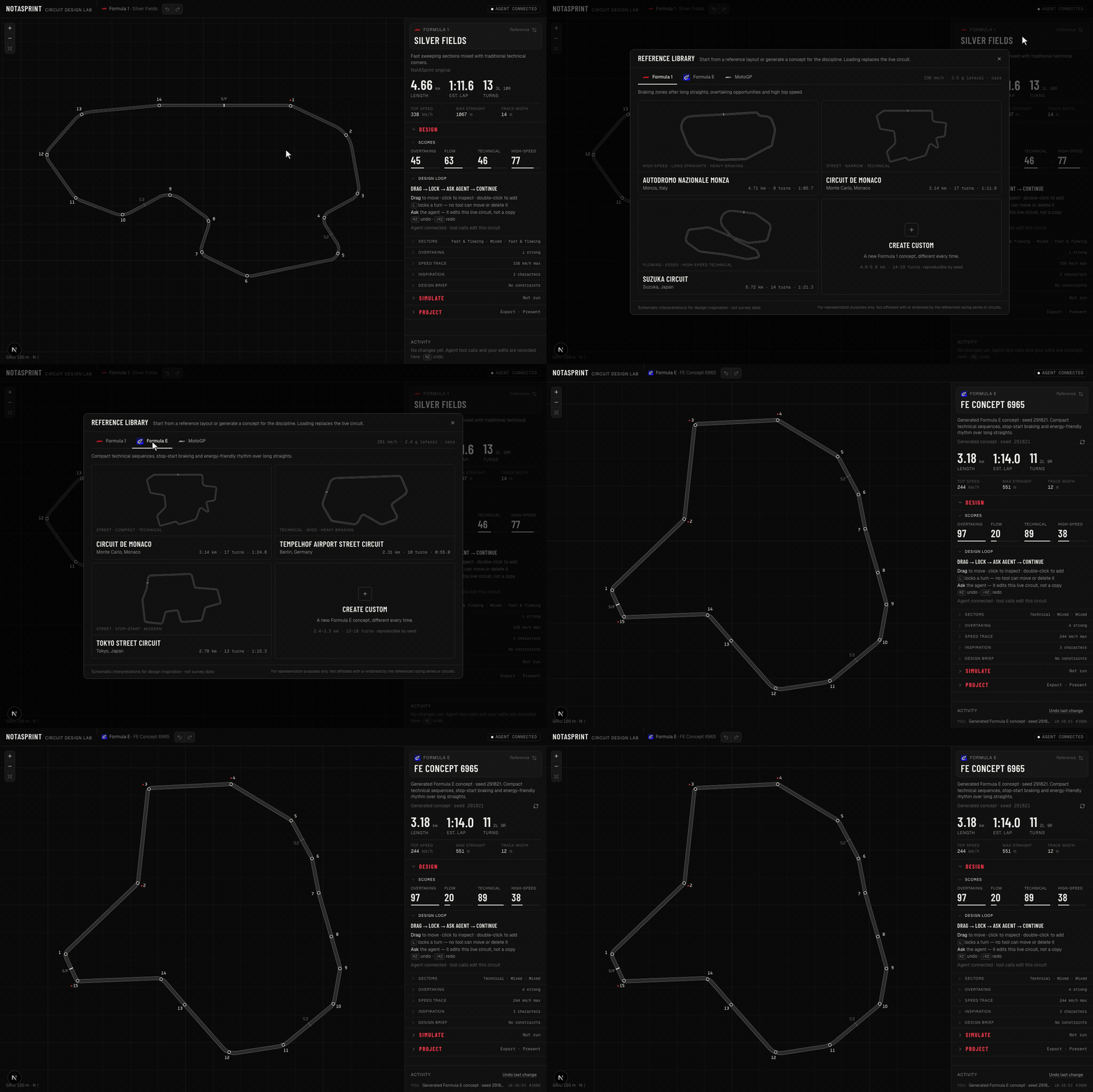
Design for Formula 1, Formula E or MotoGP: three references per discipline plus Create Custom.
-
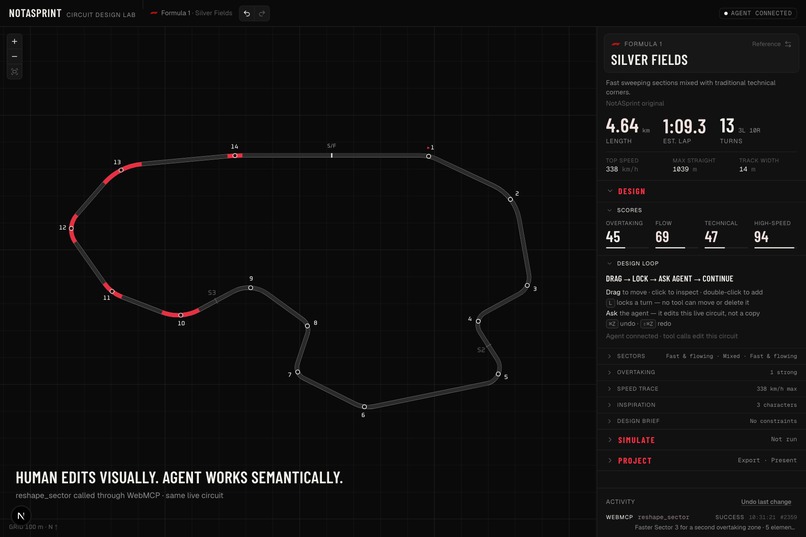
Human edits visually, agent works semantically: a real reshape_sector call through WebMCP, receipted in Activity (High-speed 77 → 94).
-
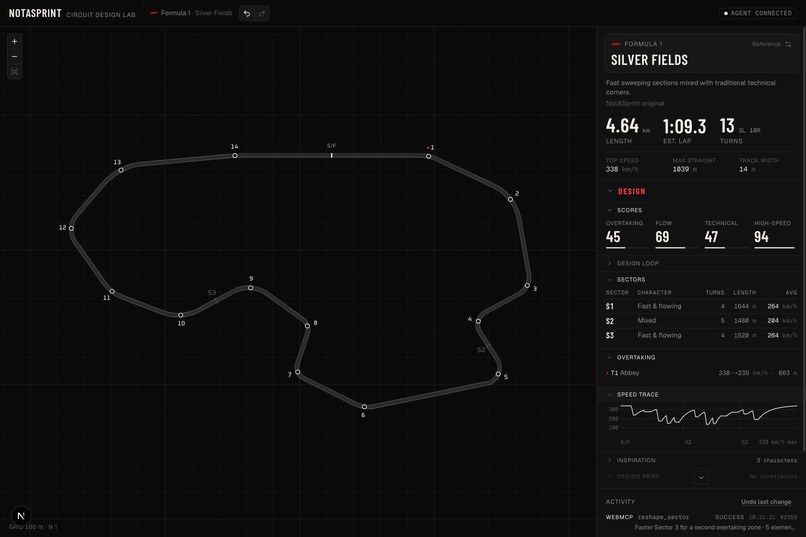
Deterministic analysis: Flow · Technical · Overtaking · High-speed, sector character, overtaking zones, speed trace.
-
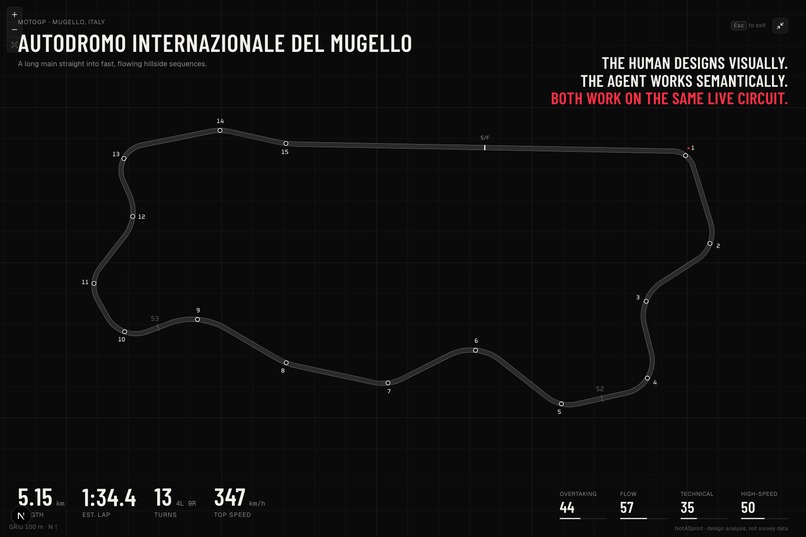
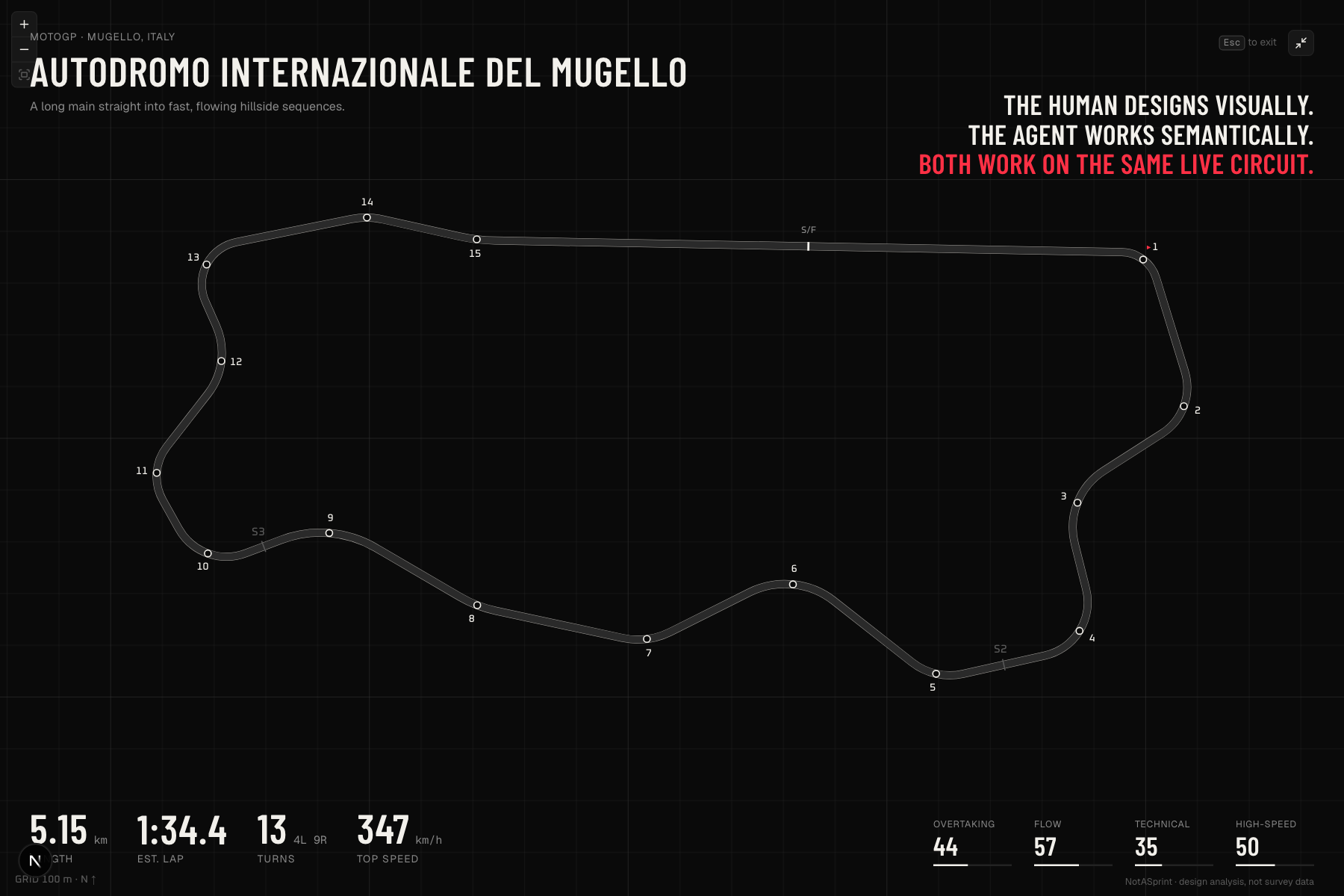
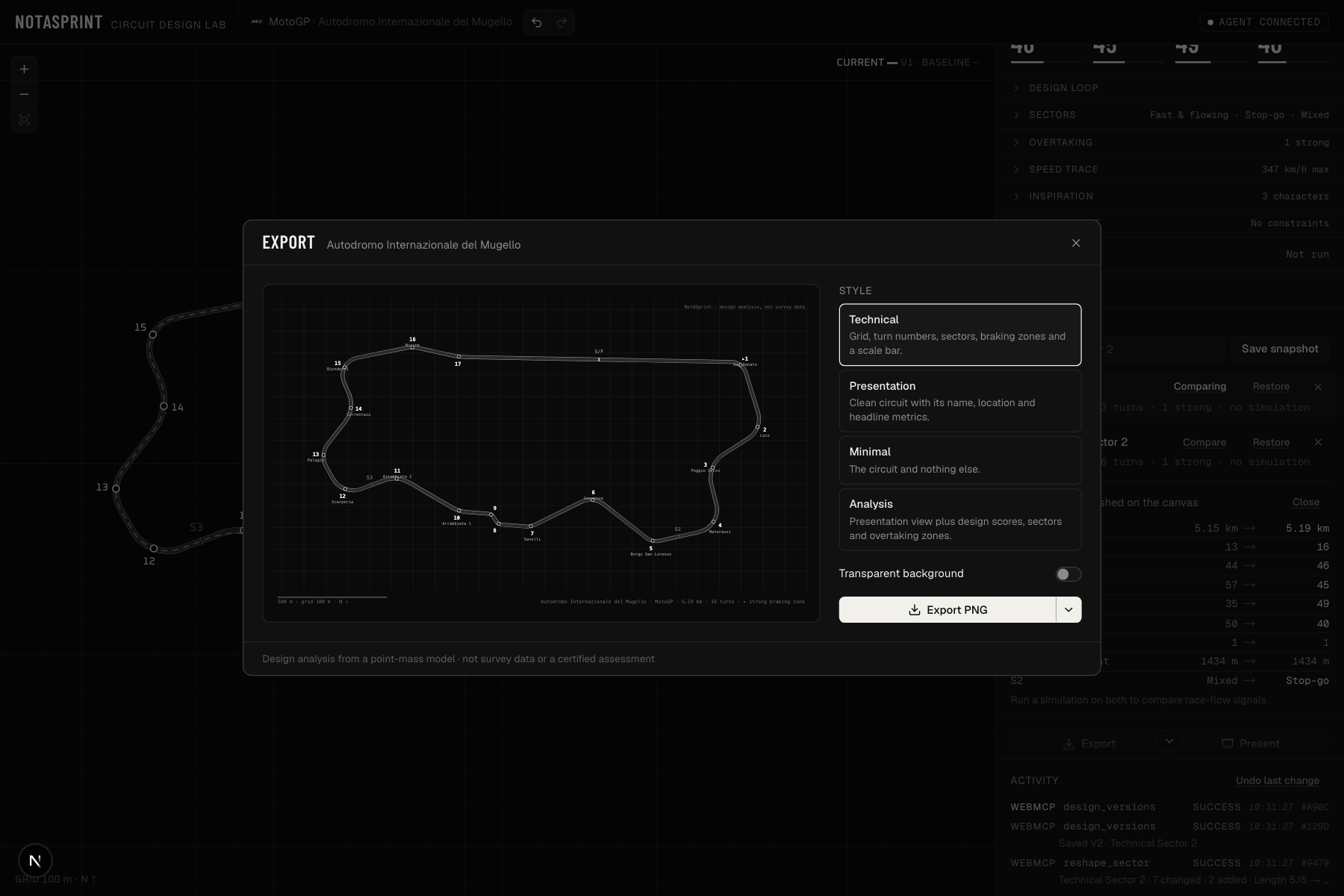
Presentation mode, Mugello. The human designs visually. The agent works semantically. Both work on the same live circuit.
-
Reference Library → Formula E → Create Custom: a seeded, discipline-aware concept, reproducible by the agent.
-
 GIF
GIF
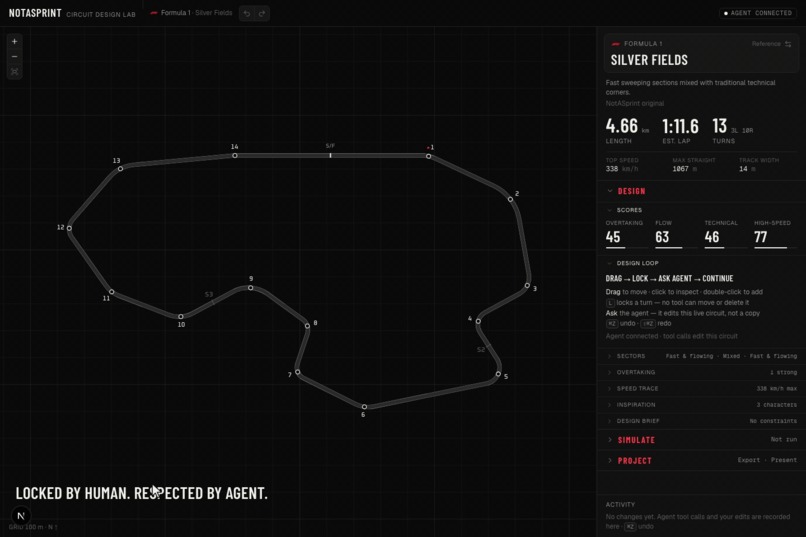
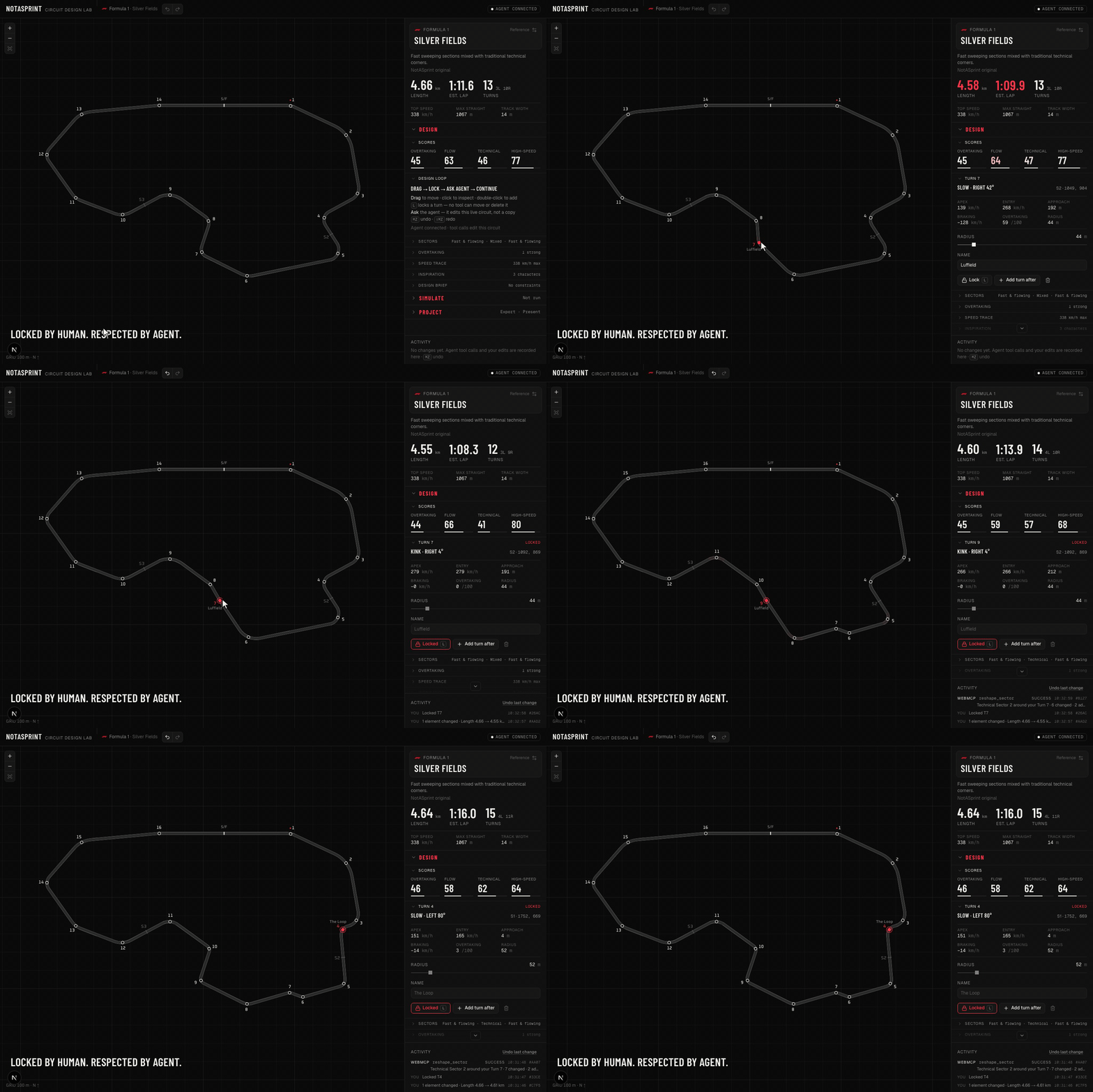
Drag Turn 7, press L to lock, ask the agent for a technical Sector 2 — it adds and reshapes corners around the lock, never through it.
-
 GIF
GIF
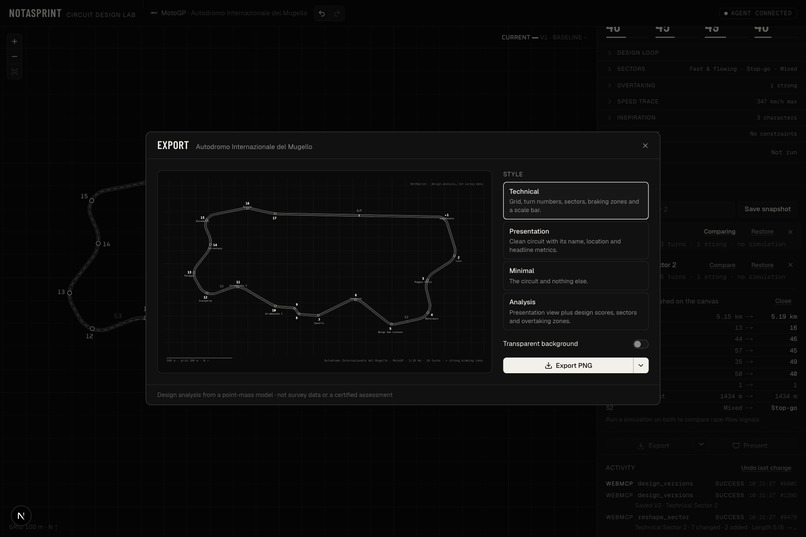
Save snapshots, compare on the canvas, export in Technical / Presentation / Minimal / Analysis styles.
-
 GIF
GIF
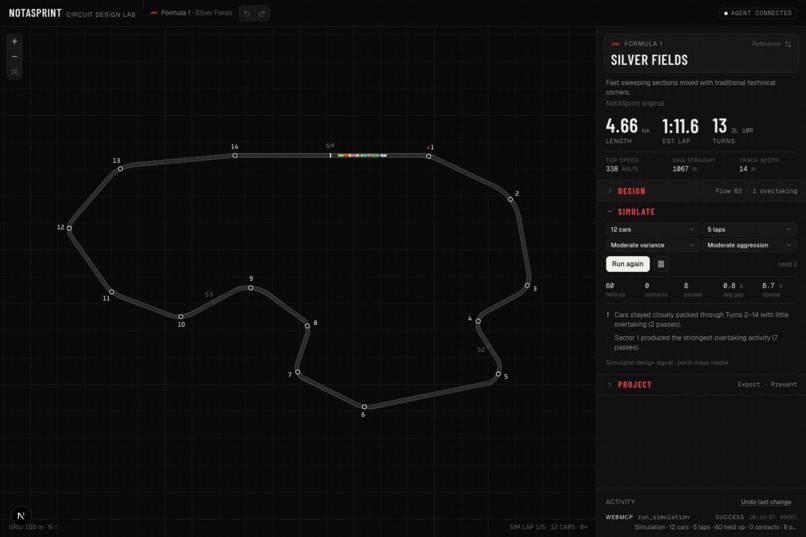
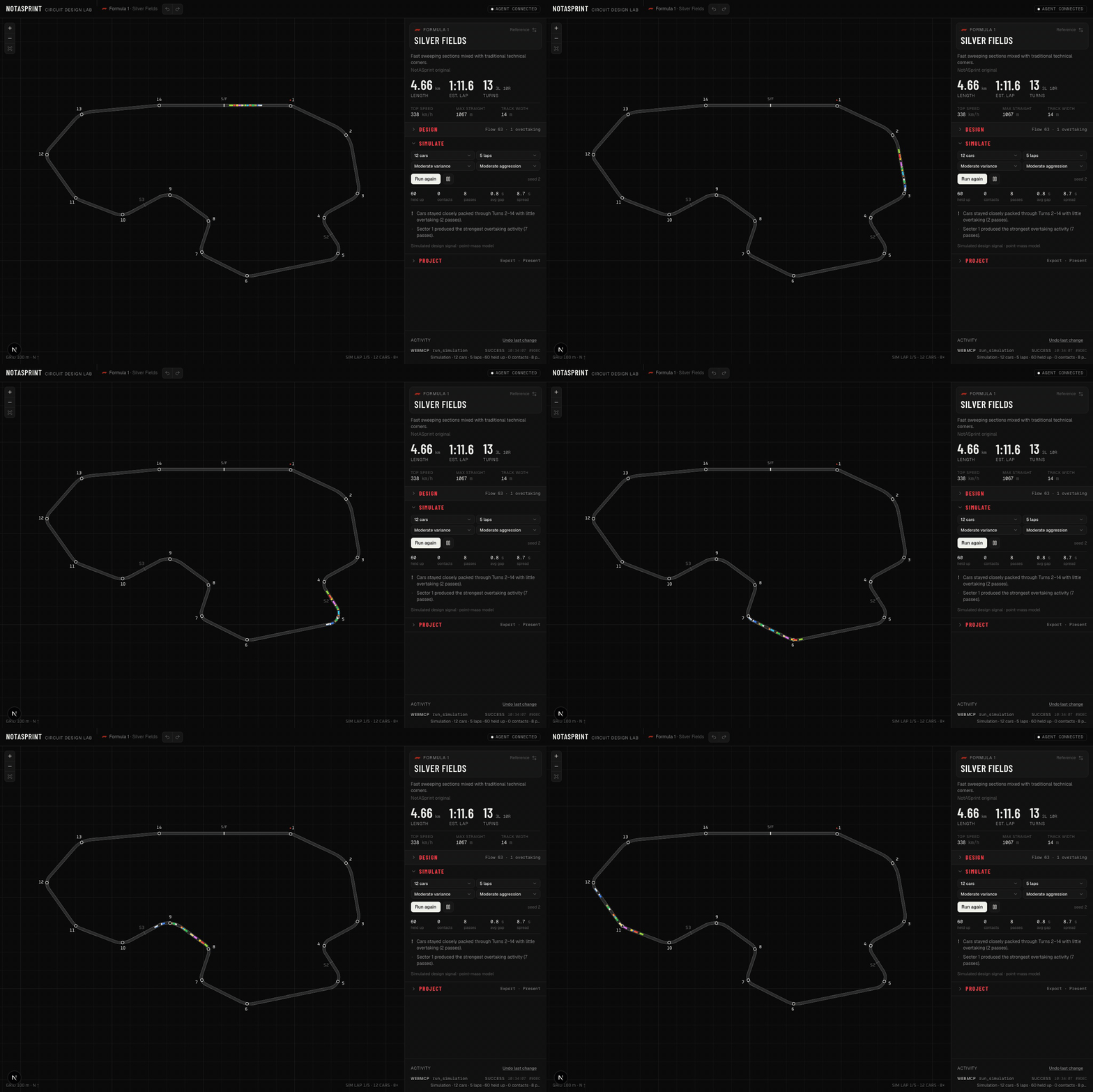
Race-flow simulation: 12 cars, 5 laps, findings ranked in the panel — design turned into testable signals.
Inspiration
Circuit design is visual, iterative, and full of tradeoffs.
A designer might move a corner because it feels better, inspect how that affects speed or overtaking, lock the decision they care about, and keep refining everything around it.
That made circuit design a natural fit for WebMCP.
We did not want to bolt a chatbot onto the side of a design tool or make an agent operate the UI by clicking buttons. We wanted the webpage itself to become the shared workspace.
The human should be able to design visually.
The agent should be able to understand and modify that exact same live circuit semantically.
That became NotASprint.
What it does
NotASprint is a WebMCP-native motorsport circuit design workspace where a human and an AI agent design the same racing circuit in the same live browser state.
The human can directly:
- reshape turns on the circuit
- inspect sectors and telemetry
- lock design decisions
- define measurable design constraints
- switch between Formula 1, Formula E, and MotoGP
- start from reference-inspired layouts or generate custom circuits
- run race-flow simulations
- save design snapshots
- compare iterations
- undo and redo changes
- export technical, presentation, minimal, and analysis views
At the same time, ChatGPT can use NotASprint's WebMCP tools to:
- read the exact live circuit
- analyze flow, technicality, high-speed characteristics, and overtaking
- identify braking-zone opportunities
- reshape entire sectors by design intent
- make precise turn edits
- apply design inspirations
- generate new circuits
- run simulations and inspect their findings
- work within a design brief
- respect turns locked by the human
- compare iterations
- export the final design
The important part is that there is no separate agent copy of the circuit.
Both the human interface and the WebMCP tools operate on the same live artifact.
A human can manually change Turn 7 and lock it without telling the agent its new coordinates. The agent can then re-read the live circuit through WebMCP, understand that Turn 7 changed, preserve the locked decision, and redesign the rest of the sector around it.
The human designs visually. The agent works semantically. Both work on the same live circuit.
How we built it
NotASprint is built with Next.js, React, TypeScript, Tailwind CSS, shadcn/ui, Lucide, and SVG, and is deployed on Vercel.
The application owns the deterministic parts of the product:
- circuit geometry
- motorsport-specific design heuristics
- circuit analysis
- design constraints
- simulation
- locks
- history
- snapshots
- references
- exports
WebMCP is registered directly in the browser using the page's model context.
NotASprint exposes 14 semantic WebMCP tools covering:
- live circuit reading
- deterministic circuit analysis
- turn-level design moves
- sector reshaping
- design inspiration
- precise turn editing
- human-controlled locks
- reference circuit loading
- custom circuit generation
- undo
- simulation
- design briefs
- design snapshots
- export
These tools describe domain intent, not mouse clicks.
For example, the agent can request a faster Sector 2 or create a stronger overtaking zone rather than receiving instructions for which UI control to press.
The human UI and WebMCP tools route into the same underlying application state and design operations. When either side changes the circuit, the other side immediately sees the new state.
NotASprint does not require its own embedded LLM, backend, database, or separate agent service. The browser application provides the structured design environment and semantic tools; ChatGPT provides the agent.
We also built three motorsport contexts:
- Formula 1 — emphasis on braking zones, long straights, overtaking, and top speed
- Formula E — compact technical sequences and stop-start braking
- MotoGP — flowing corner sequences, sustained direction changes, and wider arcs
Each discipline includes three reference-inspired starting layouts plus custom seeded circuit generation.
The circuit intelligence is deterministic and explainable. A point-mass speed profile and geometry analysis produce metrics for lap length, estimated lap time, braking zones, sectors, overtaking, flow, technicality, and high-speed running.
Challenges we ran into
The hardest part was not registering WebMCP tools.
It was making the human-agent collaboration genuinely shared and reliable.
We had to ensure that:
- manual human edits were immediately readable by WebMCP
- agent actions updated the same circuit visible on screen
- locked turns remained exact human decisions
- semantic redesigns could work around those locks
- invalid geometry was prevented or surfaced clearly
- analysis updated deterministically after every change
- simulation results became stale when the circuit changed
- undo and redo worked across both human and agent actions
- references and custom generation correctly changed motorsport context
- WebMCP activity was visible enough to understand what the agent actually did
We also found that generated circuits or aggressive semantic edits could occasionally create distracting geometry warnings.
Instead of hiding those warnings, we improved the generation and geometry-safety paths and added regression tests around the exact demo flows.
Another challenge was distinguishing WebMCP from computer use.
The goal of NotASprint is not to teach an agent where to click. The value comes from exposing circuit-design semantics directly while still keeping the same rich visual workspace available to the human.
Accomplishments that we're proud of
The interaction we are most proud of is simple:
- The agent reads and improves the live circuit.
- The human manually reshapes Turn 7.
- The human locks Turn 7.
- The agent is not told the new coordinates.
- The agent re-reads the circuit through WebMCP.
- It preserves Turn 7 exactly and redesigns the surrounding sector.
That is the clearest demonstration of why WebMCP belongs in this product.
We are also proud that NotASprint now includes:
- 14 tested semantic WebMCP tools
- Formula 1, Formula E, and MotoGP design contexts
- nine reference-inspired circuit starting points
- reproducible custom circuit generation
- deterministic design analysis
- human-controlled locking
- measurable design briefs
- race-flow simulation
- simulation-driven redesign loops
- shared undo/redo history
- saved design snapshots and comparison
- multiple export formats and presentation styles
- visible activity receipts for WebMCP and human actions
Before submission, we ran an end-to-end WebMCP audit against the real application and exercised every exposed tool, including the human-edit → lock → agent-adapts workflow repeatedly.
What we learned
The biggest thing we learned is that WebMCP becomes much more interesting when the webpage itself is part of the work.
NotASprint is not fundamentally about making an agent faster at pressing buttons.
The human and agent have different strengths.
The human is good at visual judgment:
"I like this corner here. Keep it."
The agent is good at semantic goals:
"Make Sector 2 faster, preserve three overtaking opportunities, and stay within the design brief."
WebMCP gives both sides a common language without forcing either one into the other's interaction model.
The application remains responsible for deterministic geometry, validation, simulation, history, and permissions.
The human remains responsible for judgment and final decisions.
The agent remains responsible for understanding intent, analyzing structured state, and choosing useful semantic operations.
We also learned that visible trust mechanisms matter. Locks, undo, activity receipts, deterministic analysis, and before/after metrics make agent actions easier for a human to understand and control.
What's next for NotASprint
The next step is to expand NotASprint from conceptual circuit design into a deeper motorsport design environment.
Future directions include:
- terrain and elevation-aware circuit design
- real-location circuit planning
- richer race-flow and design simulation
- more advanced engineering constraints
- pit and paddock planning
- braking and racing-line visualization
- deeper circuit comparison
- richer presentation and technical reporting
- collaborative design reviews
The longer-term vision is a workspace where a designer can move naturally between visual design, structured analysis, simulation, and agent-assisted iteration without leaving the same live circuit.
WebMCP is what makes that shared workflow possible.
Built With
- chatgpt
- codex
- lucide
- nextjs
- react
- shadcn-ui
- tailwindcss
- typescript
- vercel
- webmcp

Log in or sign up for Devpost to join the conversation.