-
-
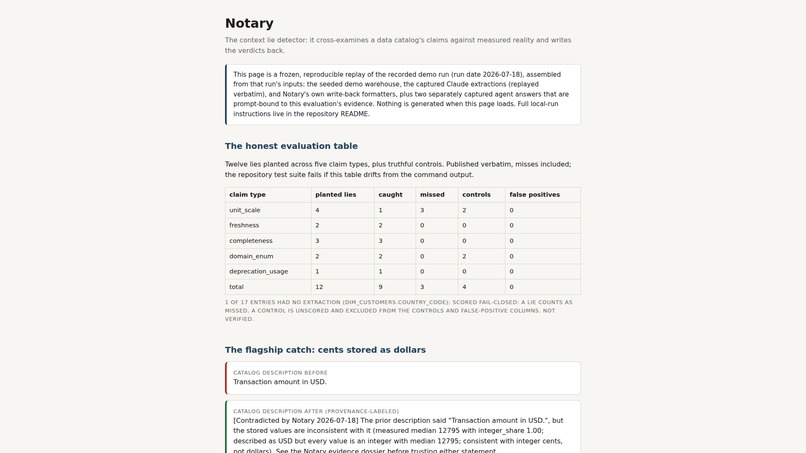
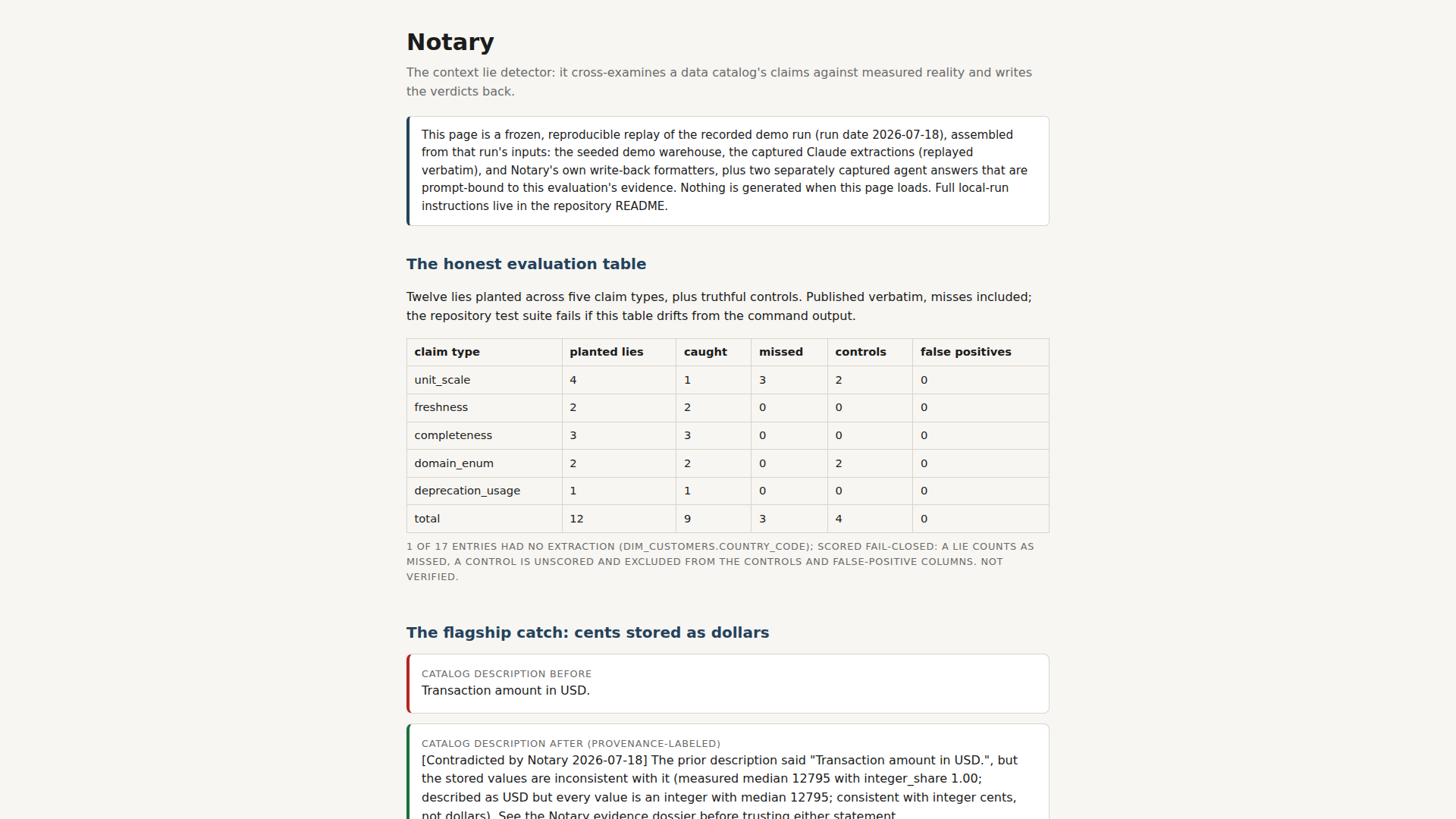
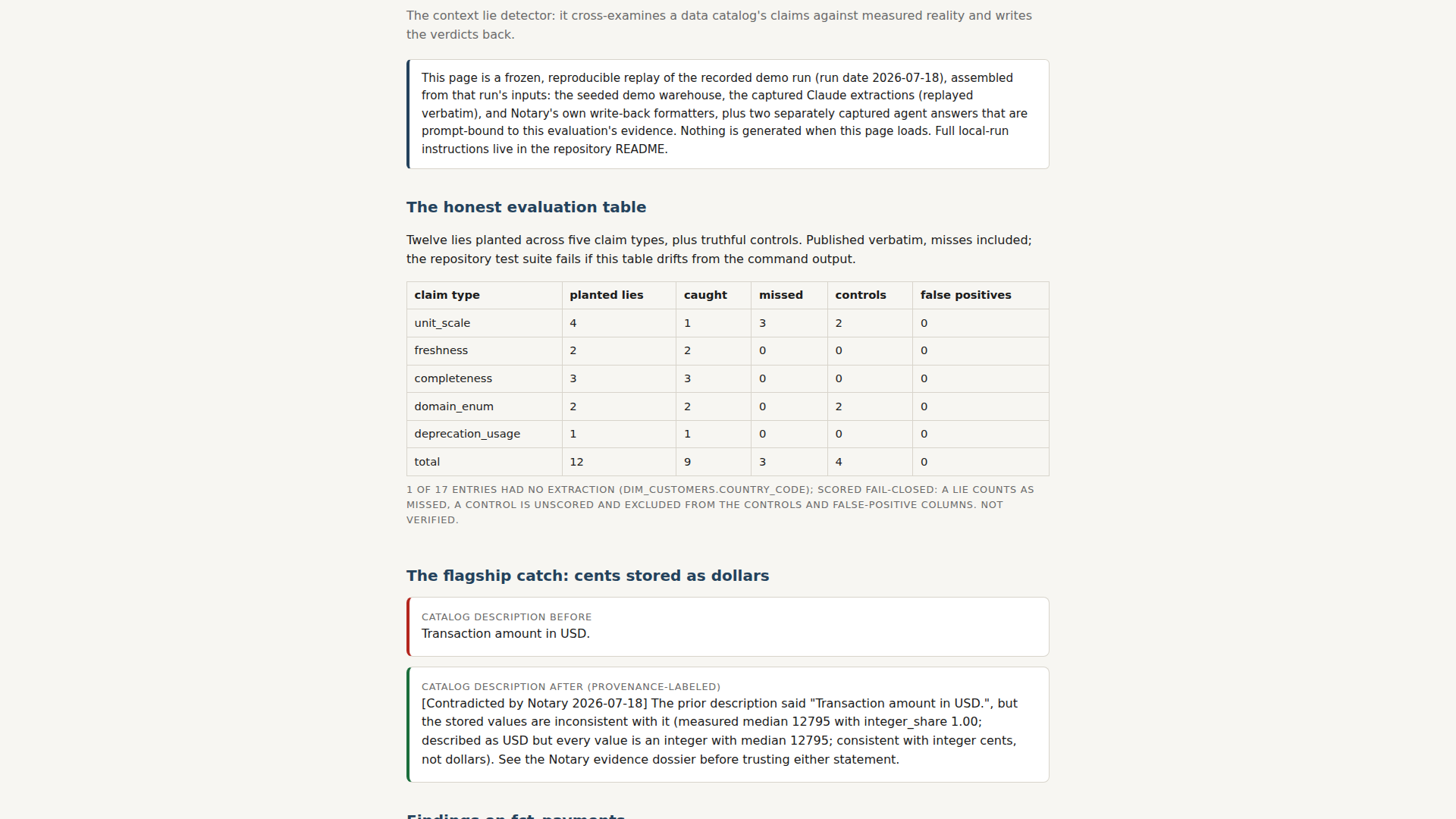
The hosted replay: a real captured Notary run, disclosed on-page, with the honest evaluation table published misses included.
-
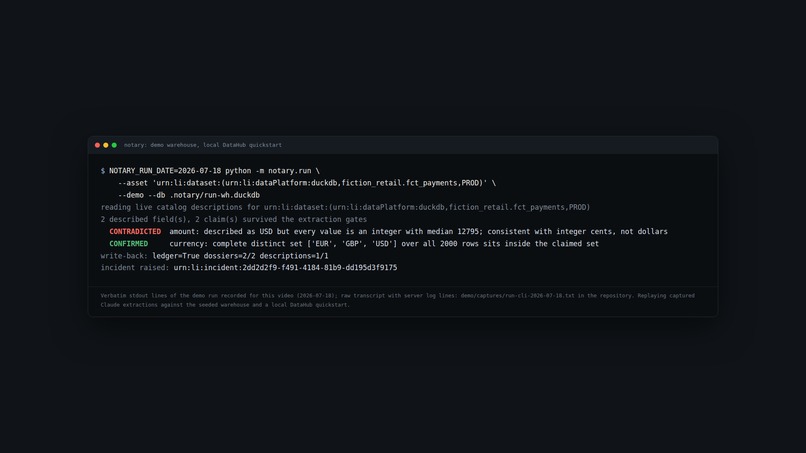
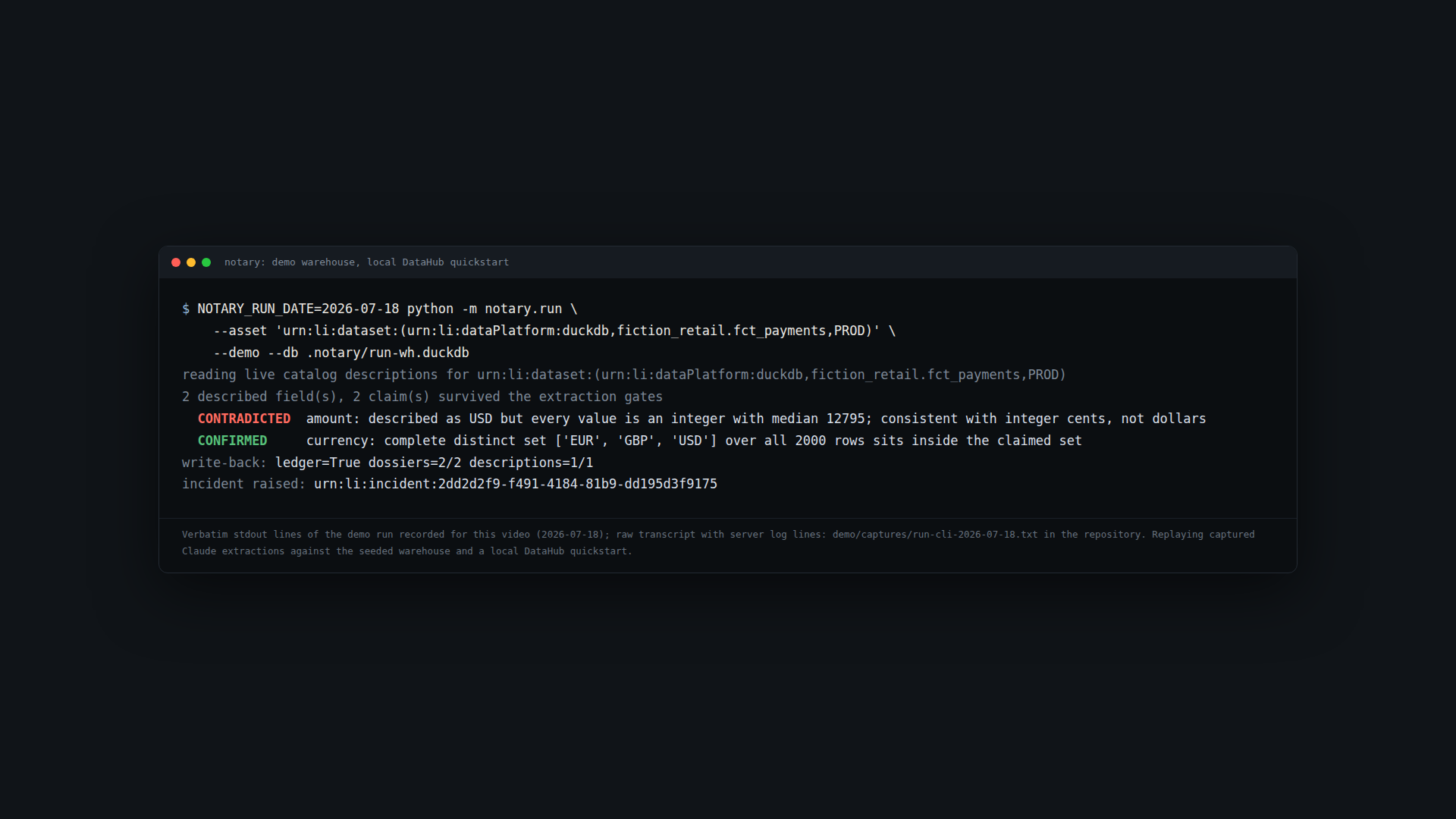
One command: Notary probes the warehouse, contradicts the USD claim (median 12795, integer cents), and writes verdicts back.
-
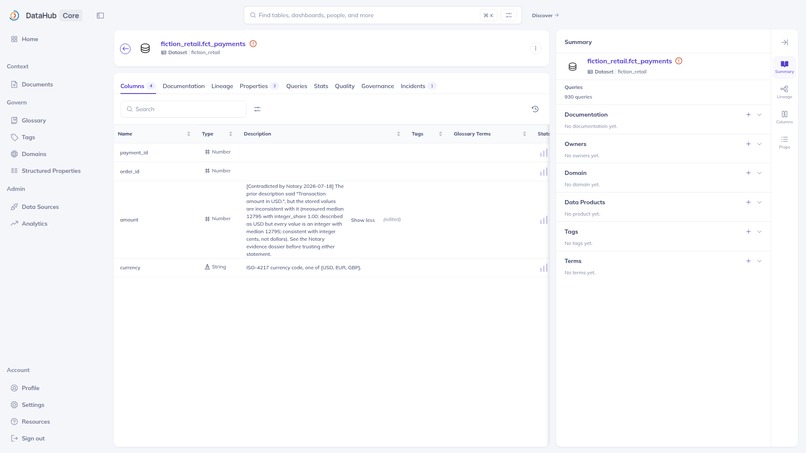
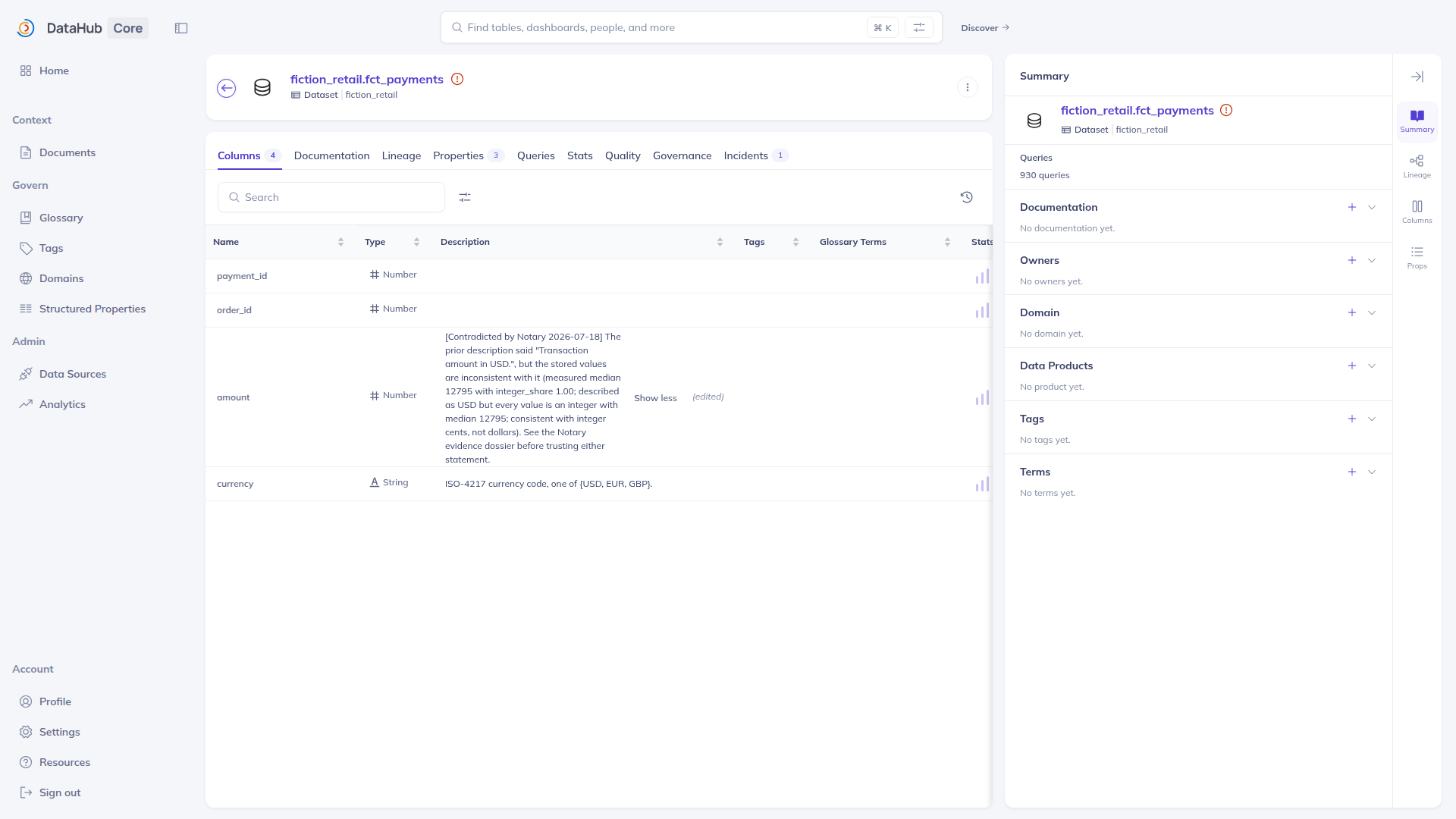
DataHub after the run: the amount column carries a provenance-labeled correction pointing at the evidence dossier.
-
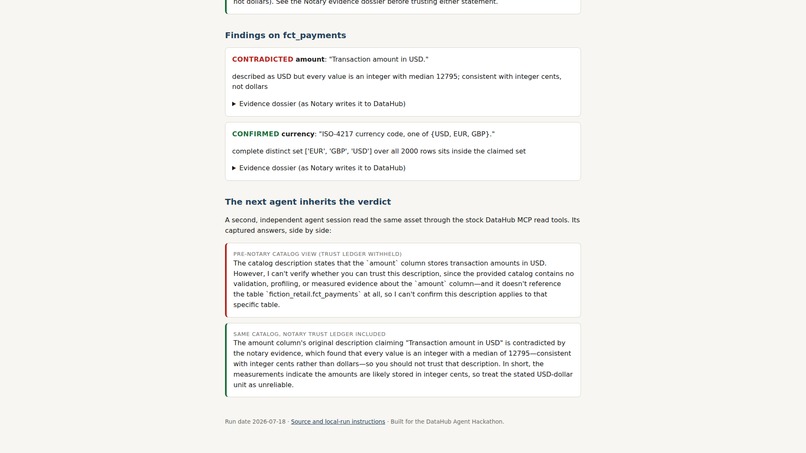
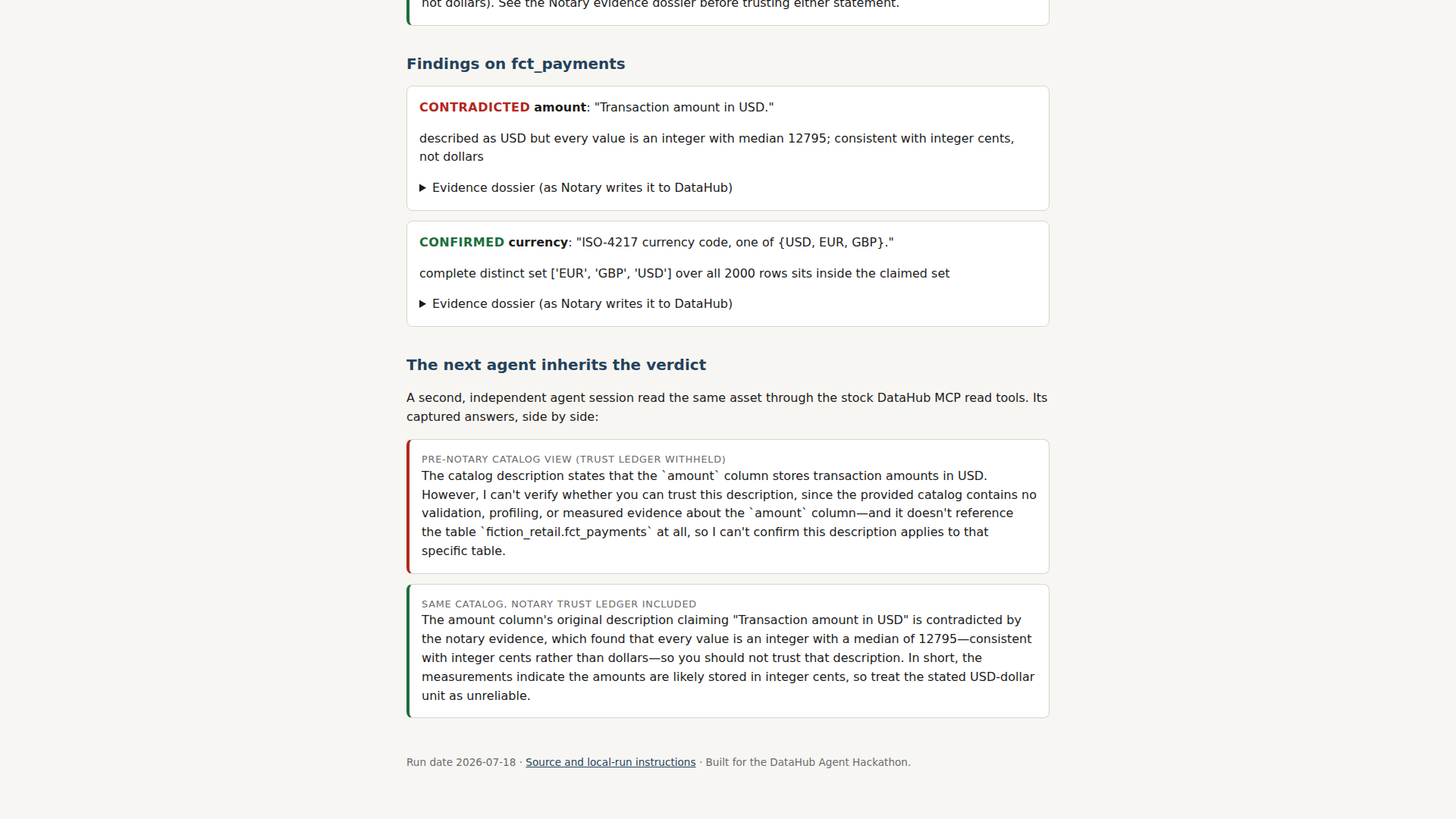
Same catalog, two answers: without the trust ledger the agent can only relay the unverified claim; with it, it refuses and cites evidence.
-
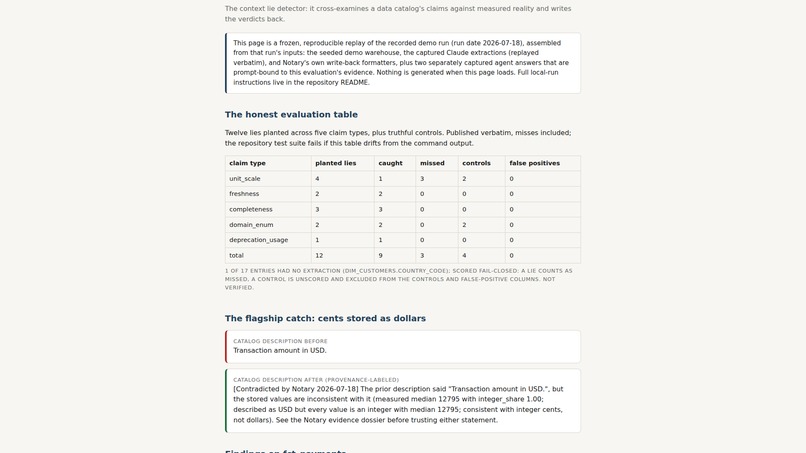
The scorecard we publish verbatim: 12 planted lies, 9 caught, 0 false positives, misses disclosed with reasons in the README.
-
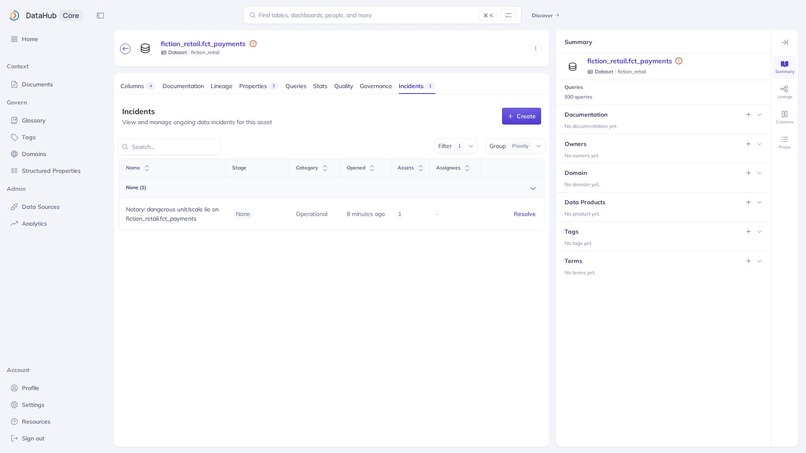
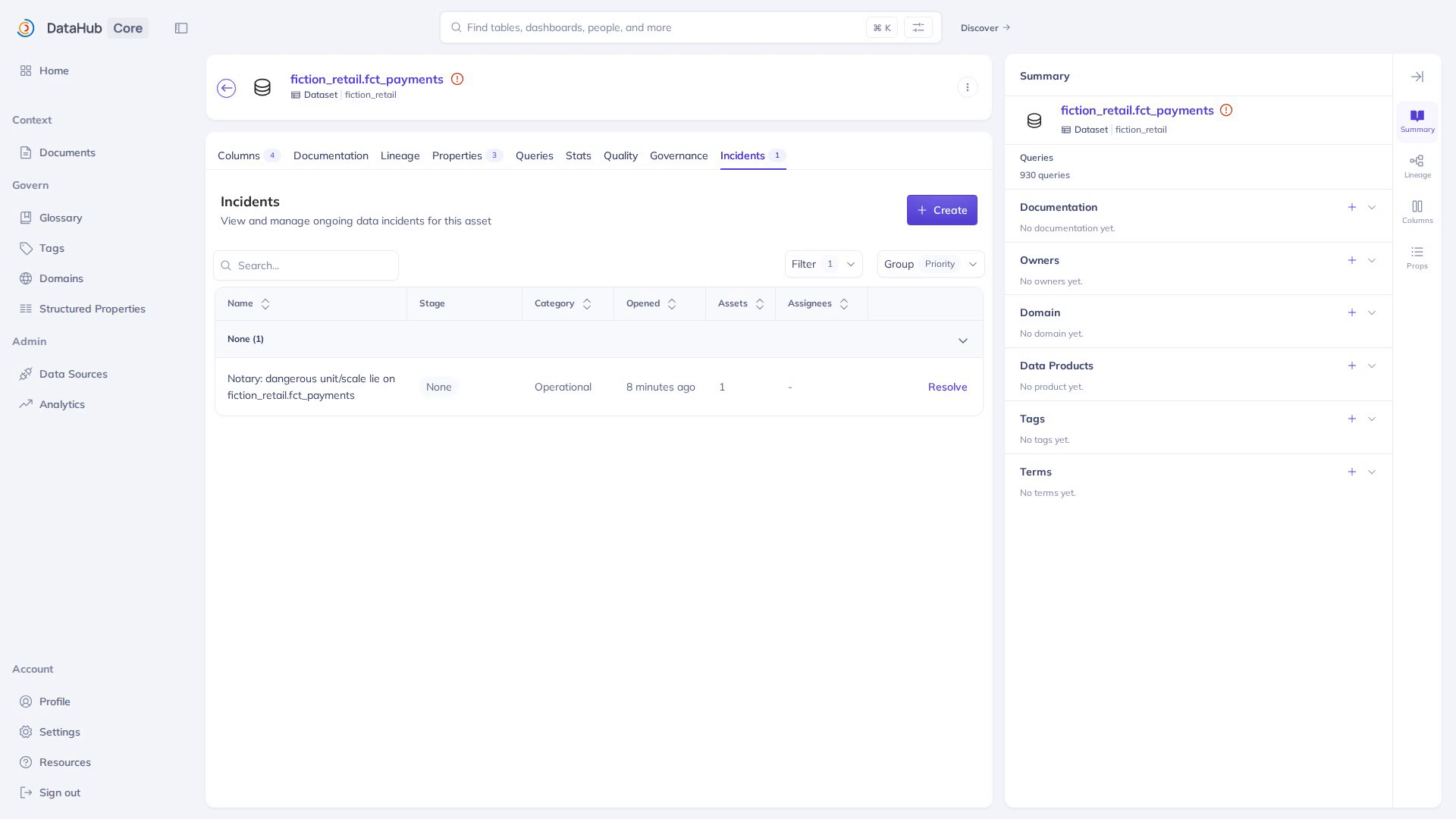
The danger gate: a contradicted unit claim on a high-traffic asset raises a real operational incident in DataHub.
The problem
A column says "transaction amount in USD" but stores integer cents. An agent grounded on that catalog can put a revenue calculation 100x off, with the catalog's own authority behind it. Catalogs accumulate claims (units, freshness, completeness, enums, deprecation) and nothing checks whether they are still true. As agents inherit catalogs as ground truth, stale context stops being an annoyance and becomes an amplifier: downstream answers carry the lie with the catalog's confidence.
What Notary does
Point Notary at a DataHub asset and it runs a verification loop:
- Reads the asset's live descriptions from DataHub (GraphQL).
- Extracts typed, checkable claims with Claude behind strict entailment gates (a claim the description does not actually state never reaches a probe); an entry whose extraction fails is disclosed and left unverified, never guessed at.
- Probes the warehouse with bounded, read-only SQL. Scans are capped; universal claims get a verdict only from complete scans.
- Adjudicates each extracted claim with a pure three-way rubric: CONFIRMED, CONTRADICTED, or UNVERIFIABLE, fail-closed. Notary does not guess.
- Writes what it learned back into DataHub through the MCP Server, so the
next reader inherits verified context instead of the lie:
- a trust ledger on the asset (structured properties: verdict, verified-at, evidence pointers)
- an evidence dossier per confirmed or contradicted claim (the probe SQL, the measured value, the claim diff), stored as DataHub documents; unverifiable claims are summarized in the ledger
- a provenance-labeled corrected description that preserves the original claim next to the measurement
- an operational incident (GraphQL), raised only when the lie is dangerous: a contradicted unit or scale claim on an asset whose catalog usage evidence shows real query traffic (the gate fails closed without it)
The verdict gate itself runs through the stock DataHub MCP Server: before a reconciliation source may corroborate a contradiction, Notary reads the asset's lineage with the stock get_lineage tool and requires the declared source to be a real upstream. That MCP receipt is written into the evidence dossier, and a failed read, a self-reference, or a possibly-truncated result all refuse rather than fall back to another transport. The same agent that writes through MCP now reads its gating evidence through MCP.
The write-back is the product: a verdict that lives in the catalog changes what the next agent does. We demonstrate exactly that with a minimal catalog-grounded agent built on the stock DataHub MCP read tools (no Notary code in the catalog-read path). Without the trust ledger, the best it can do is pass the unverified USD claim along with a shrug. With the ledger present, it refuses the contradicted claim and quotes the measured cents evidence instead. Both answers are captured and shown side by side.
Everything a run writes is reversible with one command: python -m notary.rollback removes the trust ledger, evidence dossiers, incident, and provenance-labeled corrections, restoring the original descriptions and never touching text Notary did not author.
The honest evaluation
The demo warehouse plants 12 catalog lies across 5 claim types, plus truthful controls. One command rebuilds the warehouse from a fixed seed, replays the captured Claude extractions verbatim (no network, no key), probes, adjudicates, and scores every entry. The result table is published verbatim in the README, misses included, and a test fails if the README table drifts from the command's output:
12 planted lies: 9 caught, 3 missed, 0 false positives, across 6 adjudicated truthful controls.
Zero false positives is earned, not lucky. The flagship cents catch is never issued from distribution alone: a contradiction requires an operator-declared reconciliation source that measures the claimed 100x scale on every suspect key over complete scans, and the DataHub catalog must record that source as a lineage upstream of the suspect asset. The two adversary controls prove the refusals: a legitimate whole-dollar column that matches the cents signature by distribution (Notary refuses to contradict it), and a self-referential reconciliation declaration (it earns nothing). In the demo the canonical billing ledger is the source the buggy payments load derives from, registered as the DataHub lineage the gate verifies.
The three misses are declared, not pending: a 0-to-1 distribution is scale-ambiguous by design (a stored fraction and legitimate sub-1-percent values are indistinguishable by distribution alone; our own adversarial review pipeline killed the fraction rubric we first shipped for exactly that reason), and millisecond or gram magnitude bands would be domain guesses. This project does not guess, and it does not hide its scorecard.
Judge it in 60 seconds
- Open the hosted replay: a real captured Notary run, disclosed on-page, with the honest table, the flagship cents catch, the before and after catalog descriptions, and the next-agent flip.
- Expand the evidence dossier on the flagship finding: the probe SQL and measurements, exactly as Notary writes them to DataHub.
- Read the two captured agent answers side by side: the same catalog, with and without Notary's trust ledger.
Full local run (DataHub quickstart, seeded lying warehouse, one command per step, no API key needed): the Quick start section of the README.
How we built it
- Python, DuckDB for the demo warehouse, DataHub OSS quickstart as the catalog; mcp-server-datahub carries the write-back (ledger, dossiers, corrected descriptions) and the next-agent read path, with GraphQL for description reads and incidents.
- Claude (claude-opus-4-8) for claim extraction, behind token-aware, negation-aware entailment gates; captured completions replay verbatim in tests and the demo, so the pipeline is deterministic where stability matters.
- Deterministic probes and pure rubrics; every verdict carries its evidence.
- 157 tests (10 are live integration round-trips against the quickstart, skipped when no quickstart is running): write-back, incident lifecycle, and the next-agent flip, lineage-bound reconciliation, and one-command rollback, plus a test that pins the README table and one that byte-compares the checked-in replay payload the host serves to a fresh capture. Public CI (SHA-pinned actions, locked install) runs the complete deterministic suite and reproduces the evaluation table on every push; the 10 live DataHub round-trips are validated separately against a local quickstart, with a timestamped receipt committed at docs/live-test-receipt.md. Frozen judge artifacts live in examples/.
Challenges and what we learned
- Fail-closed is a discipline, not a feature: every gate in the pipeline (fixture completeness, extraction failures, bounded scans, incident usage evidence) defaults to refusing rather than guessing, and our review pipeline repeatedly found the spots where we had not yet earned that sentence.
- Honest evaluation is a differentiator: publishing the misses, and the reasoning for why they stay missed, made the system more credible than a padded scorecard would have.
- The catalog is the right place for verdicts: structured properties, documents, and incidents mean the correction reaches humans in the UI and agents through MCP with zero custom infrastructure.
Built With
- anthropic-claude
- datahub
- duckdb
- mcp
- playwright
- python
- vercel

Log in or sign up for Devpost to join the conversation.