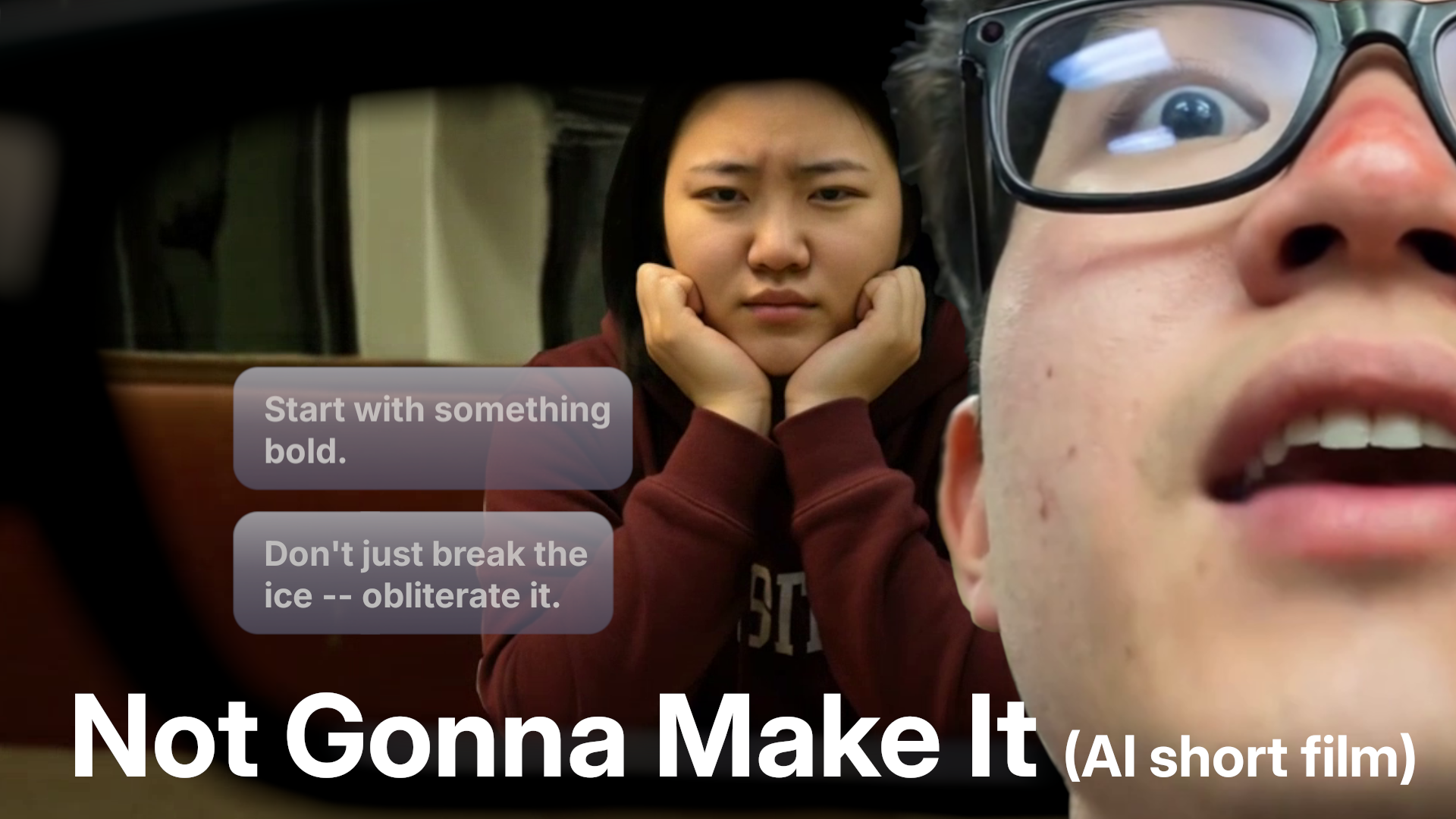
I’m David T. Lee, Founding Engineer at iDesignGlobal. AI has become a core part of my creative toolkit, helping me iterate on scenes, hone my editing skills and visualize the final story. Enjoy this excerpt about a date gone wrong!
Inspiration
Not Going to Make It is informed by observations of how ambition, uncertainty, and self-presentation intersect in modern technology-driven culture.
The project explores moments where confidence and aspiration begin to fracture under pressure - particularly in environments shaped by startup rhetoric, performance expectations, and rapid personal judgment.
Rather than framing success or failure, the film focuses on the emotional friction that emerges when two people attempt connection while carrying different assumptions about identity, risk, and direction.
What It Does
Not Going to Make It is a short narrative film adapted from the opening sequence of a feature-length screenplay.
The story unfolds during a date that gradually destabilizes through conversation. As dialogue overlaps and intentions misalign, the scene reveals tension between optimism and doubt, self-assurance and vulnerability.
The film relies on character interaction, pacing, and conversational dynamics to drive the narrative, allowing meaning to surface through timing rather than plot exposition or visual spectacle.
How I Built It
The screenplay was written to emphasize interaction, interruption, and conversational realism
The film was produced independently using a hybrid workflow combining AI-generated imagery with 3D Gaussian Splatting
Real-world spatial structure was reconstructed to allow intentional camera placement and movement
Scene continuity was maintained through controlled viewpoint selection rather than prompt-only generation
Editing focused on rhythm, overlap, and emotional cadence to preserve natural conversational flow
The production approach prioritized clarity, restraint, and narrative intention over visual complexity.
Challenges
Achieving believable emotional exchange between characters without traditional actors was a central challenge.
Maintaining consistency in facial expression, posture, and body language across AI-generated scenes required careful iteration to avoid exaggerated or artificial behavior.
Another challenge was preserving conversational authenticity - particularly timing, interruption, and pacing - which are essential to realism but difficult to sustain in generative workflows.
What I Learned
AI-assisted filmmaking can support dialogue-driven storytelling when guided by deliberate structure and editorial control.
Hybrid approaches that combine spatial reconstruction with generative imagery enable greater narrative precision than prompt-based generation alone.
The project reinforced that emotional realism often depends more on timing and interaction than on visual sophistication.
What’s Next
Not Going to Make It serves as an introduction to a completed feature-length screenplay.
Future projects will continue exploring AI-assisted narrative filmmaking with a focus on character-driven scenes, conversational realism, and contemporary themes shaped by modern technology culture.
Built With
- davinciresolve
- dreamina
- nanobananapro
- seedream


Log in or sign up for Devpost to join the conversation.