Inspiration -
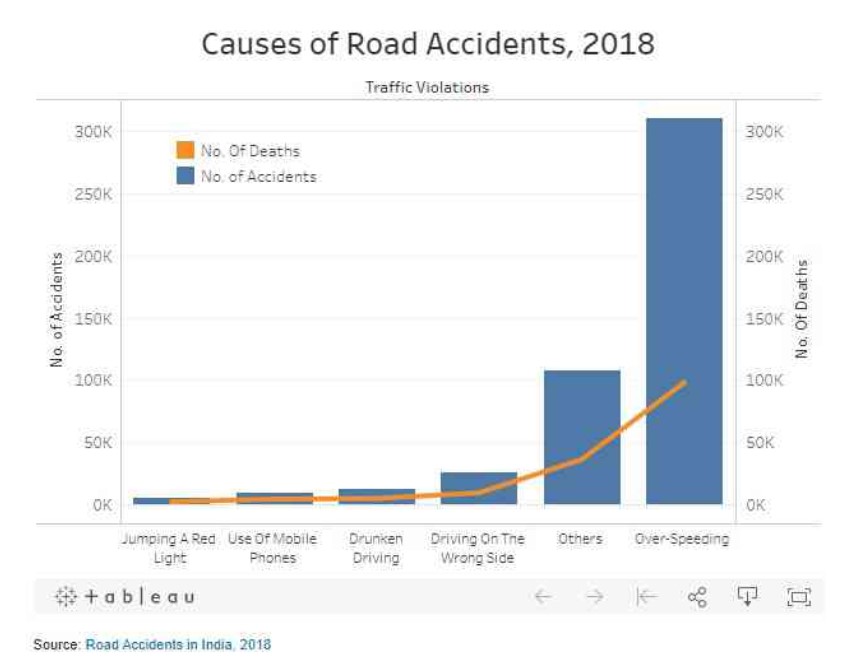
In 2018, India had 467,044 reported road accidents, an increase of 0.5% from 464,910 in 2017, according to the road ministry’s data. India has 1% of the world’s vehicles but accounts for 6% of the world’s road traffic accidents, according to data from a 2018 World Health Organization report.
In the graph attached, research has shown how the second biggest cause of Road Accidents is “Others” which comprises of all these activities which make a driver distracted, and this is essentially the main problem I intend to solve through this idea.
Artificial Intelligence and Machine Learning has allowed us to think beyond the basics and to do something out of the box. Personally I have heard of many such case in India where people have died due to accidents caused by reckless driving and lack of attention. I felt that I should pursue this project ahead due to its real life applications and desperate need in today’s society. Most drivers get distracted easily and without even realising and such a mechanism is thus helpful which will aid in making us mindful and adding to our safety. The impact it will be able to achieve is massive. Indian road accidents can be prevented by monitoring the live footage of the driver and giving warning if the driver is distracted and unsafe. The live footage of outside the car can additionally give more data to analyse and appropriate warning can be given if the driver is distracted and an obstacle is approaching nearby. To build upon this idea, the device that will be installed can be improved to monitor speeding, distracted driving and navigation combined. In today’s society, most people own cars and the product can have huge audience base along with an important use.
What it does -
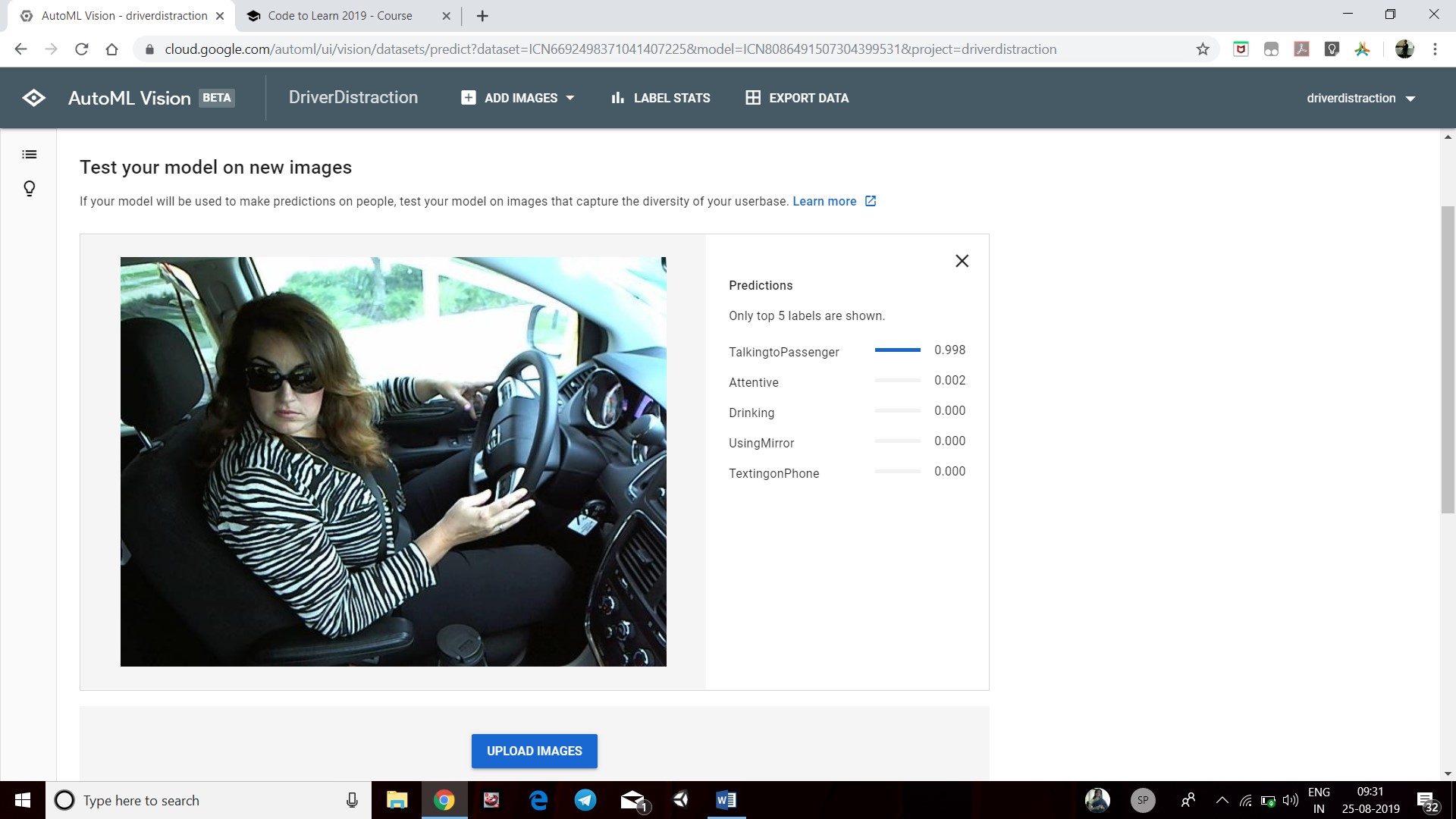
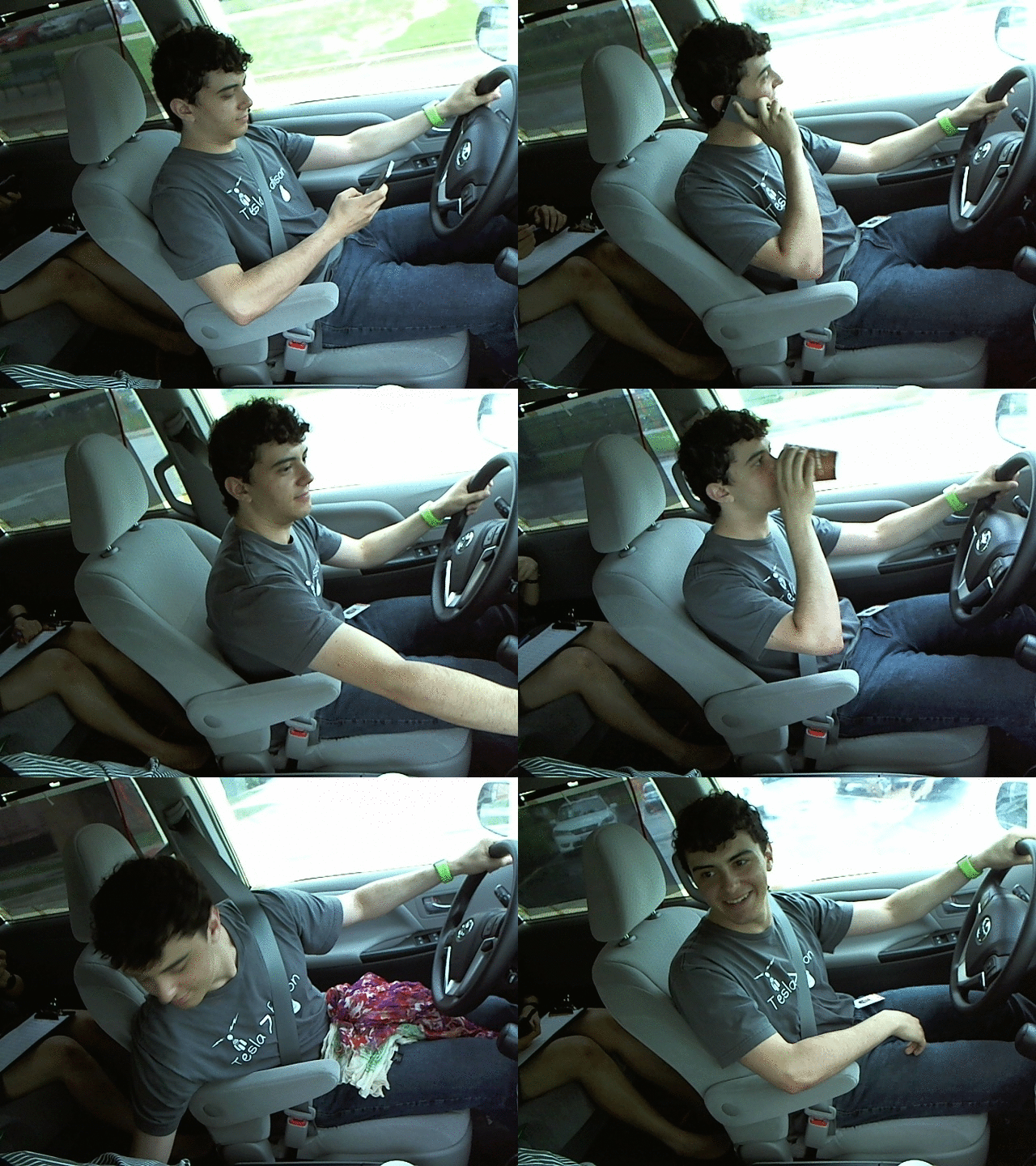
For us, we being humans can use our natural vision and sense of judgement to identify such a situational problem of being distracted. However, we cannot have a co – passenger sitting next to the driver every time and reminding him to be attentive. Thus, the question arises – “What if you get a computer to do this for you?” It will be much safer on the roads then, a preinstalled device in your car could check if you were distracted and give you appropriate warnings thus preventing many accidents. My project is this out of the box method to improve public safety on the roads by implementing a Not a Distractive Driver Anymore (NADDA) device. It consists of sets of camera one inside the care and the other outside. A device which is installed in the cars of drivers throughout the city and which is pre trained on a huge dataset. It would constantly record frames of data in the form of a livestream and give necessary warnings when it finds the driver distracted. To make it more useful and efficient to the drive safety, it would also check ahead of the car using another set of cameras. If the driver is distracted and there is a car or some object close ahead, it would give an audio warning. Additionally, the model is advanced enough to recognize different categories of distraction like talking on the phone, texting, drinking, using mirror radio, talking to co-passengers and others. Thus, I feel this has a very beneficial application and would go a mile towards Road Safety and help technology achieve its true potential in helping mankind by minimizing accidents.
How I built it-
• Firstly, a dataset of thousands of images of Indians and foreigners will have to be collected in an Indian based environment and then used as the primary dataset for the model. • My Solutions to approach this AI Computer Vision problem for processing images, and creating a model for detecting various categories for distraction and another separate category for being attentive. There are different models that can be used–
- KNN Model – Categorization of Dataset into separate classes
Accuracy after using this algorithm and 3 K neighbours on a dataset of more than 1500 images = 53.2%
Decision Tree Classifier – Moving from observations about an item to conclusions about the item's target value Accuracy after using this algorithm on a dataset of more than 1500 images = 36.7%
Convolutional Neural Network (CNN) – Pixel based, depth based analysis Accuracy after using this algorithm on a dataset of more than 1500 images = 46.52%
Transfer Learning Model – CNN Model pre-trained by experts Accuracy after using this algorithm on a dataset of more than 1500 images = 87.65%
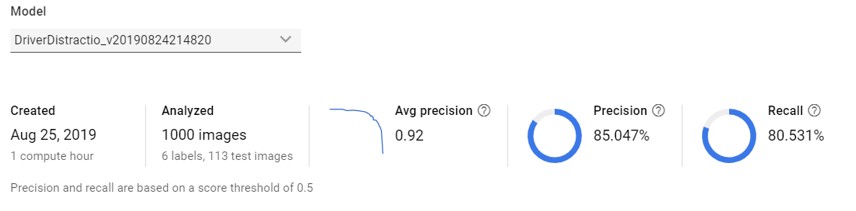
My model is one which is trained thoroughly on a large dataset with each category consisting of many images and thus a modification of the transfer learning model. This ensure an accuracy of around 95% and with 92% precision.
Challenges I ran into
- Google Colaboratory - Using transfer learning models by importing things and then checking its accuracy
- Using a dataset greater than 1000 images
- Integrating Google drive with Google Colaboratory
- General Error - Thanks to StackOverflow I could fix them
What I learned -
- How to work with Google Colaboratory and Github
- How to work with File uploads from local machines
- Working with Markdown
- How to work best with prezi
- Devpost
What's next for Not a Distracted Driver Anymore -
The project effectively detects the category of distraction or attention and then uses this to give an appropriate warning to the driver. The first stage of this is images, then subsequently on video streams and finally after a model is ready and saved, it can be applied to a proper live stream and perform its purpose. This model will be made on a local computer machine and trained and tested similarly. Once a high accuracy model is achieved it can be saved and uploaded to a circuit board like the Raspberry Pi and then using IoT an external camera feed can be set as the input to the model and a speaker device can give the warning sounds. The advanced part is the same application on the external car interface. Here the road is detected for obstacles by distance and speed as well, adding to the efficiency of the model.
Why this project is outstanding and relation to sustainability -
I feel my project is worthy for its massive application in today’s society where cars are necessities and car accidents plague the global world. In today’s advanced scenario the best of experts are building autonomous cars to drive to replace human drivers. I personally feel that such an impressive product comes with its several limitations and risks and it will take decades to integrate such a mechanism with the middle class society. Looking at the problem from a sustainable and approachable development point of view provides many improvements for such a common thing like driving. In a nutshell, this is what project intends to do and that is what makes it outstanding. Artificial Intelligence and Machine Learning has allowed us to go beyond what already exists and build upon it as never before. I am not re-inventing driving, I am focusing on achieving a layer of safety for everyone around the globe and thus tackling a problem prevalent in society. The target audience that the model will impact is all consumers of today. The market for cars is every expanding and this integration in average cars will benefit all drivers as a whole. Once efficient this product will become an efficient necessary components and can be sold as a car accessory when the cars are purchased. All these consumers for all types of vehicles will benefit by remaining mindful and much safer. This initiative integrates quite a few of the United Nations Sustainable development goals, innovation and public welfare being the most important. We as a society are developing at a rapid pace and this initiative goes a mile further to make this very development sustainable and safe. My project I feel is nothing but a concept of using today for achieving a better tomorrow. I intend to use the technological prowess we have with our reach and apply it to the problem of Road Accidents, saving thousands of lives. I feel thinking big and thinking small require the same effort and I chose to think big, not in terms of complexity but in terms of impact, which is what drives this idea.
Built With
- ai
- google-colab
- python
- tensorflow


Log in or sign up for Devpost to join the conversation.