-
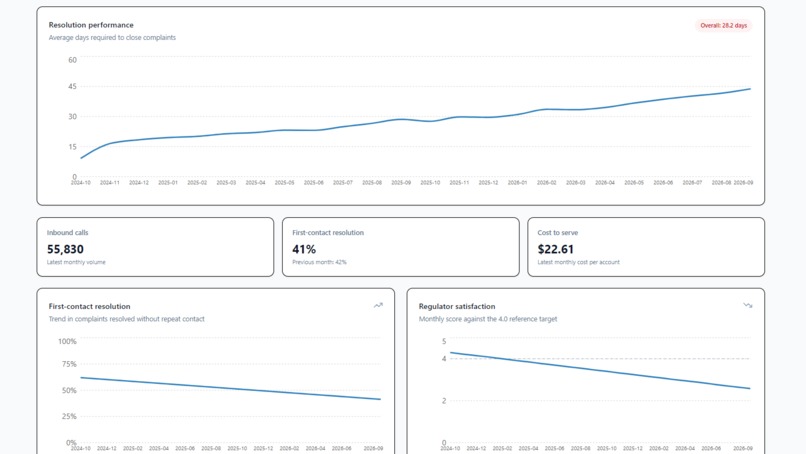
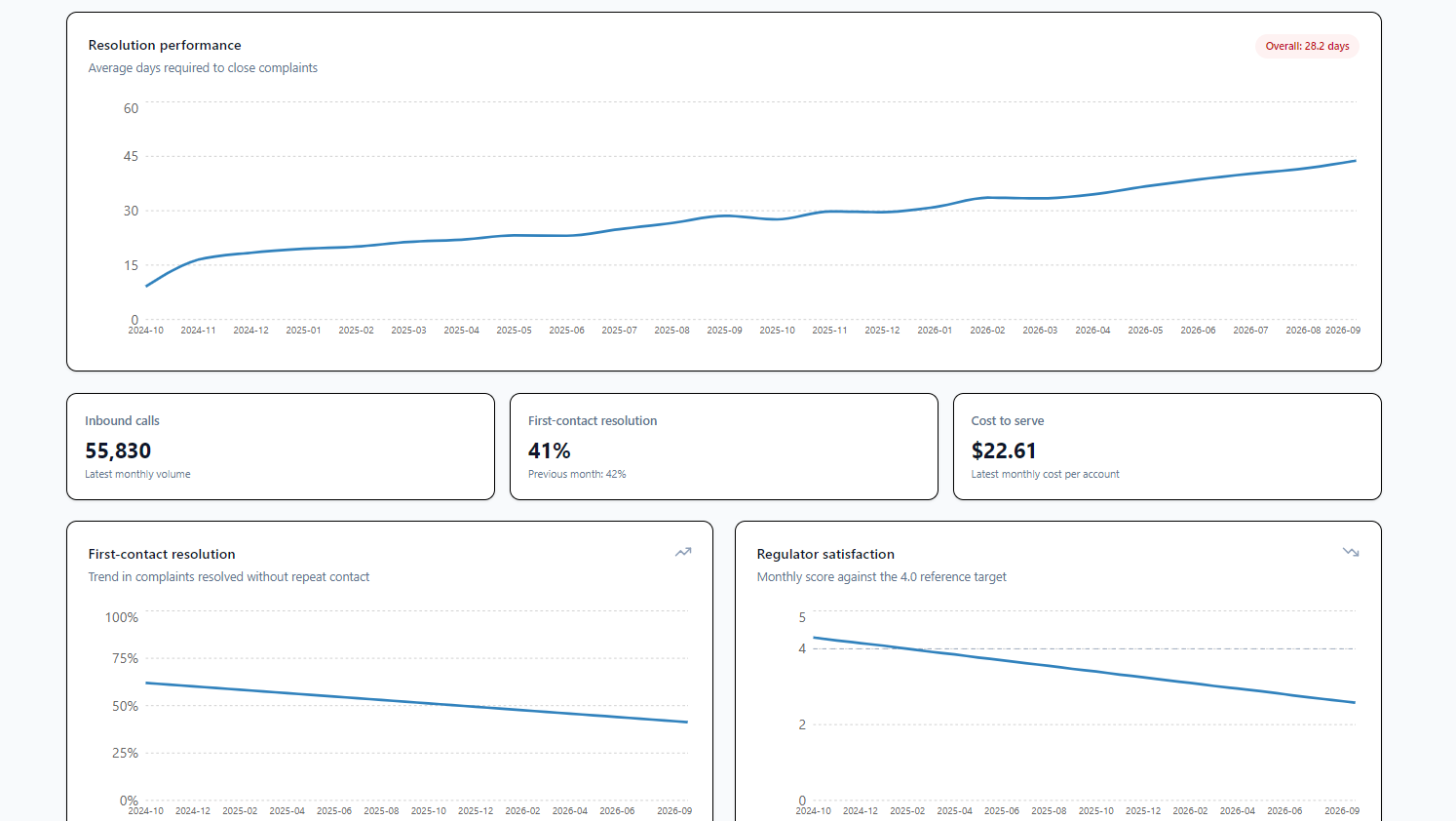
Operational performance view highlighting resolution time, first-contact resolution, inbound call volume, cost to serve, and regulator satis
-
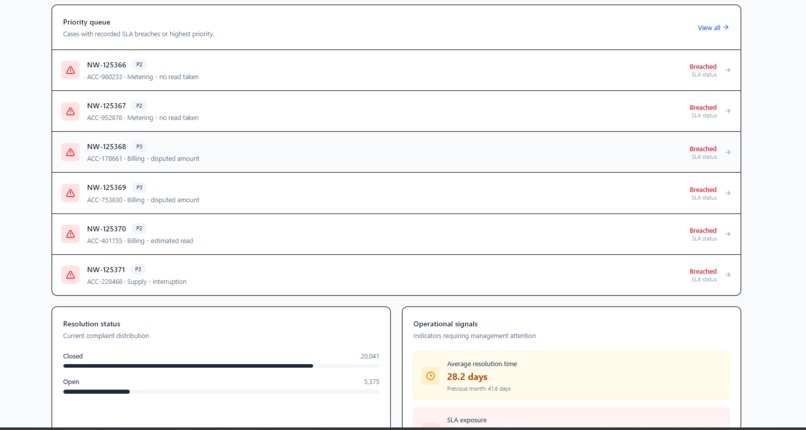
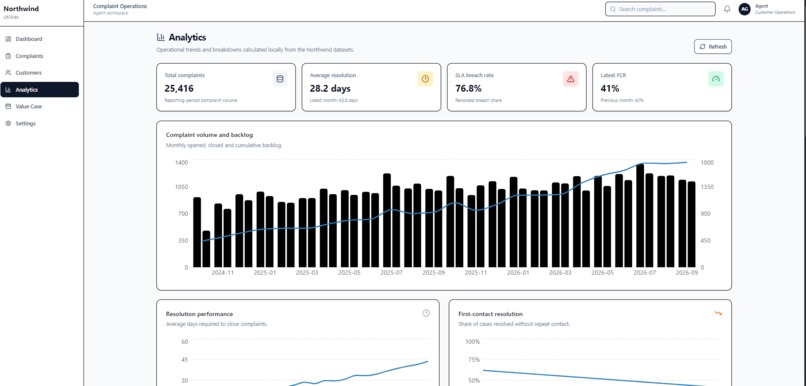
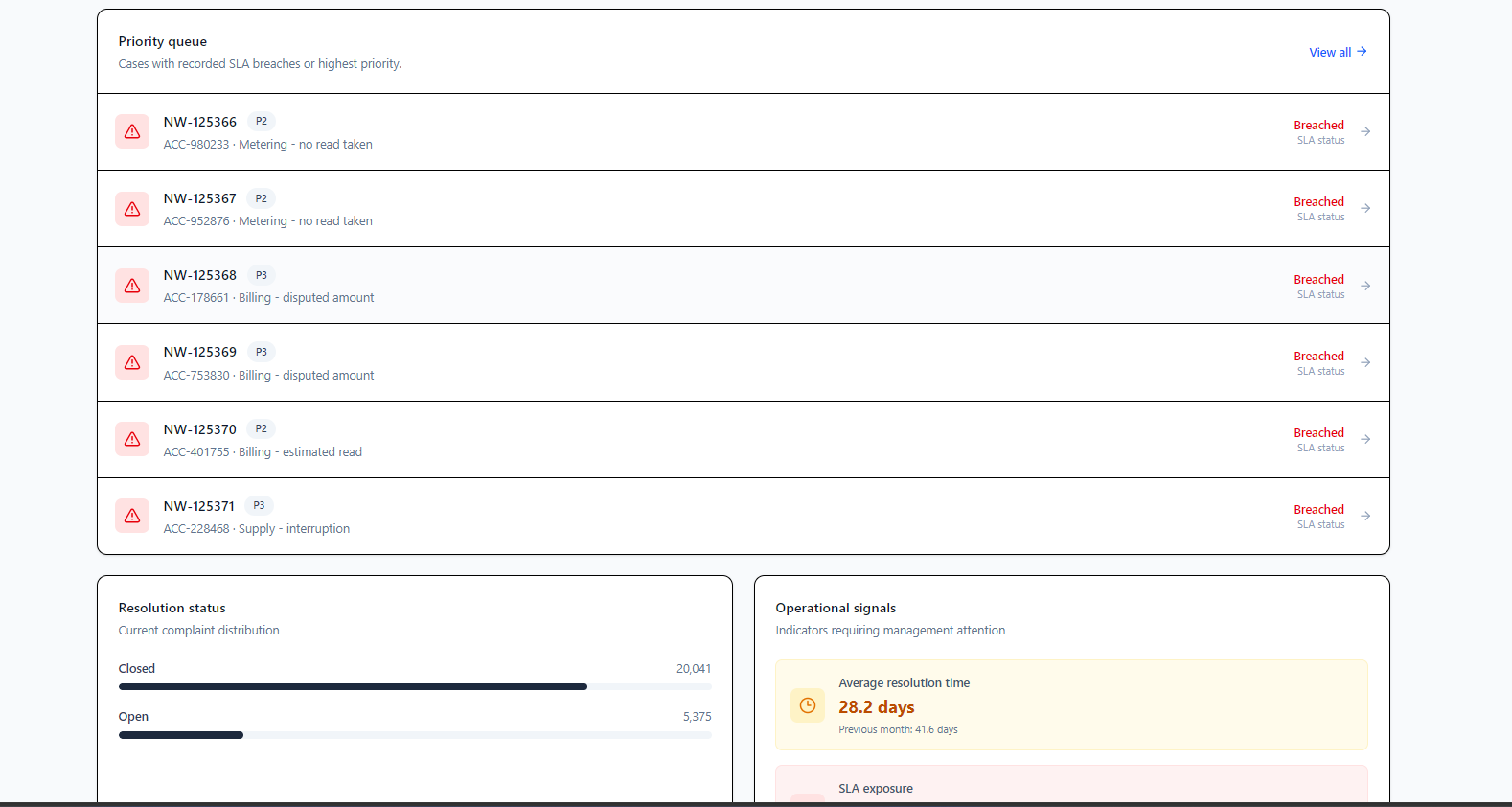
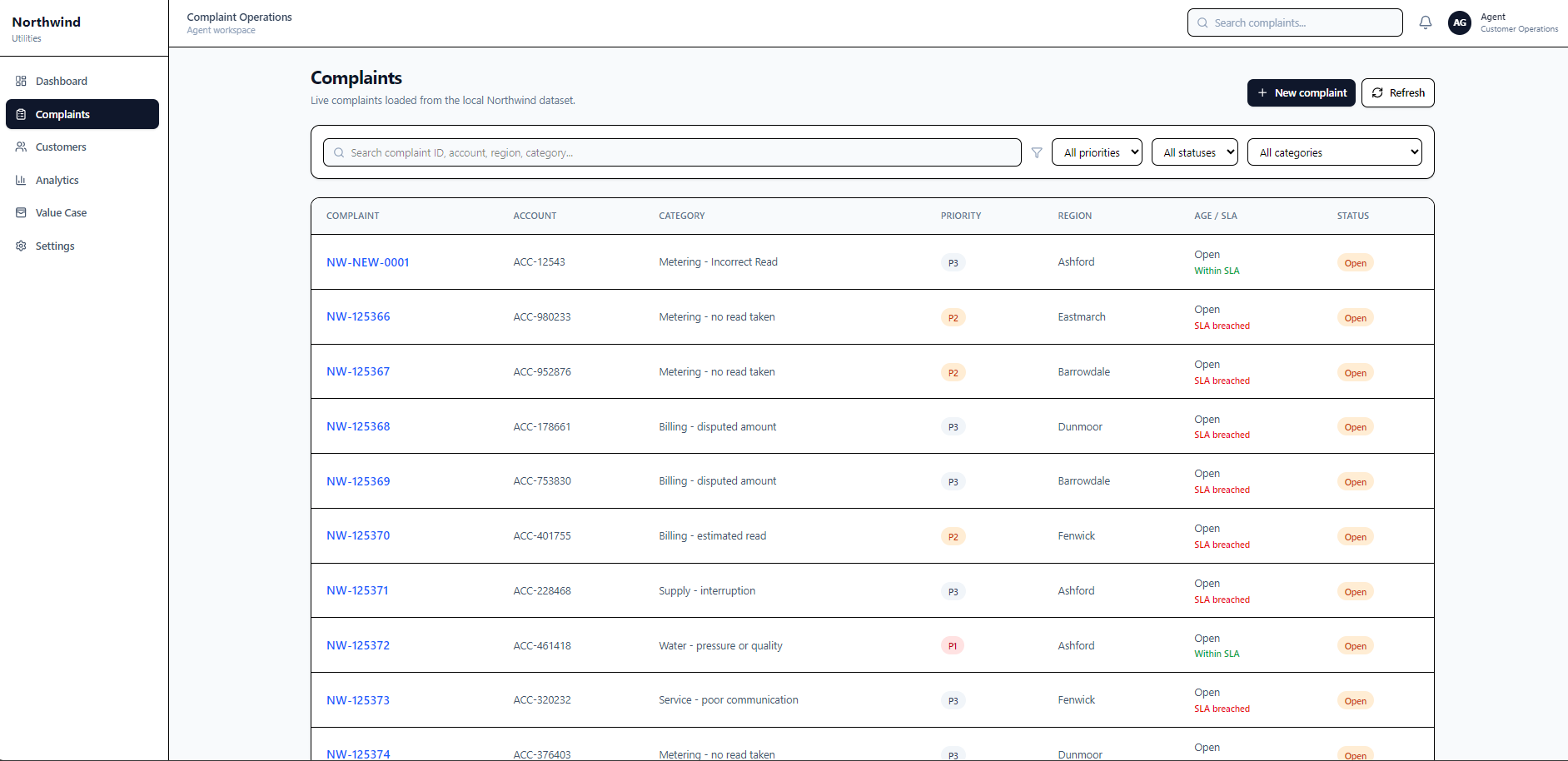
Priority queue surfacing high-priority and SLA-breached complaints so agents can focus on cases requiring immediate attention.
-
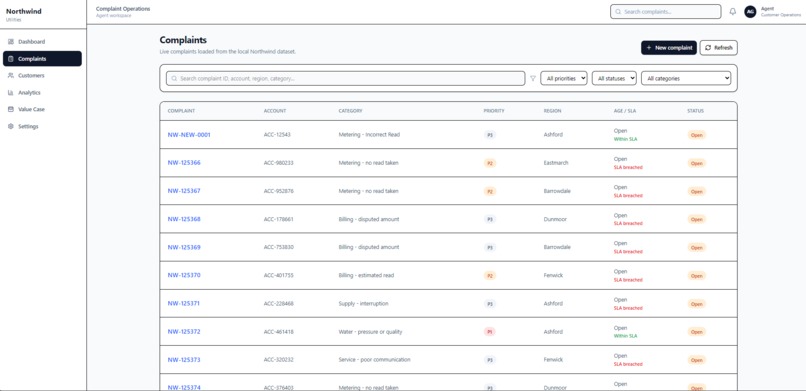
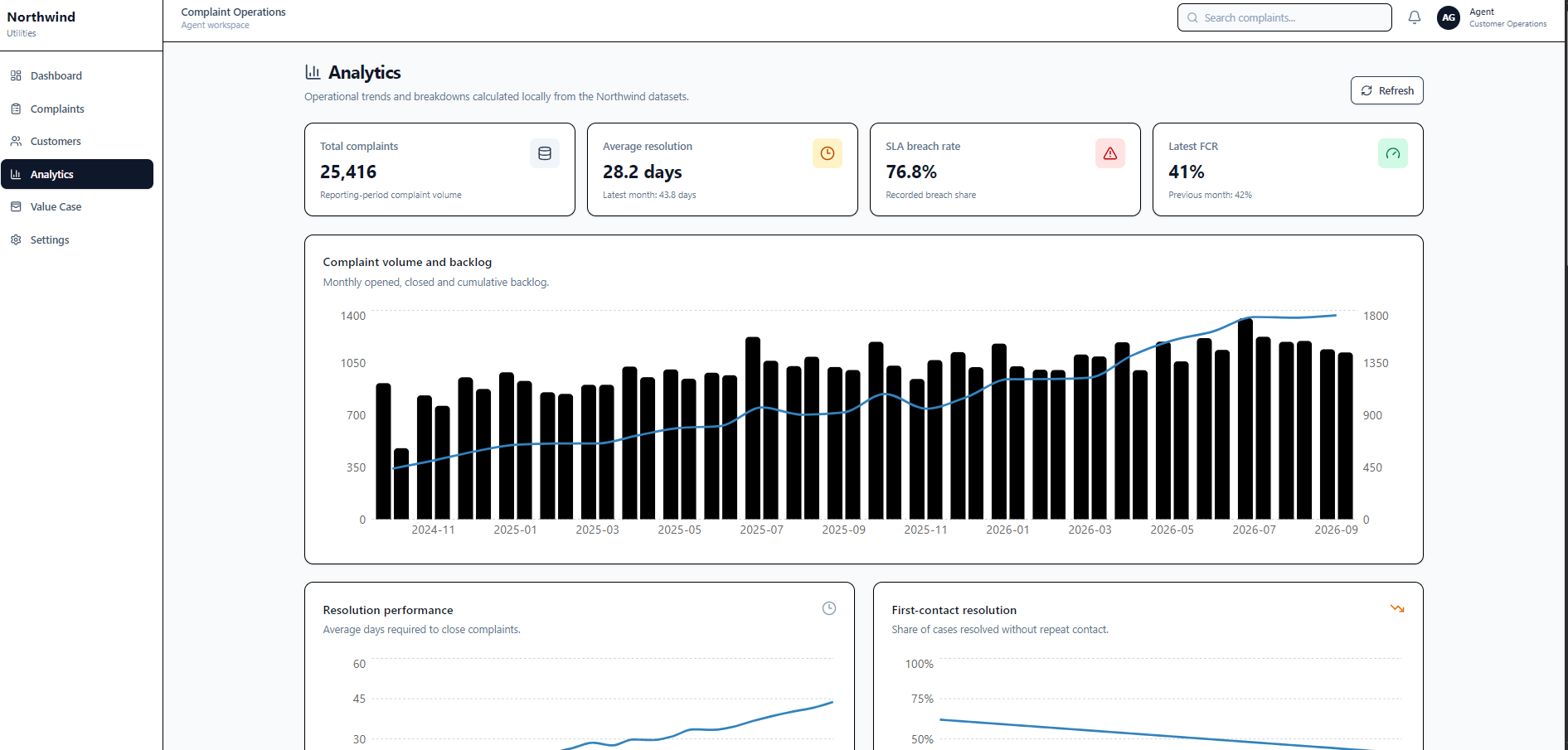
Analytics dashboard providing locally calculated trends for complaint volume, backlog, resolution performance, and first-contact resolution.
-
-
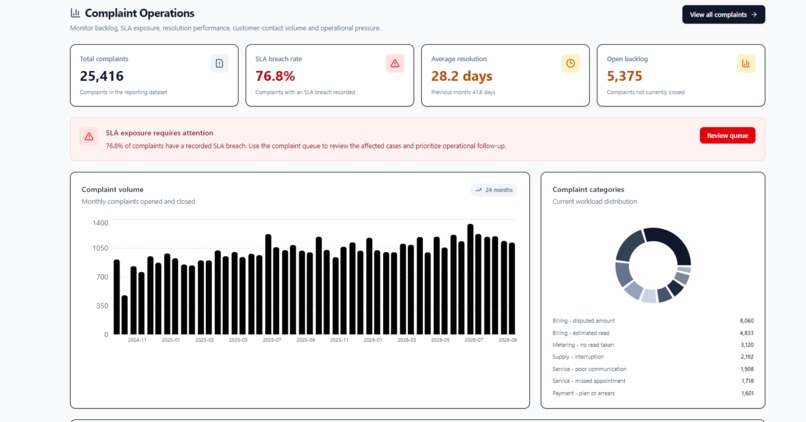
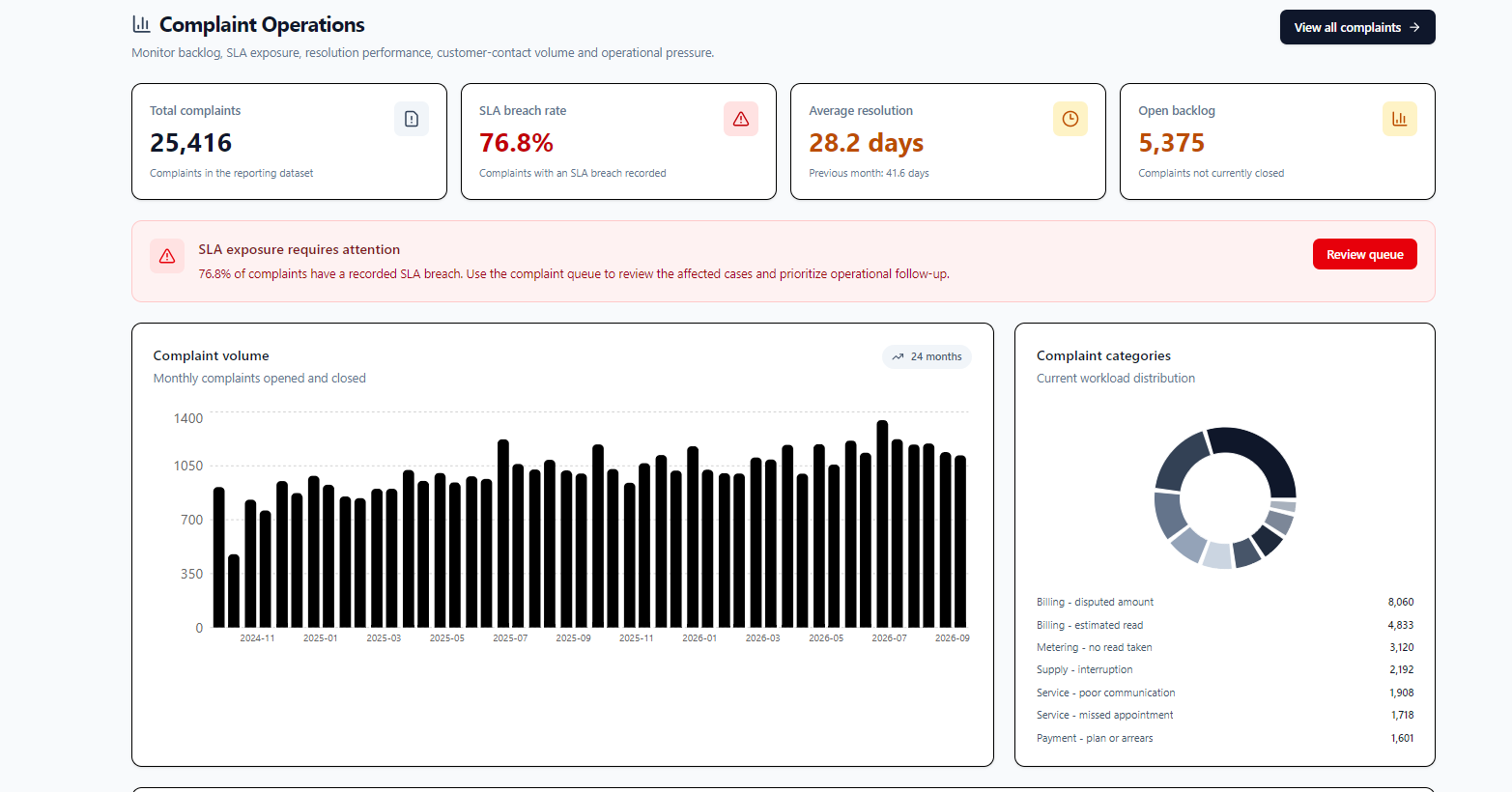
Northwind Resolve operational dashboard showing complaint volume, SLA exposure, resolution performance, backlog, and key customer-service KP
-
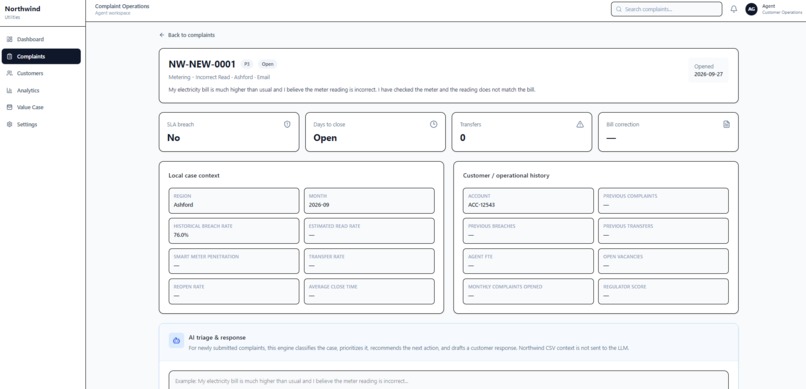
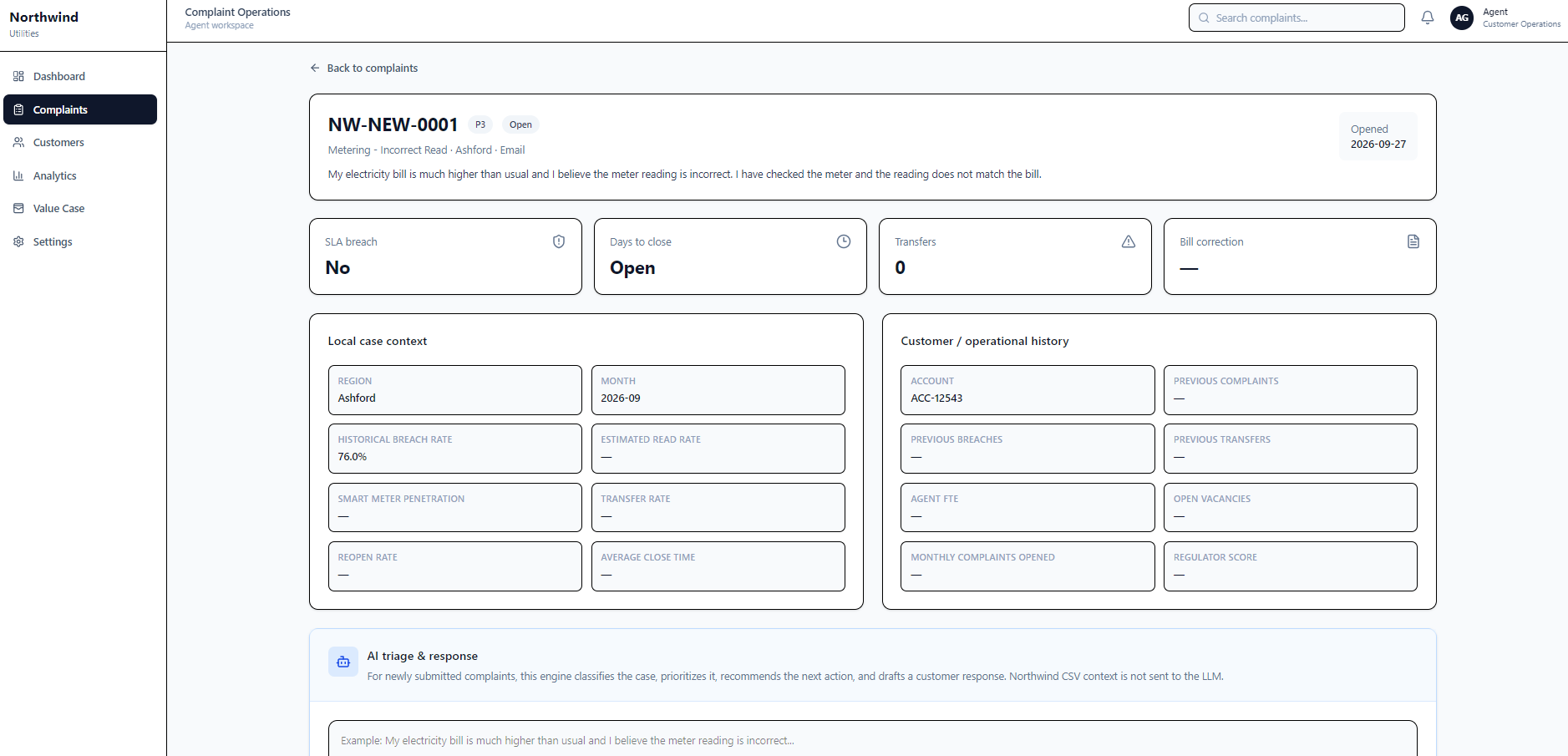
Detailed complaint view combining case information, SLA status, customer history, and locally derived operational context in one workspace.
-
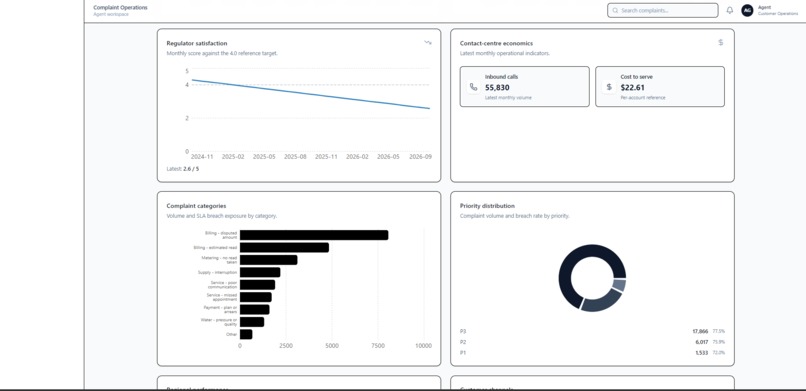
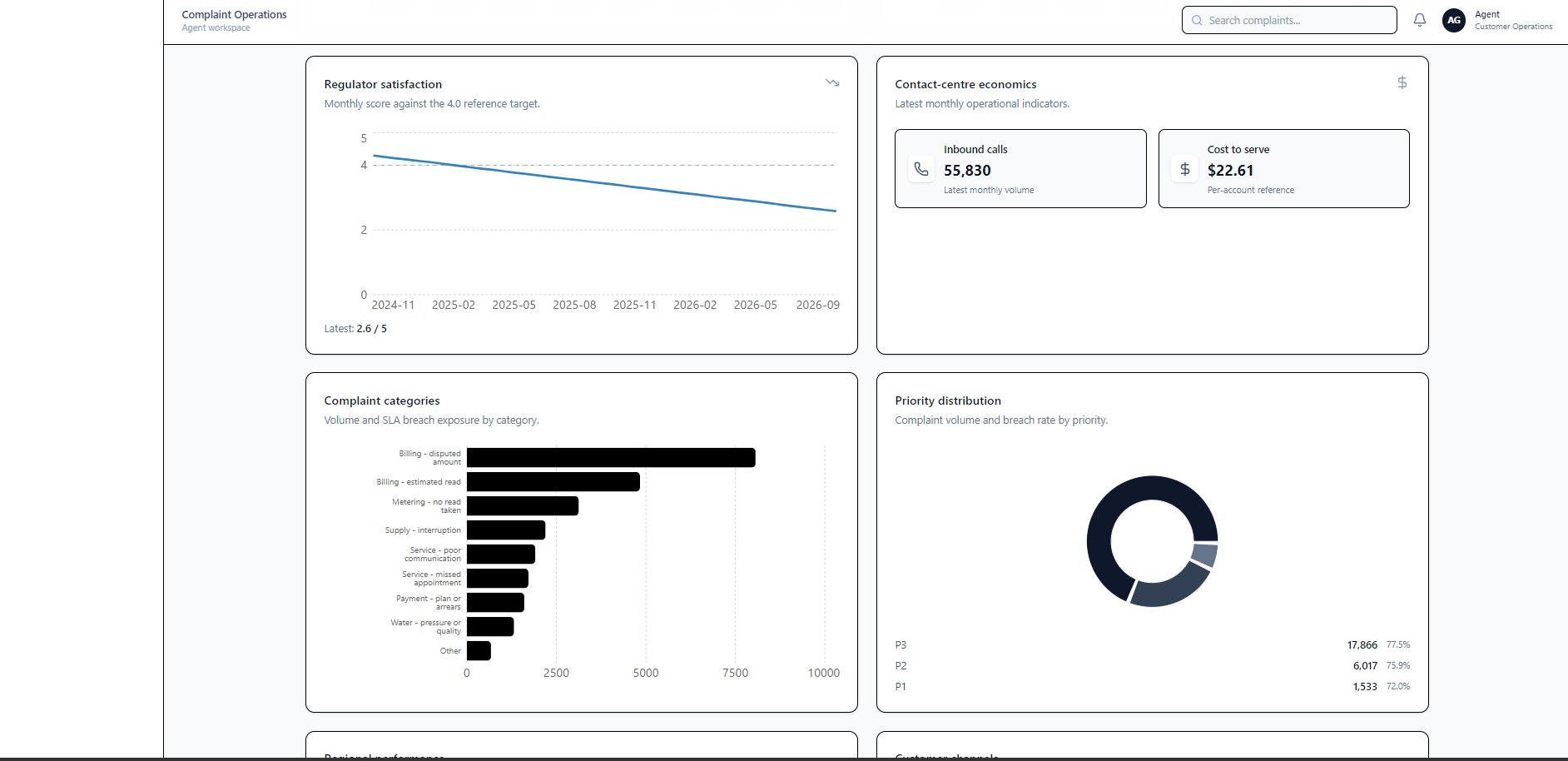
Operational analytics connecting complaint categories and priorities with regulator satisfaction, contact-centre economics, and SLA exposure
-
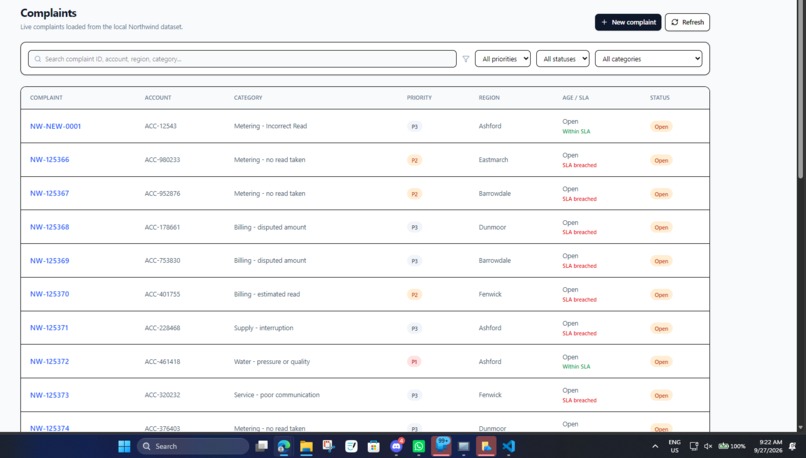
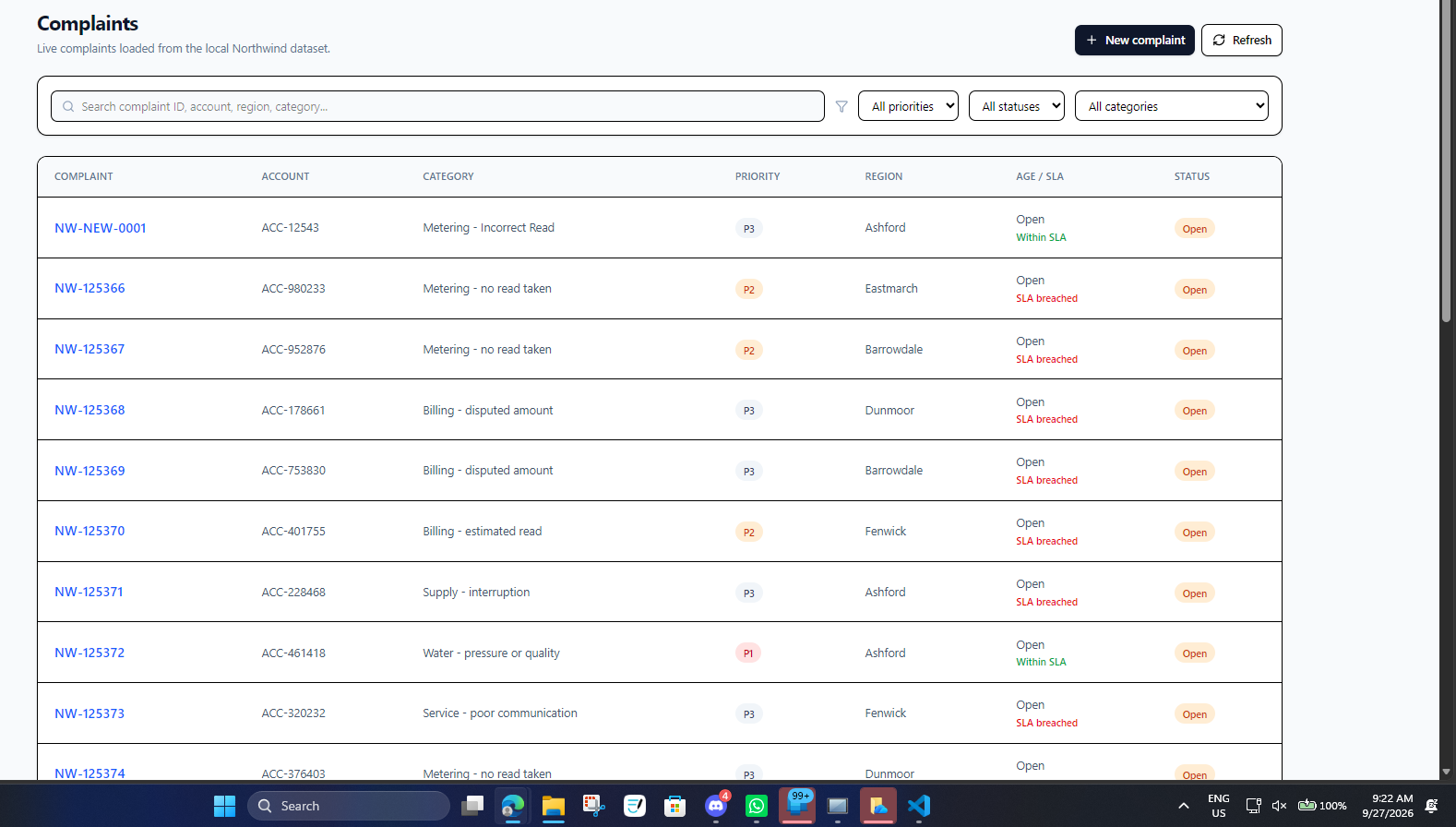
Complaint workspace allowing agents to search, filter, and review live Northwind complaint records by priority, status, category, and SLA ex
-
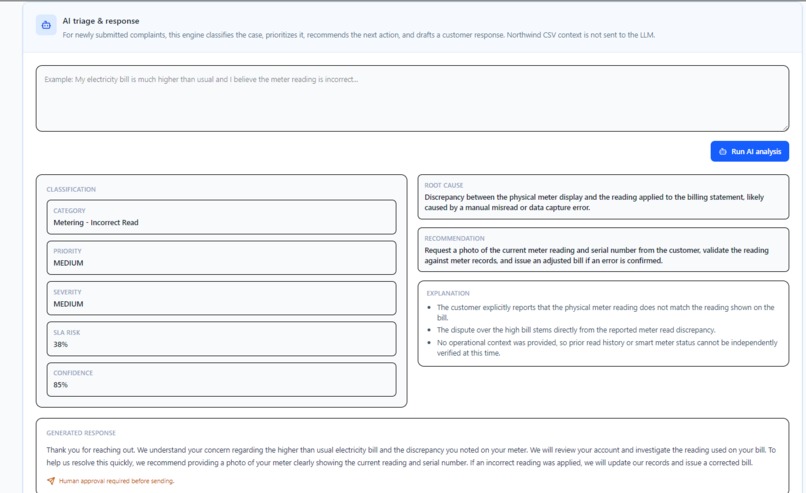
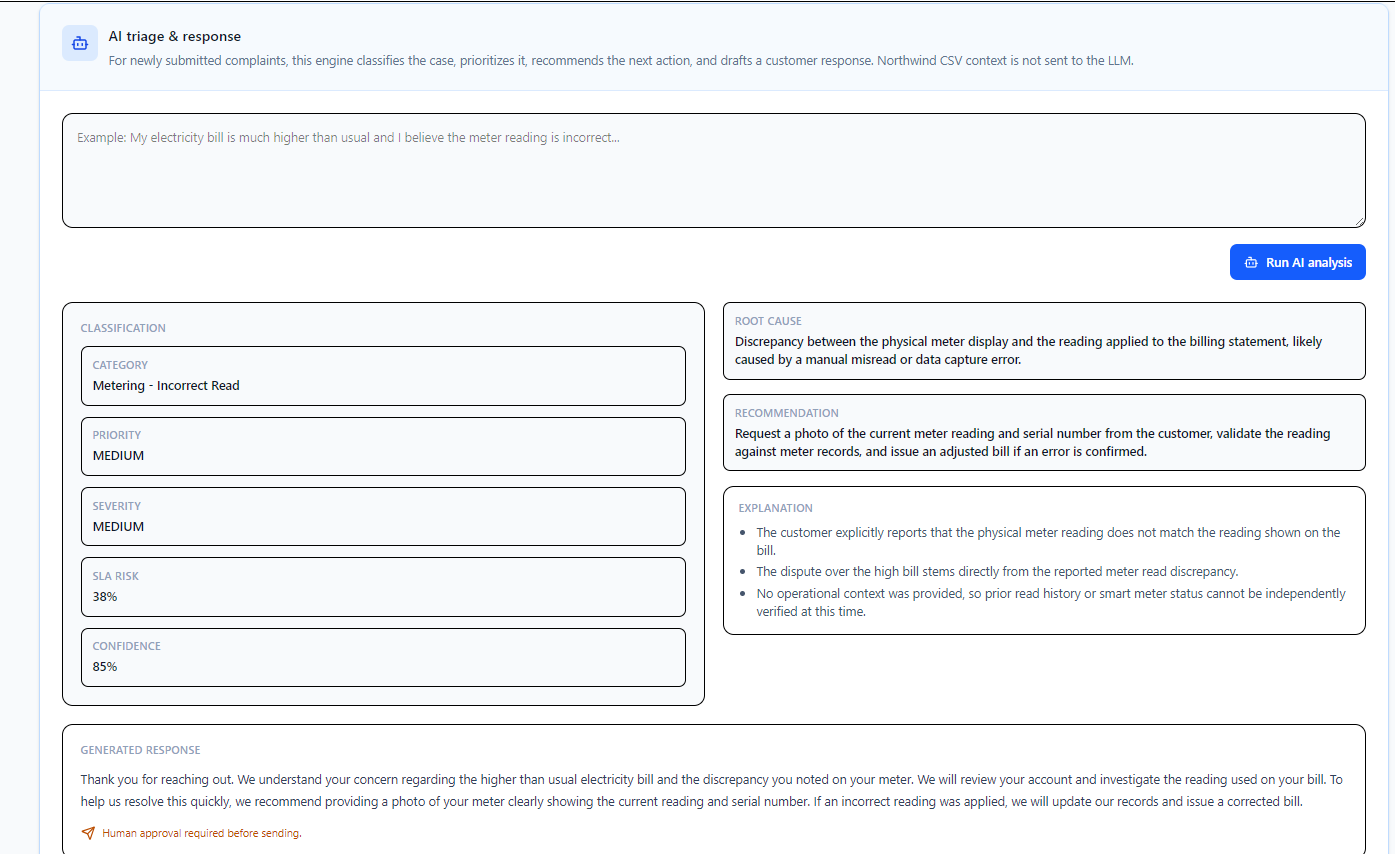
AI-assisted complaint triage providing classification, priority, severity, SLA risk, root-cause analysis, recommended action, and a customer
Inspiration
Northwind Utilities does not simply have a complaint-volume problem. It has a complaint operations problem.
The challenge data showed 1,599 open complaints, an average resolution time of 38.2 days versus a 9.1-day target, and 77% of cases breaching SLA.
This led us to ask:
How can we help Northwind determine which complaints need attention, why they matter, and what should happen next?
Instead of building another standalone AI chatbot, we wanted to combine operational data, intelligent triage, and AI assistance into one workflow.
That idea became Northwind Resolve.
What it does
Northwind Resolve is an intelligent complaint-operations platform that helps agents prioritize cases, understand their context, and act faster.
The workflow is:
Complaint → Triage → Priority & Risk → Context → Recommended Action → Response Draft → Human Approval
Agents can:
- Search and filter complaints
- Identify SLA breaches and priority cases
- View customer and operational context
- Review staffing, transfer, and KPI information
- Submit new complaints for automatic triage
For new complaint text, the AI provides:
- Classification
- Priority and severity
- Root-cause hypothesis
- Recommended action
- Confidence score
- Customer-response draft
The response is not automatically sent. The agent remains responsible for reviewing and approving it.
The platform also includes analytics and a Value Case to connect operational findings with business impact.
How we built it
Northwind Resolve is a full-stack application built with:
- React + TypeScript + Vite for the frontend
- Python + FastAPI for the backend
- Pandas for local data processing
- LiteLLM + Gemini for AI-assisted complaint handling
We processed the Northwind challenge datasets locally, connecting information from complaints, systems, monthly KPIs, meter reads, staffing, the AI pilot, and unit costs.
A key architectural decision was to keep the Northwind challenge data local rather than sending it to the LLM.
Our architecture separates:
Local operational data → Triage logic → Agent workspace → AI assistance → Human decision
We also implemented automated backend tests and validated the frontend through TypeScript compilation and a production build.
Challenges we ran into
Understanding the real problem
The biggest challenge was avoiding the assumption that the answer had to be an AI chatbot.
We first analyzed the operational problem and then determined where AI could actually add value.
Working within the data constraints
We kept challenge-data processing local and separated it from the AI language layer.
This allowed us to use AI for complaint-level assistance without using the LLM to analyze the Northwind datasets.
Connecting multiple datasets
Important context was distributed across several datasets. We had to connect complaint information with operational, staffing, system, and KPI data to create a more complete view of each case.
Building within hackathon scope
A production system would require enterprise integrations, authentication, monitoring, security controls, and extensive validation.
We focused on proving the core workflow instead.
Accomplishments that we're proud of
We are proud that we built a working end-to-end prototype, rather than only presenting a concept.
A new complaint can move through:
Submission → AI analysis → Classification → Priority → Risk → Recommendation → Response Draft
We also built a centralized agent workspace combining complaint information with operational context.
Another accomplishment was separating AI assistance from operational decision logic. Structured data remains the foundation for operational signals, while AI handles language-intensive tasks.
Finally, we built automated backend tests and validated the production frontend build.
What we learned
Our biggest lesson was:
Adding AI is not the same as solving an operational problem.
AI is most useful when it is placed in the right part of the workflow.
Structured operational decisions should remain grounded in data and explainable logic, while AI is particularly useful for classification, recommendations, and response drafting.
We also learned to distinguish between what the data demonstrates and what should be validated through a future pilot.
What's next for Northwind Resolve
Our next step would be a controlled pilot.
We would measure:
- SLA breach rate
- Resolution time
- First-contact resolution
- Transfer rate
- Agent handling time
- Customer satisfaction
- Cost to serve
We would then integrate the solution with Northwind's existing systems and strengthen production capabilities such as authentication, audit logging, monitoring, and security.
Our approach would be:
Pilot → Measure → Validate → Improve → Scale
We would only expand automation where measured operational improvements justify it.
Northwind Resolve ultimately aims to help agents resolve:
the right complaint, with the right context, at the right time.
Built With
- ai
- analytics
- artificial
- data
- fastapi
- gemini
- generative
- intelligence
- language
- learning
- litellm
- machine
- natural
- pandas
- processing
- python
- react
- rest
- typescript
- vite


Log in or sign up for Devpost to join the conversation.