-
-
Northstar Careers
Inspiration
The future of work is changing fast. When I talked with high schoolers, the same worry kept coming up: "Will the job I pick even exist when I graduate?" Career quizzes still hand students a list of job titles, as if work in 2035 will look the same as it did in 2015. It won't. AI is already changing what nurses chart, what electricians troubleshoot and what cyber analysts watch for.
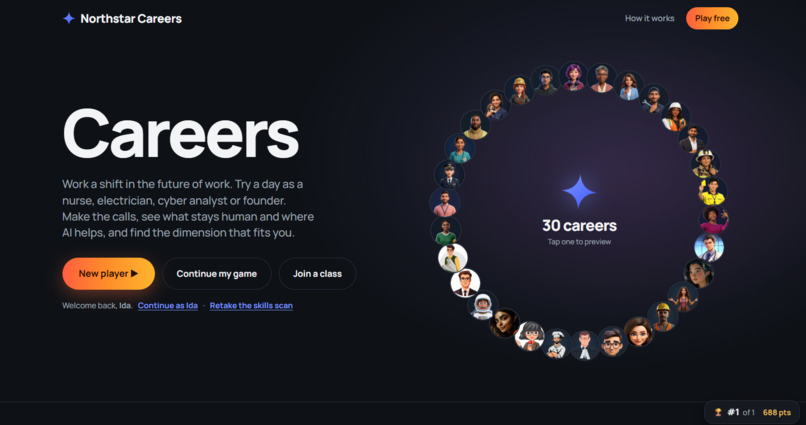
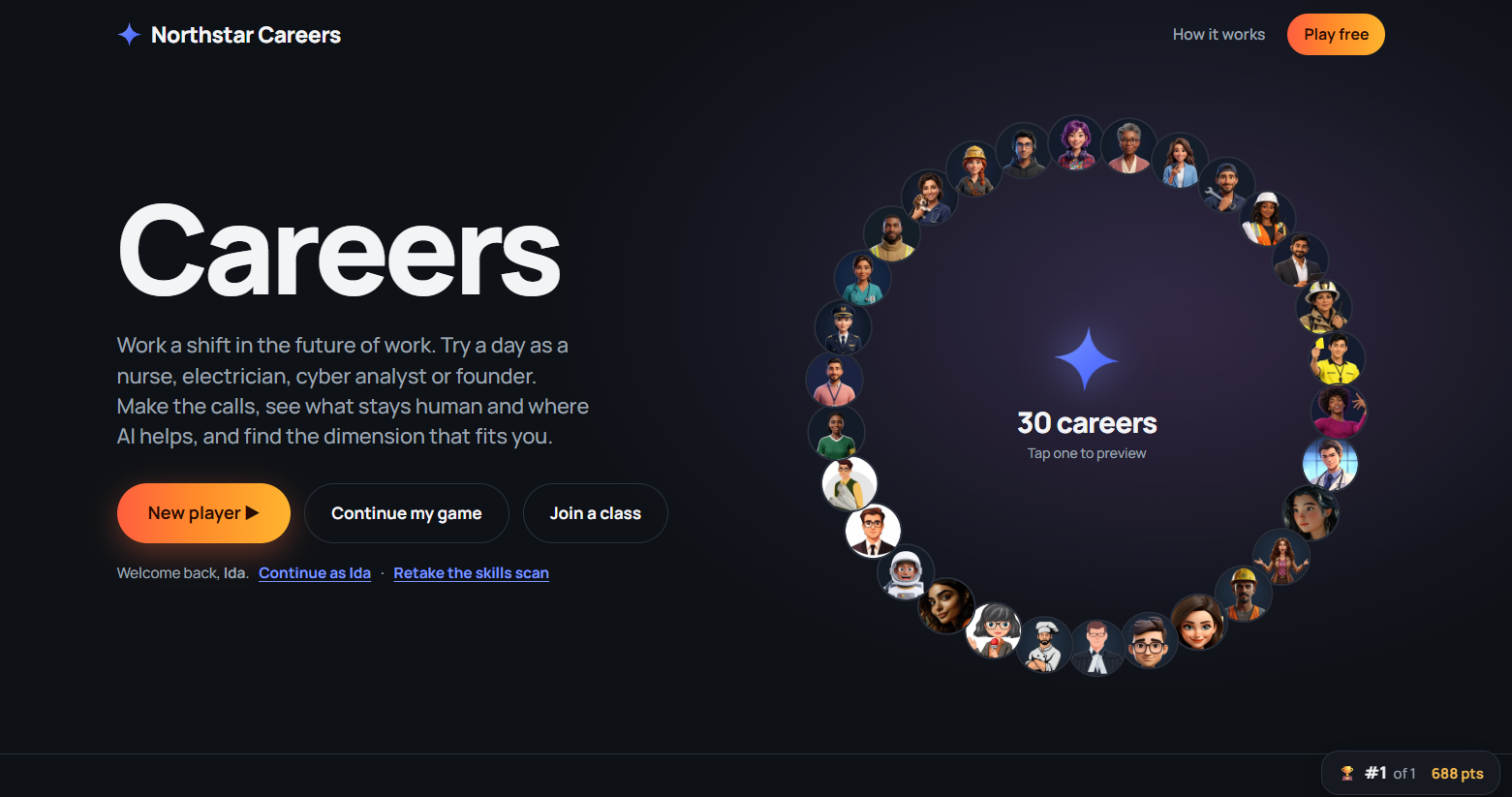
Students don't need another list. They need to step inside a job and feel it: the pressure, the decisions, the parts a human still owns and the parts AI now helps with. That's why I built NorthStar Careers. It maps high schoolers' strengths to careers, shows how AI is reshaping each one, and lets them try the jobs of 2035 in 3D before they choose.
What it does
- Create a player with a nickname and an avatar (no real names needed).
- Take a 3-question skills scan with everyday prompts like "Pick your ideal Saturday" to find your top strength (for example, Connector).
- Unlock your first 3 career pods out of 30, each with a match score.
- Play a shift in 3D. Walk the workplace, use objects and complete a 5-step shift, like a firefighter checking the duty board and running a rig check.
- Make decisions under pressure. Cards like "Air pack reads low" change your Stress, Energy and Focus. Tools like Ask mentor, Breathe and Refuel help you stay balanced.
- See how AI changes the job: what stays human and where AI helps.
- Level up with points, stars, titles and gear, then play with your class on a live leaderboard using a session code.
How we built it
I designed, coded, wrote and tested NorthStar Careers on my own.
- Front end: [framework, e.g. React + TypeScript] for the menus, skills scan, career pods, locker and vision board.
- 3D and VR: [e.g. Three.js / React Three Fiber + WebXR] so the same workplaces run in the browser and on Meta Quest.
- Assets: [tools, e.g. Blender] for avatars like the Polar Bear and Robot and for each career's environment.
- Career content: I wrote 30 career profiles, each with a strength vector, a shift script, decision scenarios and an AI-impact breakdown.
- Multiplayer: [e.g. Supabase / Firebase realtime] for class codes, live presence and leaderboards.
Matching. The scan gives each student a strength vector $\mathbf{s}$, and each career has a profile vector $\mathbf{c}$:
$$ \text{match}(s, c) = \frac{\mathbf{s} \cdot \mathbf{c}}{\lVert \mathbf{s} \rVert \, \lVert \mathbf{c} \rVert} \times 100\% $$
Scoring. I wanted to reward good, balanced decisions, not only fast ones. Each decision earns points $p_i$ times a combo multiplier $m_i$, plus a balance bonus $B$ if stress ends below a threshold $\tau$:
$$ \text{Score} = \sum_{i=1}^{n} p_i \, m_i + B \cdot \mathbb{1}\left[\text{stress}_{\text{end}} \le \tau\right] $$
Challenges we ran into
- Wearing every hat. As a solo builder I was the developer, 3D artist, game designer, writer and tester. Deciding what to build first, and what to cut, was a constant challenge.
- Running 3D everywhere. Students use Chromebooks, phones and Quest headsets, so I kept scenes light, compressed assets and supported both keyboard and headset controls.
- Real but not scary. Firefighter and nurse shifts needed real pressure without overwhelming a 14-year-old. I rewrote many decision cards to stay honest and age-appropriate.
- Describing AI fairly. It's easy to drift into doom or hype. For each career I worked to show what AI really assists with and what still needs a person.
- A short scan that still works. Three questions isn't much signal, so tuning 30 career profiles until the matches felt right took many rounds of testing.
- Live classrooms. Keeping the leaderboard and "who's playing what" in sync without lag or duplicate players took several rewrites.
Accomplishments that we're proud of
- Building the whole thing solo: app, 3D worlds, game systems, multiplayer and all the career content.
- 30 careers, each with its own playable 3D shift and decision scenarios.
- A complete loop in minutes: skills scan, career match, a 3D shift, then results and level-ups.
- A game that rewards wellbeing. Players earn a balanced-finish bonus for keeping stress in check, so the best score goes to the healthiest decisions, not just the fastest ones.
- Classroom-ready from day one. A teacher shares one session code and the whole class can play and compete on a live leaderboard.
- Private by design. Students play with fun nicknames like Mighty Rocket 63 instead of real names.
What we learned
- Doing beats reading. Students remembered a career far better after one 3D shift than after reading about it.
- Balance is a skill. Stress, Energy and Focus started as a game mechanic and became one of the most important lessons in the product: good professionals manage themselves, not just the task.
- Design for the weakest device first. Building for low-end hardware made the VR version better too.
- Scope is everything when you work alone. Shipping one polished loop beat half-building ten features.
- Technically, I leveled up in [3D/WebXR, realtime systems, game design; edit to match].
What's next for Northstar Careers
- Fully immersive shifts on Meta Quest, with hand tracking for every career.
- More careers of 2035, including roles that don't exist yet.
- A teacher dashboard with class insights and suggested next careers to explore.
- Real-world pathways: partnering with schools and local employers so a great shift can lead to a real job shadow or internship.
Built With
- claude
- css3
- gltf
- google-fonts
- html2canvas
- html5
- javascript
- localstorage
- meta-quest
- meta-quest-browser
- netlify
- oculus
- three.js
- virtual-reality
- web-audio-api
- webgl
- webp
- webxr
