Business software for humans and agents
Most business software was designed around a simple assumption: humans use the interface, while automation happens somewhere behind it.
We built a different model.
Our workspace is designed for a future where humans and AI agents can work together directly inside the same live business application.
The human defines the goal and constraints. The agent investigates the current business state, analyzes signals, compares possible approaches, and creates a structured proposal. The human can then modify the constraints, reject or approve the proposal, and remain the final decision-maker. Once approved, the application executes the change and verifies the resulting state.
Why WebMCP?
WebMCP is central to this experience.
Instead of asking an agent to operate a business application by interpreting screenshots, clicking arbitrary UI elements, or relying on fragile DOM interactions, the application exposes meaningful business capabilities through WebMCP.
Our tools represent application-level capabilities such as:
- inspecting live business state
- analyzing business signals
- comparing scenarios
- drafting proposals
- revising proposals based on human constraints
- requesting approval
- executing approved changes
- verifying the resulting state
This makes the web application itself an agent-accessible capability surface.
WebMCP is therefore not a decorative integration or a separate chatbot connection.
It is the capability contract between the agent and the live business application.
A new human-agent workflow
The core workflow is:
Human intent → Agent analysis → Structured proposal → Human constraints → Proposal revision → Human approval → Execution → Verification
For example, a business owner can ask:
«Improve conversion without increasing the total budget.»
The agent can inspect the current business state, analyze the relevant signal, compare scenarios, and produce a structured proposal containing evidence, assumptions, constraints, expected impact, risks, and alternatives.
The human can then add:
«Prioritize low-risk changes.»
The agent must incorporate that constraint into the revised proposal rather than simply repeating the original recommendation.
The human remains in control of consequential decisions.
What becomes possible?
The important change is not simply that an agent can "use a website."
The agent can participate in the application's actual workflow using structured capabilities while the human remains an active collaborator.
This makes it possible to move from:
human uses software + AI gives advice
to:
human and agent collaborate through the software itself.
The application can understand the agent's structured actions, preserve business state, enforce authorization and approval rules, execute approved changes, and verify the outcome.
Better UX
Traditional business software often separates analysis, decision-making, and execution across dashboards, forms, automation tools, and conversations.
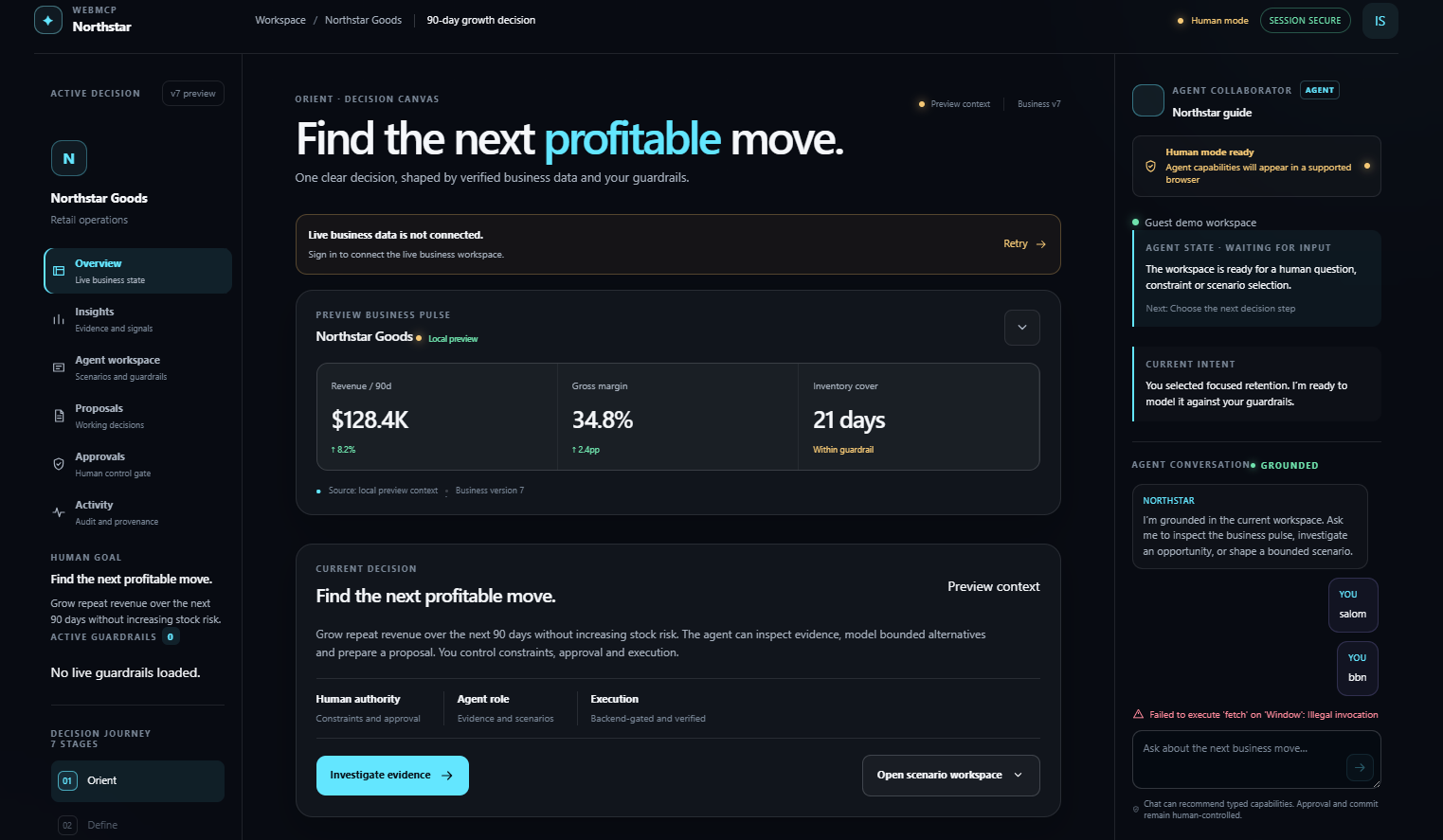
Our interface brings these stages into one coherent workflow.
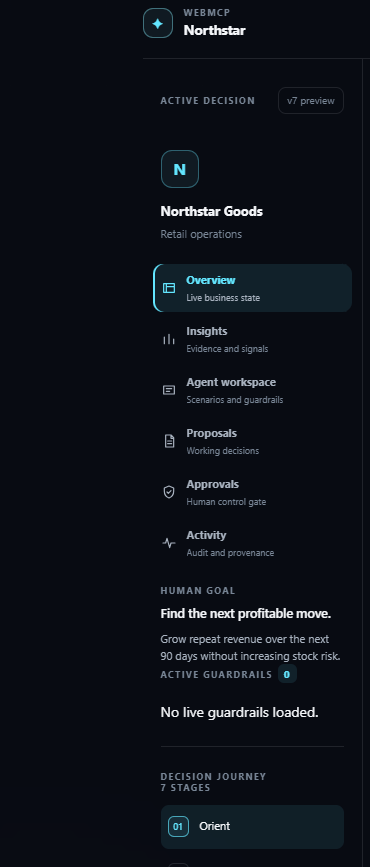
The user can see:
- what the agent observed
- what it analyzed
- what it proposes
- which constraints are active
- what requires human approval
- what was executed
- what was verified
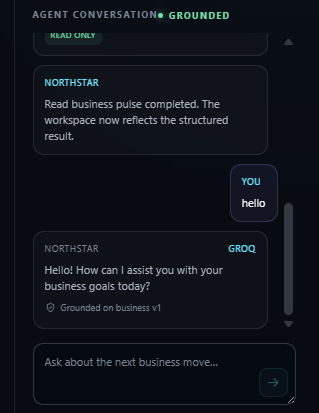
The result is not another AI chat interface.
It is a decision and execution workspace where human judgment and agent capabilities are deliberately combined.
Human authority
The agent does not become the final decision-maker.
Proposal and execution are intentionally separated.
A consequential action requires the appropriate human approval, while the application remains the authoritative source of business state.
The system also accounts for changing state so that an outdated proposal should not blindly become a new business action.
Implementation
The frontend exposes selected high-value application capabilities through the WebMCP API using:
"document.modelContext.registerTool(...)" [9/4/2026 12:05 PM] Islombek Abdurasulov: Each tool has a meaningful name, description, structured JSON input schema, and execution handler connected to the application's real functionality.
The WebMCP layer is organized around three conceptual capability groups:
READ
- inspect current state
- inspect relevant business information
PROPOSE
- analyze
- compare
- draft
- revise
COMMIT
- request approval
- execute an approved change
- verify the result
The application's backend remains responsible for authoritative state, validation, authorization, persistence, and business rules.
This separation allows WebMCP to provide an agent-facing capability layer without turning the browser interface into a security boundary.
Why this matters
We believe the next generation of the web will not simply be websites that humans visit or agents automate.
It can be a web where applications expose meaningful capabilities that humans and agents can use together.
Our project explores what that interaction model could look like in a real business environment.
Humans decide. Agents collaborate. The application executes and verifies.
Built With
- gin
- go
- groq
- llm
- next
- postgresql
- react
- typescript
- webmcp


Log in or sign up for Devpost to join the conversation.