-
-
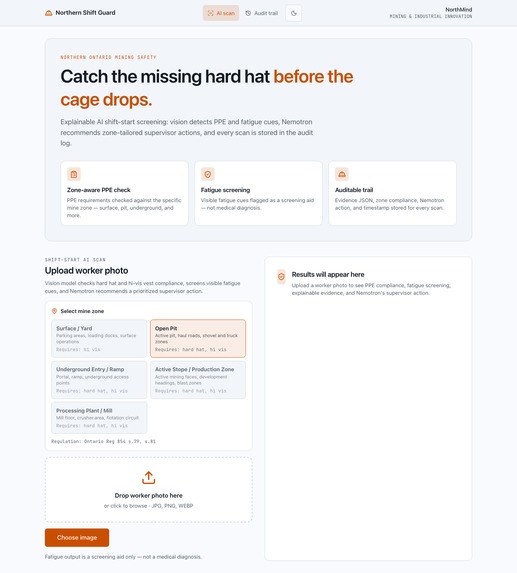
home_page
-
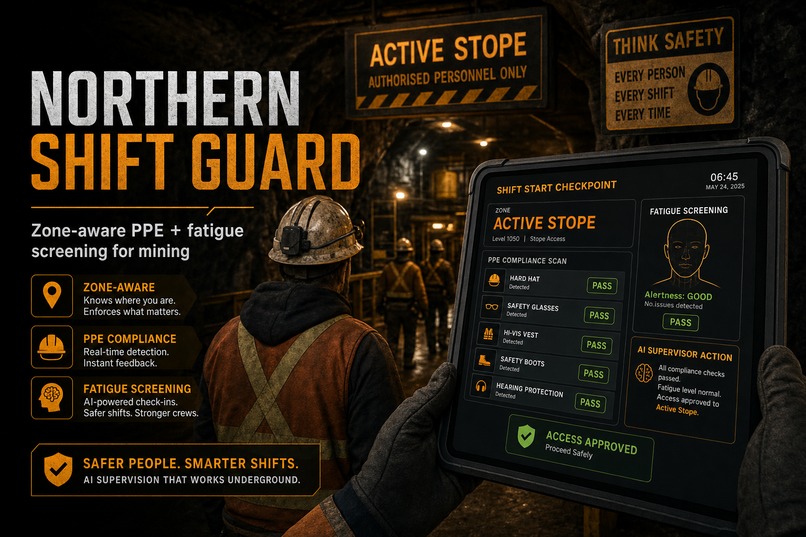
project_cover
-
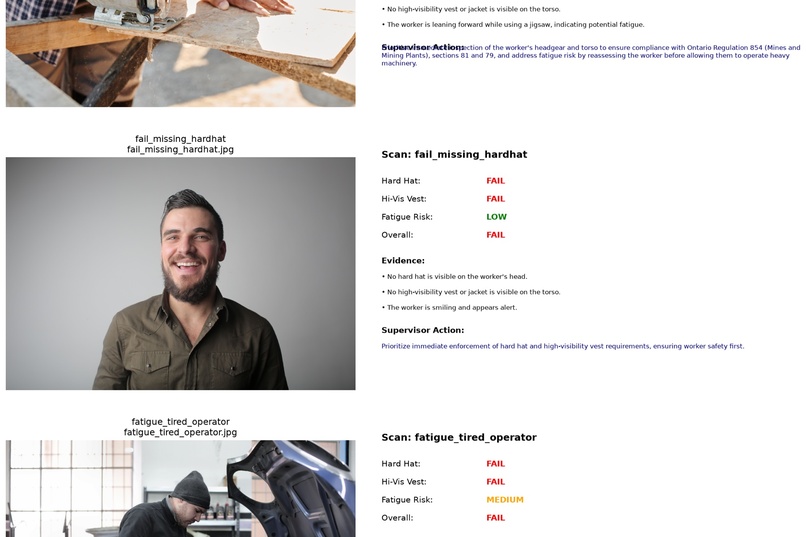
Analysis report
-
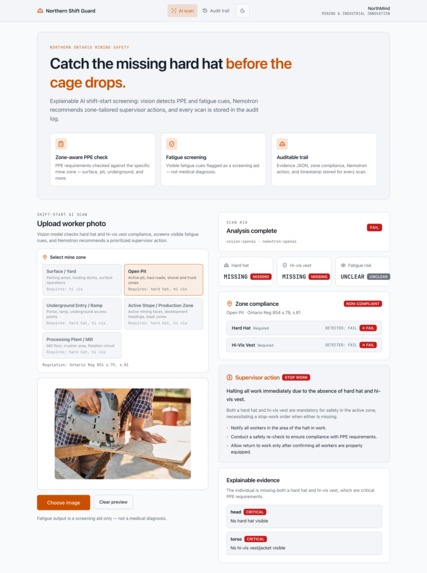
Demo_Analysis
-
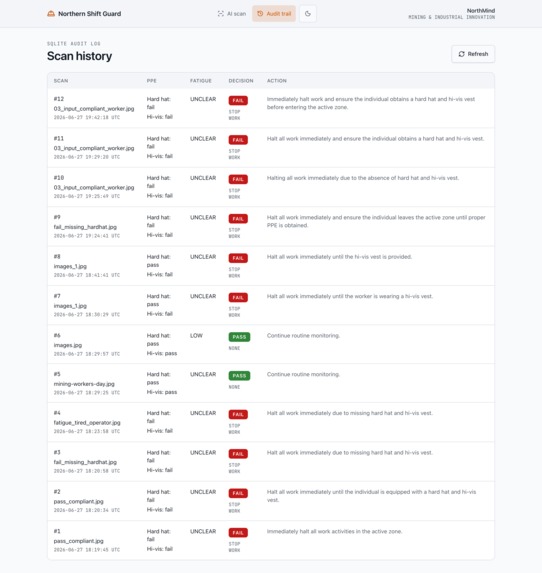
Audit
Northern Shift Guard — Project Story
Inspiration
Northern Ontario mines are losing experienced tradespeople to retirement faster than they can replace them. New workers mean more risk — especially at shift start, when fatigue from overnight travel and unfamiliar PPE protocols combine. Yet shift-start safety checks are still done manually: a supervisor glances at a worker, makes a judgment call, and nothing is recorded.
If something goes wrong later — an injury, a liability dispute, an MOL inspection — there is no record of what was checked, what was seen, or what action was recommended. The decision was a black box.
We wanted to change that. Not with another alarm that beeps and gives a confidence score, but with a system that reasons like a safety officer: what did we see, what does it mean for this specific zone, and what should the supervisor do right now?
What We Built
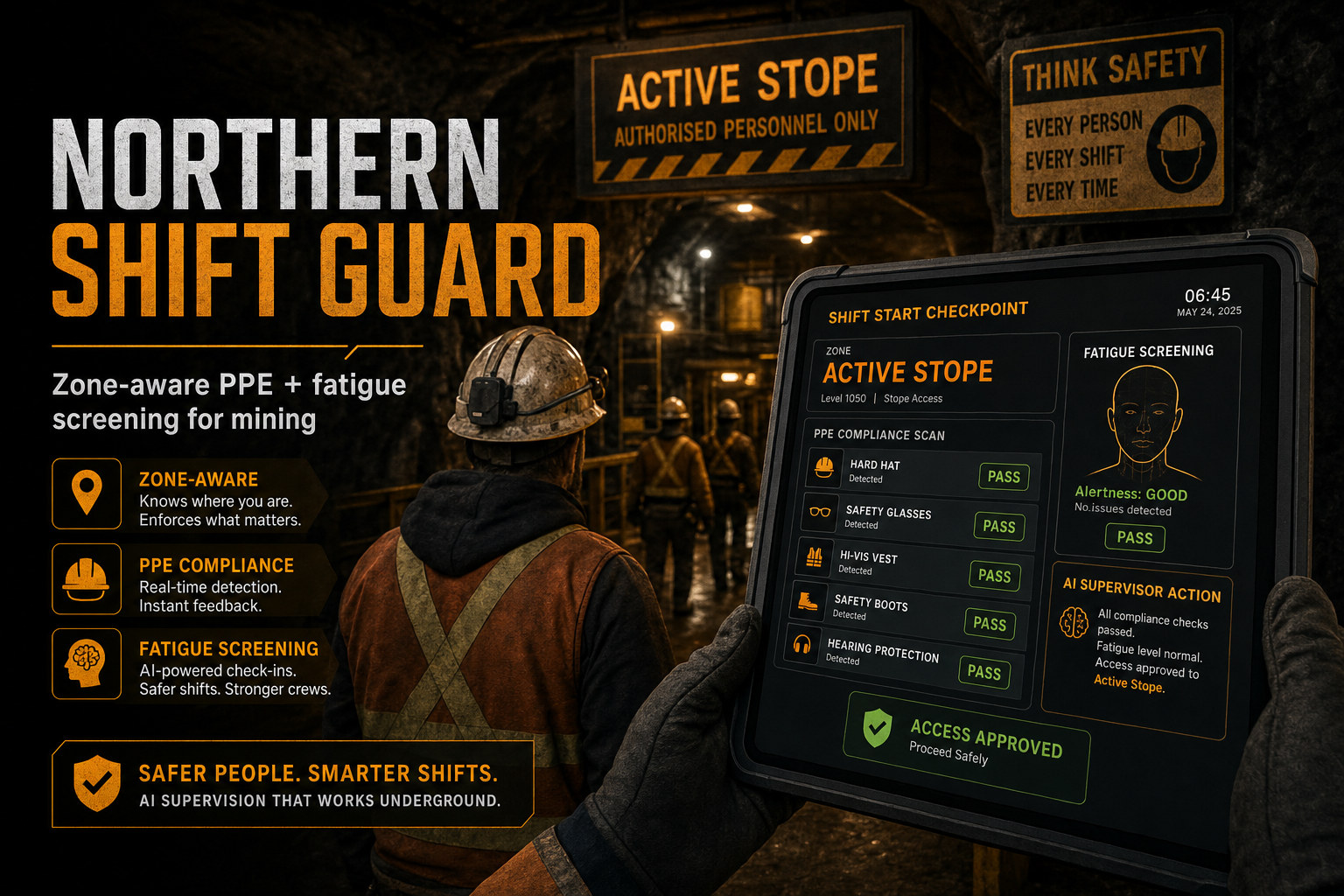
Northern Shift Guard is a shift-start AI screening tool for Northern Ontario mining operations.
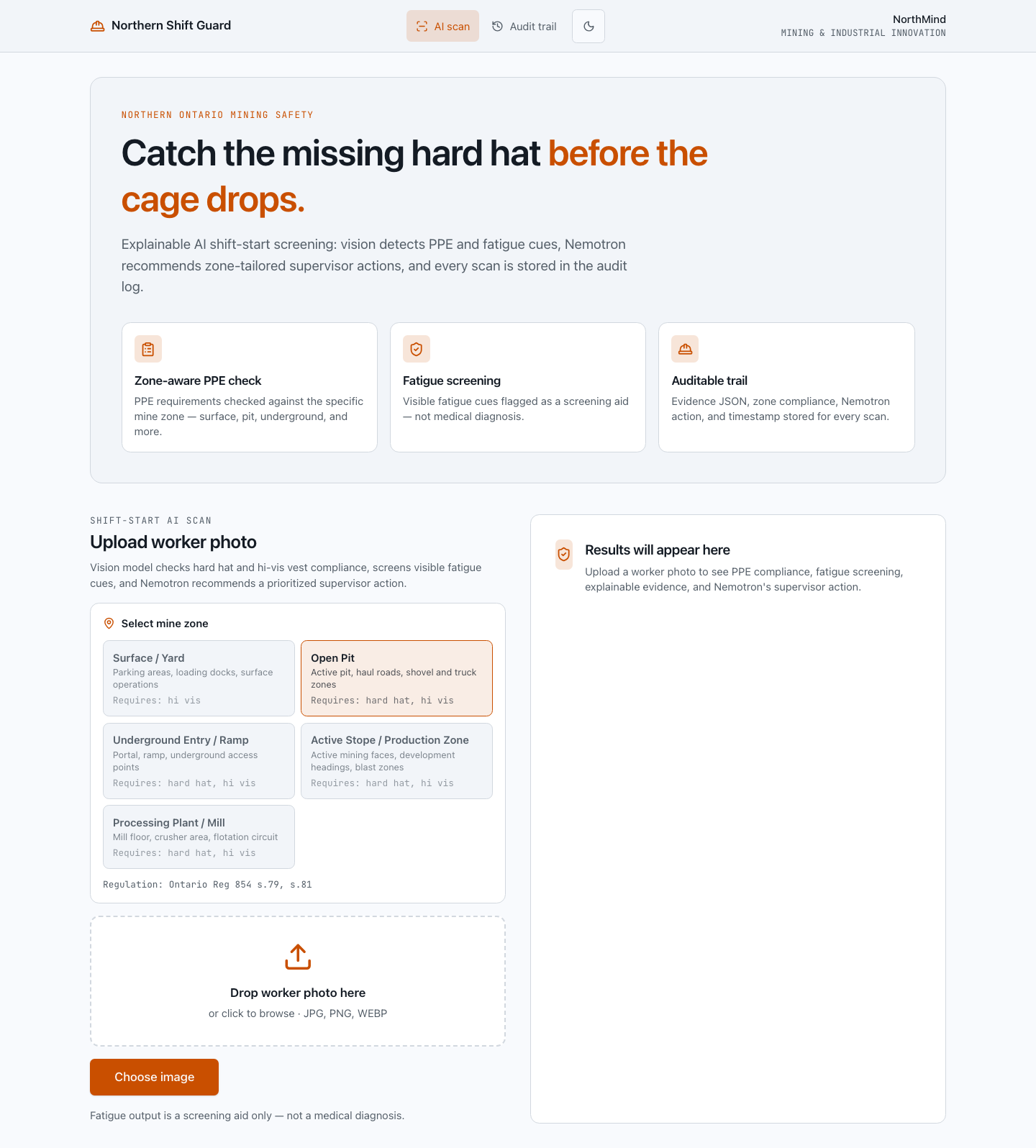
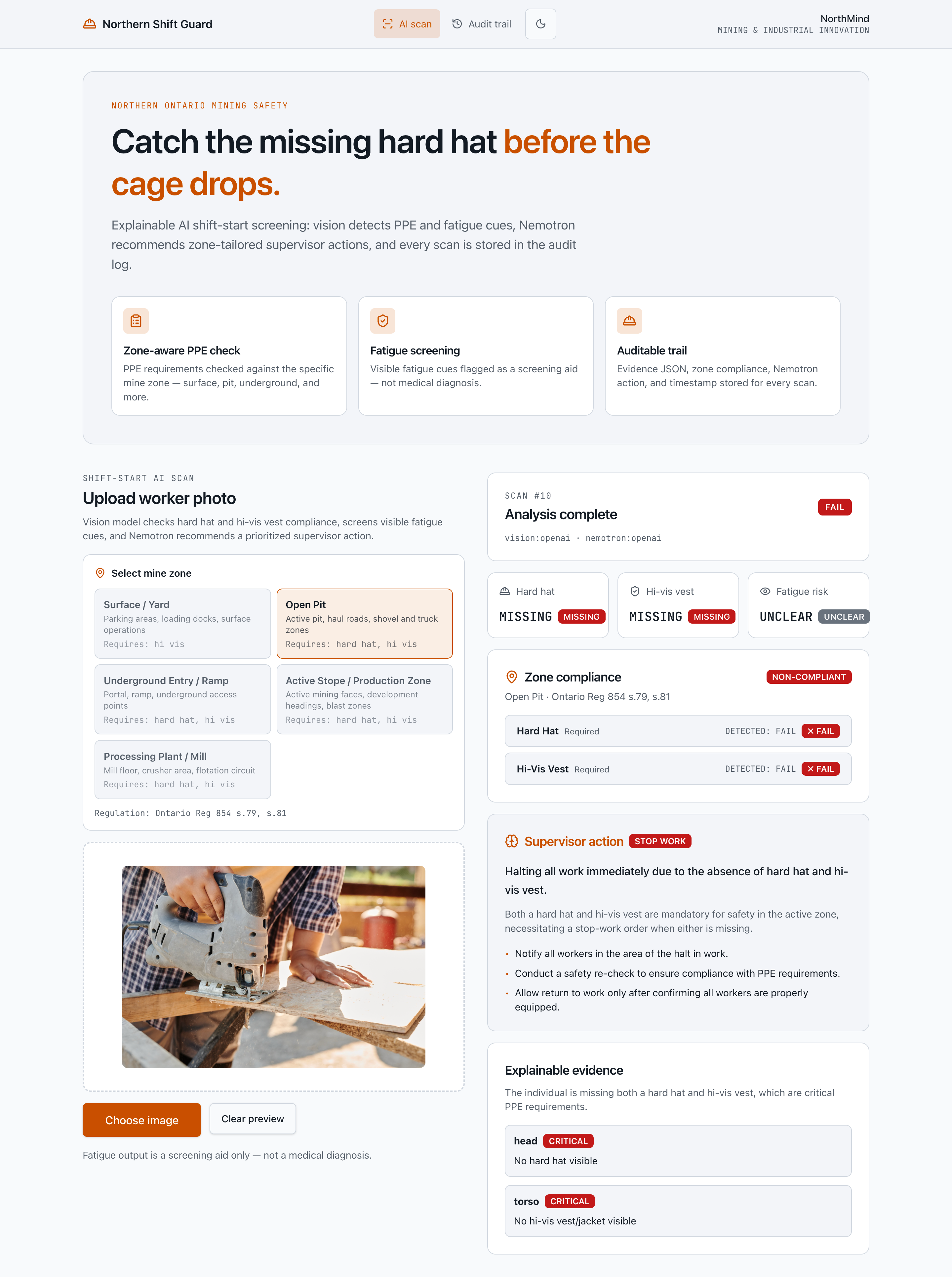
A supervisor selects the mine zone a worker is about to enter — surface yard, open pit, underground ramp, active stope, or processing plant. Each zone has different PPE requirements under Ontario Regulation 854. They upload a worker photo. The system:
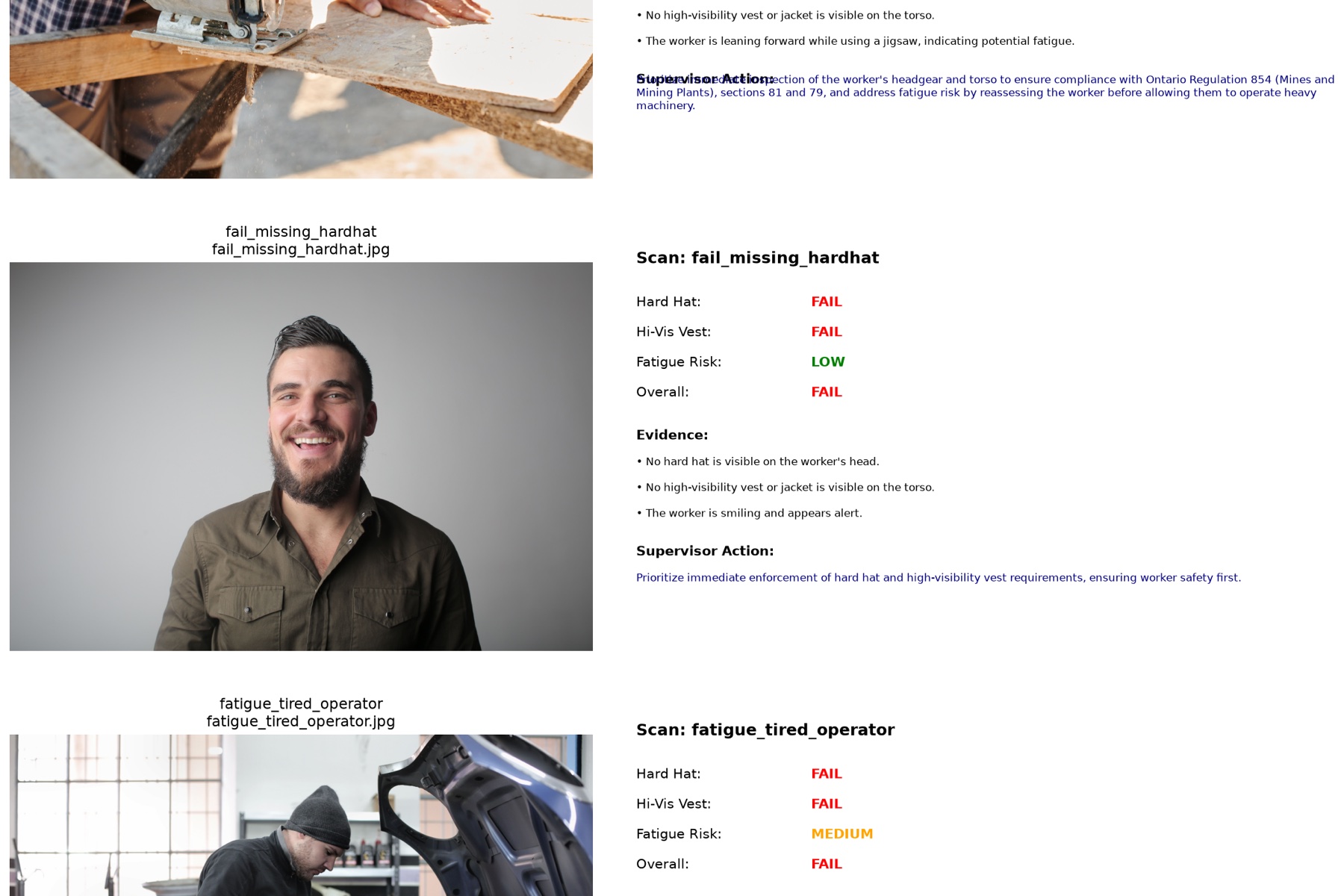
- Detects PPE compliance (hard hat, hi-vis vest) and visible fatigue cues using GPT-4o vision
- Checks zone compliance — not a global rule, but the specific requirements for that zone (e.g. surface only requires hi-vis; active stope requires both hard hat and hi-vis under s.81 and s.105)
- Reasons over the evidence using NVIDIA Nemotron, producing a plain-language prioritized supervisor action — not just a flag, but what to actually do and why, grounded in Ontario mining regulations
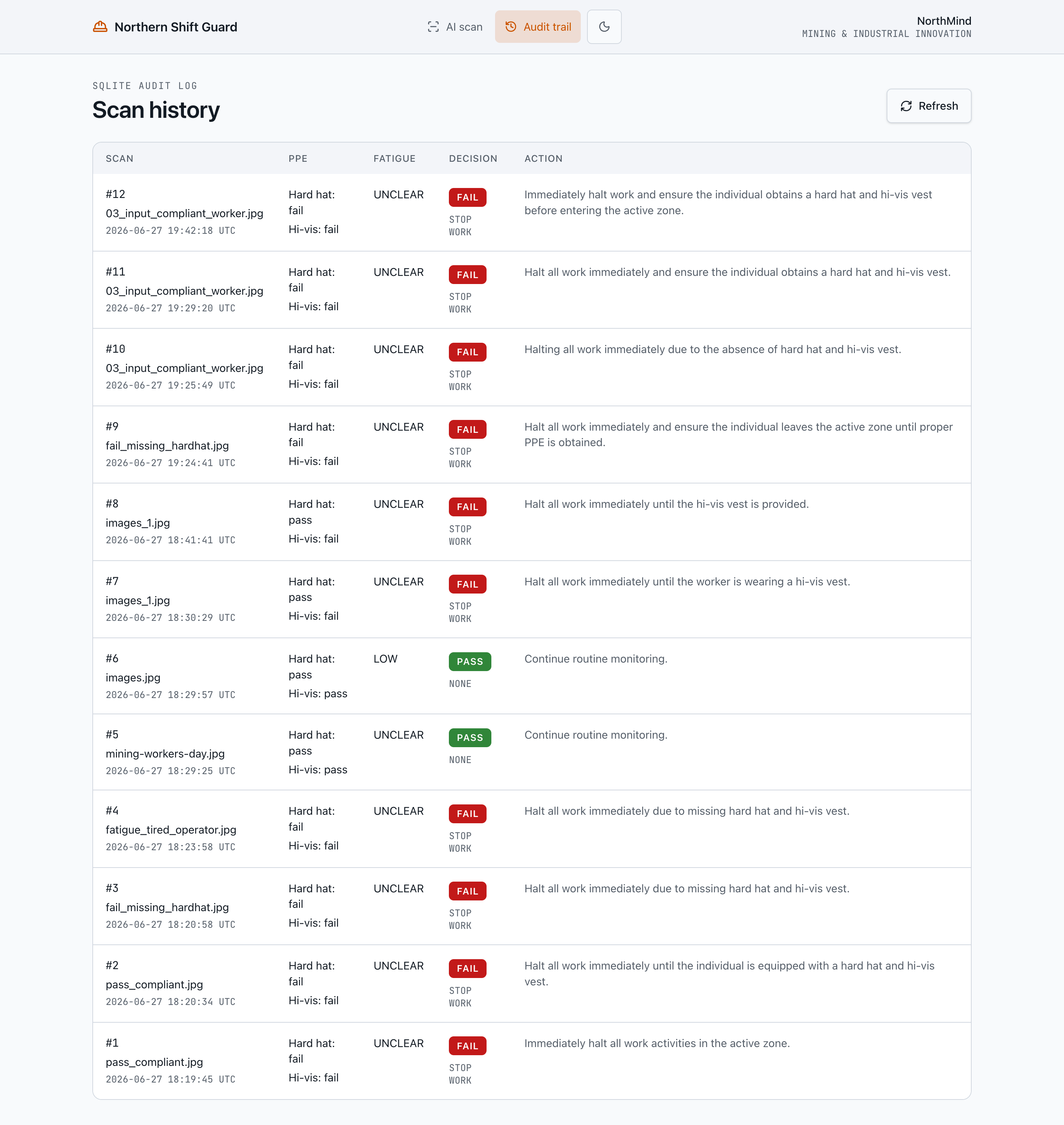
- Stores every scan — detected PPE, zone compliance result, Nemotron's full reasoning, and timestamp — in TiDB Cloud, building a permanent, traceable audit trail
The result: every shift-start safety decision is explainable, zone-specific, and auditable. No black boxes.
How We Built It
Stack:
- Backend: FastAPI (Python) —
/api/analyzeaccepts an image + zone, runs the full pipeline, persists to TiDB - Vision: GPT-4o with structured JSON output — detects hard hat, hi-vis vest, fatigue indicators, and generates natural-language evidence per region
- Reasoning: NVIDIA Nemotron (with GPT-4o-mini fallback) — receives vision evidence + zone context + Ontario Reg 854 safety references, returns a prioritized supervisor action
- Zone compliance engine: custom Python service compares detected PPE against zone-specific requirements from a
zones.jsonconfig, producing per-item compliant / non-compliant / not-required status - Audit storage: TiDB Cloud — every scan stores vision JSON, zone compliance result, Nemotron action, provider metadata, and UTC timestamp
- Frontend: React + Vite with an industrial dark-theme UI — zone selector, image upload, PPE status cards, zone compliance panel, Nemotron supervisor action, explainable evidence cards, and full audit trail tab
Pipeline:
Worker photo + zone selection
  → GPT-4o vision → { hard_hat, hi_vis, fatigue_risk, evidence[] }
  → Zone compliance check (detected vs. zone requirements)
  → Nemotron + Ontario Reg 854 context → { priority, supervisor_action, rationale, steps[] }
  → TiDB audit record
  → UI: zone compliance panel + supervisor action + evidence cards
Challenges We Faced
1. Replicate model deprecation
The original LLaVA-13B model we planned to use via Replicate returned a 422 "version does not exist" error on the day of the hackathon. We pivoted to GPT-4o vision — which turned out to be significantly better quality for structured PPE detection, and supports response_format: json_object for reliable parsing.
2. Making compliance zone-aware, not global A naive PPE detector flags everything against the same ruleset. The real insight was that a worker heading to the surface yard only needs hi-vis — flagging them for no hard hat would be wrong. Building the zone compliance layer required defining per-zone requirements (grounded in actual Ontario Reg 854 sections) and making the Nemotron prompt zone-context-aware so its supervisor action reflected the actual zone risk level.
3. Keeping the reasoning explainable It's easy to produce a pass/fail label. It's harder to produce reasoning a supervisor actually trusts. We structured the Nemotron output into four components — priority level, one-sentence action, rationale, and step-by-step recommended actions — so every decision has a transparent chain: what was seen → what it means for this zone → what to do about it → why.
4. Audit trail that survives restarts
Early in development, db.py dropped and recreated the scans table on every server restart (fine for local dev, catastrophic for TiDB). We fixed this to CREATE TABLE IF NOT EXISTS with AUTO_INCREMENT (MySQL/TiDB syntax) so scan history persists across deployments.
What We Learned
- Zone-aware compliance is the real differentiator. Generic PPE detectors exist. What mines actually need is a system that knows the difference between a surface check and an underground entry check — and adjusts both the compliance verdict and the supervisor guidance accordingly.
- GPT-4o vision with structured JSON prompts is production-ready for safety screening applications. The evidence quality (region + observation + severity) is far beyond what a fine-tuned YOLO classifier alone can provide.
- Explainability is not a feature — it's a requirement in regulated industries. Every layer of the system (vision evidence, zone compliance, Nemotron rationale) was designed to answer: why did the system say that?
What's Next
- Webcam / real-time capture — scan workers as they pass a checkpoint, not just via upload
- Batch shift scanning — process an entire crew at once before cage descent
- TiDB analytics — shift-over-shift compliance trends, zone risk heatmaps, flagged-worker patterns
- Expand PPE types — gloves, safety glasses, respirators, metatarsal boots per zone
- WSIB / MOL report export — auto-generate incident documentation from TiDB audit records
Built With
- claude
- cursor
- fastapi
- gpt-4o
- jupyter-notebook
- lucide-react
- nvidia-nemotron
- openai-api
- pydantic
- python
- react
- sqlalchemy
- tailwind-css
- tidb-cloud
- typescript
- uvicorn
- vite


Log in or sign up for Devpost to join the conversation.