-
-
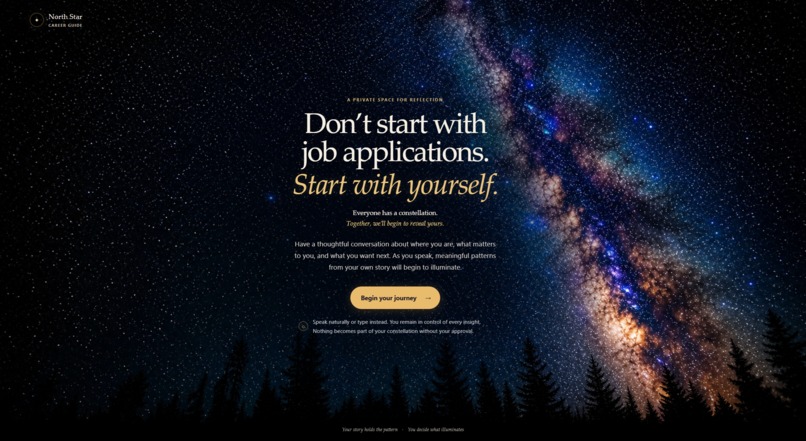
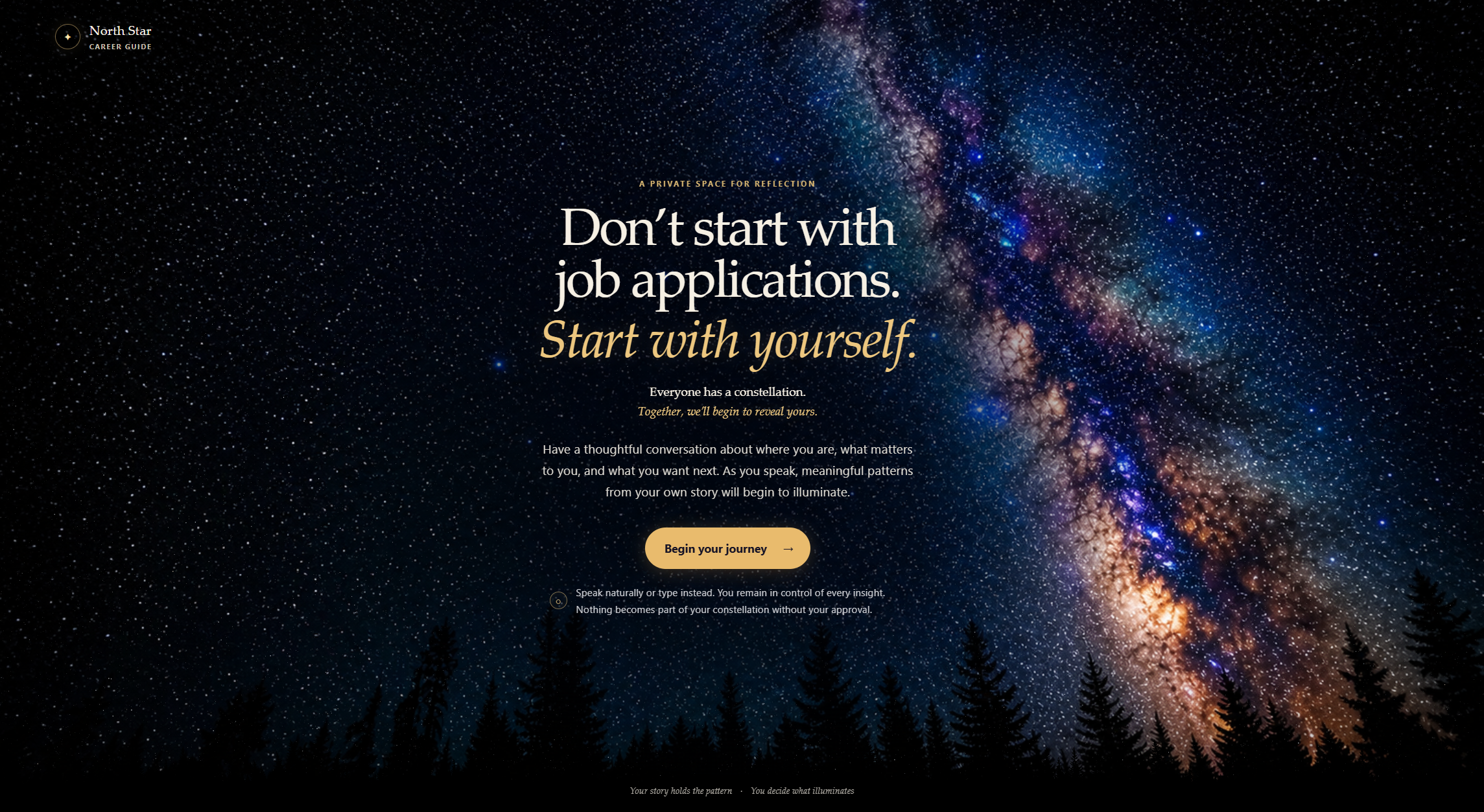
North Star Career Guide’s voice-first, starlit coaching experience.
-
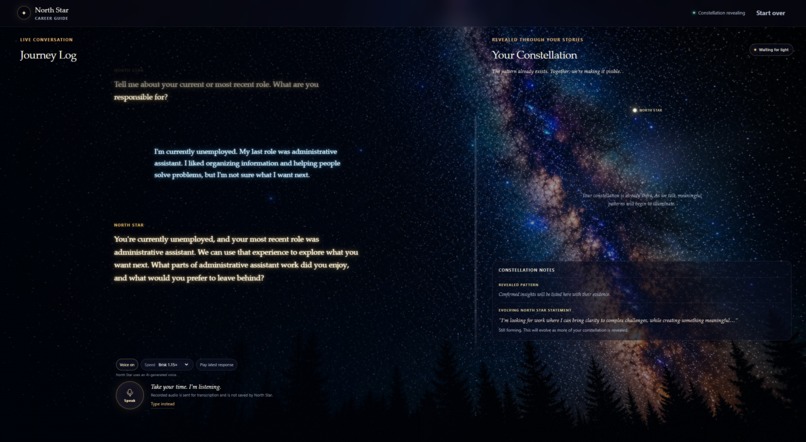
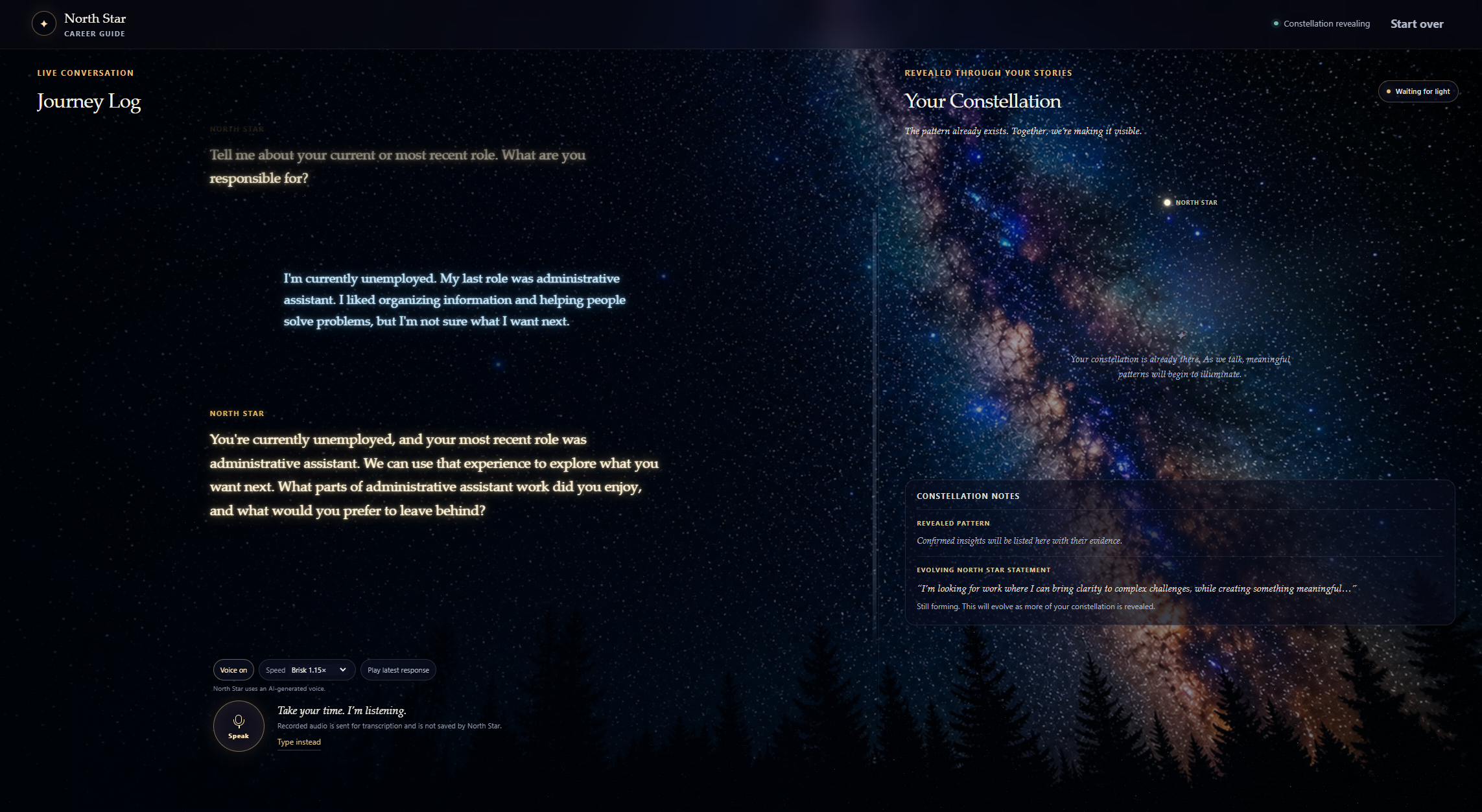
North Star separates current circumstances from past experience and turns uncertainty into exploration.
-
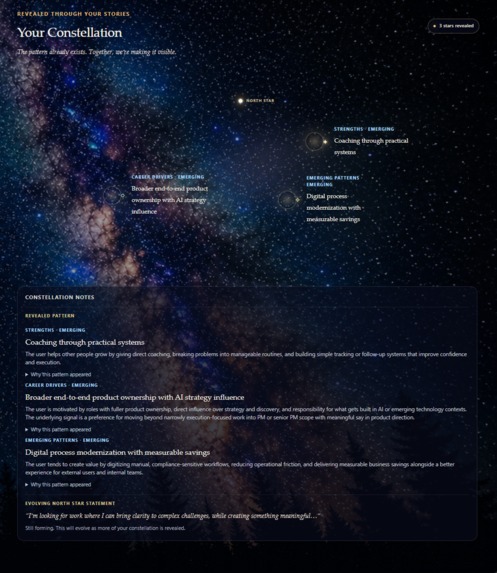
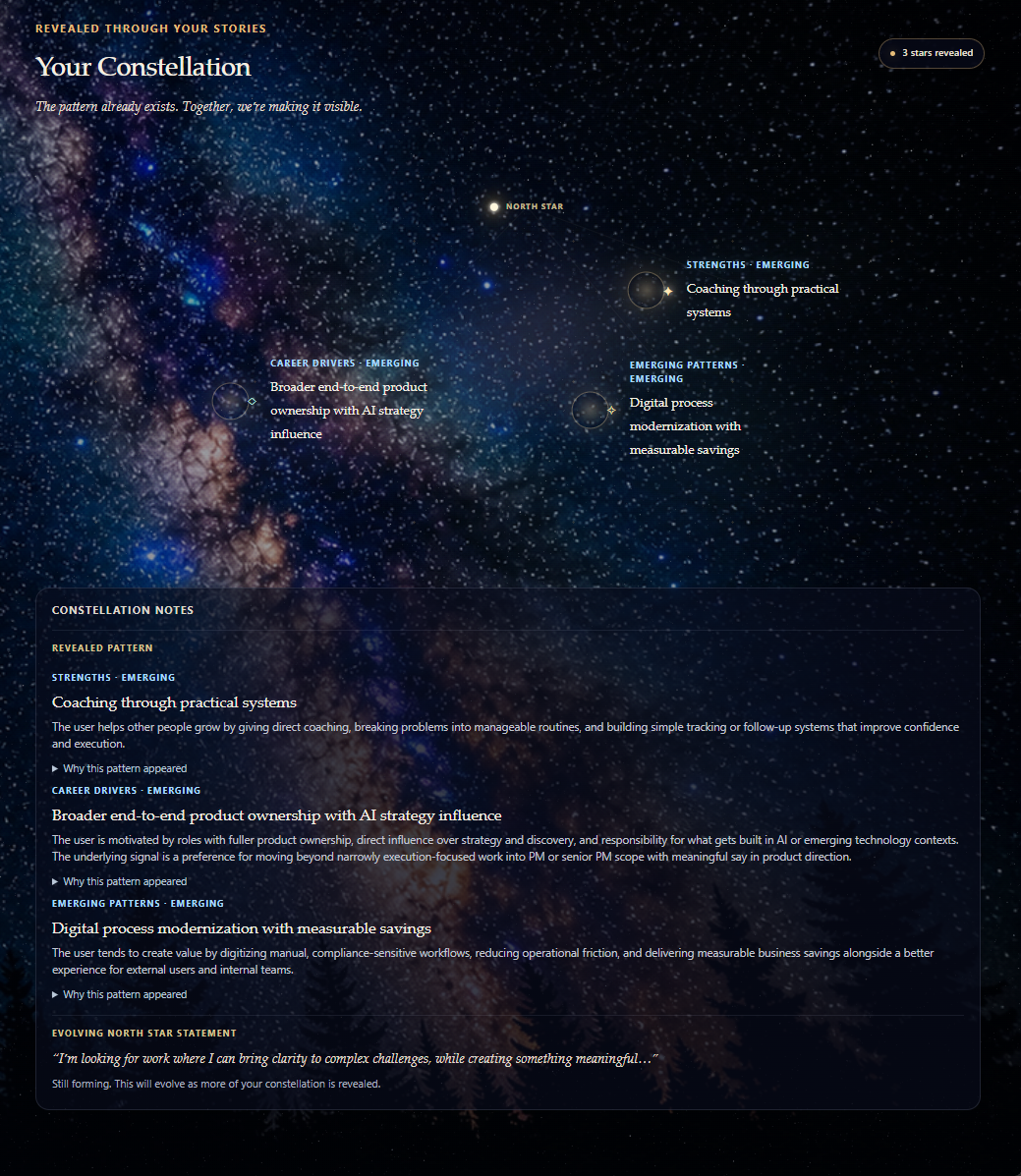
As evidence accumulates, North Star turns conversation into a constellation of emerging strengths, career drivers, and patterns.
-
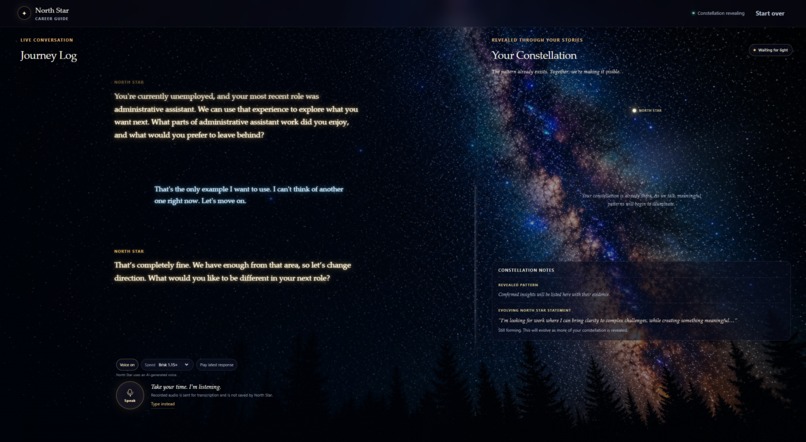
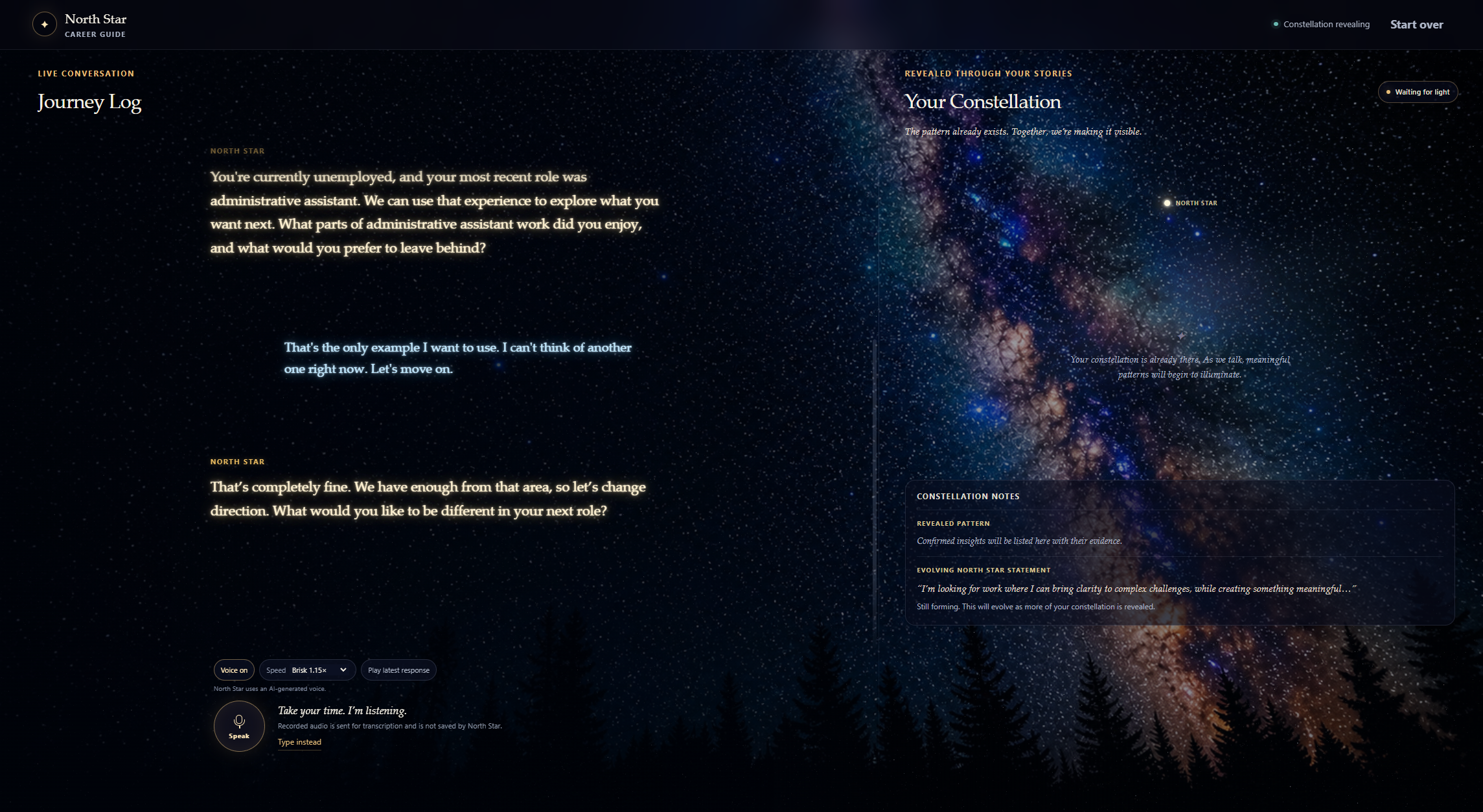
North Star recognizes when it has enough information instead of forcing users through a rigid script.
Inspiration
North Star began with my own career transition.
I am a product manager, an MBA student, and a suburban mother in my 40s trying to make sense of what I want from the next chapter of my career. As I worked on my own job search, I became increasingly frustrated by how many career tools begin at the very end of the process—with a résumé, a job title, a list of keywords, or an application.
Those tools assume people already know how to explain what they are good at, what kind of work fits them, and which parts of their experience actually matter.
Many people do not.
That is especially true for people whose careers do not fit a polished corporate template: hourly workers, gig workers, caregivers returning to work, students, people who have been laid off, and career changers. Valuable skills are often buried in work that feels ordinary, and most people have never had someone help them recognize or articulate those patterns.
North Star existed only as an idea until last Friday, when I happened across the OpenAI Build Week email. The timing felt like a sign to stop imagining it and start building.
I built North Star Career Guide around one simple premise:
Before an AI helps someone apply for jobs, it should first understand the person.
What it does
North Star is an adaptive, voice- and text-enabled AI career coach that gradually builds an evidence-backed understanding of a user’s:
- career and life experience
- responsibilities and accomplishments
- skills and strengths
- work preferences
- motivations and values
- practical constraints
- possible career direction
Instead of forcing the user through a rigid questionnaire, North Star decides whether the most useful next action is to ask a question, reflect something meaningful, clarify a misunderstanding, repair an incorrect assumption, summarize, or move to a different topic.
The application can recognize useful career evidence from ordinary work—not only formal “projects” or executive accomplishments. It can learn from customer service, recurring responsibilities, training, organizing information, gig work, school, volunteering, qualitative improvements, and problems solved in day-to-day work.
As meaningful patterns emerge, they appear in a visual constellation. Every surfaced insight remains under the user’s control and can be accepted, revised, or rejected.
How I built it
North Star is built as a Next.js and TypeScript web application using GPT-5.6 Sol through the OpenAI Responses API.
The conversational system is designed around this loop:
User response
→ conversational-signal detection
→ fact, correction, and evidence extraction
→ user-model update
→ working-hypothesis update
→ conversation-state assessment
→ next-action selection
→ natural response generation
North Star separates explicit facts from provisional interpretations.
For example:
- “The user previously worked as a Quality Analyst” is a fact.
- “The user may prefer analytical, behind-the-scenes work” is a working hypothesis.
- A surfaced career driver remains provisional until the user reviews it.
GPT-5.6 helps North Star interpret natural spoken or typed language, identify candidate facts and corrections, recognize evidence of skills and preferences, detect signals such as confusion or a request to move on, generate working hypotheses, and propose the next useful conversational action.
Deterministic application logic protects explicit corrections, current-versus-past work separation, topic boundaries, persistence, evidence provenance, repetition prevention, and removal of rigid career quotas.
Codex acted as an engineering collaborator throughout the project. I used it to inspect and map the repository, trace a user turn through the UI, API, model, validation, reducer, and persistence layers, identify competing question planners, diagnose why adaptive responses were being overwritten, design the implementation plan, implement the new North Star Brain behavior, create regression tests, and validate the production build.
The core product decisions remained mine: redefining success around understanding rather than completion, designing the coaching methodology, prioritizing user autonomy, deciding which behaviors were acceptable, and determining what to cut for the submission deadline.
Challenges I ran into
The hardest problem was not generating career advice. It was teaching the system how to know when it had enough information.
An early usability test exposed several important failures:
- repeatedly requesting more project examples
- confusing current gig work with a previous employer
- asking abstract, corporate-sounding questions
- assuming every user had ownership, metrics, management scope, or product decisions
- prioritizing career-driver collection over understanding the person
That feedback changed the architecture.
Instead of patching individual phrases, I created two internal specifications:
- North Star OS — the reusable conversational reasoning rules
- Career Guide Coaching Manual — the career-specific coaching methodology
These documents define how the system listens, remembers, handles uncertainty, chooses its next action, recognizes information saturation, repairs misunderstandings, and adapts across career levels.
A second challenge was balancing model flexibility with deterministic safeguards. A stronger model alone could not solve the problem if local code still forced the wrong next question. The final design gives GPT-5.6 room to reason conversationally while local policy protects corrections, closed topics, state integrity, and user boundaries.
Accomplishments that I'm proud of
When I entered Build Week, I was starting from zero: no coded product, no working application, no development team, and no prior coding experience.
I am not a software engineer. I am a product manager, an MBA student, and a suburban mother in my 40s who had never coded anything a day in her life. I came into this hackathon knowing how to understand users, define problems, make product decisions, and recognize when an experience was not working—but not how to turn any of that into a functioning application.
With Codex as my engineering collaborator, I built North Star Career Guide from the ground up and deployed it as a working public product in a matter of days.
That alone is something I am incredibly proud of.
But I am even prouder that I did not stop at making something that looked beautiful or could carry on a basic AI conversation. When real usability testing exposed that North Star was repeating questions, confusing employment history, and pushing users toward answers that fit its own assumptions, I stepped back and reconsidered the entire product.
I researched how exceptional career coaches, recruiters, clinicians, and interviewers actually listen, reason, recognize uncertainty, and know when they have enough information. That research became the foundation for North Star OS, the Career Guide Coaching Manual, and a new conversational reasoning architecture called North Star Brain v1.
During Build Week, I:
- designed and built the complete voice- and text-enabled product experience
- created a visual constellation that reveals evidence-backed career insights over time
- redesigned the conversation engine around understanding rather than completing a checklist
- separated current and previous work experiences so unrelated roles are not merged
- added correction-aware behavior when North Star misunderstands the user
- taught the system to recognize “I don’t know,” “no more examples,” and “let’s move on” as valid conversational states
- removed fixed requirements for formal projects, management responsibility, product decisions, numeric metrics, and five career drivers
- enabled North Star to learn from ordinary responsibilities, qualitative outcomes, gig work, hourly work, and other real-life experience
- preserved adaptive GPT-5.6 responses instead of replacing them with rigid hardcoded questions
- added automated regression tests based on actual usability failures
- implemented production speech transcription and spoken responses
- deployed the application publicly using GPT-5.6
One production test captured exactly why the redesign mattered. After a user said:
“That’s the only example I want to use. I don’t have any more projects—let’s move on.”
North Star responded:
“That’s completely fine. We have enough from that area, so let’s change direction. What would you like to be different in your next role?”
A few days earlier, I had never written code. By the end of Build Week, I had built and deployed an AI product that could listen, learn from testing, recover from its mistakes, and treat the person—not its own checklist—as the center of the experience.
That is the accomplishment I am proudest of.
What I learned
The most important lesson was:
Understanding is more important than completion.
The real intelligence in an adaptive coaching product does not come from a large prompt alone. It comes from combining:
- a capable language model
- structured memory
- clear source-of-truth rules
- working hypotheses
- conversation-state awareness
- user-controlled insights
- deterministic protections against repetition and incorrect assumptions
I also learned that an MVP does not have to be complete—but it does have to be trustworthy.
North Star does not yet need to generate every résumé, recommend every career path, or support every future feature I envision. But the first slice needed to do its core job well: listen accurately, respect the user’s boundaries, recover when it was wrong, and avoid forcing people into assumptions that did not fit their lives.
For a product asking users to share personal career history, uncertainty, setbacks, and aspirations, trust cannot be postponed to a later release. The MVP could be narrow, but the experience at its center had to be thoughtful and reliable enough for users to feel safe continuing the conversation.
That realization helped me make difficult scope decisions during the hackathon. Instead of adding more visible features, I focused on making the foundational interaction stronger.
Another important realization was that useful career evidence is often hidden in work the user considers ordinary. A cashier, delivery driver, caregiver, student, or administrative assistant may not describe their experience as “projects,” but their daily work still contains real evidence of reliability, judgment, service, organization, learning, and problem solving.
What's next for North Star Career Guide
The next phase will deepen the North Star Brain beyond the hackathon-safe implementation.
Planned improvements include:
- account-based longitudinal memory
- a brief introduction so North Star can address users by name
- a growing accomplishment and skills library
- richer evidence and hypothesis tracking
- résumé and LinkedIn generation grounded in verified evidence
- interview preparation
- career-path exploration
- job-search and networking support
- stronger support for students, caregivers, veterans, gig workers, and career changers
- more user control over their career model
- secure user accounts with encrypted data storage, clear consent controls, and the ability for users to review, export, or permanently delete their personal career information
- additional North Star Guides for other areas of life and work
The long-term goal is not simply to help people apply for jobs.
It is to give every person a trusted guide that remembers their story, understands what matters to them, and helps them decide what comes next.
Built With
- career-coaching
- career-development
- codex
- conversational-ai
- future-of-work
- generative-ai
- github
- gpt-5.6
- human-centered-ai
- localstorage
- next.js
- openai
- productivity
- react
- responses-api
- speech-to-text
- text-to-speech
- typescript
- vercel
- voice-ai
- web-app


Log in or sign up for Devpost to join the conversation.