-
-
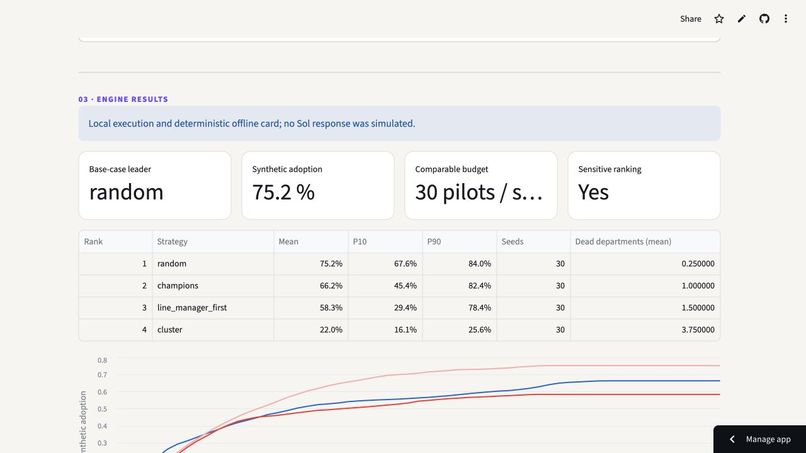
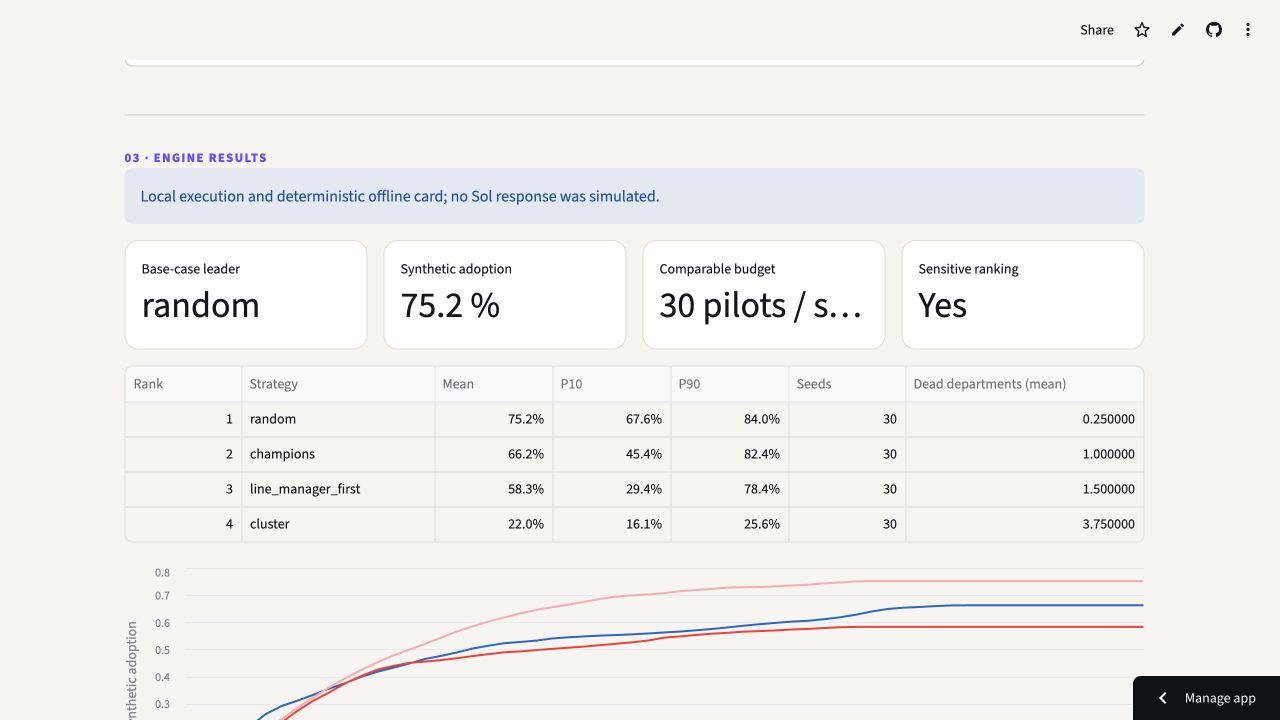
The deterministic network engine compares equal-budget strategies and exposes sensitivity
-
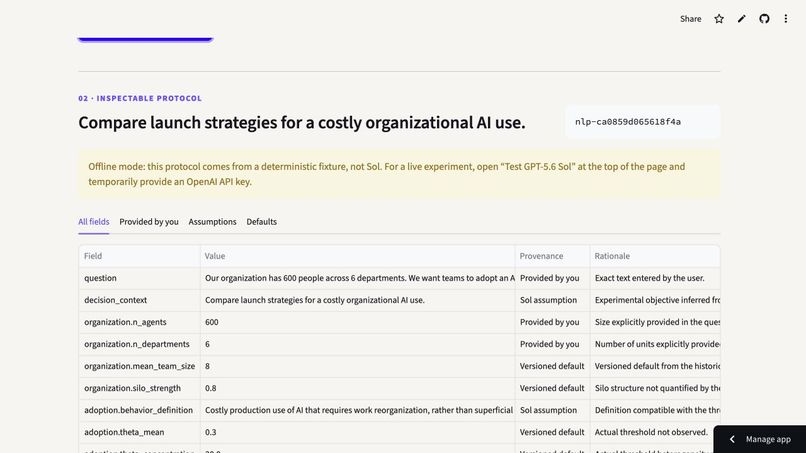
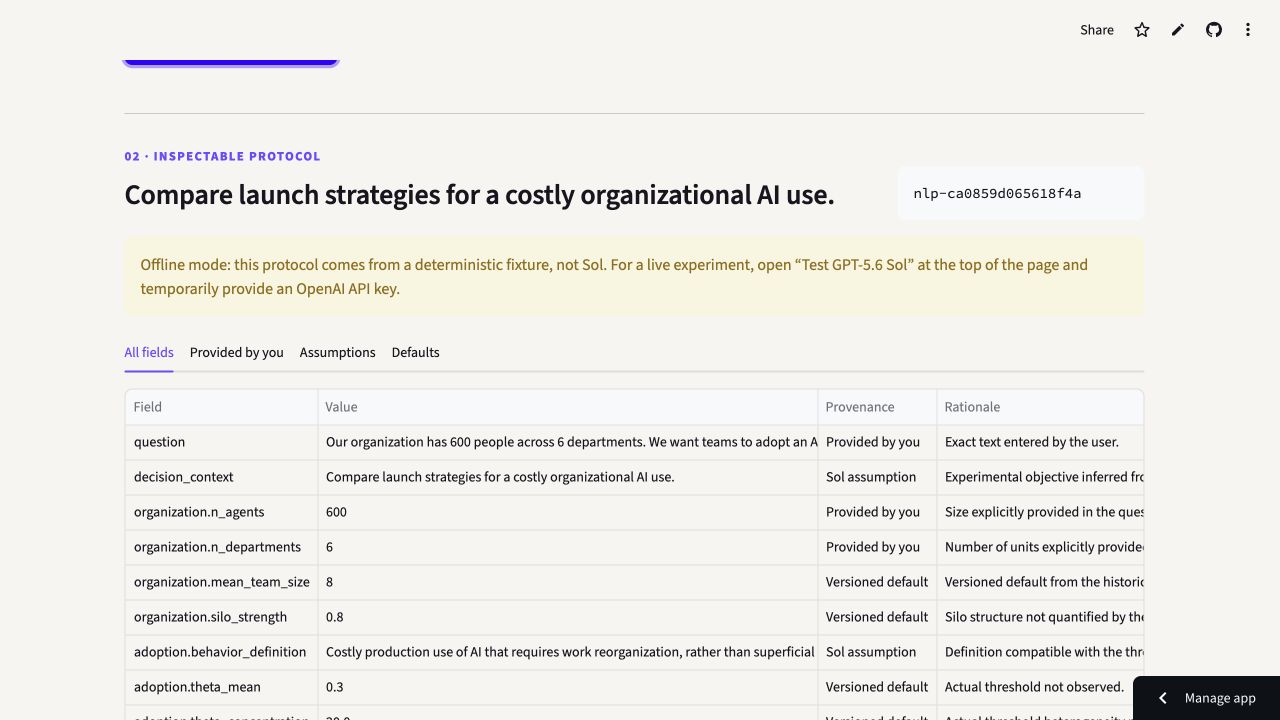
Every protocol field distinguishes user facts, Sol inferences, and versioned defaults
-
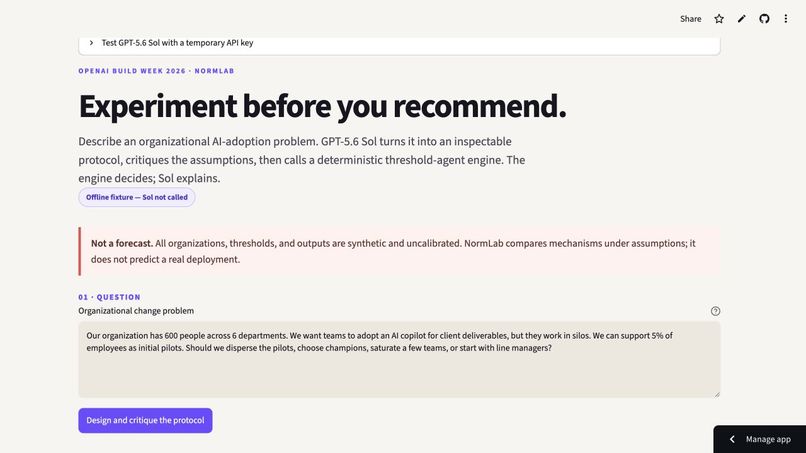
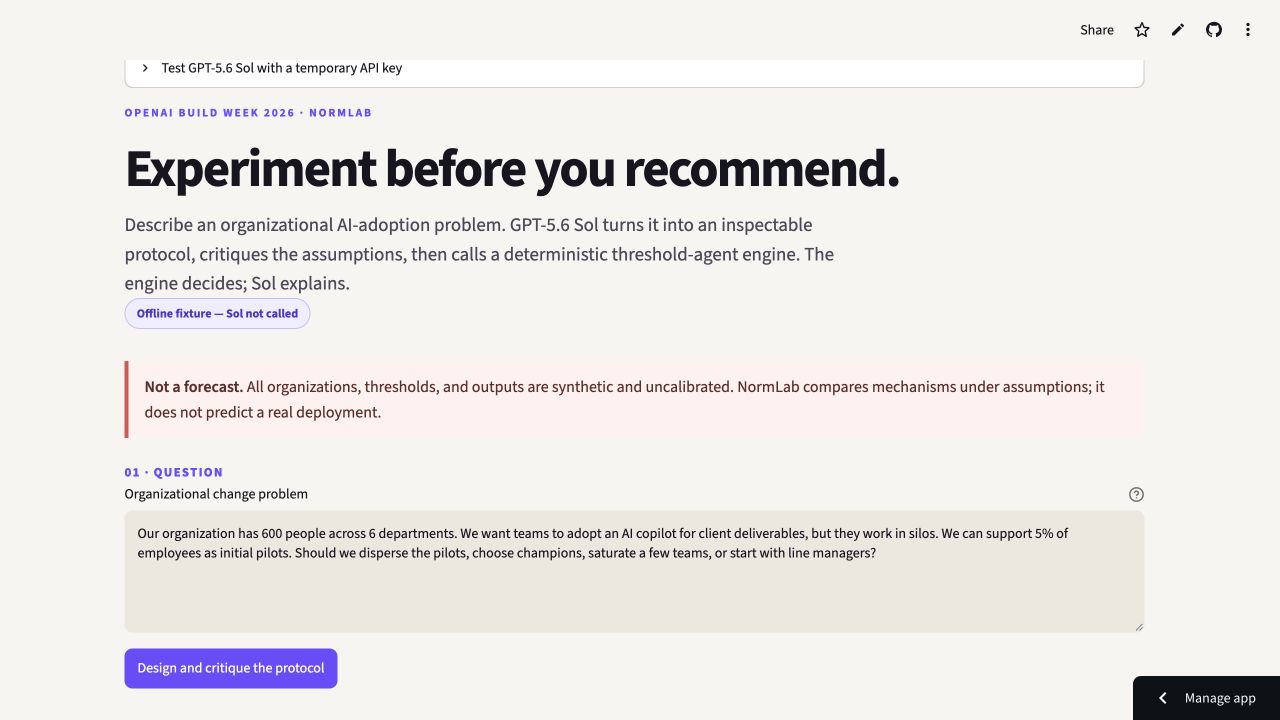
From an organizational question to an inspectable experiment
-
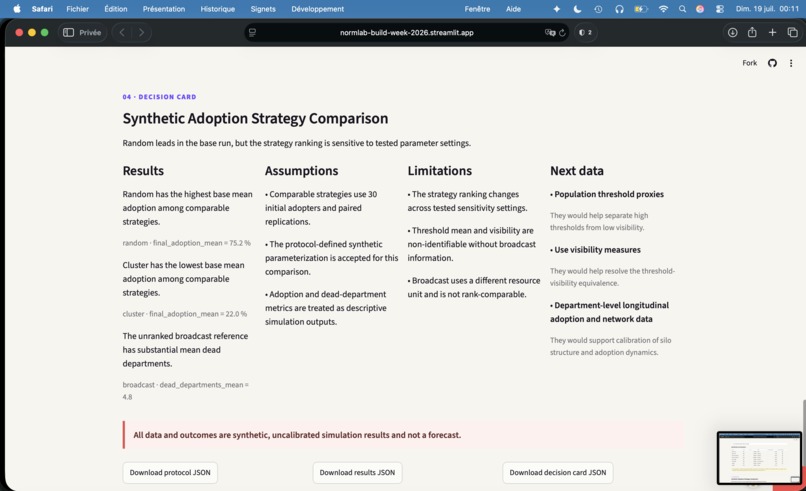
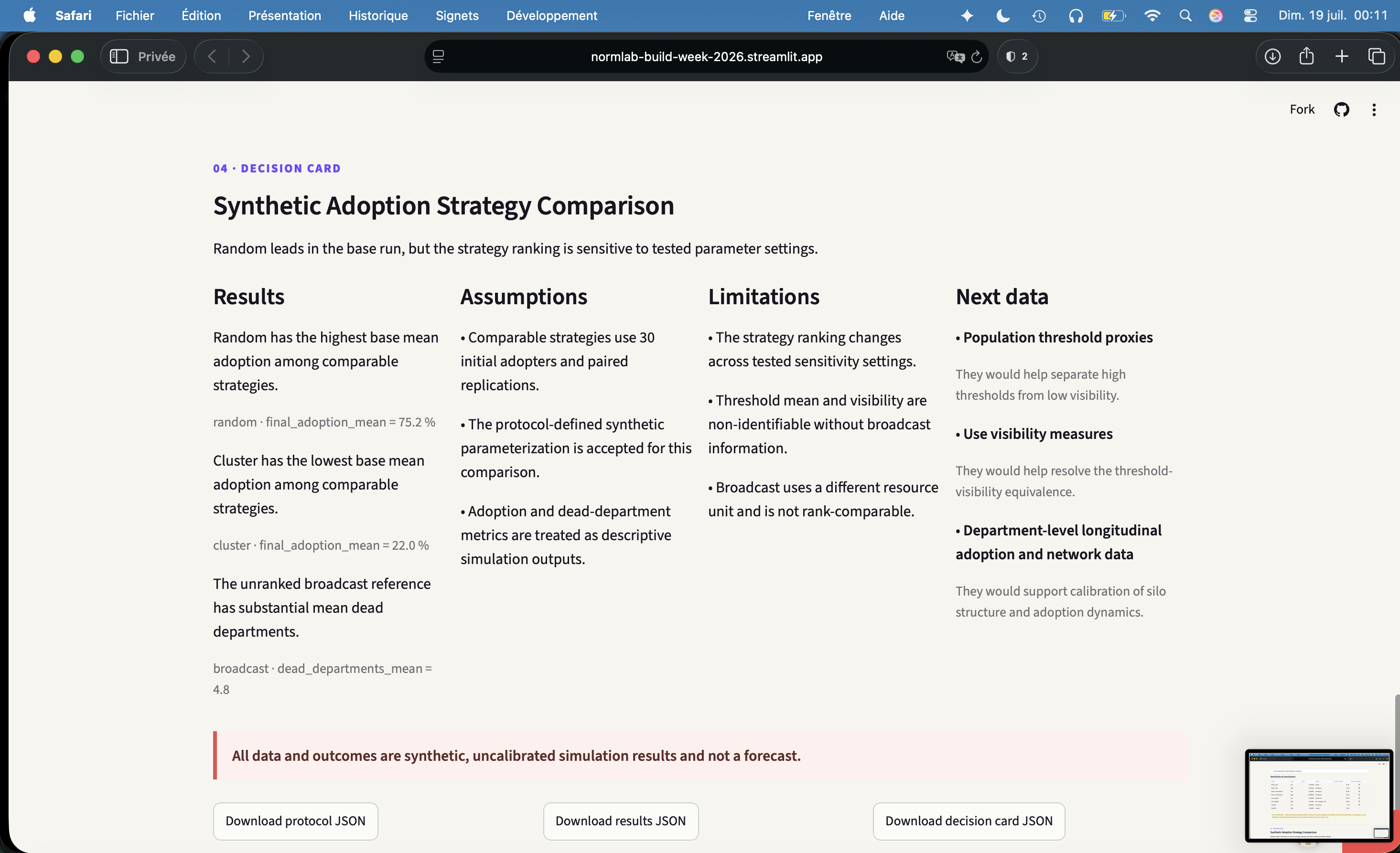
The decision card separates results, assumptions, limitations, and the next data to collect
Inspiration
NormLab grew out of my research interest in historical state formation, network science, and complex contagion. I originally built a deterministic threshold-agent simulator to explore how norms spread when people need reinforcement from several contacts rather than a single exposure. I then asked whether the same scientific mechanisms could make organizational AI-adoption decisions more explicit and testable.
Those decisions are often made before an organization has enough evidence to separate plausible mechanisms. Should limited pilot support be dispersed, allocated to highly connected champions, concentrated inside a few teams, or given to line managers first? A persuasive narrative can answer that question too easily.
NormLab starts from a different principle: GPT‑5.6 Sol designs and critiques the experiment; a deterministic engine computes the result. The product does not claim to forecast a real organization. It makes assumptions inspectable and turns missing evidence into a concrete data-collection agenda.
What it does
An evaluator describes an organizational AI-adoption problem in natural language.
GPT‑5.6 Sol produces a typed protocol and critique. Every value is visibly labeled as
provided, inferred, or system_default. A human can inspect and edit the protocol
before approving execution.
NormLab then forces a strict tool call into a deterministic complex-contagion engine. Four interventions are compared with identical pilot budgets, paired synthetic organizations, and shared seeds. A broadcast intervention uses a different resource unit and is therefore kept outside the main ranking. Coded sensitivity analysis reports ranking changes, and a mandatory flag exposes the threshold/visibility non-identifiability.
Finally, Sol writes a decision card grounded only in engine output. Local validators check every numeric reference and keep Results, Assumptions, Limitations, and Next data separate. All visible outputs state that the simulation is synthetic, uncalibrated, and not a forecast.
How I built it
NormLab began with my research into how states form. That led me to complex contagion: the idea that social change often needs reinforcement from multiple contacts rather than a single exposure. I then studied how norms spread through networks and realized that the same mechanisms could help organizations reason more carefully about the diffusion of AI practices.
I had already built a deterministic threshold-agent simulator for studying norm diffusion. During Build Week, I extended it into NormLab: a product that lets organizations turn an AI-adoption question into an explicit experiment rather than jumping directly to a recommendation.
NormLab uses Python, Streamlit, Pydantic, NetworkX, NumPy, pandas, pytest, and the
OpenAI Responses API with the explicit gpt-5.6-sol model. Sol uses structured
outputs for protocol and decision-card schemas and a single strict deterministic tool.
The integration uses store=False; no API key or private reasoning is written to the
repository or exports.
The numerical engine is a deterministic threshold-agent simulation. It existed
before Build Week and was frozen at commit
0e2d2601332b64981a80c816a4820e5a5a25c669. During Build Week, six required engine
files were ported verbatim under AGPL‑3.0 and verified by SHA-256 parity tests. The
language-to-protocol workflow, provenance model, validators, paired orchestrator,
budget ledger, sensitivity analysis, Sol tool integration, decision card, interface,
tests, audit exports, and deployment are all new Build Week work.
How I used Codex
The majority of NormLab’s core functionality was built in one primary Codex thread. Codex first inspected the frozen historical project in read-only mode and documented the pre-Build Week baseline. It proposed five explicit scientific and product decisions; I reviewed and approved them before implementation. Codex then ported the engine with attribution and parity checks, built the typed schemas and guardrails, implemented the Sol integration and Streamlit product, wrote the tests and evals, and deployed the public demo.
Codex also helped turn live failures into product safeguards. A truncated structured
response led to a bounded decision-card prompt and a tested token reserve. When Sol
omitted a required identifiability warning, Codex added a deterministic
system_guardrail layer while preserving visible provenance. This collaboration is
recorded in dated commits and BUILD_WEEK.md.
Challenges
- Keeping Sol useful without allowing it to replace deterministic computation.
- Preserving user facts separately from model inferences and system defaults.
- Comparing strategies fairly despite different intervention mechanics.
- Showing sensitivity and non-identifiability without presenting synthetic results as forecasts.
- Making the live Sol path testable without committing or publicly funding an API key.
Accomplishments
- A complete public journey from natural-language question to verified decision card.
- Deterministic reproducibility, paired scenarios, equal-budget checks, and raw-run exports.
- A live public GPT‑5.6 Sol smoke test with three coherent audit artifacts.
- 26 passing tests, including legacy parity, invented-evidence rejection, tool-call substitution rejection, and the offline Streamlit journey.
- Clear documentation separating the pre-existing engine from Build Week work.
What I learned
LLMs are most credible in simulation products when they improve the experimental contract rather than impersonate the simulated people. The difficult product problem is not generating a recommendation; it is making provenance, comparability, sensitivity, and uncertainty impossible to hide.
What’s next
After Build Week, NormLab could add calibration workflows for aggregated, privacy-preserving organizational data, protocol comparison across repeated pilots, and exportable research reports. Those extensions would require validation and new scientific decisions; they are intentionally outside this submission.

Log in or sign up for Devpost to join the conversation.