-
-
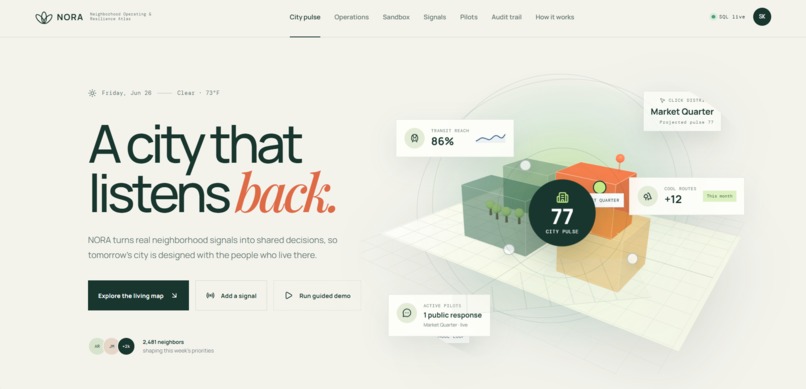
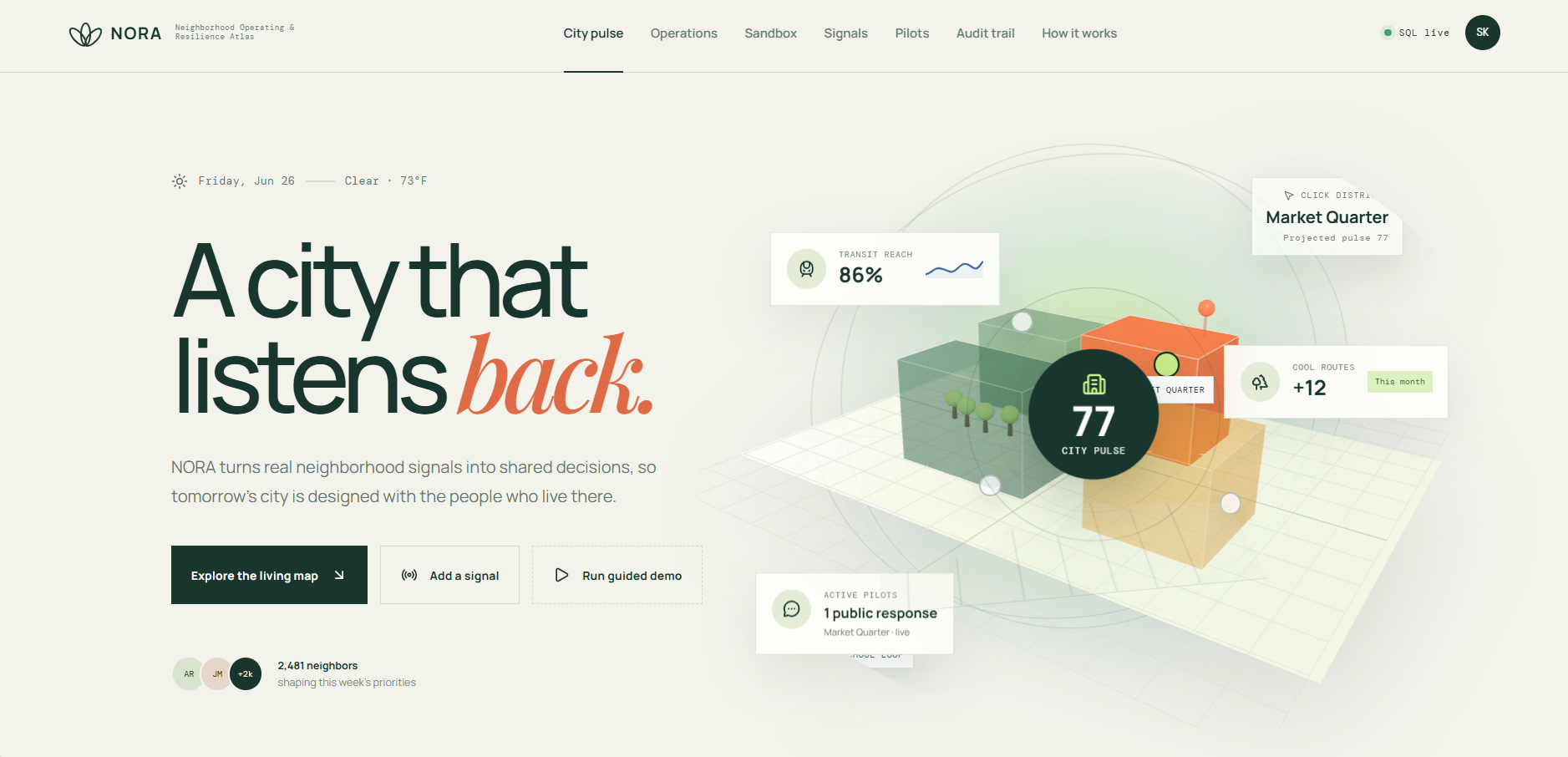
The first thing you see when you open the submission, a premium feel paired with 3d graphics.
Inspiration
NORA was inspired by the idea that a future city should not just be “smart” because it has sensors — it should be responsive because it listens to the people who live there. We wanted to imagine civic technology where resident observations, city data, and public decision-making all connect in one place.
What it does
NORA, the Neighborhood Operating & Resilience Atlas, helps communities turn neighborhood signals into action. Residents can submit local issues, vote on priorities, triage signals, launch public pilots, test interventions in a city simulator, and generate a proposal summary showing budget, equity lift, confidence, and projected impact.
How we built it
We built NORA as a full-stack local web app with a React/Vite frontend and an Express backend. The app uses SQL-backed storage through SQL.js/SQLite, so signals, votes, pilots, and civic audit events persist beyond a page refresh. We also added a Three.js-powered 3D city model, interactive district views, a guided demo flow, and printable proposal summaries.
Challenges we faced
One challenge was balancing visual polish with reliability. We wanted NORA to feel futuristic and memorable, but still run locally with one command and no external services. Another challenge was moving from client-only storage to a real SQL-backed backend while keeping the app simple enough for a hackathon demo. We also had to solve local development issues around pnpm versions, ports, and dependency setup.
What we learned
We learned how much stronger a civic-tech demo feels when every action has a visible trail. Adding SQL-backed audit events made the project feel less like a static concept and more like a working system. We also learned that small presentation details — clear statuses, before/after impact, accessible controls, and a polished proposal modal — make a big difference in how quickly people understand the idea.


Log in or sign up for Devpost to join the conversation.