-
-
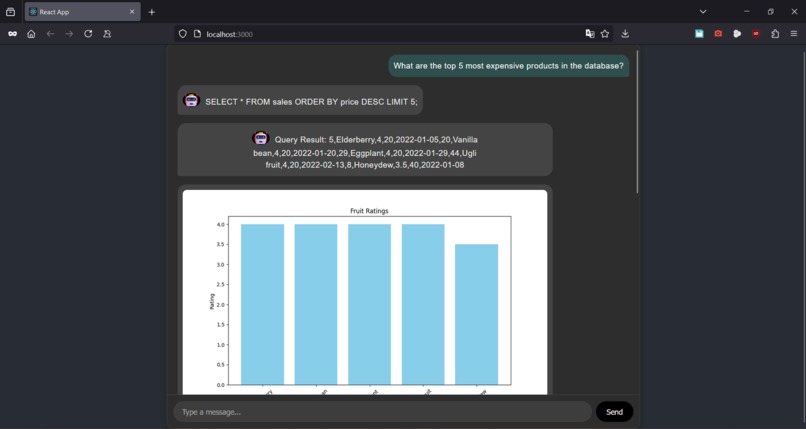
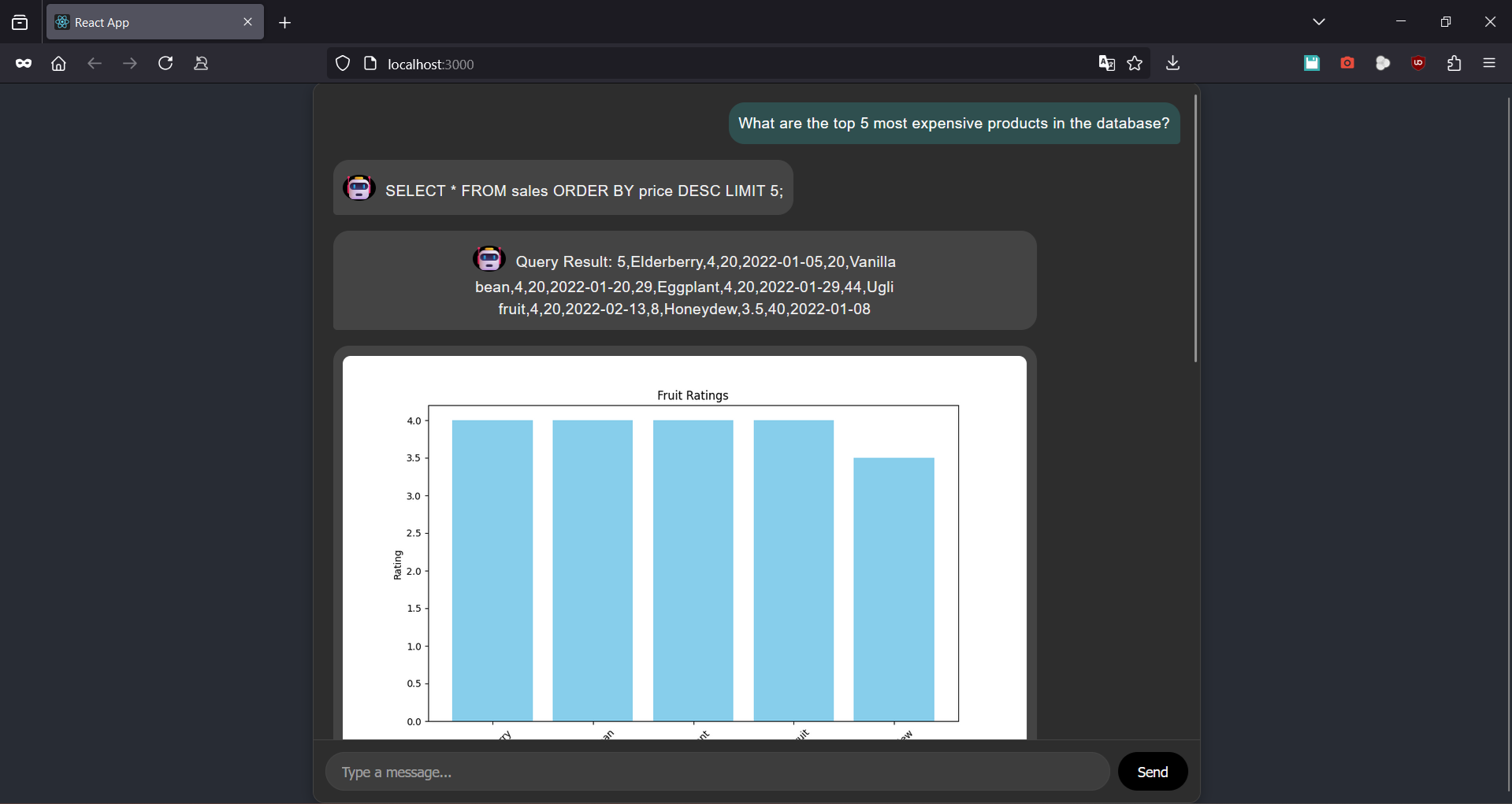
Screenshot
# Inspiration
In many organizations, business analysts (BAs) and other non-technical employees rely on data for decision-making. However, a lack of SQL proficiency and technical expertise often prevents them from directly accessing and analyzing data. As a result, they depend on technical teams to write queries, leading to delays, inefficiencies, and increased workloads for developers.
To address this challenge, we envisioned an AI-powered natural language interface for databases—a tool that allows non-technical users to interact with data effortlessly. Instead of writing complex SQL queries, users can input their requests in plain English, and the AI will convert them into SQL, execute the query, and present results in an intuitive format, including graphs and charts.
This solution reduces onboarding time for new employees, minimizes the need for SQL training, and enhances productivity by democratizing data access across all departments. By making data interaction more intuitive, we empower employees to independently explore business insights, ultimately fostering a more data-driven and agile organization.
# What it does
Our web application empowers users to interact with a SQL database using natural language, eliminating the need for SQL expertise. The AI-powered system seamlessly translates user commands into SQL queries, executes them, and retrieves the relevant data.
Beyond just displaying query results, the system automatically generates insightful visualizations to help users interpret the data more effectively. Users can simply type questions like "Show me the total sales by region for the last quarter" or "What are the top 5 best-selling products this year?", and the platform will return both the SQL output and an intuitive graph or chart.
This approach makes data analysis accessible, efficient, and user-friendly, enabling business analysts, managers, and other non-technical users to explore business insights effortlessly—without writing a single line of SQL.
# How we built it
To develop this application, we leveraged cutting-edge AI and modern web technologies to create a seamless experience for users.
Backend
We utilized a pre-trained LLM model (ChatGPT API) to convert natural language queries into SQL. The backend, built with FastAPI, processes the user’s request in multiple steps:
- Parsing the input – The system interprets the user's intent.
- Generating SQL – The LLM translates the request into an optimized SQL query.
- Executing the query – The query is run against the database to retrieve the required data.
- Dynamically generating Python code – Instead of relying on static visualization templates, the backend dynamically generates Python code to visualize the retrieved data based on the query type and dataset characteristics. This dual-layer AI approach ensures that we are not only using the model for natural language to SQL translation but also for intelligent, adaptive data visualization.
Frontend
For the frontend, we used React to create a fast, responsive, and intuitive user interface. Users can simply enter their queries in natural language, receive structured SQL outputs, and view automatically generated interactive visualizations. The UI is designed for ease of use, making database interactions accessible even for users with no technical background.
By combining AI-driven query translation, automated visualization generation, and a modern web stack, we built a powerful, user-friendly data analysis platform that simplifies SQL-based data exploration for everyone.
# Challenges we ran into
One of the biggest challenges was ensuring that the system could accurately understand user intent and correctly map queries to the appropriate database tables. Since users express requests in different ways, the AI needed to interpret vague or ambiguous queries and translate them into structured SQL statements.
To achieve this, we implemented context-aware natural language processing (NLP) and schema-aware SQL generation. The system dynamically extracts table structures, column names, and relationships to determine the most relevant fields for each query. This was particularly challenging because:
- Users might not specify exact column names (e.g., "Show me recent orders" instead of "SELECT order_date, total_price FROM orders").
- Queries might require joining multiple tables without explicit instructions.
- Synonyms and variations in terminology needed to be automatically mapped to the correct fields (e.g., "employees" vs. "staff").
By combining intelligent query parsing, schema awareness, and AI-driven optimization, we created a system that can accurately translate natural language into SQL, adapt to different database structures, and provide fast, meaningful insights to users without requiring technical expertise.
# Accomplishments That We're Proud Of
We successfully built a system that enables non-technical users to analyze data without writing SQL queries. The integration of AI-generated SQL and automated visualizations makes data analysis seamless, intuitive, and accessible.
One of the most significant accomplishments is that our system can reduce training time and cost by allowing new employees to interact with databases independently, without needing extensive SQL training. This makes onboarding faster and more efficient, ultimately improving productivity for businesses.
We are also proud of how the system dynamically maps user intent to the correct database tables, ensuring accurate query results. Additionally, we optimized query processing to ensure fast response times and smooth database interactions, making the experience more efficient for users.
# What We Learned
Throughout the hackathon, we gained valuable experience in frontend and backend development, refining our skills in building a seamless and efficient web application. We learned how to effectively integrate React for the frontend and FastAPI for the backend, ensuring smooth communication between the user interface and the AI-powered query engine.
Most importantly, we improved our debugging skills, as we encountered and resolved various challenges, from AI-generated SQL accuracy issues to visualization errors and API optimizations. Debugging across the entire stack—from query translation to rendering dynamic charts—was a crucial learning experience that strengthened our problem-solving abilities.
This hackathon reinforced our understanding of full-stack development, AI integration, and performance optimization, giving us hands-on experience in building an intelligent and user-friendly application.
# What's Next for the Project
Next, we plan to enhance the AI model’s ability to handle more complex queries, including nested queries, advanced filtering, and aggregations. We aim to support additional database types, making the system more versatile for different business needs.
We also plan to introduce customizable visualizations, allowing users to tailor how data is presented based on their preferences. Additionally, we will enhance security and scalability to accommodate larger datasets and enterprise-level use cases, ensuring efficient and secure data interactions.
Another key improvement will be multilingual support, enabling users to query the database in different languages. This will make the system more accessible to global users, breaking language barriers and further democratizing data access.


Log in or sign up for Devpost to join the conversation.