Inspiration
If you run a small airport, your job is to win new flights: you pick a route, pitch it to an airline, and hope. The evidence you pitch with is a route study built on tickets people already bought, so it can't see the people who would fly a route that doesn't exist yet. That work is expensive (Savannah's airport pays a consultant $135k a year) and small towns compete hard for help: in the 2024 federal air service grant round, 56 communities applied and 14 were funded.
Qloo knows something ticket data cannot: where people's tastes for a place already point, even with no flight there. We wanted to find out if that signal predicts which routes airlines launch next.
What it does
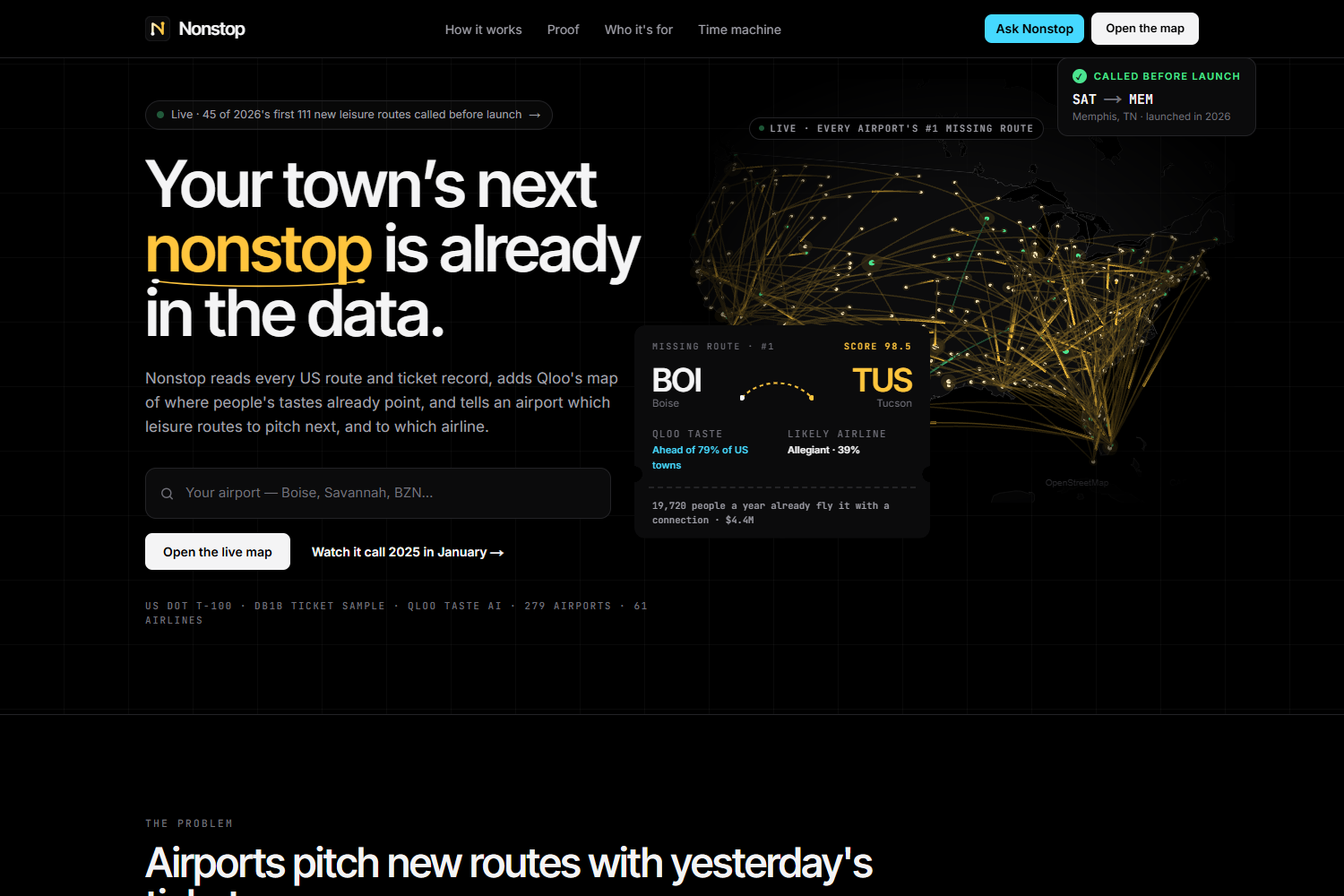
Nonstop tells an airport which leisure flights it is missing, which airline is most likely to fly each one, and writes the pitch.
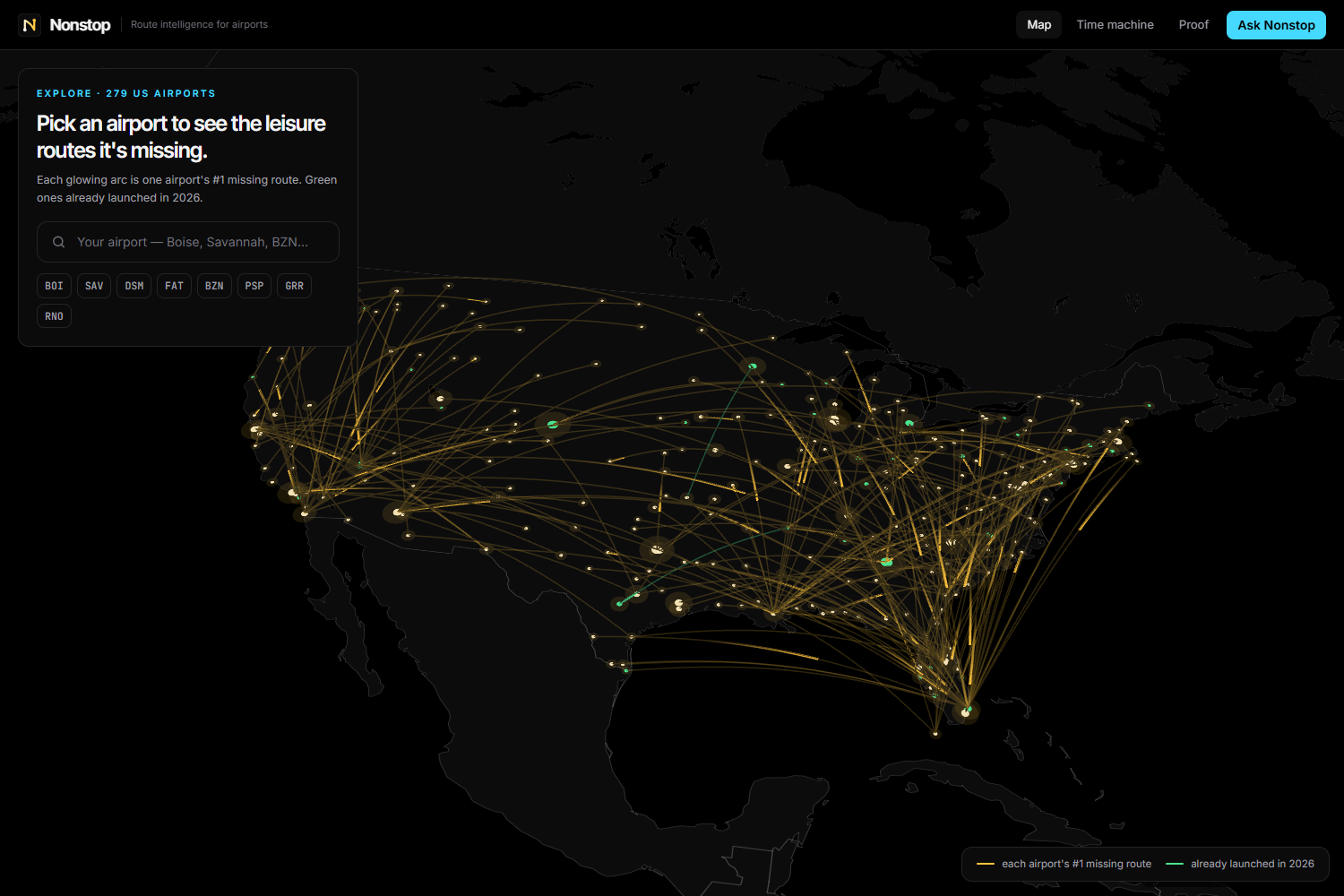
- Live national map: each of 279 US airports and its #1 missing leisure route.
- Airport view: a ranked list for every airport. Each route shows existing connecting demand and spend (DOT tickets), Qloo's taste map for the destination, why it ranks where it does, and the likely airline.
- Qloo, called live: "Re-check this live on Qloo" measures a route's taste figures again, right now.
- Ask Nonstop: an agent with seven tools, two of which call Qloo live (how any town feels about any place, and what an area loves right now). Every step it takes is shown.
- Route case: one click writes the document an airport sends to an airline network planner, built only from Nonstop's facts.
- Time machine and proof: the 2025 replay and the full backtest, in the open.
How we built it
- Data: US DOT T-100 (all 61 US airlines, every route, every month) to find each year's new routes; the DB1B 10% ticket sample for connecting demand and fares; OurAirports.
- Qloo: a US-wide taste heatmap (about 10,000 cells) for 158 leisure destinations; each origin airport gets its catchment affinity, its rank among all towns, and its preference against its own other options. Destinations are matched by coordinates, because name search is unreliable.
- Model: logistic regression trained on past leisure-airline launches, with distance, airport size, leisure carriers present, ticket demand, metro features and Qloo features. A matchmaker learns each leisure airline's habits.
- Agent: DeepSeek with tool calling over Nonstop's own functions plus live Qloo.
- App: FastAPI on Render; Next.js, deck.gl and MapLibre on Vercel.
Challenges we ran into
- Proving Qloo adds anything. Taste tracks distance, so we controlled for distance and ticket demand and tested on a later year the model never saw. Qloo's lift is real but modest (+0.0075 AUC, 90% CI +0.0014 to +0.0127), and we say so.
- Second airports. The model first picked Everett for Boise, but Seattle is already served. Metro features fixed it.
- Survival. Taste did not predict which routes survive, so Nonstop makes no survival claims.
- Qloo's data stays private. The public repo has code only, and the hosted app runs from a private data bundle.
Accomplishments that we're proud of
- Trained only on data up to December 2024, it had 96 of 2025's 191 new leisure routes in their airport's top 10 in January.
- In 2026 so far, 45 of 111 new leisure routes were called before they launched.
- Accuracy (AUC) 0.910 without Qloo, 0.918 with it, on routes it never saw.
What we learned
Taste is a real demand signal for leisure travel, strongest for leisure carriers and weakest for survival. Being honest about the limits made the product sharper.
What's next
A public, timestamped prediction ledger for 2026 to 2027 so anyone can check the calls, and working with a small airport on a real route pitch.
Built With
- deck.gl
- deepseek
- fastapi
- lightgbm
- maplibre
- next.js
- pandas
- python
- qloo
- react
- render
- scikit-learn
- tailwindcss
- typescript
- vercel


Log in or sign up for Devpost to join the conversation.