-
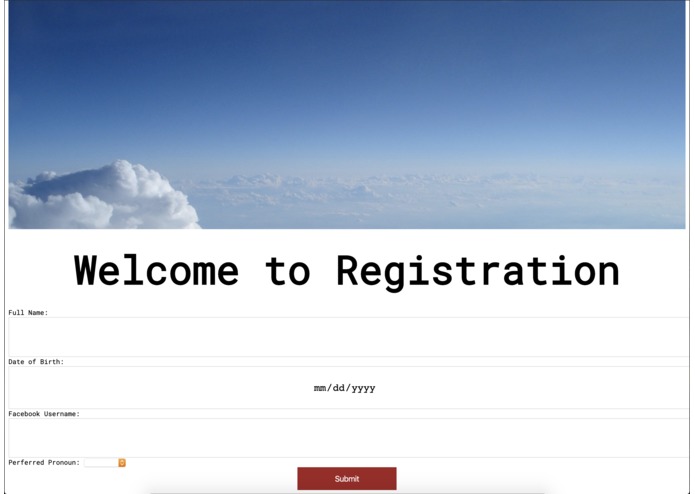
Screenshot Showing User Registration

Inspiration
Recently, there have been numerous reports depicting an increase in LGBTQ+ and non-binary hate-crimes, including individuals facing harassment or violence while walking on the street and while traveling. We wanted to be able to advocate for the LGBTQ+ and non-binary community while also building them a platform to meet new, likeminded people. In addition, to combat the fear of travelling, we generated a way for individuals to travel with other individuals to increase their comfort levels and decrease their travel anxiety.
What it does
Essentially, we created a travelling website for non-binary and LGBTQ+ individuals to use and travel the world together, forming new friendships and also establishing a safe and more comforting environment for them. When first accessing the website, users will be able to enter their information (name, birthday, what they identify as, and their Facebook username), three cities they wish to travel to, and what they enjoy doing. After they input this information, their information is stored into a database where our matchmaking takes place. Our matchmaker pairs users up based on age and dream destinations. After the dream destination is set, we coded a web-scraper to find the top things to do in that dream destination. We then reach back out to the matched users with a document, showing their Facebook information so they can reach out and chat through FB messenger, and also a document depicting the top things they can explore and experience together.
How we built it
Half of our team worked on the front-end web development while the other half worked on the back-end. The front-end team used HTML, CSS, JS, and PHP to develop the website. HTML was used to provide the basic layout of the website, by allowing us to create input fields so that we may take in necessary user information that would be crucial for matching people up. But because HTML is just essentially a markup language we had to add some features that allowed us to actually manipulate the data in a manner that would allow the back-end team to use said data, that’s where JS and PHP came in where JS is where we performed much of the formatting and error checking for inputs, and PHP is what would create the output file that the backend team would end up using. Once we had a bit more free time or whenever we felt stuck we took the time to try and make the website more presentable through the use of CSS and it’s styling features. The back-end team used a variety of programs to create the matchmaking and web-scraping software. We coded primarily in Python and used several libraries such as Selenium and Beautiful-Soup.
Challenges we ran into
Many of us had to learn a bunch of items in a short period of time. The front-end team had to learn how to write to an adjacent file in order to communicate with our back-end. This ate a lot of our time because we had to learn PHP and AJAX, which neither one of our front-end developers had used before. The back-end team had to figure out how to use Selenium to be able to find a list of the top things to do in a certain location, according to the users’ interests. Our toughest challenge however, was finding a way to integrate front-end and back-end.
Accomplishments that we're proud of
We are proud that our website functions and is able to match individuals with similar interests and travel destinations together.
What we learned
We learned how to use a variety of languages, including HTML, CSS, JS, and libraries, including Selenium and beautiful-soup. This was a very meaningful learning experience as we can see ourselves utilizing the languages and libraries we learned in this hackathon to future projects. In addition, we also experienced personal growth in regards to overcoming challenges.
What's next
In the future, we hope to work on making our website global. Currently, it only serves those residing in the US, however, the scalability of our project is very plausible, and with just a little more research and time, we will be able to make it accessible worldwide. To add to the user experience, we will incorporate a calendar API to help our users plan out their travel days easier and get more advanced travel matches based on compatible schedules. We would also like to include a social media aspect, so that travelers can share their experiences.


Log in or sign up for Devpost to join the conversation.