-
-
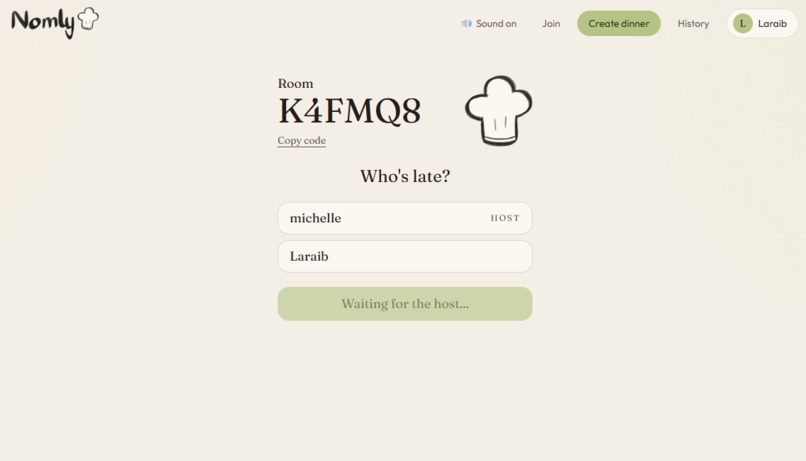
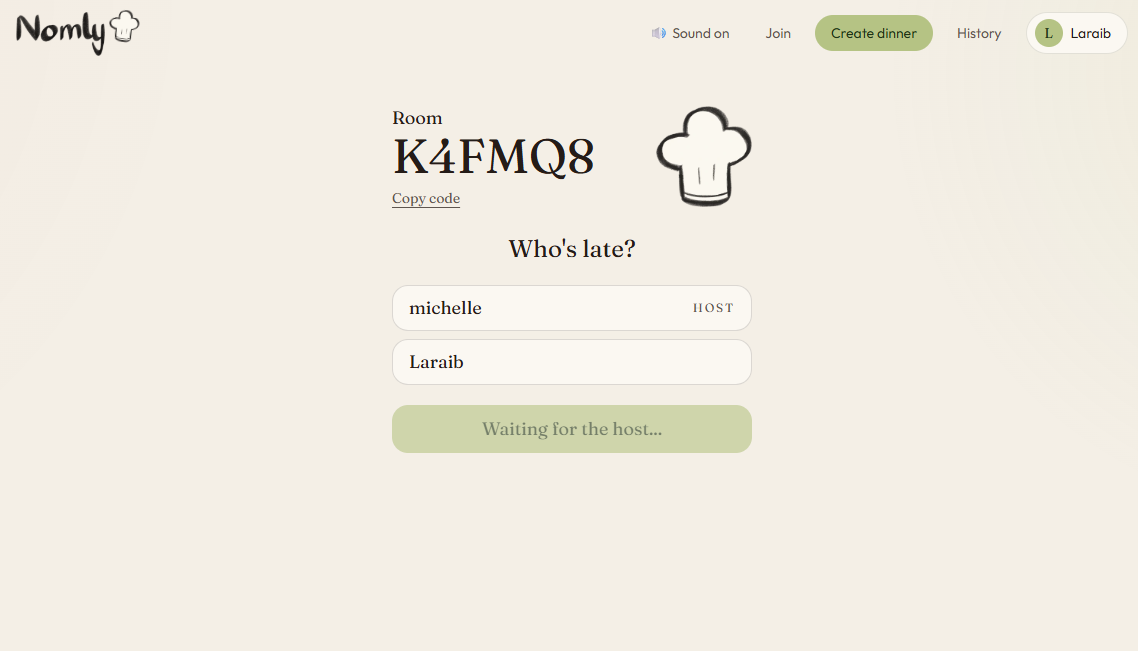
Lobby
-
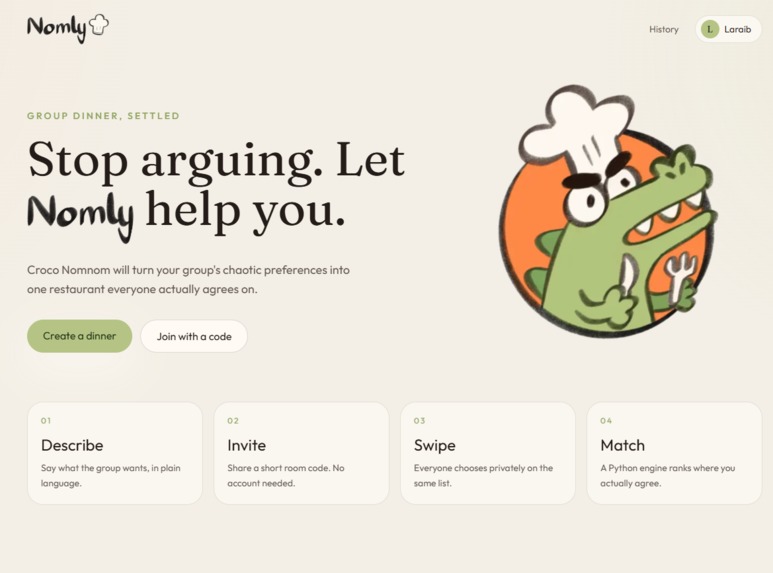
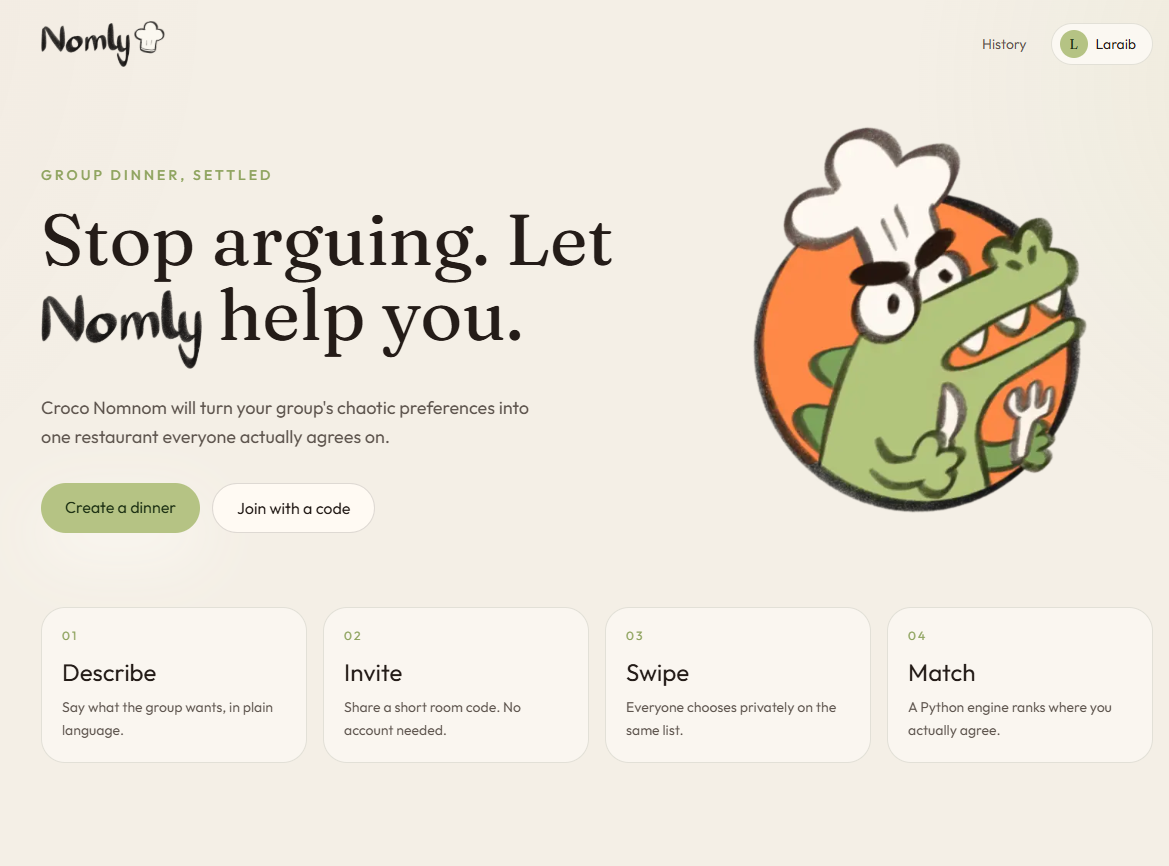
Home Page
Inspiration
Do your plans never seem to leave the group chat?
We’ve all experienced the same frustrating question: “Where should we eat?” What sounds simple quickly turns into a group chat full of conflicting preferences, budgets, dietary restrictions, and endless restaurant links.
Most restaurant apps are built for one person making the decision. We wanted to build something different: a restaurant discovery experience designed around the group.
Nomly was created to turn the debate into a collaborative experience where everyone gets a voice, while still making it possible to actually reach a decision.
What it does
Nomly helps groups find a restaurant that everyone can get behind. One person starts a dinner session by describing what the group wants in plain English, such as: “Five students looking for somewhere cheap around Burnaby, preferably Japanese or Korean, casual, and vegetarian-friendly.”
Nomly uses Gemini AI to understand that request and turn it into structured search preferences. Group members then join the session using the session join code on their device and swipe through the restaurant options independently.
Nomly looks for overlap between everyone's preferences, rather than simply recommending restaurants to one person.
It also accounts for important constraints such as dietary restrictions, budget, location, and group preferences, helping the group move from “Where should we eat?” to “Let's go here.”
How we built it
Nomly combines an AI-powered intent layer with restaurant discovery and group matching.
- AI intent parsing converts natural-language dinner requests into structured preferences.
- Restaurant search finds candidates matching the group's hard constraints.
- Login and signup pages let users create an account and return to their dinners.
- A personal dashboard shows restaurants, past dinners, and session details in one place.
- Group sessions allow friends to participate from their own devices through a shared session.
- Collaborative swiping captures individual preferences without requiring everyone to make decisions together on one screen.
- Group matching identifies restaurants where preferences overlap.
- Explainable recommendations help answer the question: “Why did Nomly choose this place?” Our goal was to keep the experience simple for users while handling the complexity behind the scenes.
Challenges we ran into
The biggest challenge was realizing that group recommendations are fundamentally different from individual recommendations. A restaurant can be perfect for one person but terrible for the group. We had to think about how to combine different preferences without allowing the loudest or most enthusiastic person to dominate the decision. We also had to distinguish between hard constraints and soft preferences. Something like a nut allergy needs to eliminate a restaurant, while something like “I'd prefer Japanese” should influence the ranking without necessarily eliminating everything else. Another challenge was making AI useful without letting it become unpredictable. Instead of having the AI directly choose restaurants, we use it to understand what the user means and convert that intent into structured parameters that our matching system can work with.
Accomplishments that we're proud of
We're proud that Nomly isn't just another AI wrapper around restaurant search. We built the experience around a problem people actually encounter: making a decision as a group. We're especially proud of:
- Turning messy natural-language requests into structured dinner preferences.
- Designing Nomly around multiple users making independent decisions.
- Combining individual preferences into a meaningful group recommendation.
- Treating dietary restrictions and other important requirements as hard constraints.
- Creating an experience that is quick, social, and fun rather than another endless restaurant-search page. Most importantly, we built something that we would genuinely use ourselves.
What we learned
We learned that building a good AI product isn't necessarily about giving an LLM more control. In Nomly, AI is most useful when it handles the part humans are bad at—translating messy language into structured intent—while deterministic logic handles important decisions such as constraints and group matching. We also learned that designing for multiple users introduces an entirely different set of problems. A recommendation isn't successful because one person likes it; it's successful when the group can agree on it.
What's next for Nomly
Nomly is just the beginning. Next, we want to make group decisions even smarter and fairer by introducing features such as:
- Vibe matching using restaurant reviews to understand things like casual, quiet, lively, date-night, or student-friendly atmospheres.
- Meet-in-the-middle travel time, finding restaurants that are convenient for everyone rather than simply choosing the center of a map.
- Better personalization as Nomly learns each user's preferences over time.
- More details on restaurant cards, such as ratings, prices, the menu, etc.
Ultimately, we want Nomly to become the easiest way for a group of people to answer one deceptively difficult question: “Where should we eat?”


Log in or sign up for Devpost to join the conversation.