-
-
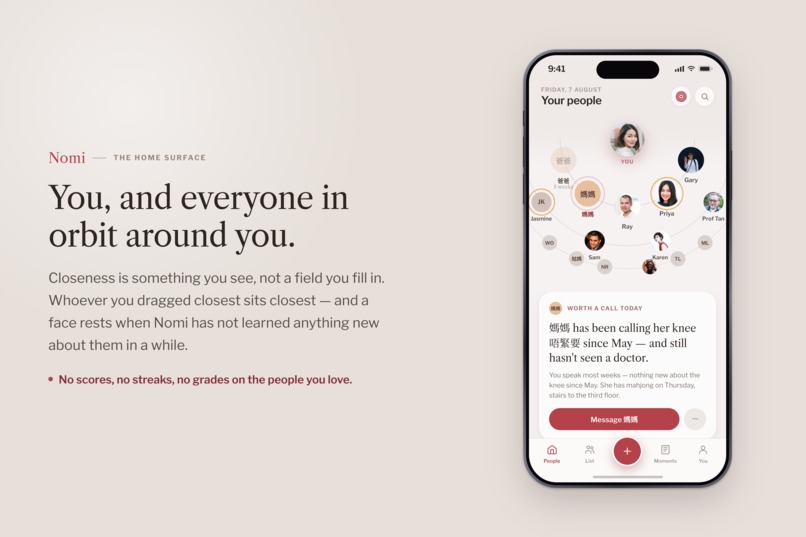
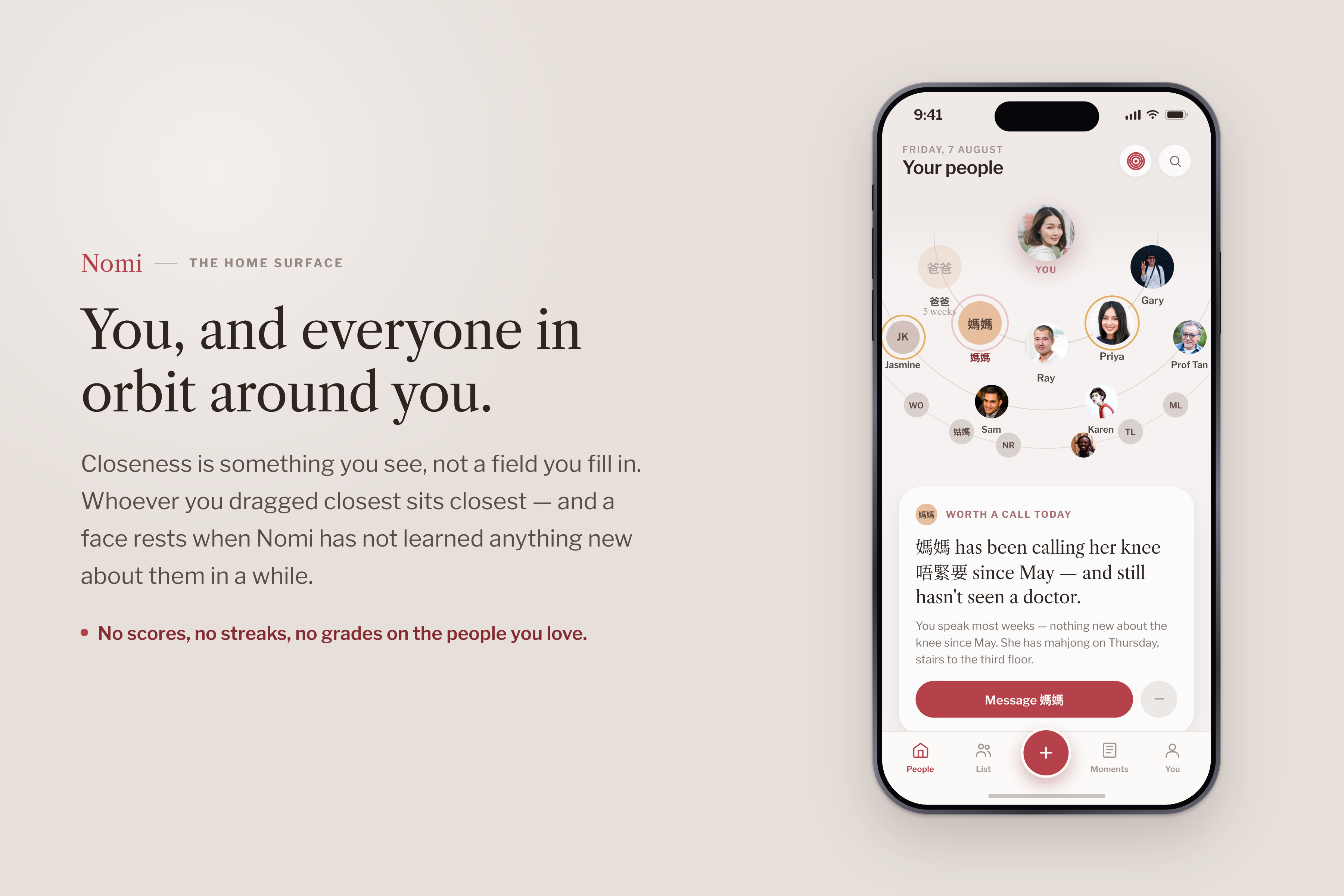
The home surface: You, and everyone in orbit around you.
-
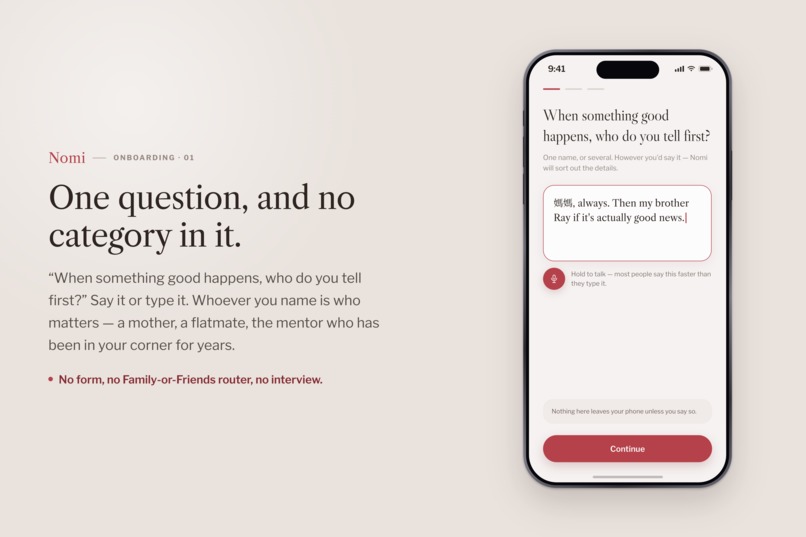
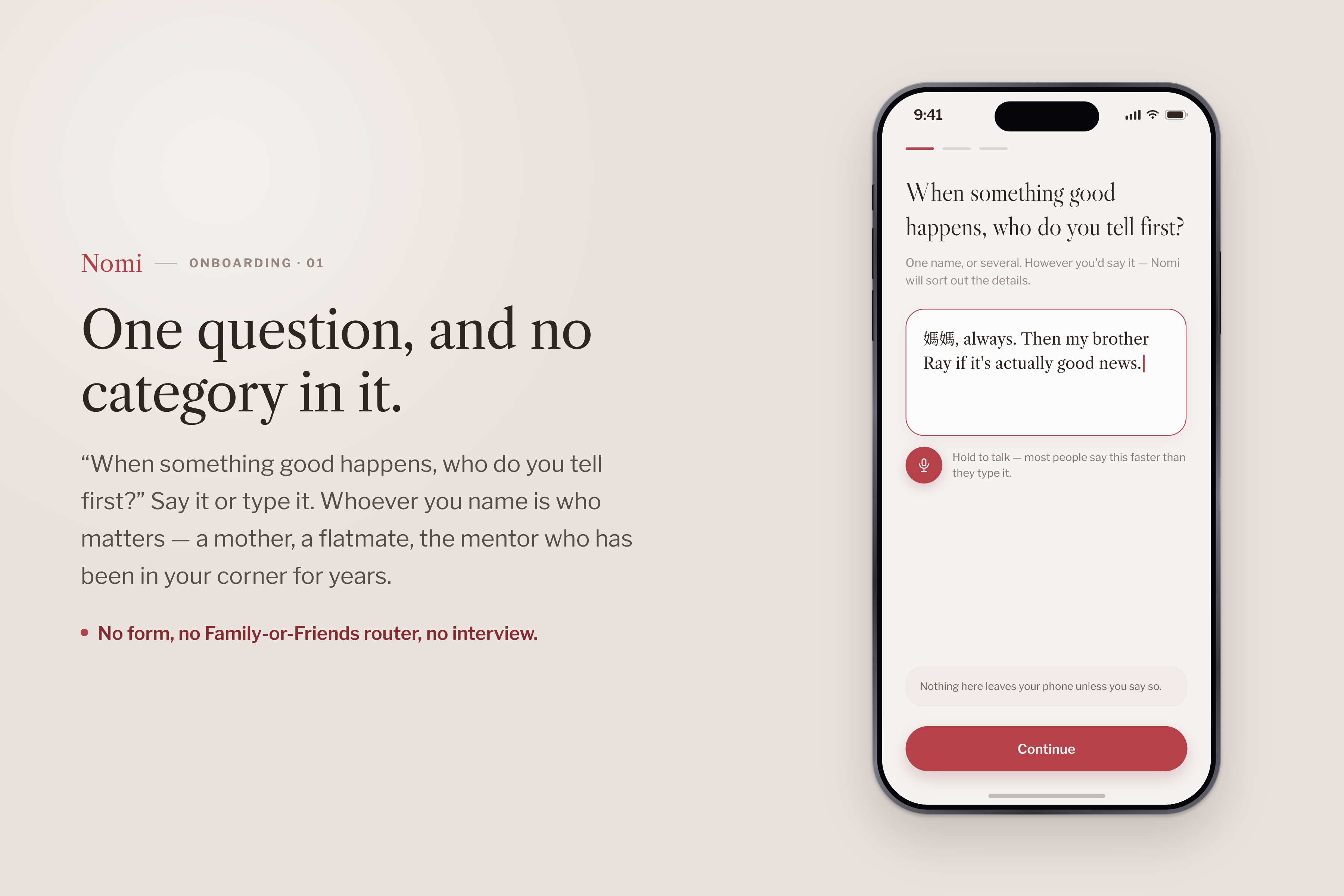
Onboarding · 01: One question, and no category in it.
-
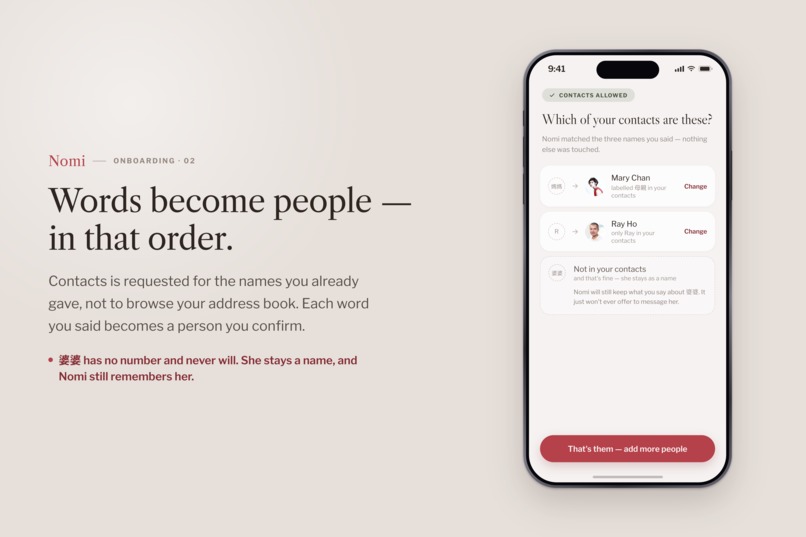
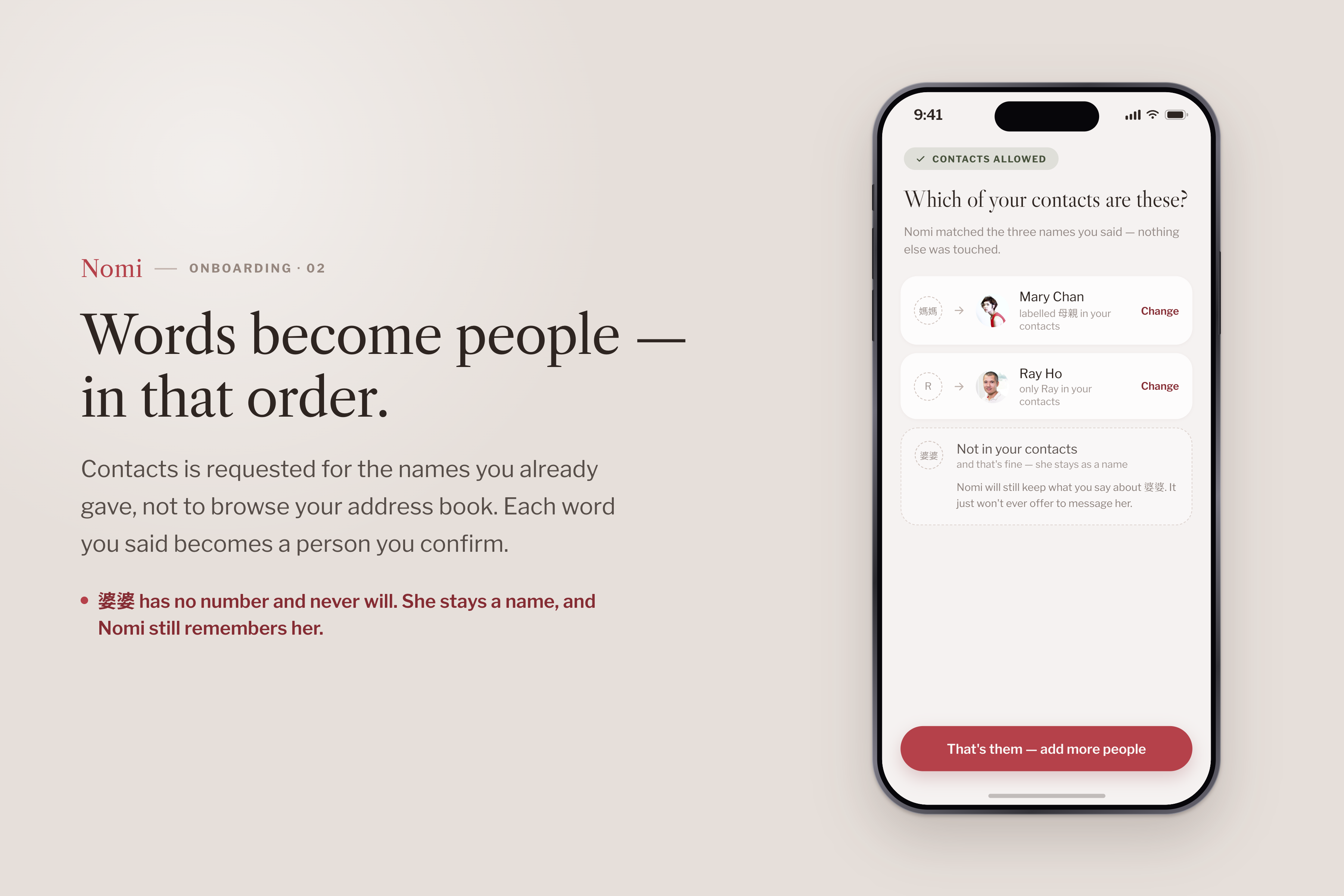
Onboarding · 02: Words become people — in that order.
-
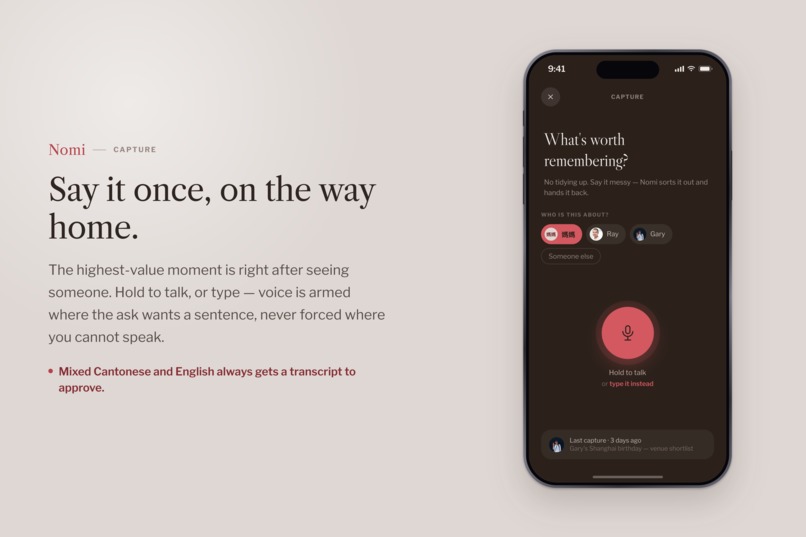
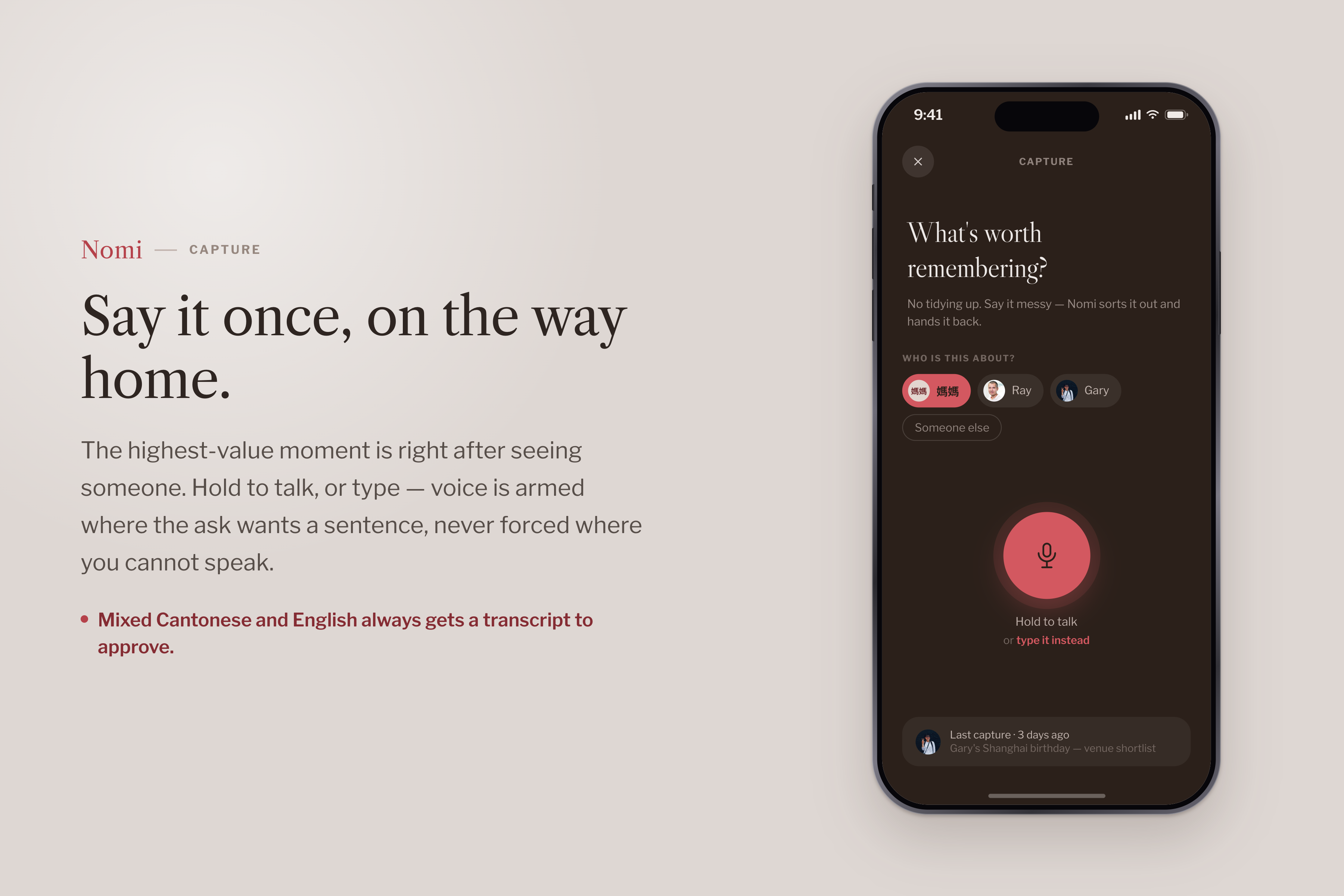
Capture: Say it once, on the way home.
-
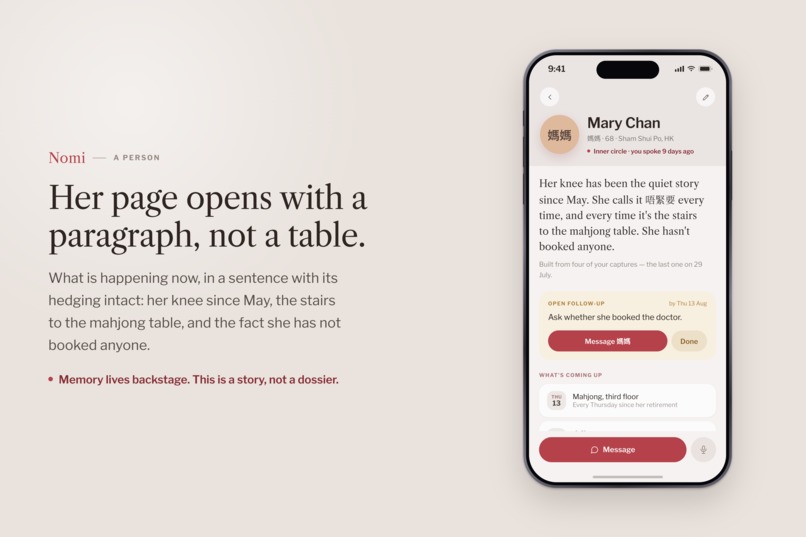
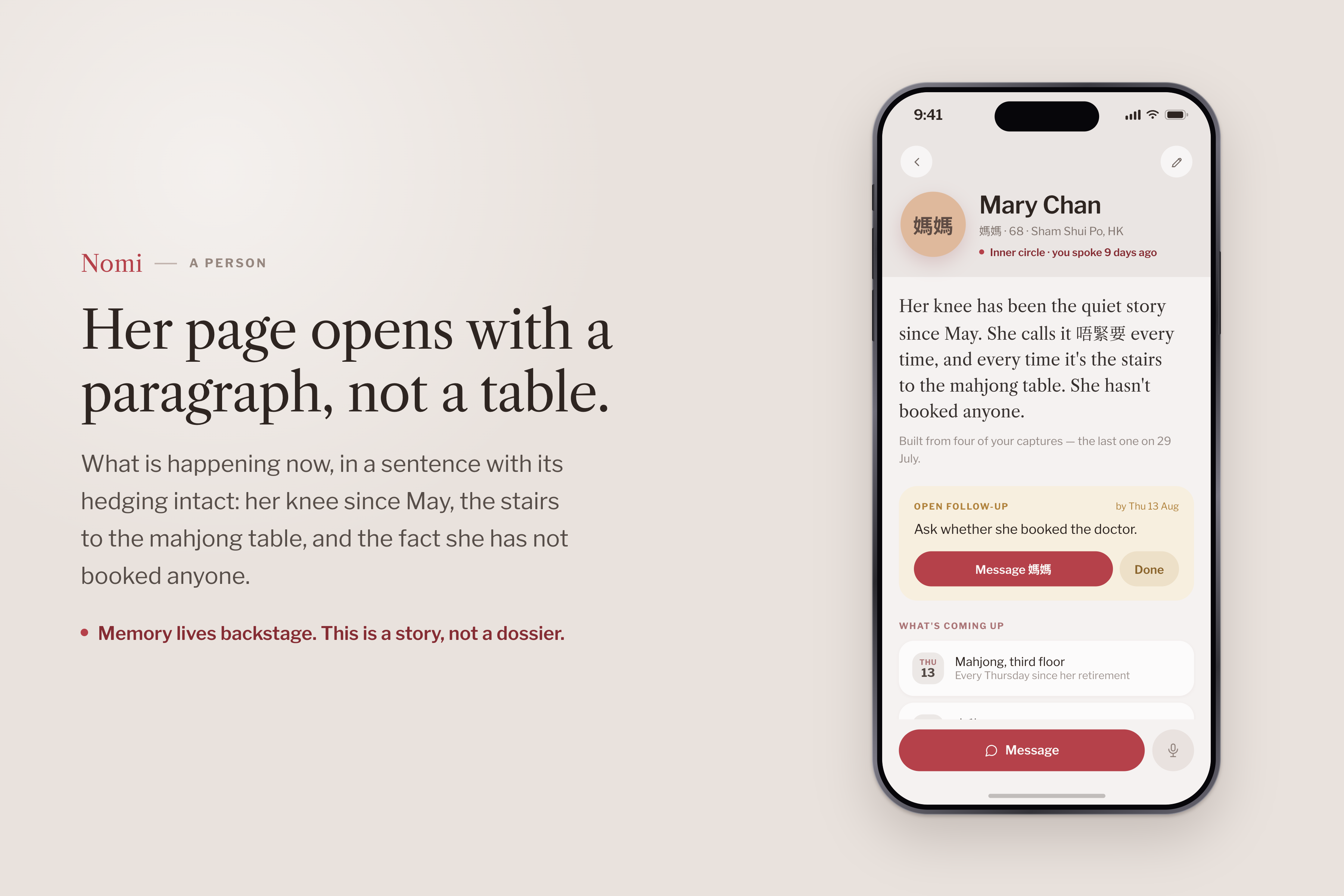
A person: Her page opens with a paragraph, not a table.
-
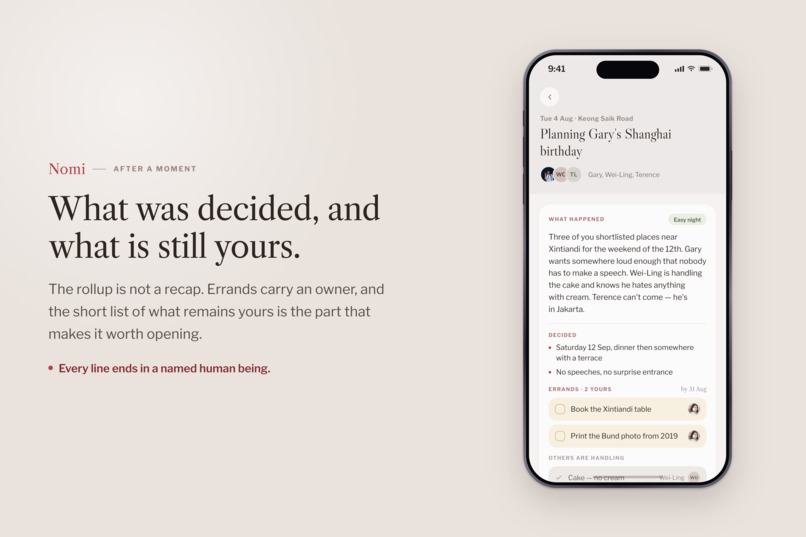
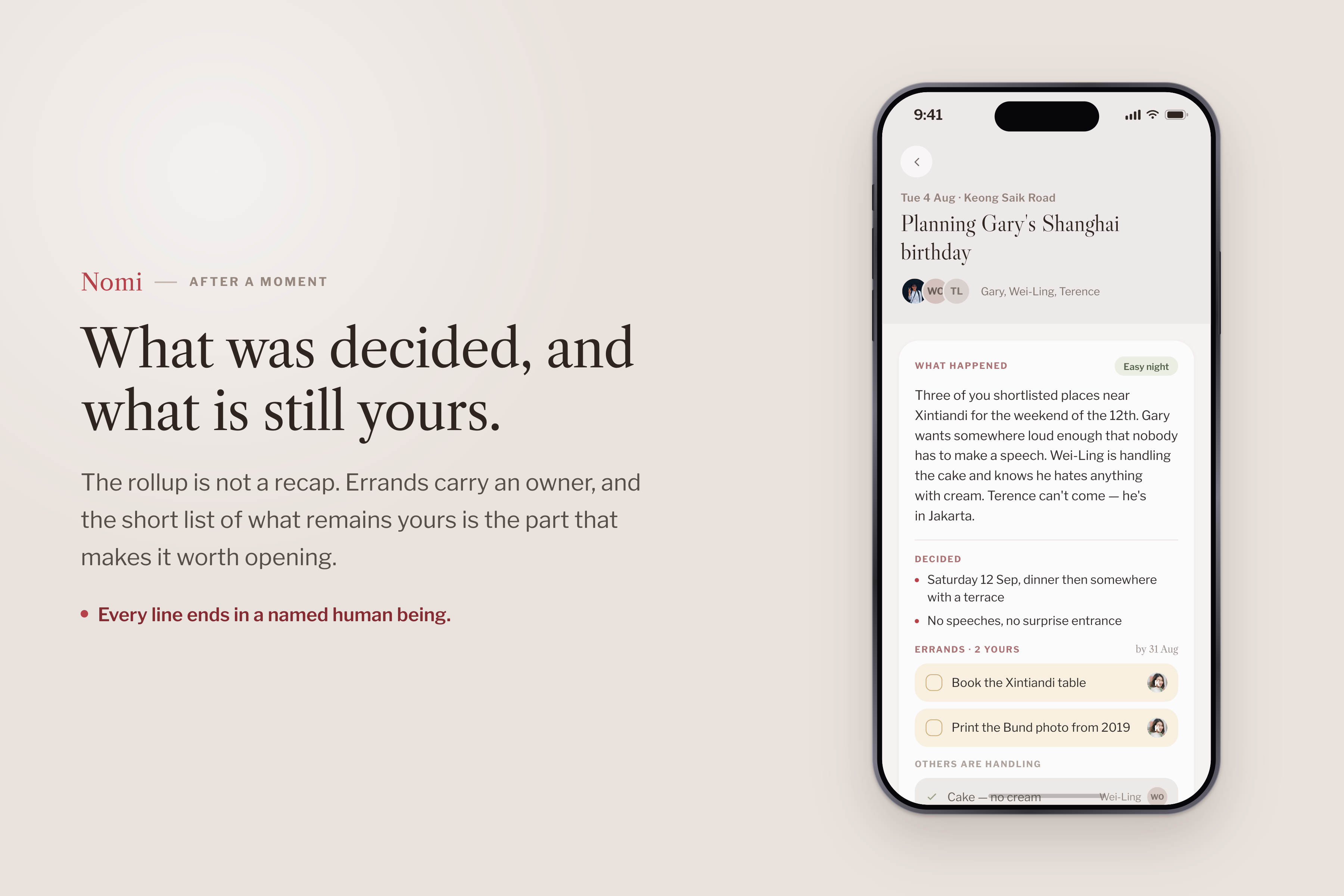
After a moment: What was decided, and what is still yours.
-
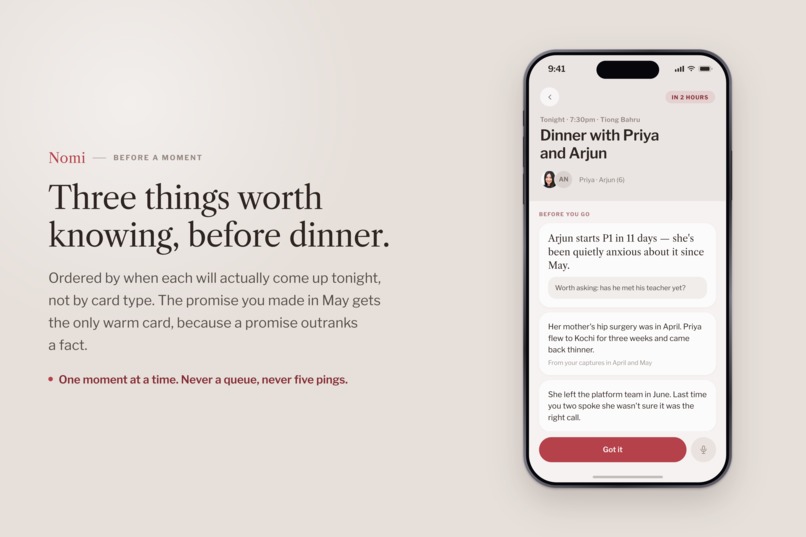
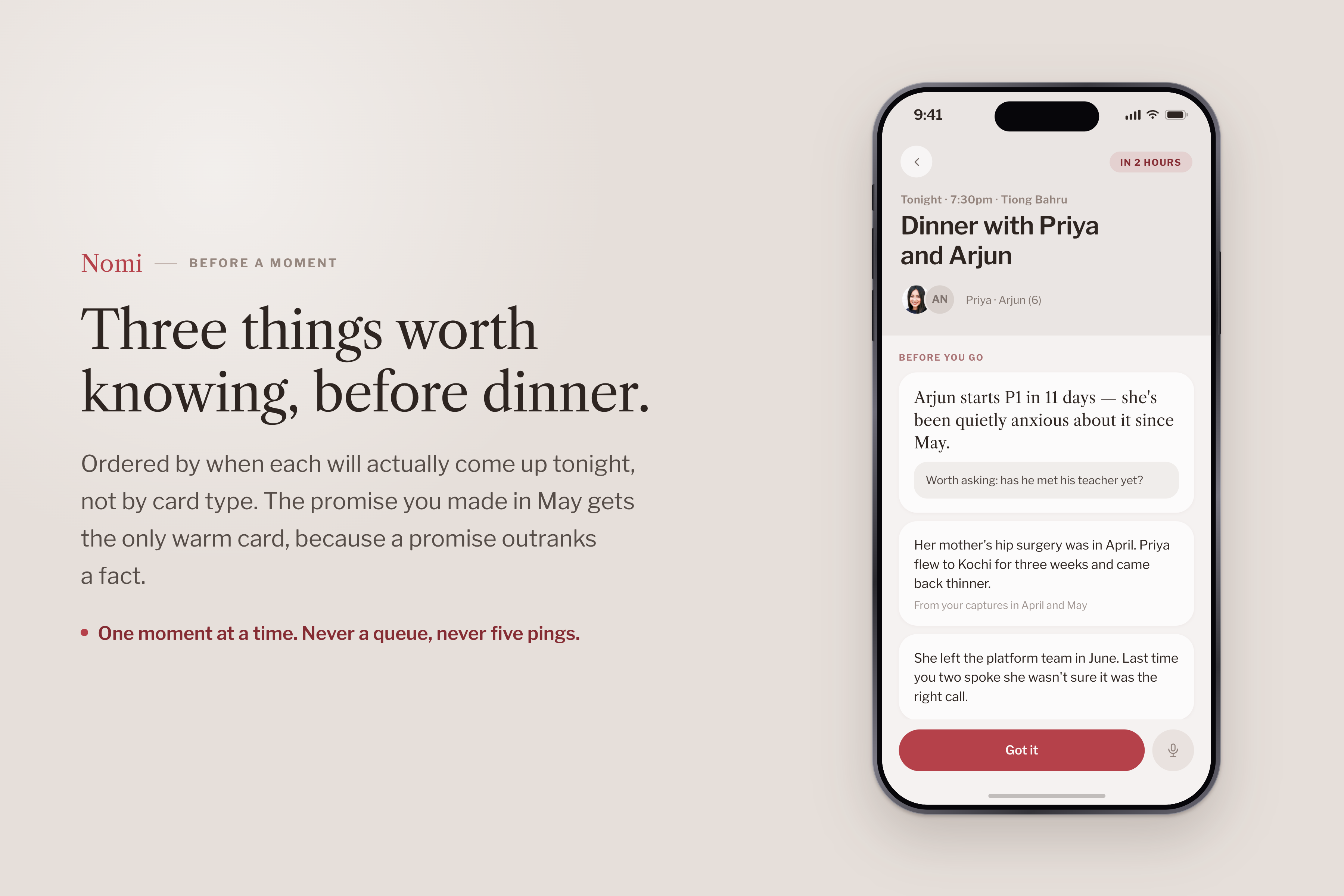
Before a moment: Three things worth knowing, before dinner.
-
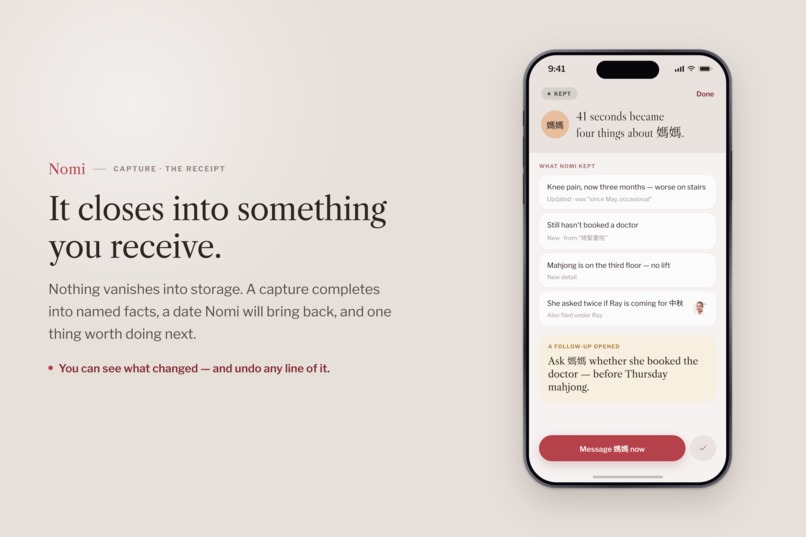
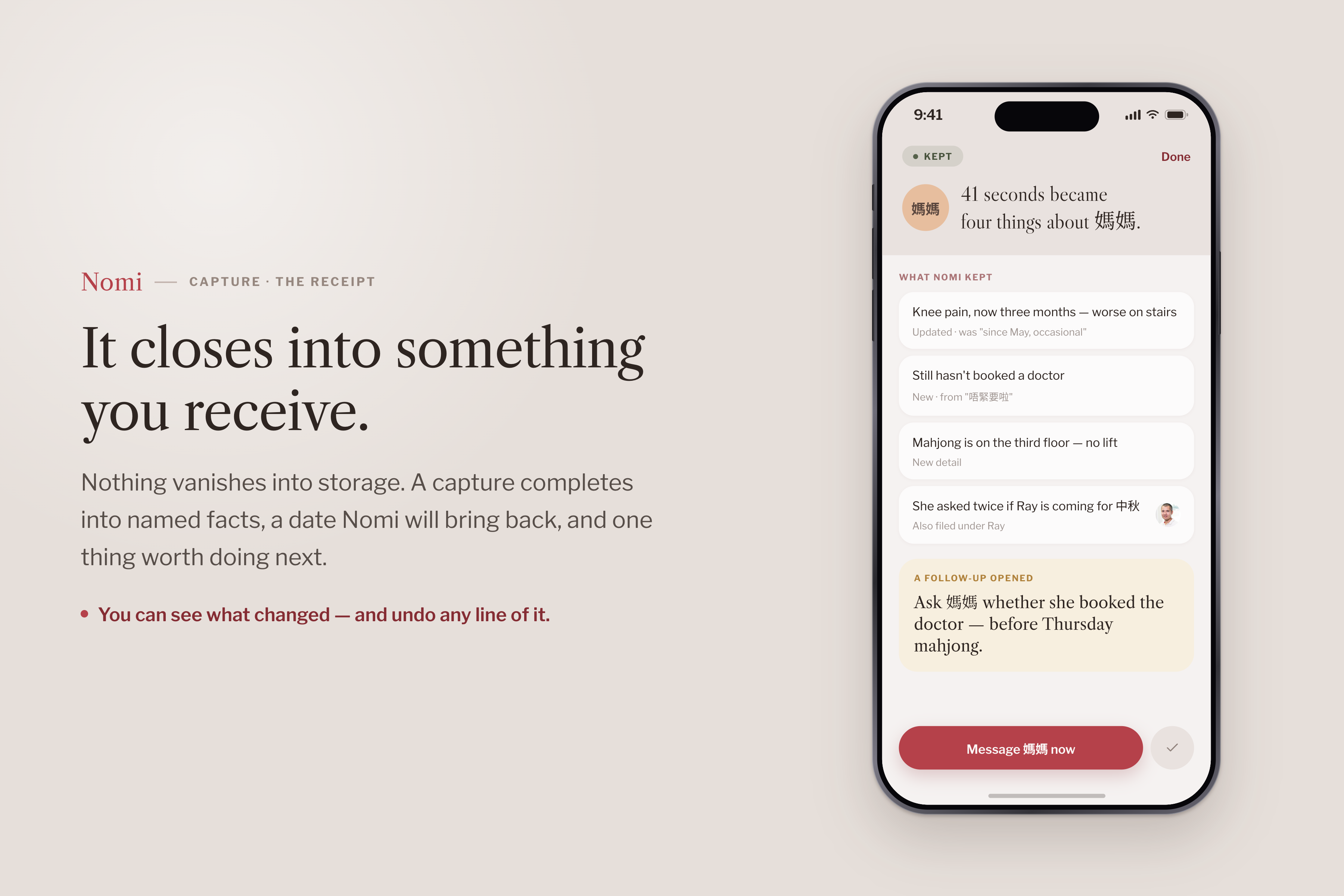
Capture · the receipt: It closes into something you receive.
-
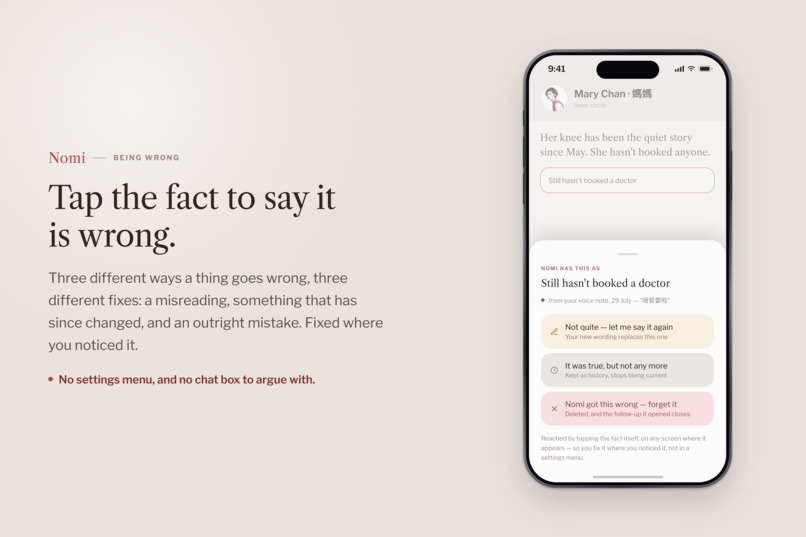
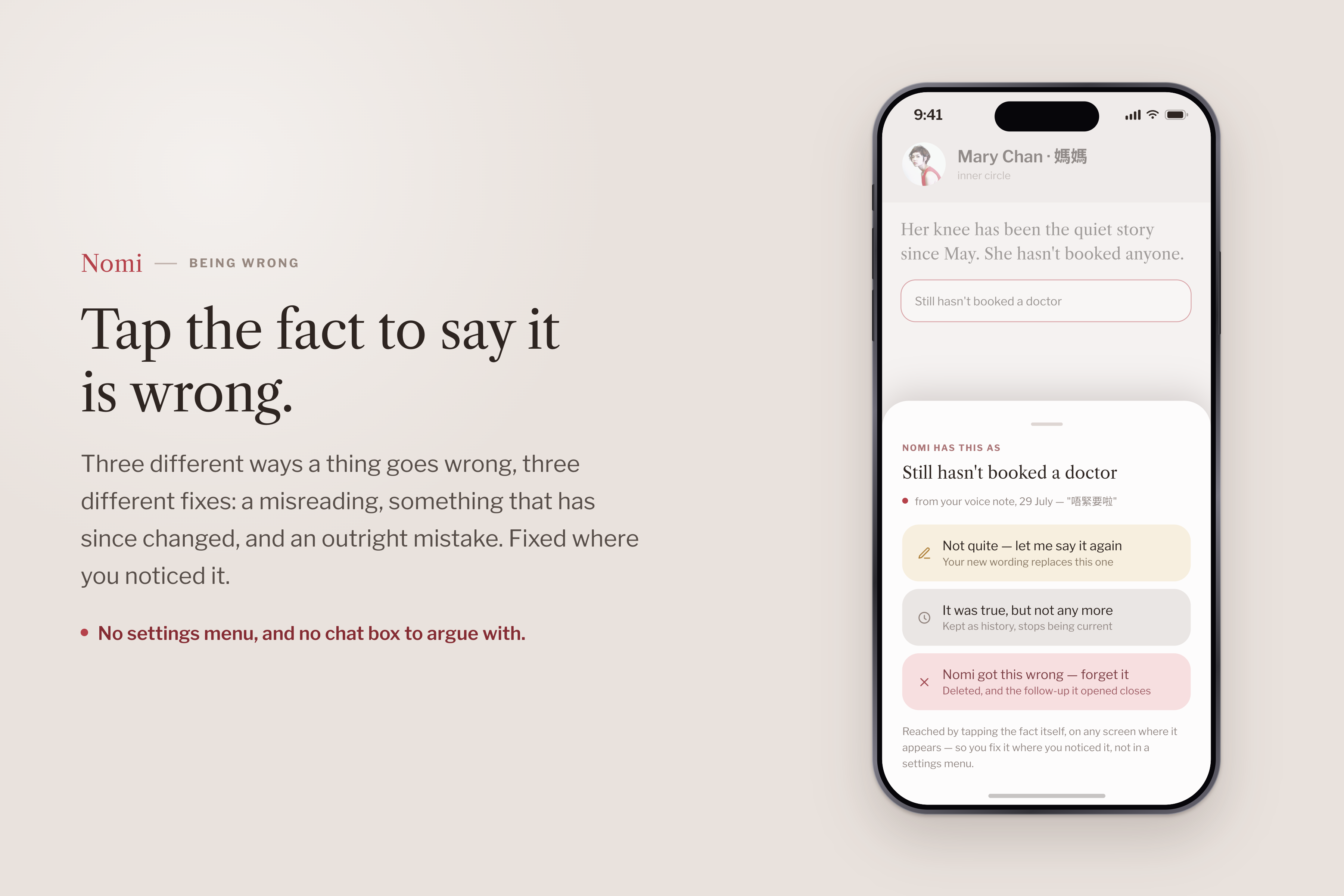
Being wrong: Tap the fact to say it is wrong.
-
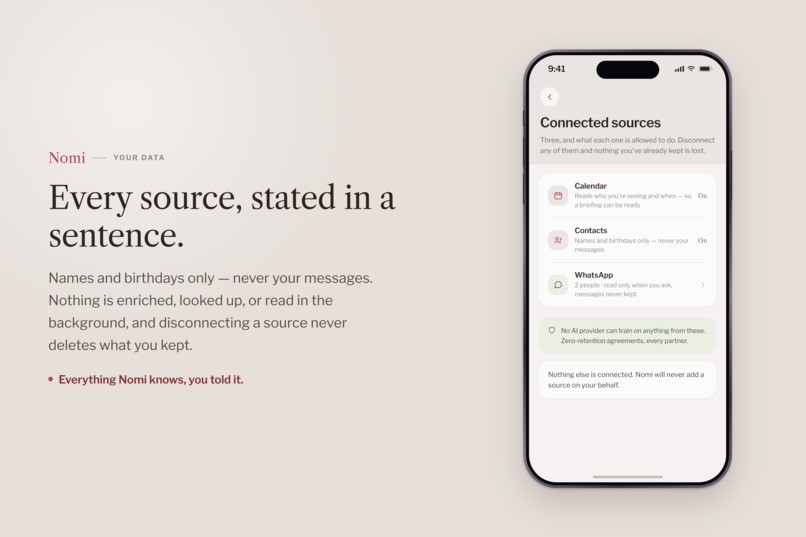
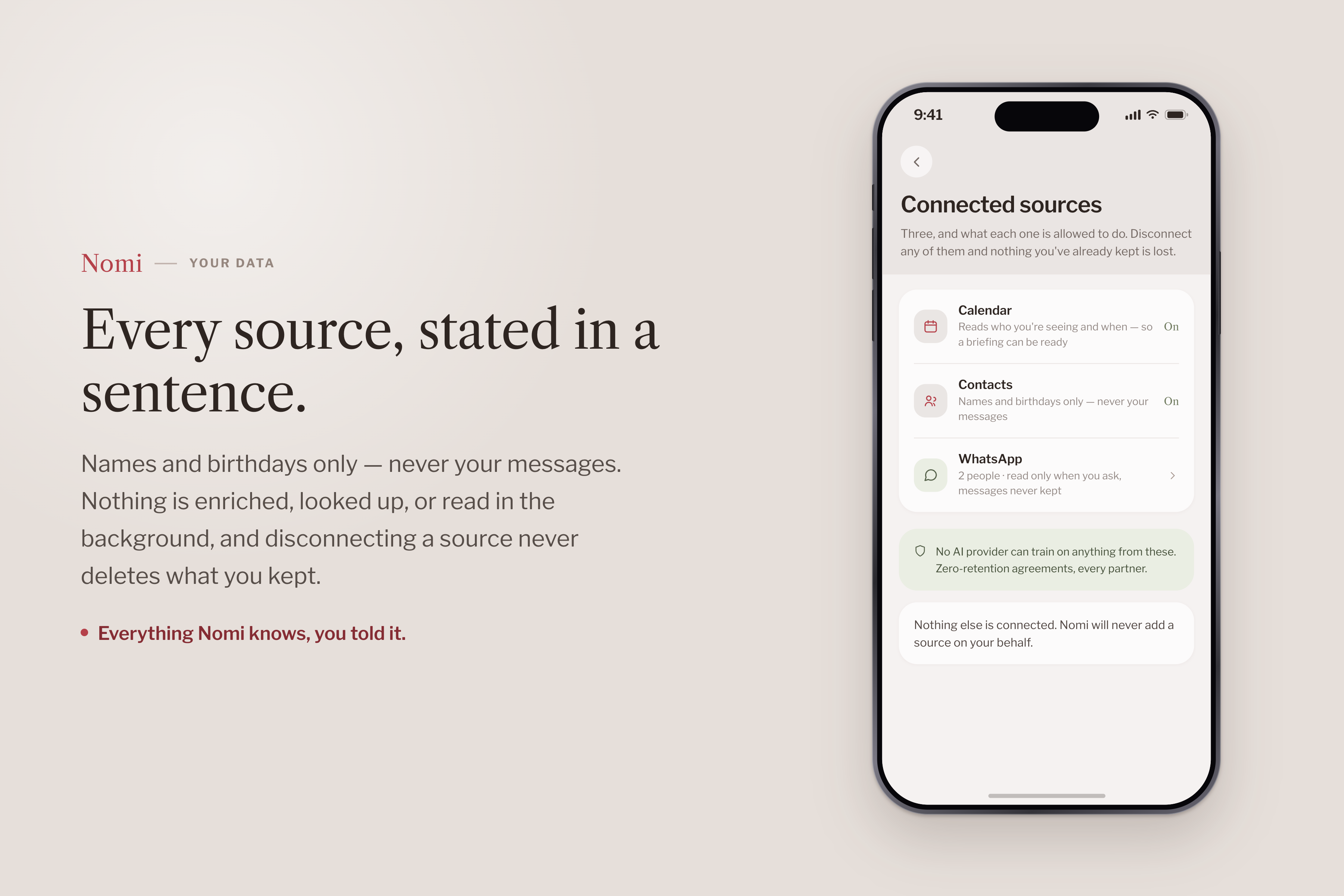
Your data: Every source, stated in a sentence.
-
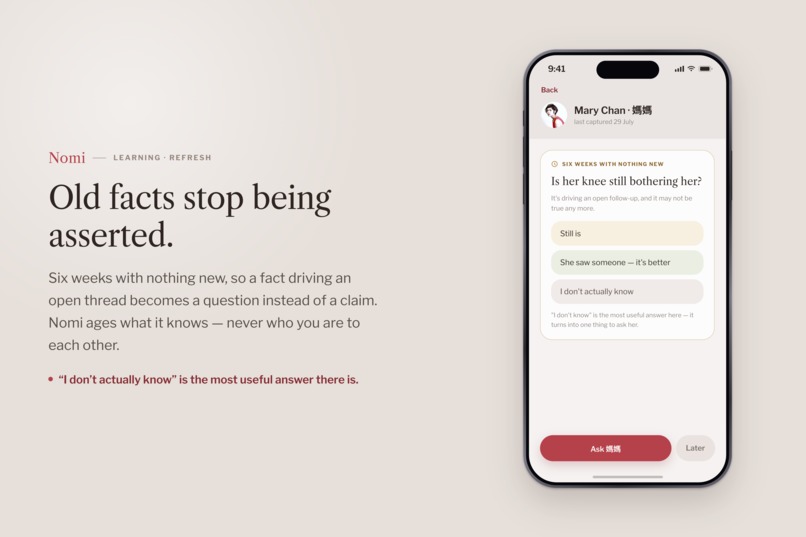
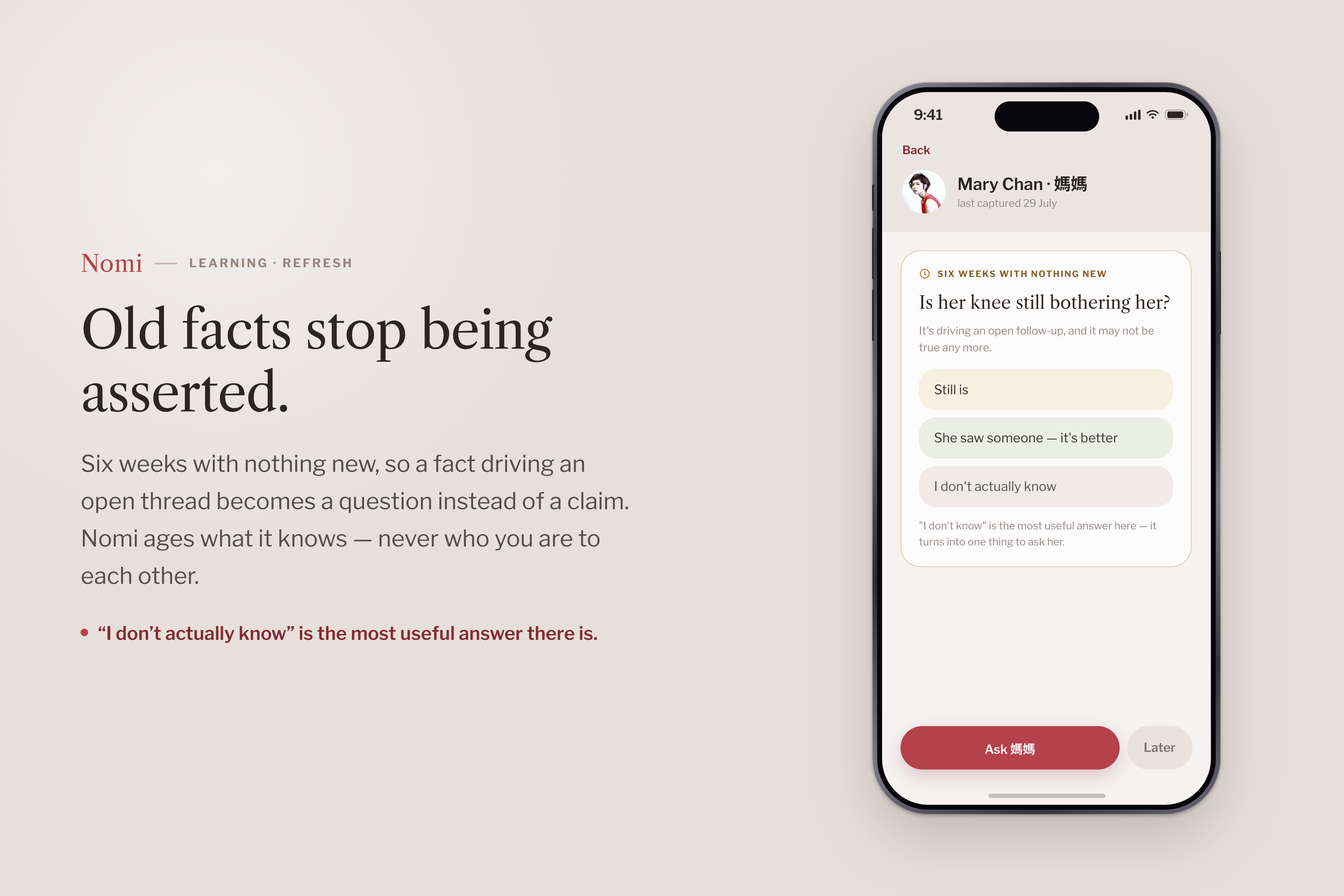
Learning · refresh: Old facts stop being asserted.
-
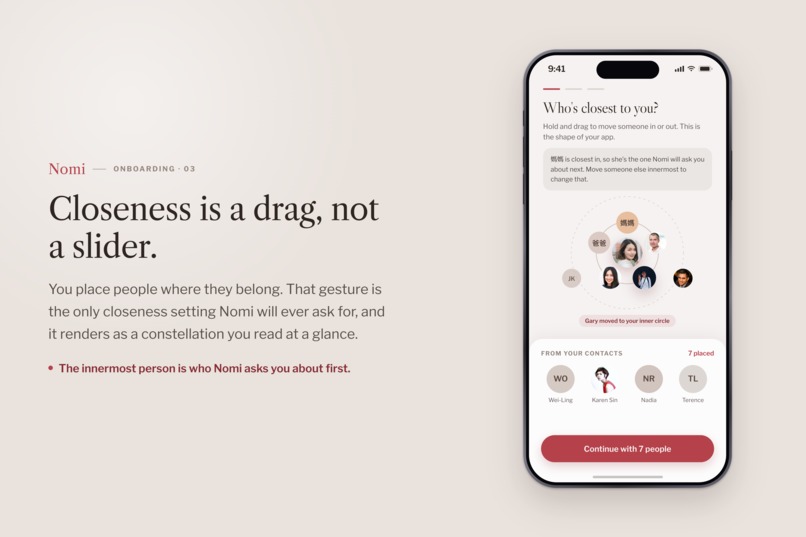
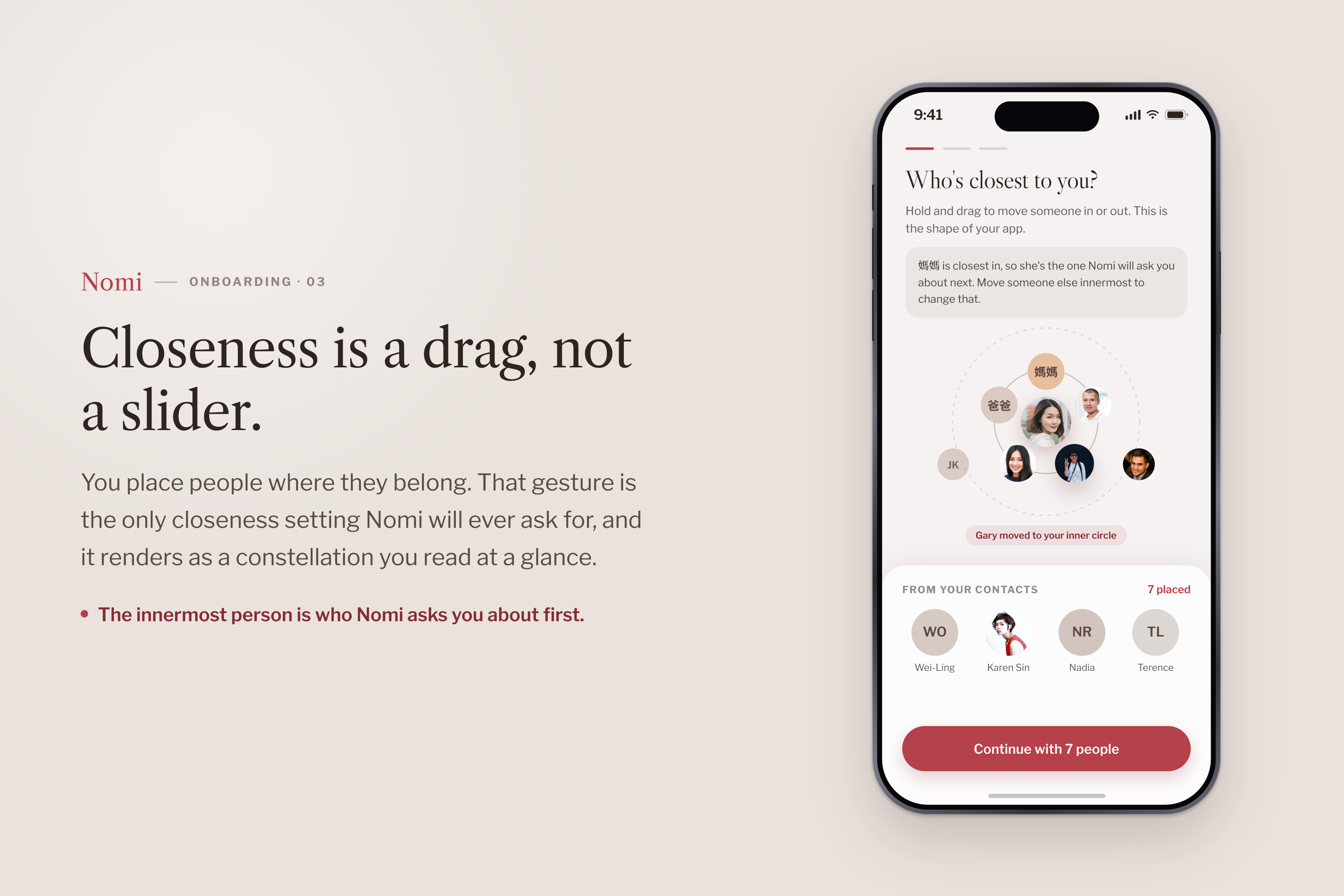
Onboarding · 03: Closeness is a drag, not a slider.
-
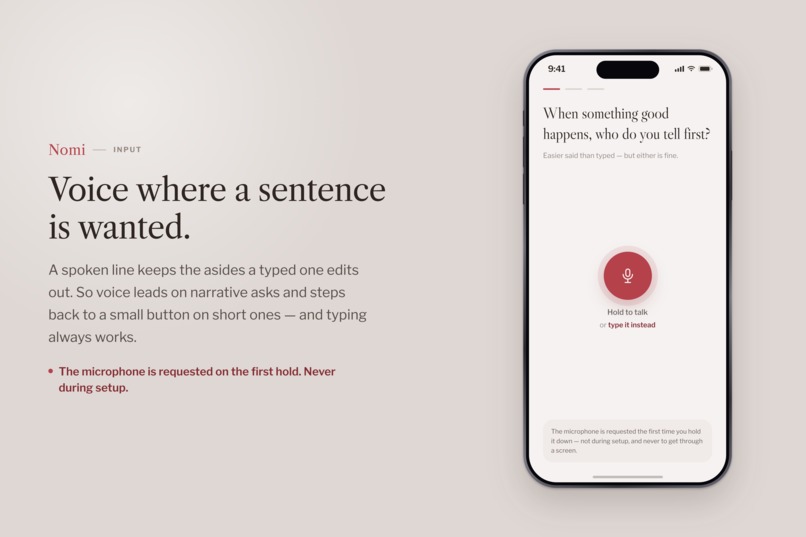
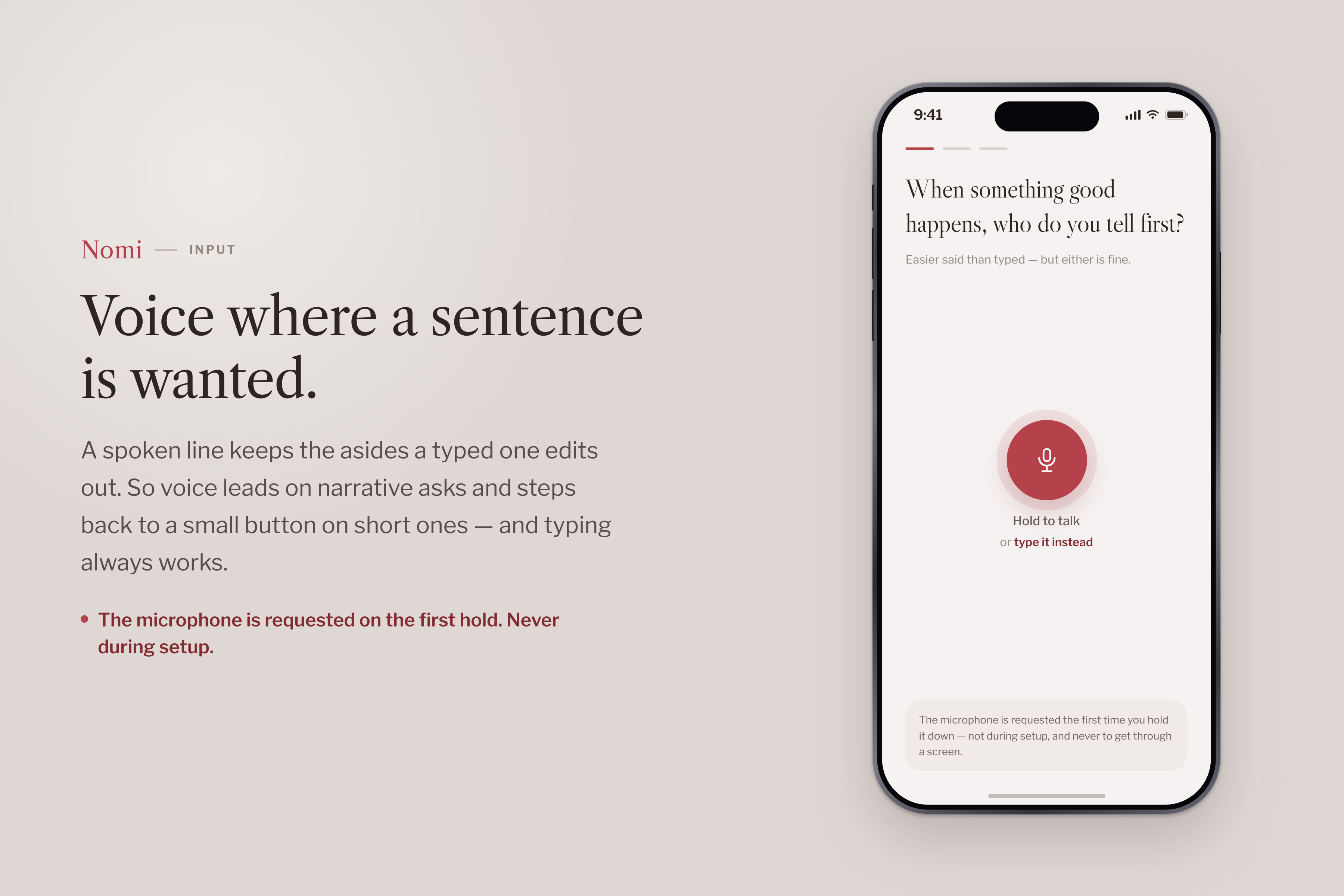
Input: Voice where a sentence is wanted.
-
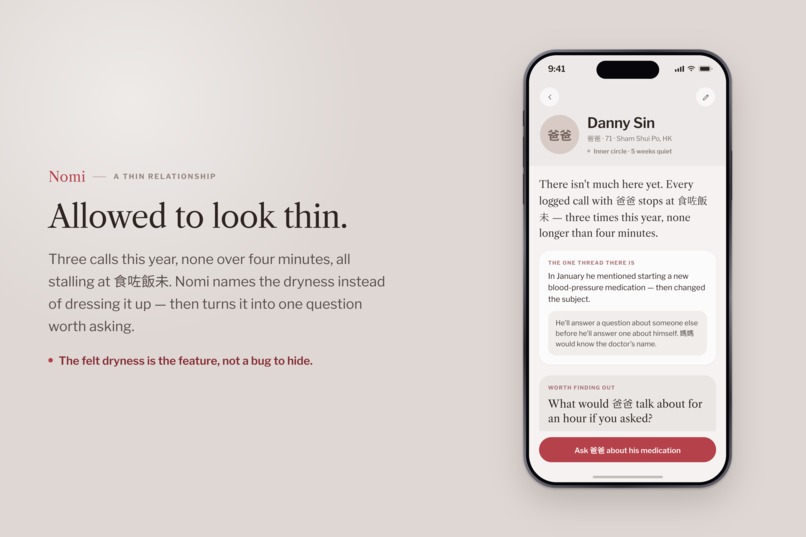
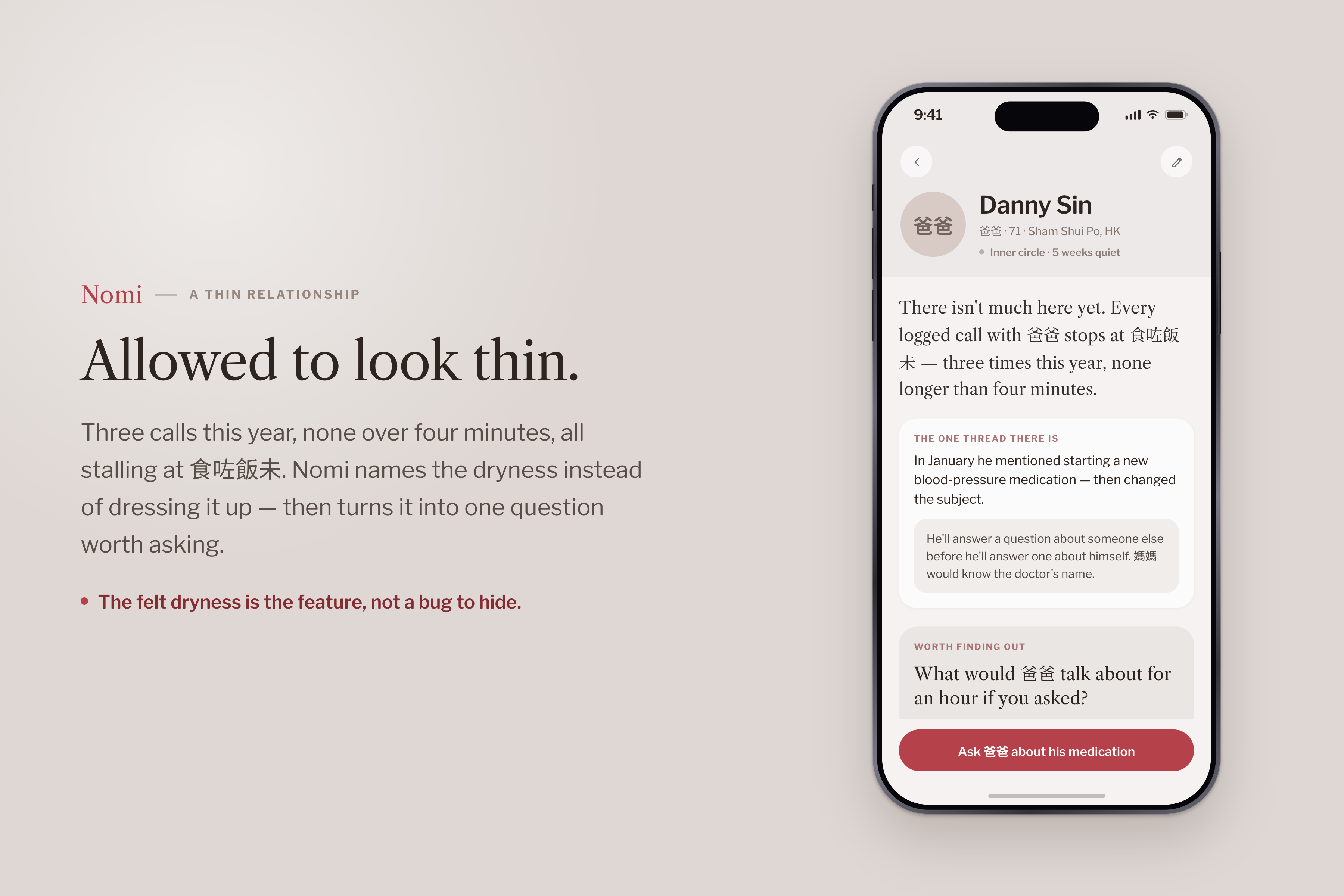
A thin relationship: Allowed to look thin.
-
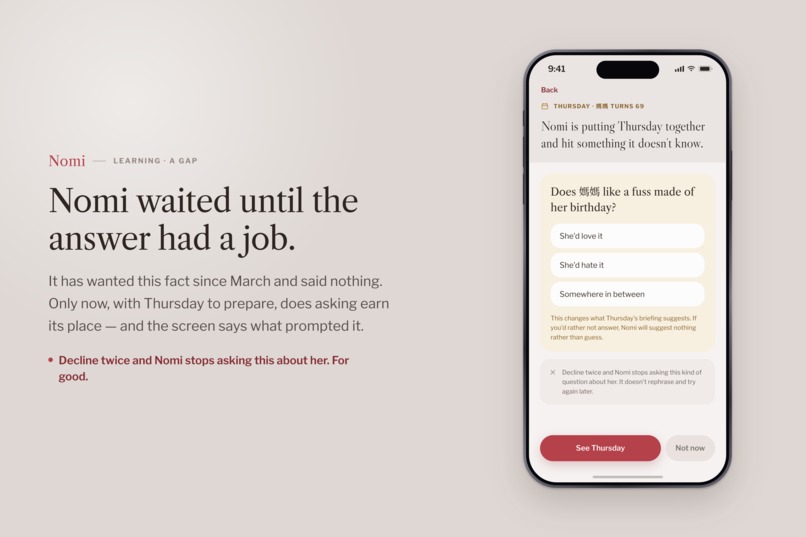
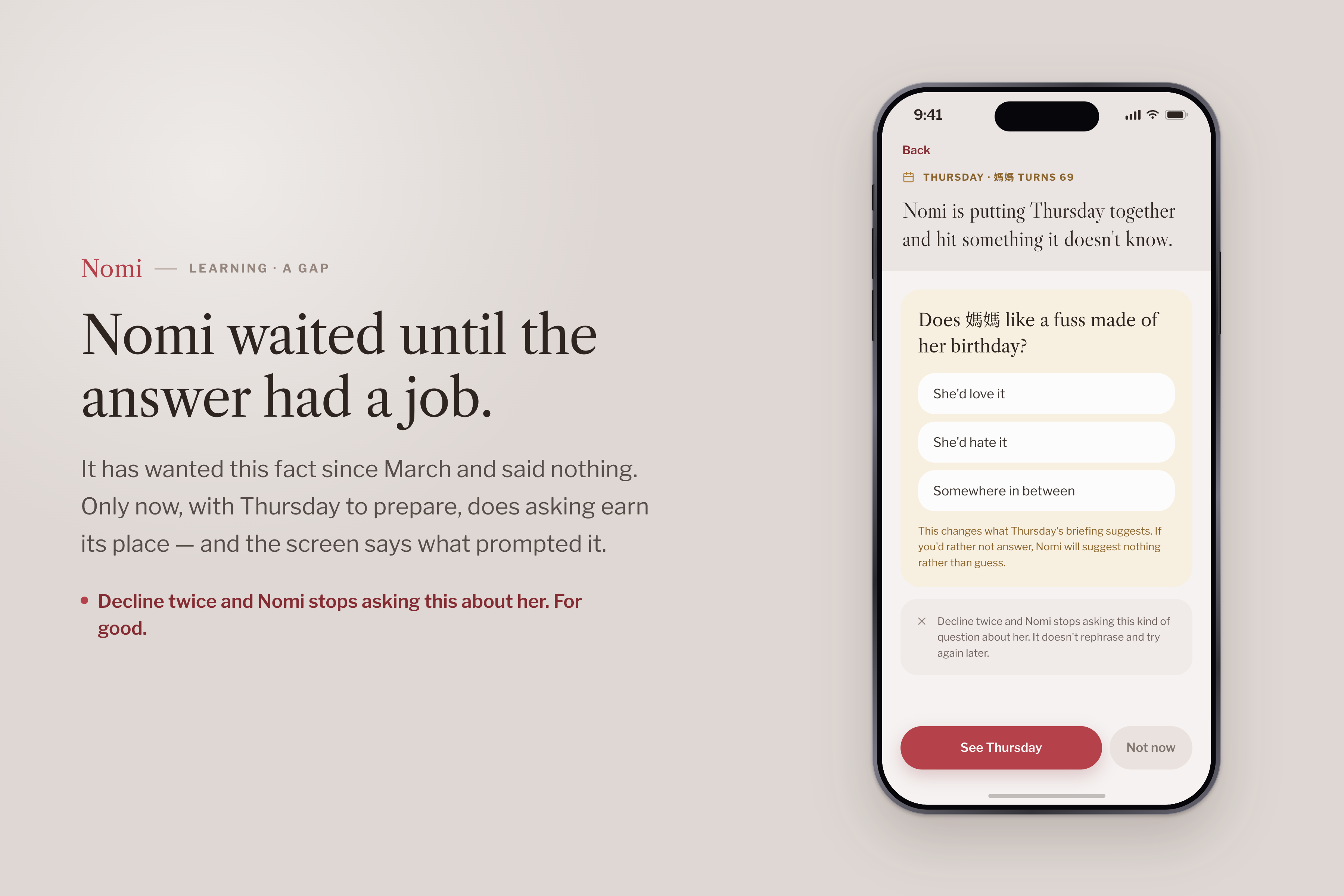
Learning · a gap: Nomi waited until the answer had a job.
Inspiration
The problem was personal before it was a thesis. I kept failing the people I love in small ways — always saying “coffee soon” but never actually meeting up, blanking on what a friend had shared, missing the moments that mattered to my grandma and my family. Not because I didn't care, but because work and information overload took the brain capacity that care runs on. Some of those moments don't come back. Some turned into regrets.
Then my work caught up with my life. After years in management consulting I moved into philanthropy, helping a foundation think through how to promote human flourishing. The evidence kept pointing at one place — human connections.
Harvard's 85-year Study of Adult Development puts it in one line: *Good relationships make a good life.*
And two other frameworks built independently say the same:
- Positive psychology's PERMA model names Relationships as one of the core pillars for well-being
- Harvard's Human Flourishing framework counts close relationships among the five domains people everywhere seek for their own sake, and a driver of the rest that moves happiness, health, and meaning over time (Chen et al., Scientific Reports 2022)
Meanwhile, our real life is running the other way. The digital world has largely weakened real-life connections. And it isn't only the phones. We often run life's priorities backwards. Evenings traded for work. The Global Flourishing Study shows, in Hong Kong, the city's most educated professionals, our own users, are flourishing least.
In the age of AI, as machines take over more of the thinking, what stays distinctly human is the relating, and our education does not really "teach" it.
I shared all of this with my co-founder, Billy, my long-time friend from college. Both of us believe technology should make our lives better.
Most AI now answers loneliness by replacing human relationships with itself. We built the opposite: an AI that helps you connect better, in real life.
What it does
Nomi is the AI that helps you connect better. It works with you, never instead of you. Its whole job is turning the care you feel into care the people you love actually feel.
Nomi is not a CRM, not a companion, not a matchmaker, not a ghostwriter. Nomi is for the people who matter to you as a human being, never clients, prospects, or anyone you maintain for what they yield.
And it starts by knowing you — but it never interviews you. The name is the ask: Nomi, know me. The trick is that every question Nomi asks is about someone else, and the answers describe you.
Know me. Onboarding opens with one question, and there is no category in it: "When something good happens, who do you tell first?" Say it or type it — a sentence, not a form. Whoever you name is who matters, whether that's your mother, your flatmate, or the mentor who's been in your corner since your PhD. Nomi reads the names back as words — nothing has a face or a number yet — then asks one follow-up shaped by what you said: name a parent and it asks who else was in the house; name a friend and it asks how you met. Answer or skip. That's the whole interview.
Know your people. Only now does Nomi ask for contacts, and it asks for the names you already gave: to message Mom or Ray, it needs the contacts behind those words. Each name becomes a person you confirm. Names with no phone number stay names — your grandmother is on the map because you said her, and Nomi will hold what you tell it about her without ever offering to text her. Then you place everyone: drag whoever is closest into the middle. That drag is the only closeness setting Nomi will ever ask for, and it isn't a slider or a score — it's a constellation you read at a glance. You at the center, your people in orbit.
See what's gone quiet. A face rests when Nomi hasn't learned anything new about that person in a while — not when you haven't called. That distinction is the product. Calling weekly and knowing nothing new is drift; one long conversation in six weeks isn't. Recent contact holds the fade off, and when it clears, you see it clear. No grades on the people you love, no streaks, no numbers going up.
Close them, in real life. One moment at a time, never five pings and never a queue. Before dinner, the three things worth knowing. A promise made in May comes back before the birthday, not after. Say one honest line afterwards — "her dad's surgery is next month" — and it becomes next month's ask how the surgery went. When something's hard, Nomi asks the question a good friend would ask; it won't write your message. And it keeps asking, for years: when a fact gets old enough to doubt, Nomi stops asserting it and asks you instead — is her knee still bothering her? "I don't actually know" is the most useful answer there is, because it turns into something to ask her.
How we built it
Human defines the concept through real user interviews. AI built most of it.
Nomi is a two-person company, and the engineering is orchestrated by AI. 610 merged pull requests across two production repositories in 62 days, ~7,600 automated tests, 115 committed release-gate reports, and a 211-row ledger where every escaped bug earns a permanent check so its whole class can't recur. AI wrote the code; a human gate decided what shipped.
Challenges we ran into
- Making help that doesn't make relationships artificial. AI is powerful, and the easiest product to build would do everything for the user — write the message, send the gift, perform the care. That would manufacture "synthetic intimacy” at scale. Our answer focuses on real human connection: Nomi helps you find your words but never writes them, and every session is designed to end in real life, not in more AI chat
- Resisting the commercial gravity. The obvious money is purely professional relationship management — salespeople, agents, bankers with thick client books. We refused it, structurally: no client import, no pipeline. Nomi is for the people who matter to your flourishing as a human being
- Capturing messy human moments. A dinner with one friend touches ten topics and five other people. Turning 41 seconds of one messy sentence into structured, person-tagged memory, with the right facts attached to the right people and promises carrying due dates, took a schema and an extraction pipeline we rebuilt more than once
Accomplishments that we're proud of
When we first shared and tested the concept with 10+ potential users, the resonance was immediate and personal — they didn't ask how Nomi could help, they told us their own personal stories.
And the sharing itself made the case. Those conversations with friends, longer, warmer, and more honest than we'd managed in years, were a joy in their own right. Building a product about connection kept giving us connection, and that lived experience reinforced the belief underneath the company more than any citation could: social connection is key to human flourishing.
That conviction had to ship. In the XPRIZE three-month build window, we took Nomi from a purely personal problem to an AI agent concept to a working MVP on Gemini, tested it with pilot users, and submitted it to the Apple App Store for public release.
What we learned
- Active logging fatigues users before it rewards them. Our first prototype focused on making it easy to log key moments, and we were customer zero. Within days, we had stopped: the filing felt like homework, and the payoff hadn't arrived yet. That was the moment we understood why every relationship app before us died. So we redesigned the UX so that no input feels like homework. Onboarding asks only for the minimal, most important context. Nomi gathers intelligence in the background. And every prompt it offers is both intelligent help and a capture
- What it looks like is what it is. Our first build looked clean to us: a calendar view, a list of people. Then, in in-depth interviews, pilot users described it back as something professional, a CRM, which is everything Nomi refuses to be. The UI's look and feel contradicted the product. So we rebuilt the whole home around a visual constellation: you at the center, your people in orbit
- Understanding others starts with understanding yourself. Our early flows jumped straight to other people: their birthdays, their news. Something felt off, and the concept work eventually named it: half of every relationship gap lives in you, your own ideal of closeness. So onboarding now opens with a moment of reflection, one question about who matters, before Nomi asks anything about them
What's next for Nomi: Better Human Connections
Public release is now under App Store review. Once published, we will start distribution where trust already exists: inside our pilot users' own constellations, for fast feedback and quick iteration.
2027 is our first full year. Social campaigns speak to everyone that needs Nomi: Hong Kong's scattered families, the 30-to-54s whose attention is crushed by work, children, and aging parents.
From there, the map is drawn by our users' own families. Each overseas market opens in two steps: the diaspora corridor first, where every Hong Kong user already knows someone, then the whole market a year later. The UK and Canada corridors open in 2028, the UK converts to a full launch in 2029, and Canada, the Bay Area, and Australia follow in 2030.


Log in or sign up for Devpost to join the conversation.