-
-
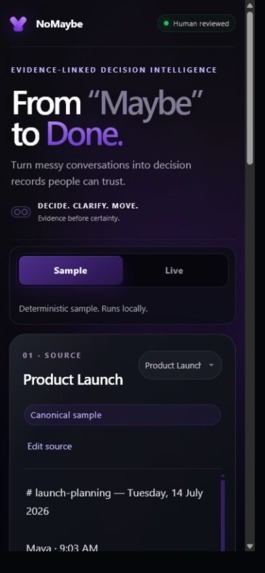
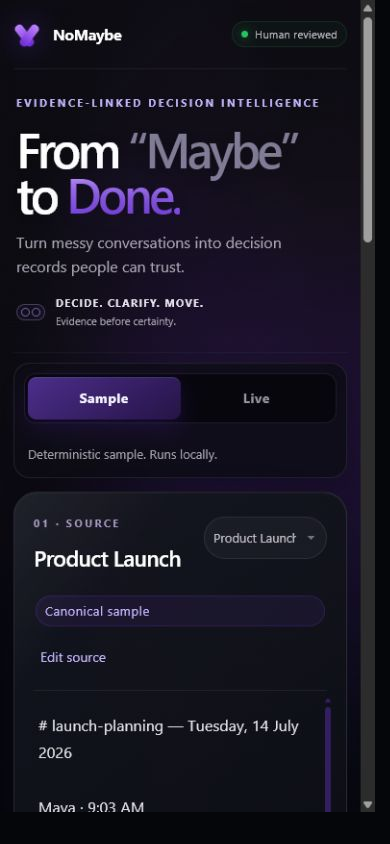
Mobile workflow
-
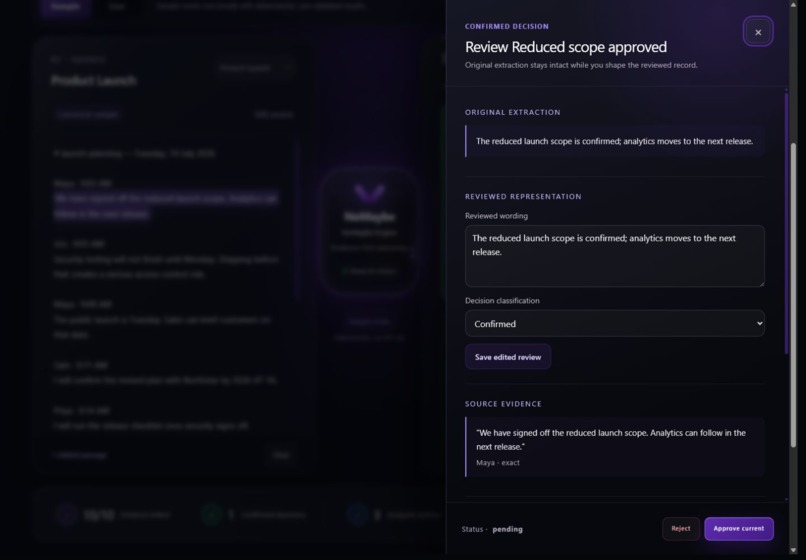
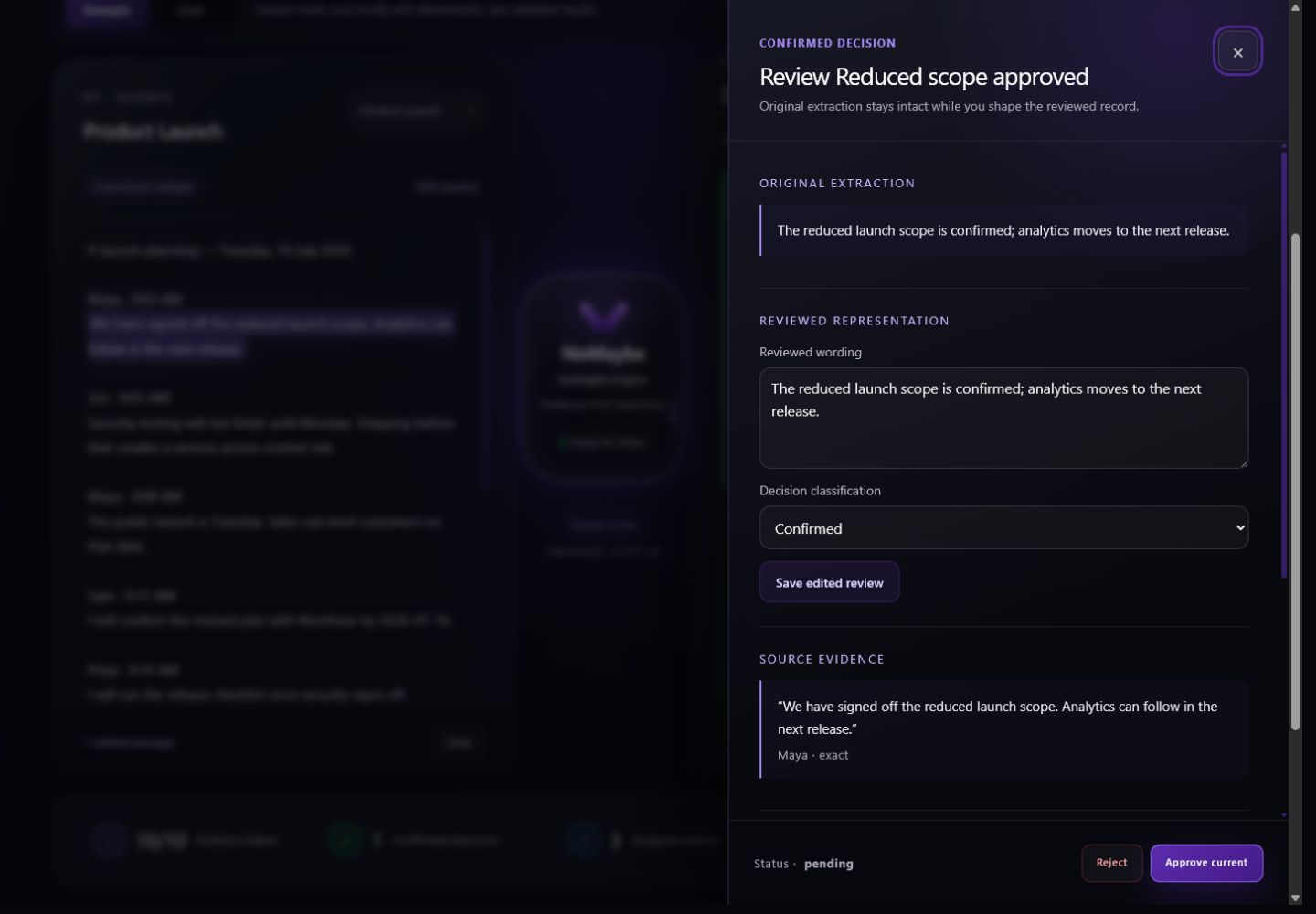
Human review
-
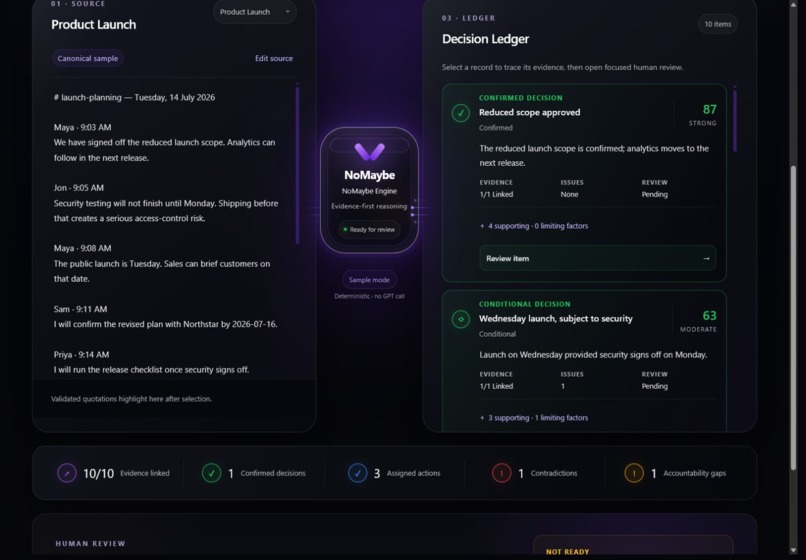
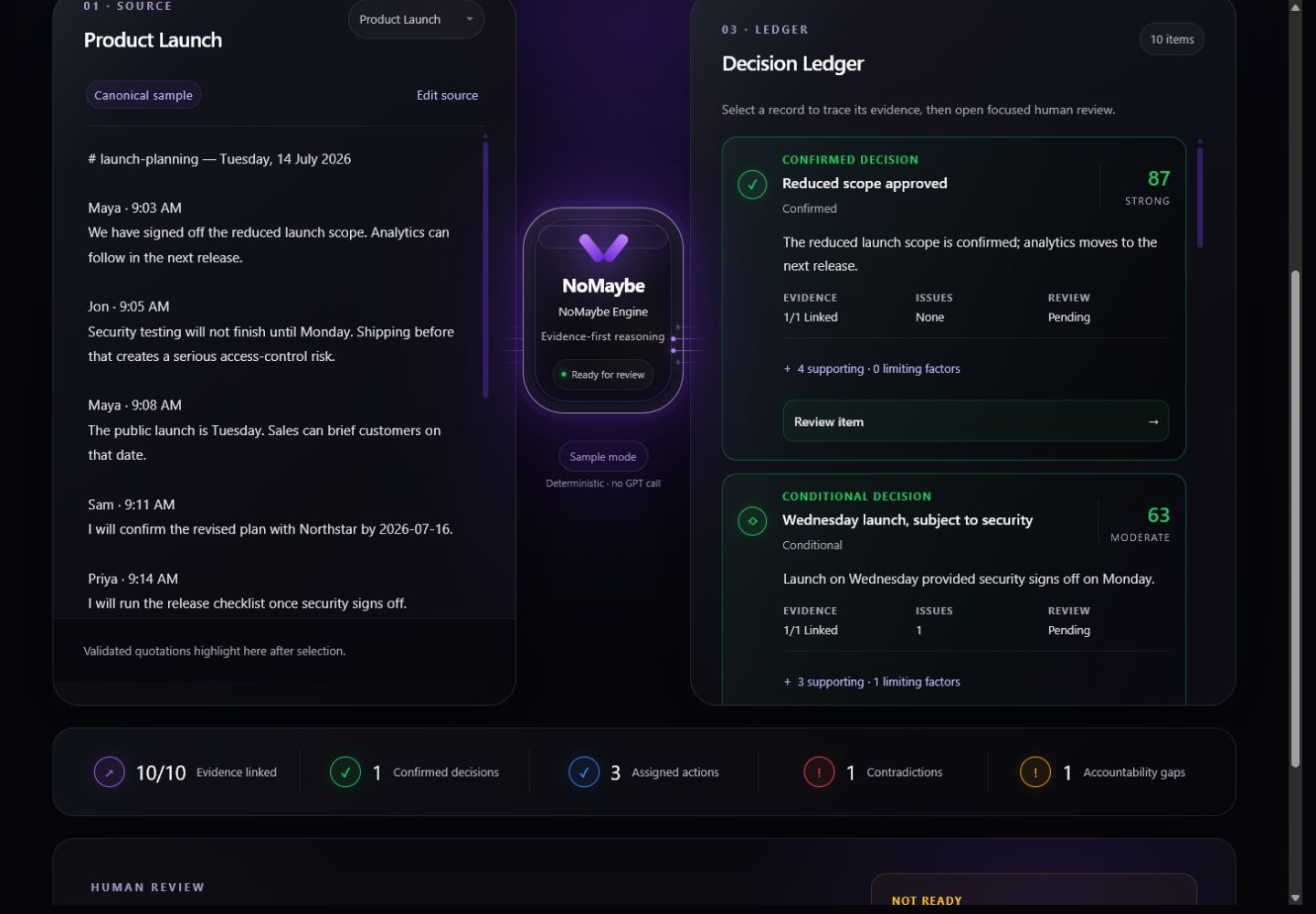
Decision Ledger
-
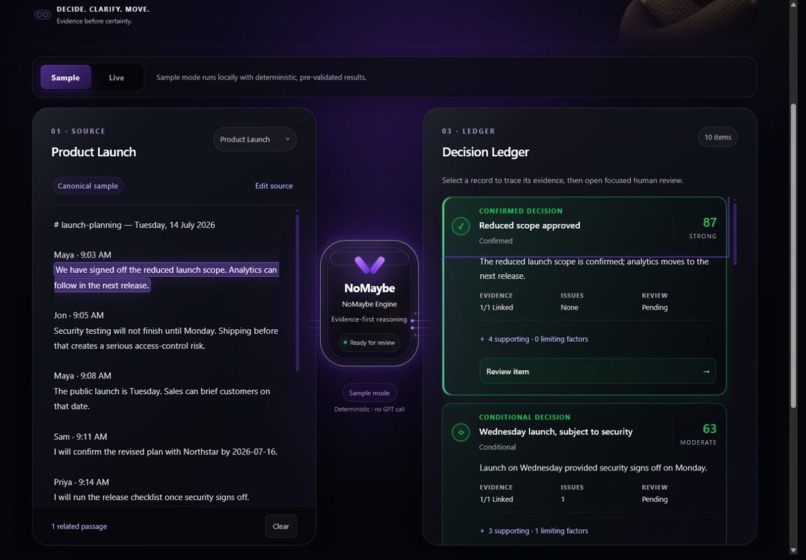
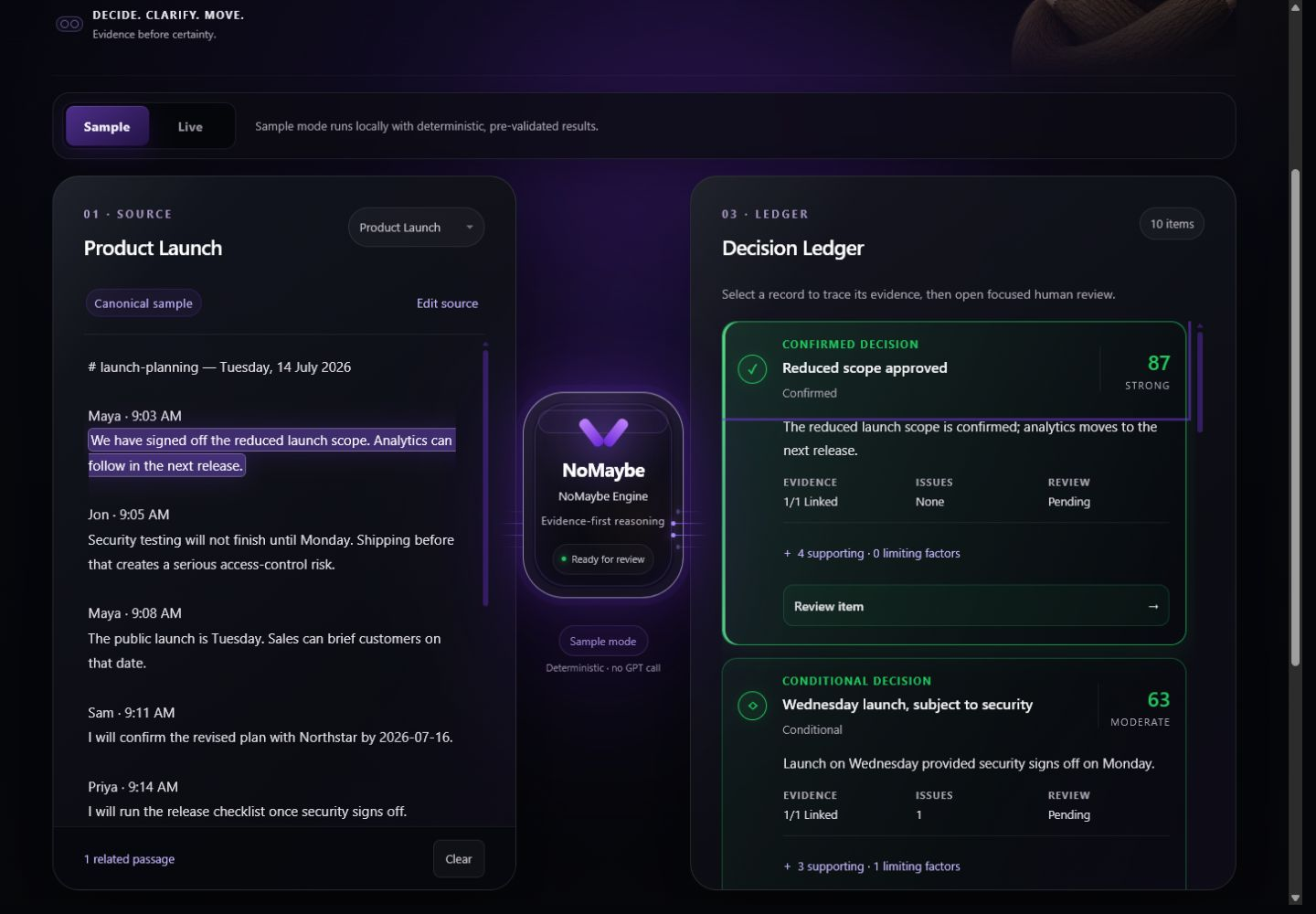
Evidence linking
-
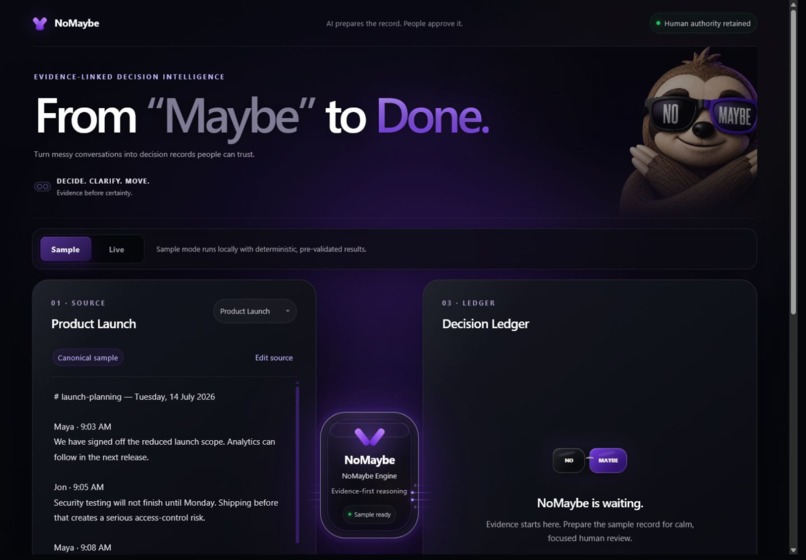
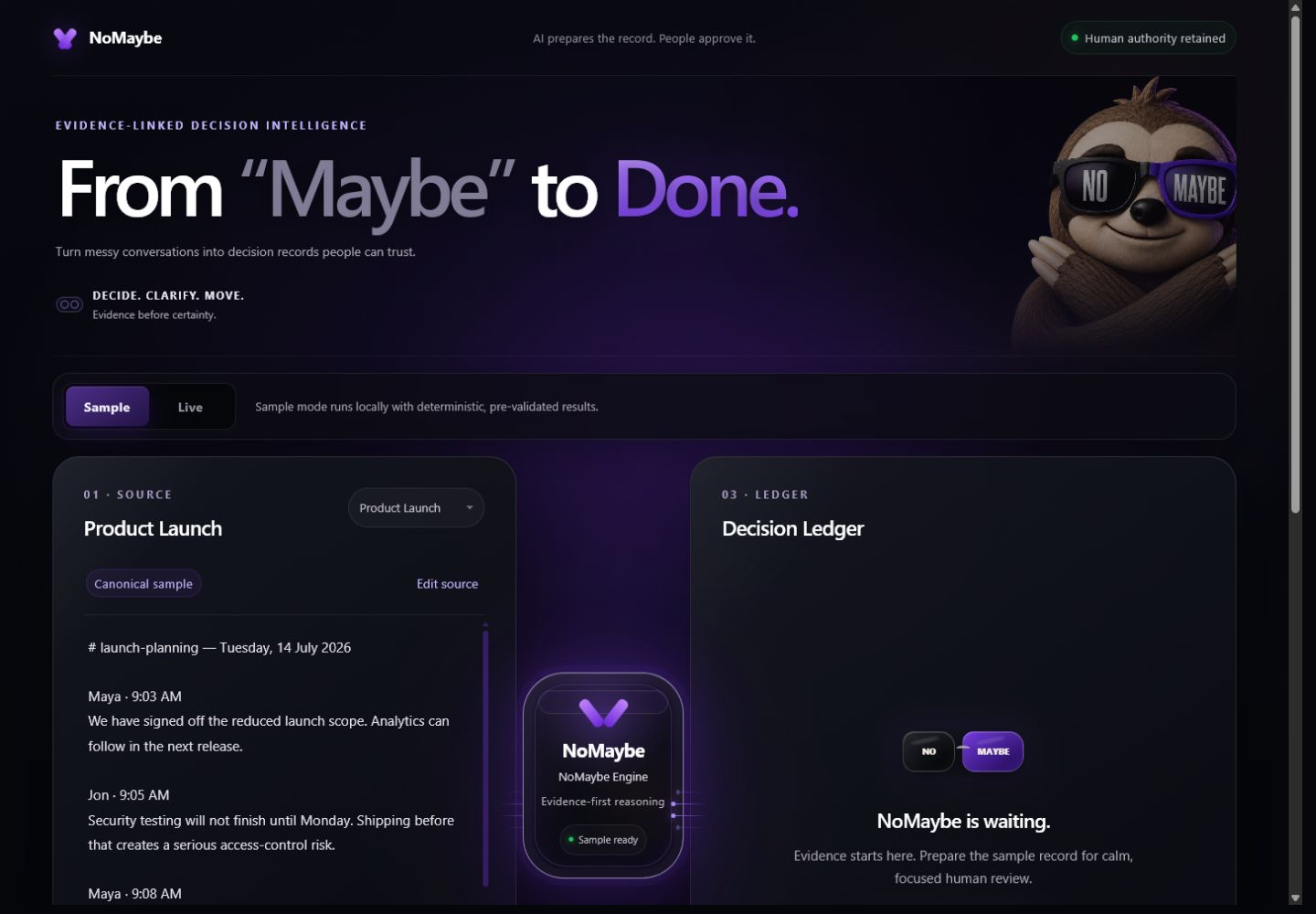
NoMaybe hero
-

Live analysis
-
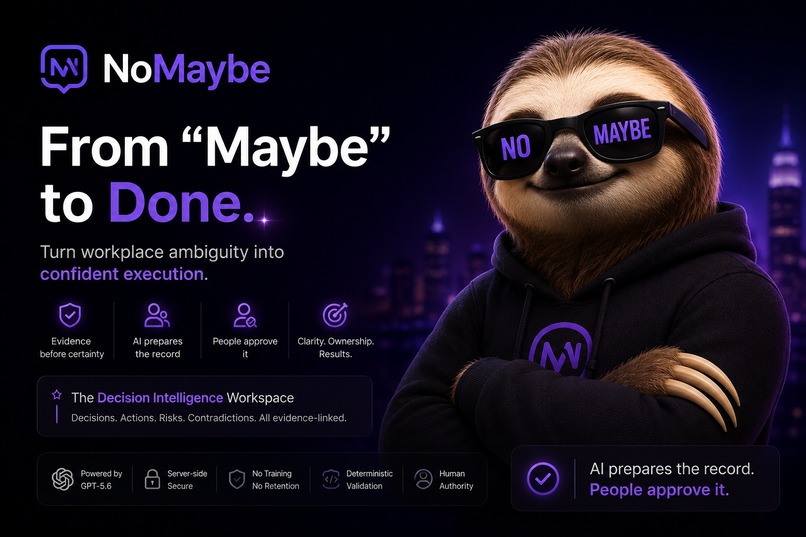
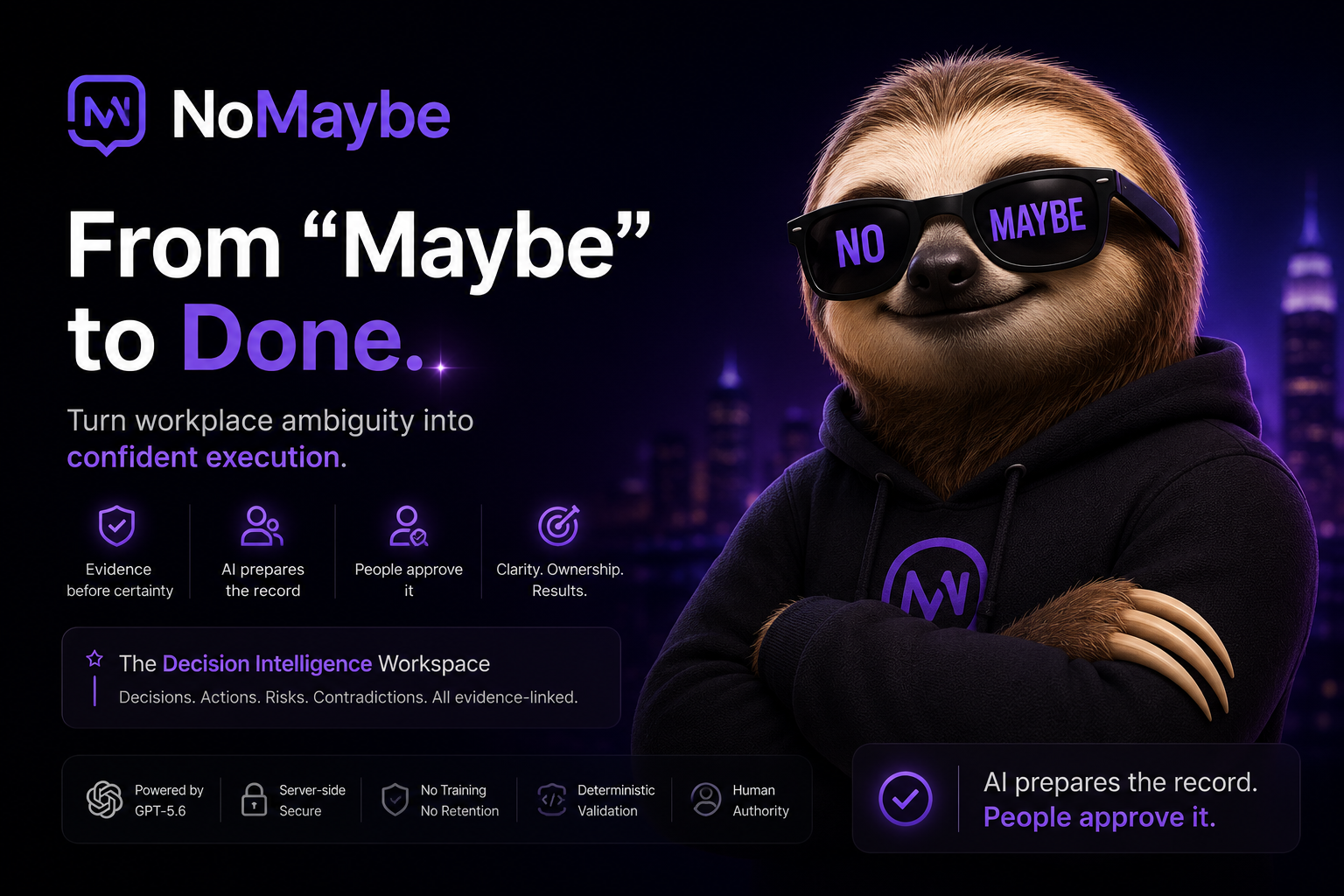
NoMaybe Cover

Short description
NoMaybe is a decision intelligence workspace for the ambiguity that meeting summaries leave behind. GPT-5.6 extracts candidate decisions, actions, questions, risks, contradictions, and accountability gaps. Deterministic code validates every quotation against the source, calculates transparent Evidence Strength, and exposes issues. People then edit, approve, acknowledge, or reject the resulting Decision Ledger.
Full project description
Workplace conversations rarely fail because nobody took notes. They fail because the notes blur different states together: a suggestion sounds like a commitment, a conditional decision loses its condition, an action has no owner, two dates conflict, or a polished summary gives no way to inspect the evidence.
NoMaybe is a decision intelligence workspace built around a simple principle: evidence before certainty. A user supplies meeting notes, a transcript, or a decision thread. NoMaybe prepares a Decision Ledger containing confirmed, conditional, and proposed decisions; assigned actions; open questions; risks; contradictions; and accountability gaps. Every record retains the source quotations that support it.
The product has two complete paths. Sample Mode runs locally using three deterministic, pre-validated fictional scenarios, making the core workflow reliable and private. Live Mode sends only the entered title and source text when the user chooses Analyse. A server-side route calls GPT-5.6 through the OpenAI Responses API and requests strict structured output.
GPT-5.6 is deliberately not the final authority. It produces candidate records. Zod validates the response shape and category rules. Deterministic post-processing replaces provider identifiers, resolves quoted evidence against the immutable source, rejects unsupported or ambiguous matches, validates explicit dates, detects issues, and calculates Evidence Strength from visible factors. The model never supplies trusted source offsets.
The result is a Decision Ledger designed for review rather than passive consumption. Selecting a record highlights its supporting passage. A focused review drawer preserves the original extraction while allowing a person to edit the current wording, classification, owner, deadline, or missing accountability. Reviewers can approve, acknowledge, or reject records. Contradictions remain visible after acknowledgement, and rejected records remain in review history rather than disappearing.
This separation of responsibilities is what makes NoMaybe distinct. GPT-5.6 contributes flexible language understanding and candidate extraction. Deterministic code contributes repeatability, evidence integrity, explicit issue rules, and transparent scoring. Human review contributes judgment and authority. None of the three is asked to do the work of the others.
The application uses Next.js App Router conventions and React, compiled by Vinext and Vite to a Cloudflare Worker-compatible runtime. Live analysis is server-only. The API key is never exposed to the browser; OpenAI storage is disabled with store: false; no model tools or browsing are enabled; source instructions are treated as untrusted data; and application responses use no-store headers. Controlled failures preserve the user’s source without echoing it in server errors.
NoMaybe is publicly deployed through OpenAI Sites. The final workflow is responsive, including a compact mobile experience and full-height mobile review sheet. The submission includes 99 passing automated tests covering domain rules, schemas, evidence resolution, review behaviour, UI state, runtime execution, and rendered output.
The current product intentionally excludes persistence, authentication, export, and direct meeting-platform integrations. Those are future opportunities, not hidden claims. What exists today is a complete proof of a more trustworthy pattern for workplace AI: turn messy conversation into an inspectable record, preserve uncertainty, and keep people responsible for what becomes official.
That scope is intentional: the submission focuses on the quality of the decision record, its evidence, and the review boundary before adding organisational infrastructure.
Inspiration
Meeting summaries often read well but still leave a team asking: “So what did we actually decide?” NoMaybe began with the observation that ambiguity is not merely missing prose—it has structure. Conditions, conflicts, owners, deadlines, and unresolved authority should be represented explicitly and tied back to evidence.
What it does
NoMaybe transforms source conversation into an evidence-linked Decision Ledger, exposes contradictions and missing accountability, calculates transparent Evidence Strength, and provides a human review workflow for editing, approving, acknowledging, and rejecting records.
How it works
- Choose a deterministic sample or enter fictional source text in Live Mode.
- Analyse to generate structured candidate records.
- Validate candidates and resolve quotations deterministically.
- Inspect each ledger item beside its source evidence.
- Review and decide what becomes part of the human-approved record.
How it was built
Next.js 16 App Router conventions and React 19 provide the application model. Vinext and Vite compile the app to Cloudflare Worker-compatible ESM. The server integrates the OpenAI Responses API with GPT-5.6 and Zod structured output. TypeScript domain modules handle evidence resolution, issues, metrics, Evidence Strength, and review. Node’s test runner and Testing Library cover domain, API, runtime, reducer, UI, and rendered HTML behaviour.
Challenges encountered
The hardest challenge was defining a useful boundary between model judgment and deterministic trust. Evidence could not be accepted merely because the model returned a quotation or offset. The implementation therefore resolves quotations independently, refuses to guess duplicated passages, retains malformed dates as explicit issues, and recalculates reviewed records without mutating original extraction.
Accomplishments
- A real, publicly deployed GPT-5.6 workflow.
- Eight explicit ledger categories with source evidence.
- Deterministic evidence resolution and transparent strength factors.
- A complete human review workflow on desktop and mobile.
- Secure server-only configuration and controlled failure behaviour.
- 99/99 passing automated tests and a production Worker-compatible build.
What we learned
Useful AI systems need more than a capable model. The product becomes more trustworthy when probabilistic interpretation, deterministic validation, and human authority are visibly separated. Explicit uncertainty is not a weakness in the interface; it is information the user needs to act responsibly.
What is next for NoMaybe
The next opportunity is a durable Decision Intelligence Platform: authenticated workspaces, persistent decision history, permissioned collaboration, exports, notifications, source connectors, and analysis across records. These capabilities are not part of the current submission.
Built With
- ai
- cloudflare-worker-compatible-runtime
- decision-intelligence
- eslint
- future-of-work
- gpt-5.6
- next.js-16
- node-test-runner
- openai
- openai-responses-api
- productivity
- react-19
- sites.
- testing-library
- typescript
- vinext
- vite-8
- zod-4


Log in or sign up for Devpost to join the conversation.