NomadHouse
Inspiration
Real estate is the largest asset class in the world and transacting it is stuck in the middle ages. The failure to keep pace with technology traps trillions of dollars and locks people into single year-round geographies.
At its core, a real estate transaction requires only changing the name on a deed. In practice, a number of expensive additions are required. The usual suspects driving transaction cost are: real estate agents, lawyers, registry fees, title search & insurance, and banks (if using their financing). An average of 7% of the total assets value is lost in this friction on each real estate transaction, which far surpasses other assets. The proverb, "hold onto real estate for at least two years before selling" is relevant simply because the transactions have an immense price tag.
Since the onset of the internet a number of web2 companies have taken a stab at this problem, foremost being Zillow. For years Zillow tried squeezing out real estate agents, the most expensive component of the transaction. Zillow ultimately failed because of the transactions complexity. Homebuyers are afraid of real estate transactions: the multi-month process, dozens of legal documents, byzantine rules, and professional quarterbacking. Zillow's largest revenue stream today is recommending their users to real estate agents in their area.
What Zillow lacked was the new infrastructure in which to move the transaction. Zillow was never able to launch a "Buy Now" button because of the traditional transaction rails.
We are at a special moment in history where this is changing. By bringing real estate transactions on-chain we believe transactions can be sufficiently simplified to launch the "Buy Now" button.
When cheap and fast real estate transactions become possible a number of new possibilities open downstream. The area we find most exciting is the opening up of homeownership to those seeking multi-geographies, often called digital nomads. In the U.S. along the number has increased from 5m to 15m in the past four years and continues to trend up. A world in which you can trade shares of ownership in your favorite cities at the click of a button is a world we want to live in.
What it does
To unlock hyper fluid homeownership we brought a number of ideas / product features together. Organized via our happy path, these features are:
A KYC process for all users to comply with U.S. regulation and necessary property information to verify the user is the rightful owner
A Filecoin API to store relevant metadata per wallet address, this will be called for a title search when a purchase is initiated
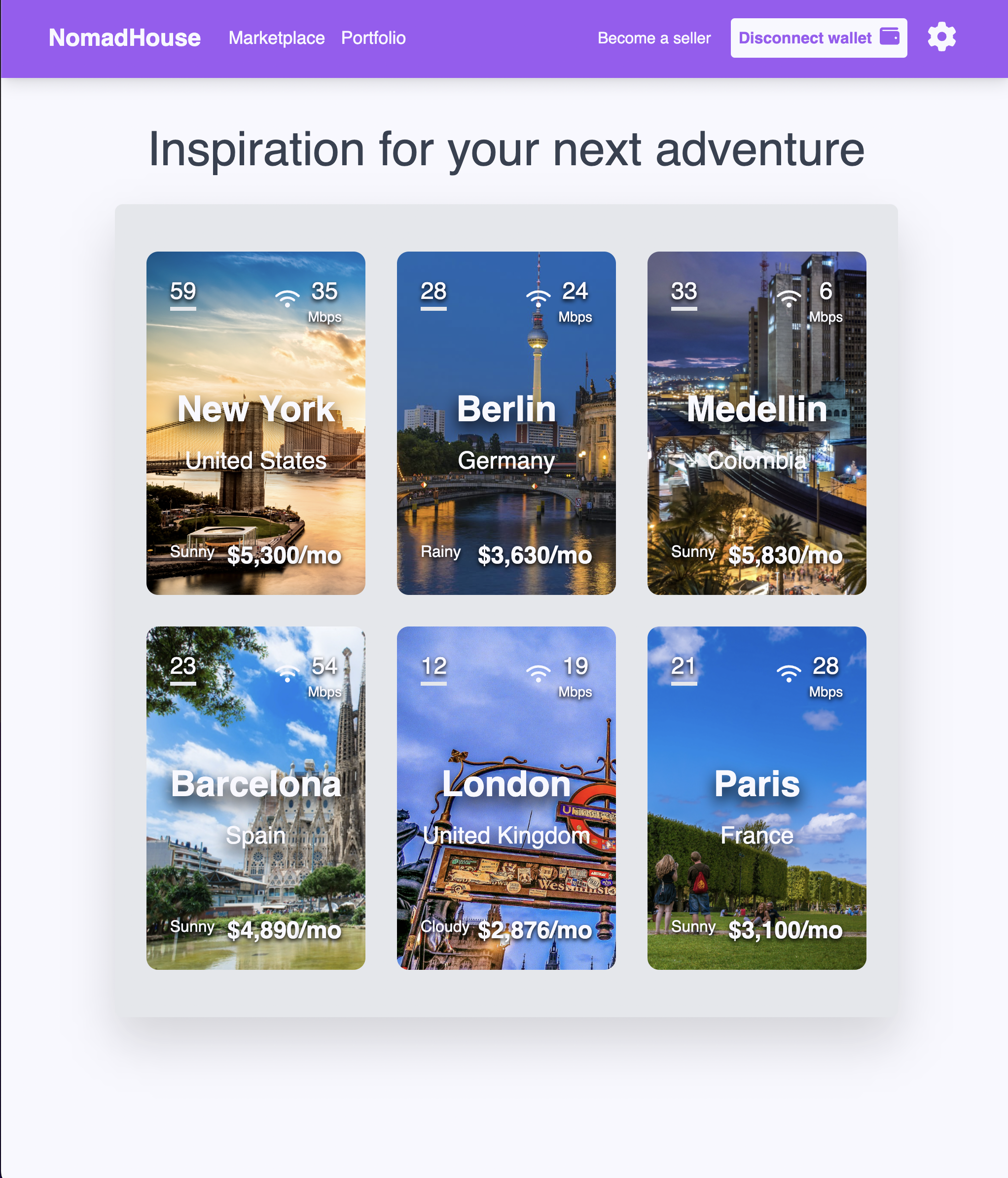
A marketplace UI that allows users to select cities -> properties -> weeks that they would like to purchase
A Chainlink oracle that pings Filecoin for an instant title search which, if returned positive, allows the user to proceed in the transaction
Our "marketplace" smart contract that pings our "collections" smart contract to transfer the NFT (which confers ownership) to transfer between wallets
The ownership is now transferred and didn’t include any agents, lawyers, county deed office interaction, etc!
How we built it
To ensure title data validity and tightly couple that data to the NFT collection contract we used Chainlink AnyAPI. We mocked title metadata hosted on IPFS/Filecoin (Thanks to web3.storage) which includes 3 key parameters:
The owner address which will be linked to a user’s Identity through an in-app KYC system. This approach ensures a linking factor between the title ownership data and the address attempting to mint and sell the Deed NFT
The number of fractional shares to issue for the title
A boolean which represents the final result of a set of the hybrid automated and manual onboarding title search. This is a complex set of processes that require multiple screenings of different data sources like title registries, divorce settlements, identity verification, etc (out of hackathon scope). Once onboarded and database integrations are established we can switch to a fully automated title search.
The “collection” smart contract creates an API request to verify title ownership, given a positive result, the contract enables minting for the verified address.
Once the Deed NFT collection is minted, our “marketplace” smart contract enables the title owner to list those deeds. It then provides the right to sell his shares instantly to other KYC’d addresses through our web application.
Challenges we ran into
The #1 challenge we ran into was the design of the software & data architecture. We worked to balance security, data integrity, and compliance with government policies on trading real estate assets, no small task.
This was particularly challenging given the compliance requirements for title ownership verification. We are selling securities in a liquid marketplace without reliance on third parties (like brokers/agents) and, ideally, without any counter-party risk.
Originally we had intended to automate the property data upload and title verification process but the time/complexity overhead became apparent. We pivoted to a simplified and manual set of data structures and processes on the application side. This allowed us to focus on the smart contract design.
Accomplishments that we're proud of
We built on the shoulder of giants and went slightly beyond to make this possible.
Web2
We used web2 best practices to build a web app with user interact-ability. This includes a marketplace and portfolio pages. Nested in the marketplace UI flow is a calendar select and buy process.
Web3
A wallet sign-on allows users to forgo the traditional email process and more securely ties critical user data to their account. Our “collections” smart contract mints ERC721 NFTs that are necessary to represent property ownership (via U.S. LLC).
NomadHouse Web3
There are two primary area we consider our team to have innovated: Instant Title Search. Ensuring the seller has up-to-date unencumbered right to sell their property is a requirement for any legitimate real estate transaction. In order to ratchet transactions down to near instantaneous we needed to make this possible. By aggregating relevant real world data and storing it in our Filecoin API we unlock this potential. Buyers are able to instantly trigger an updated title search upon purchase. As an added benefit to decentralized storage we reduce document loss, a particularly acute problem in developing countries, and enable a version history. Title agents will be intrigued by reading this paragraph. On-Chain Securities Trading. Legally representing deeds on-chain requires a number of subsidiary components. We require all users to have gone through a KYC process and keep their assets in custodial wallets. These assets will only be eligible to be sold to other users that have performed KYC, we plan to open to other platforms with similar rigor. We also leveraged legal innovation to confer our NFTs legal representation of U.S. LLCs. In effect, by sending one of our Deed NFTs from one user to another holds the full force of changing legal signatures on an LLCs operating agreement.
What we learned
Significant data engineering, and working with local governments, needs to happen. Only when we have aggregated all relevant title data in a county our infrastructure can enable instant real estate transactions.
On a technical level we learned that the ERC721 specification does not provide a mechanism for restricting transfer to KYC’d recipients. We learned how to add that restriction. Using Chainlink to pull data from APIs, Filecoin specifically, was a moment of team growth. Another moment was understanding how to use the Chainlink multiple parameter API.
Bringing title data on-chain is an opportunity to migrate the entire real estate industry towards a more transparent, robust, and efficient system.
The idea behind this is to perform a migration from traditional registry data sources to a decentralized infrastructure, which would eventually ensure visibility and allow for a data source which is a much more trustworthy source of truth for Title data. This aspect is what will eventually remove the need for restricting processes in the real estate market which make transactions much more rigorous than they need to be.
What's next for NomadHouse
We are increasingly excited about our opportunity to improve real estate. By unlocking trapped asset value and new lifestyles we believe our project has a significant positive social impact on the world. In order to continue executing on this vision we are doing the following:
First-step: Chainlink hackathon 😊
Summer 2022: Startup accelerator, onboard first listings (sellers), and build a digital nomad community (buyers) 🏗️
Fall 2022: Make first complete sale and growth 🚀


Log in or sign up for Devpost to join the conversation.