Inspiration
Many older adults want to remain independent, and many families want to support that independence. But today, families are often forced to choose between not knowing when something is wrong and relying on invasive cameras or constant check-in calls that can make older adults feel watched rather than supported.
For our team, this problem is personal. Jocelyn's grandmother lives at home with a caretaker during the day but is alone at night. When she became ill one evening, she did not tell any of her relatives because she did not want anyone to worry. By the time her family learned what had happened, she needed a lengthy hospital stay—an outcome that might have been avoided if the change had been noticed sooner.
That experience revealed a larger gap: between appointments and caregiver visits, important changes in an older adult's routine can go unnoticed. We created Noma to make those invisible moments visible without taking away the resident's privacy or independence.
What it does
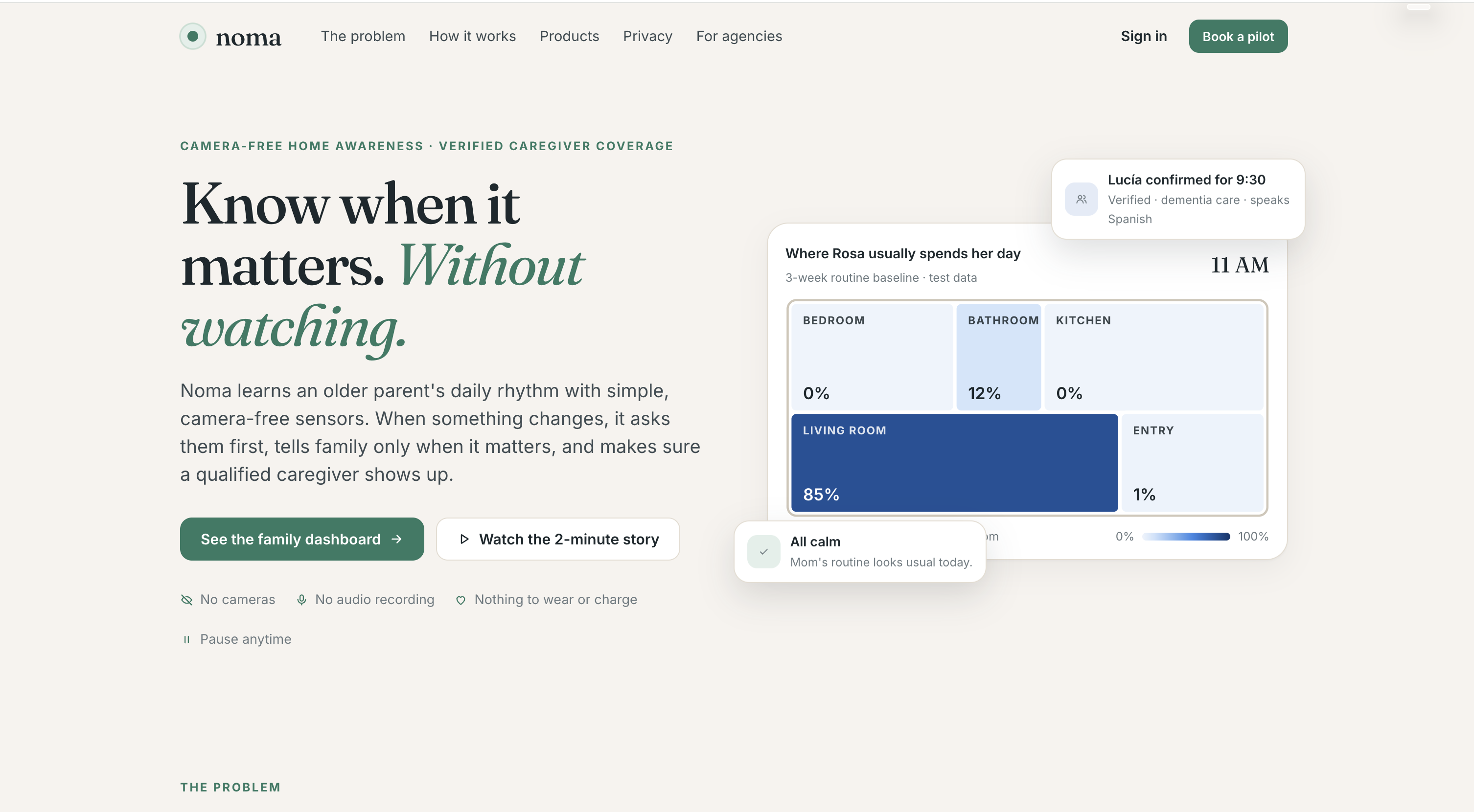
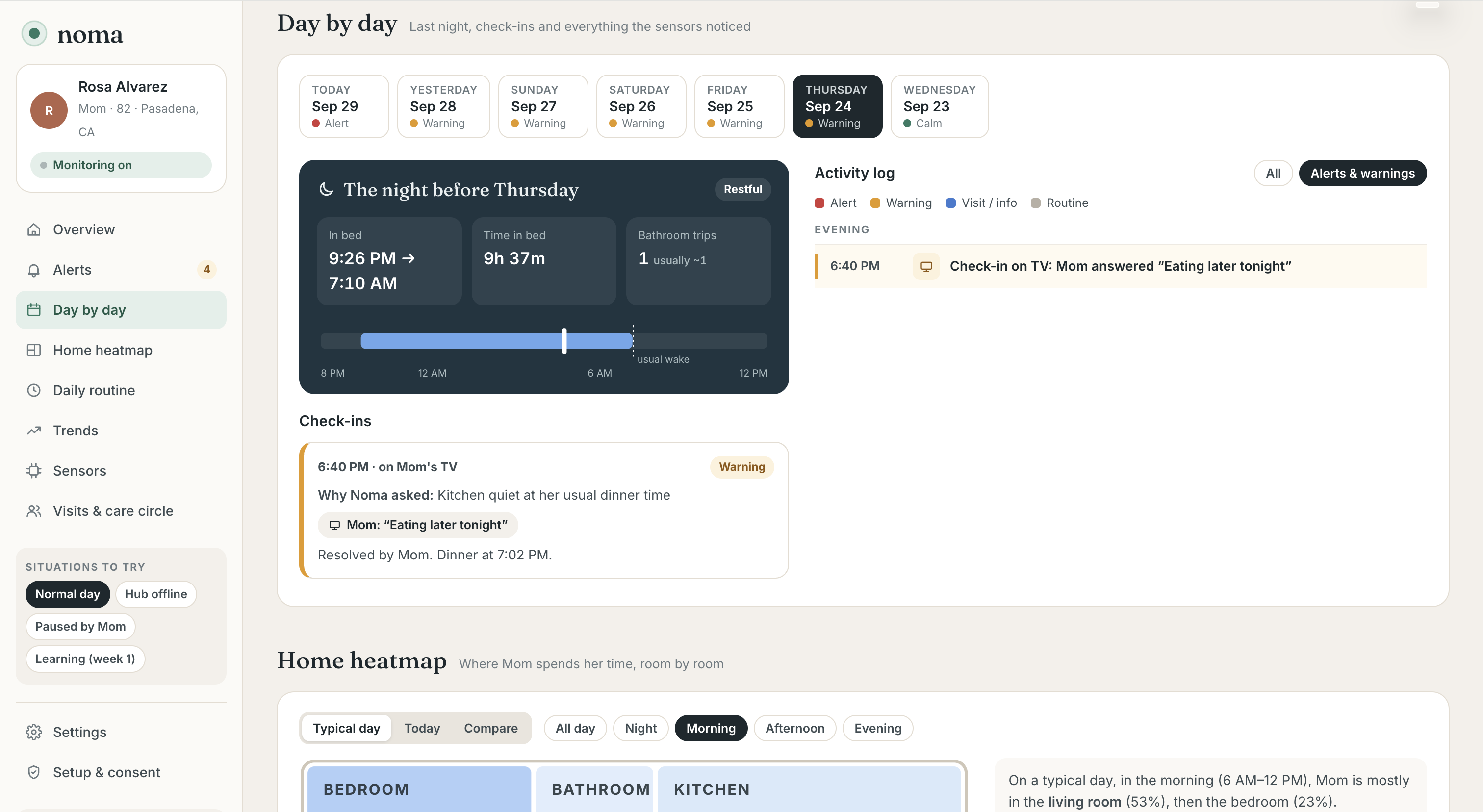
Noma is a camera-free home awareness system that learns an older adult's normal routine, identifies meaningful changes, and coordinates the right response.
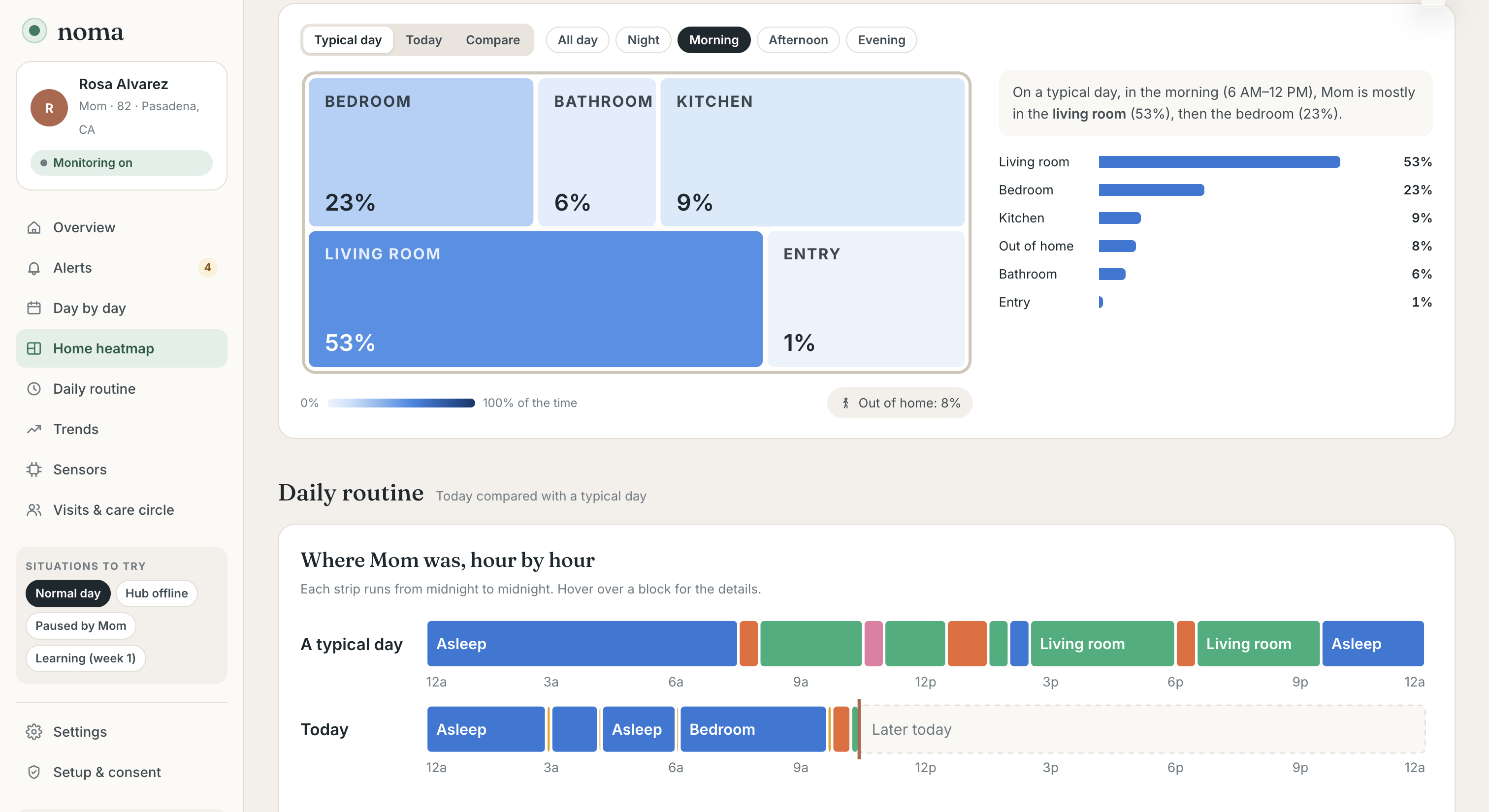
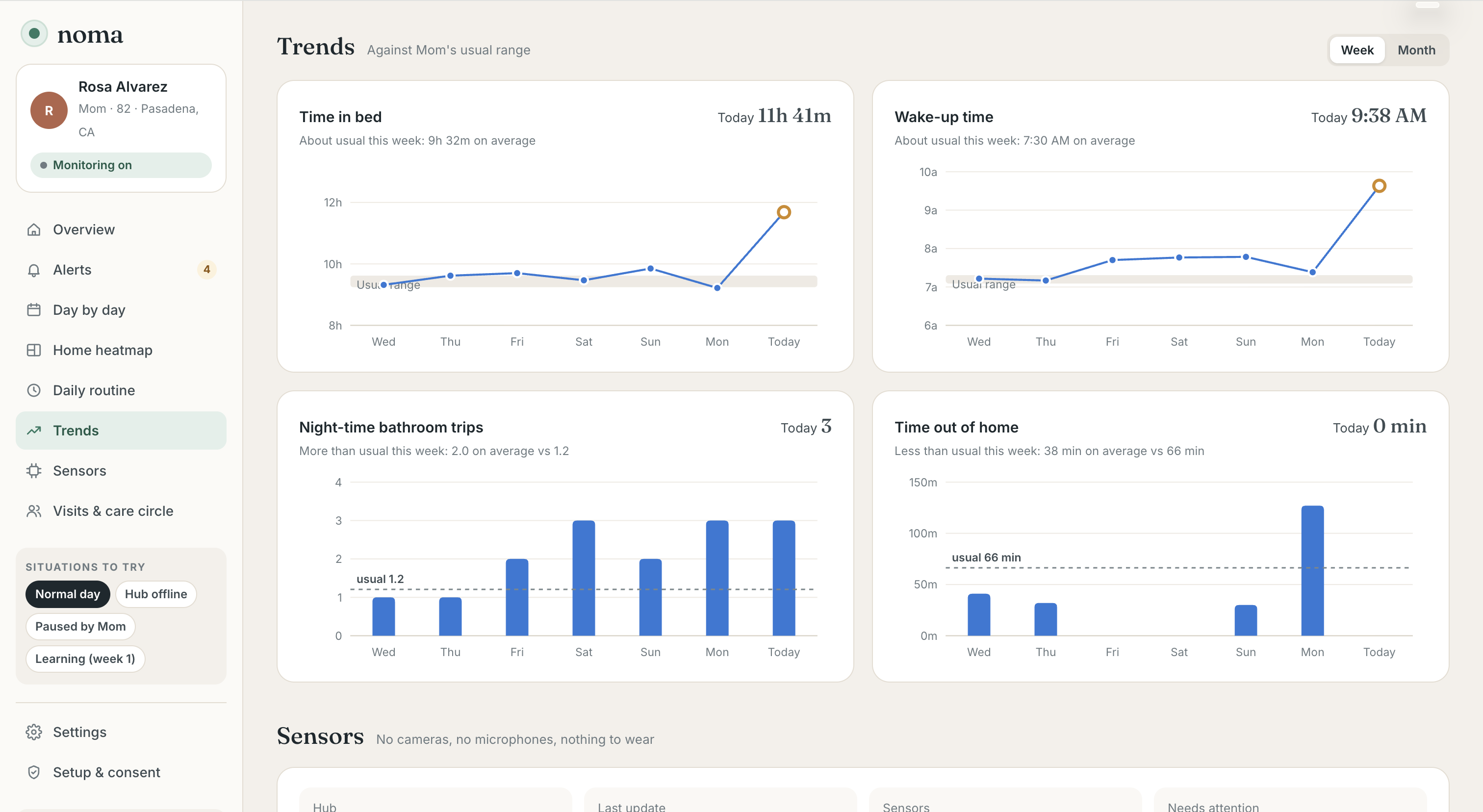
- Passive, privacy-first awareness: Low-cost ambient sensors observe patterns such as movement, sleep, bathroom visits, meals, and time away from home—all without using cameras.
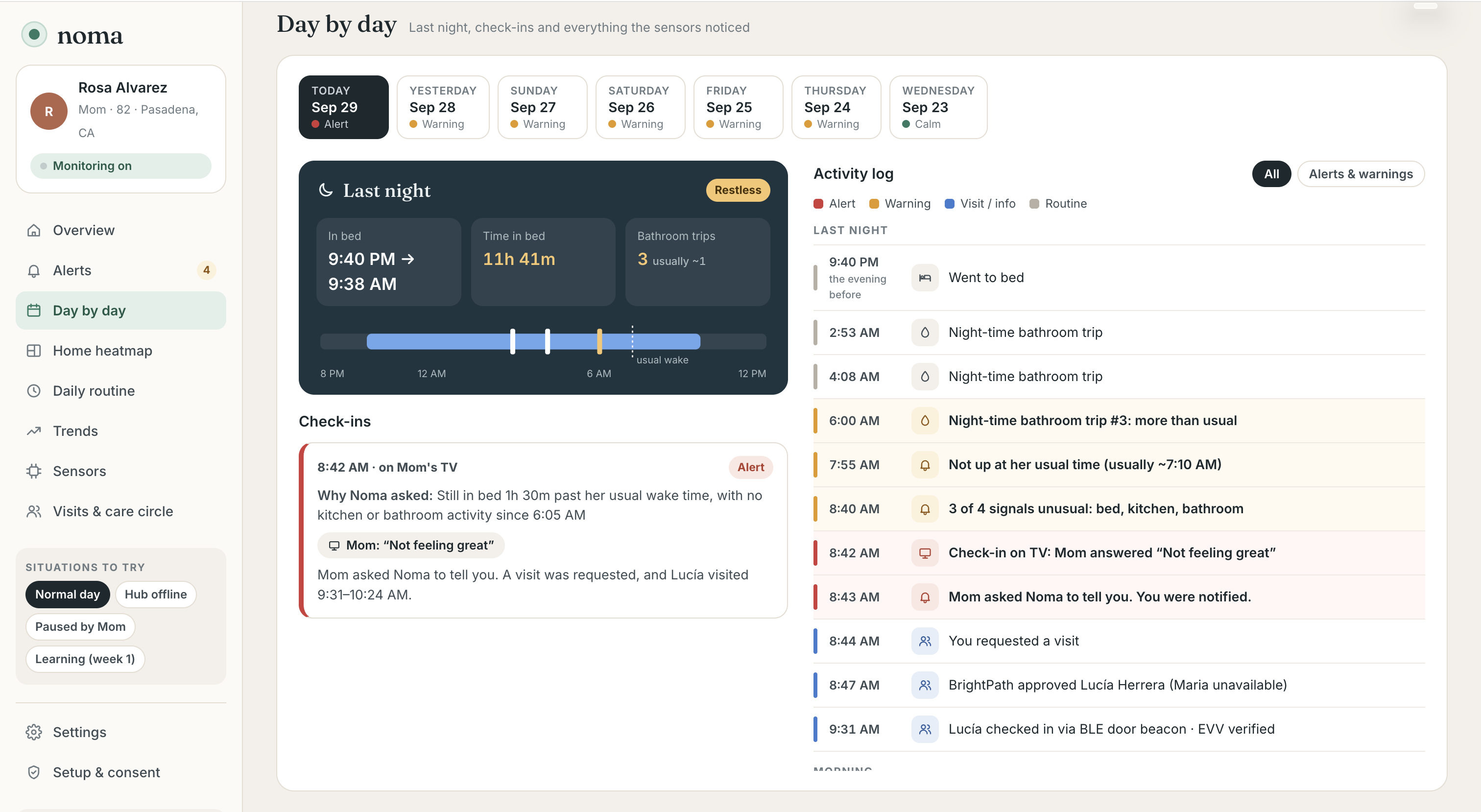
- Personalized insights: Rather than applying the same rules to everyone, Noma learns each resident's baseline and surfaces unusual changes, such as fewer kitchen visits, more frequent nighttime bathroom trips, or an unexpected period of inactivity.
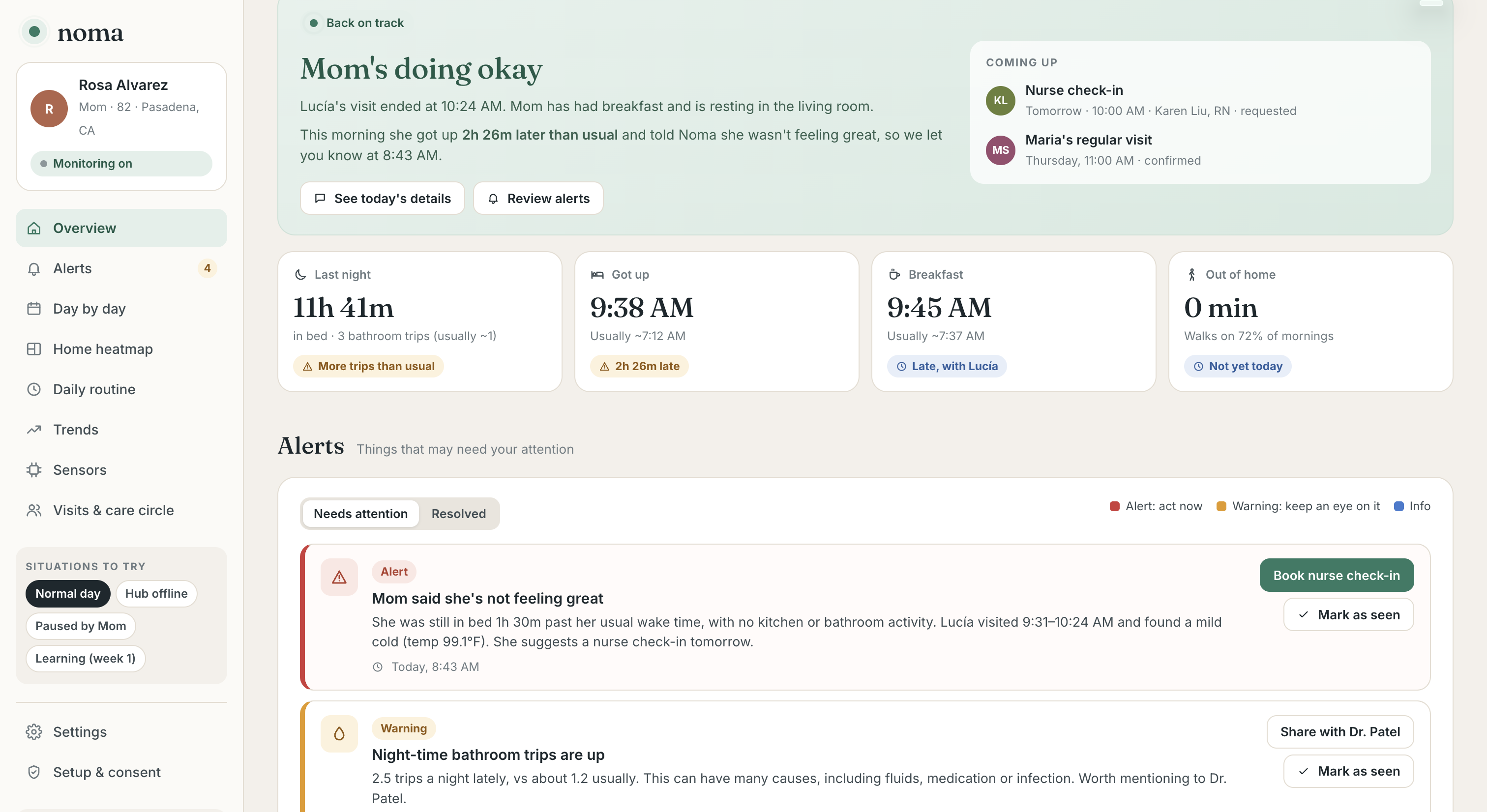
- Resident-first check-ins: When Noma notices something unusual, it checks with the resident through a familiar device such as a TV, smart speaker, or home hub. This gives the resident an opportunity to respond before anyone else is contacted.
- Thoughtful escalation: If the resident needs help or does not respond, Noma alerts their chosen family member or caregiver with clear context instead of a vague notification.
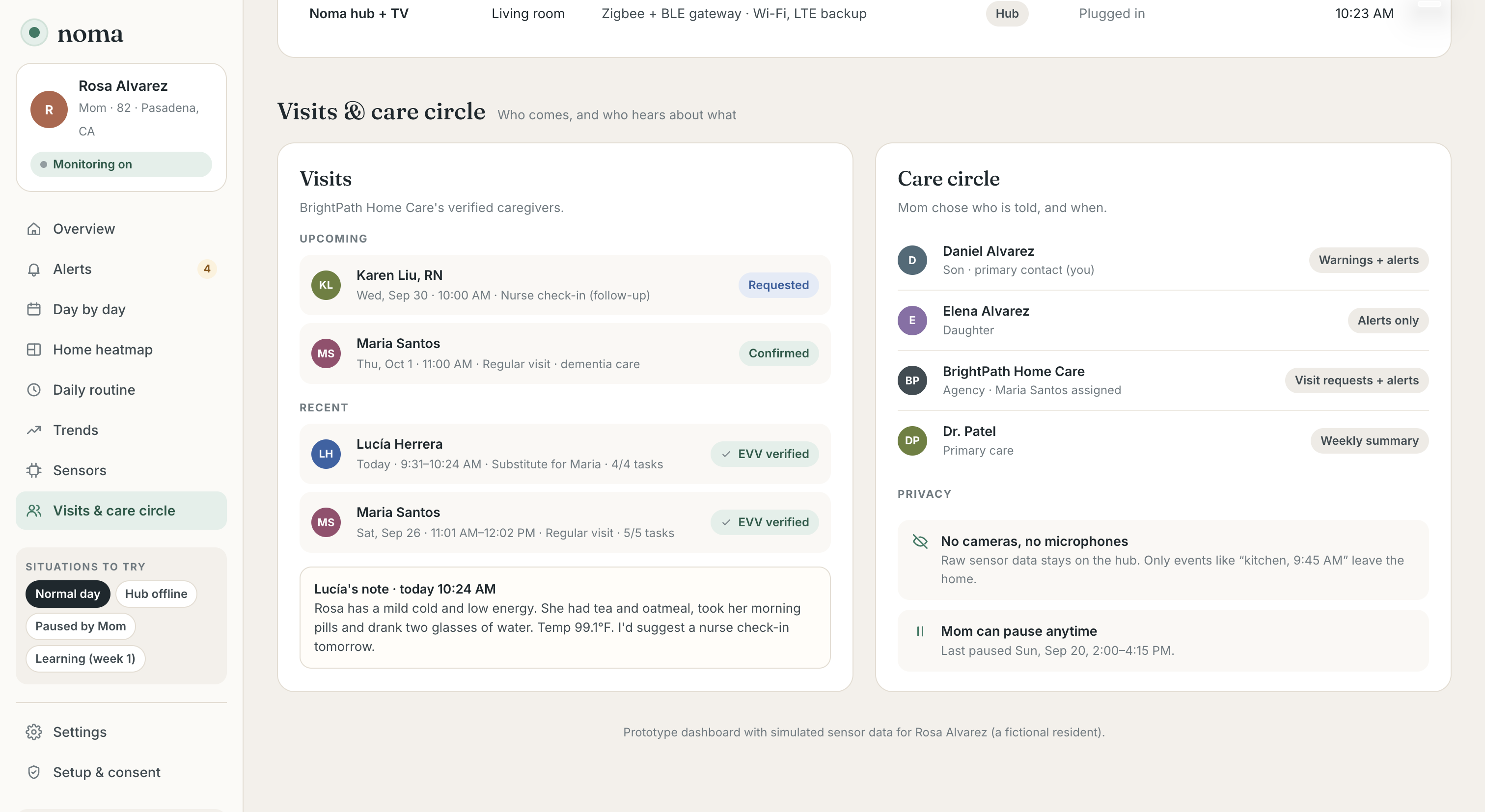
- Care coverage: When an in-person visit is needed—or a scheduled caregiver cancels—Noma can help connect the family with a verified substitute from a participating agency's caregiver pool, share only the information needed for the visit, and confirm that care was delivered.
- Centeralized family notifications: Caring for an older adult often involves an entire network of family members. Noma keeps everyone informed in one place with shared updates and alerts, eliminating scattered group chats, repetitive text messages, and uncertainty about who has responded.
Noma closes the loop between noticing a change and getting a trusted person there to help.
How we built it
We began by interviewing people with a range of caregiving experiences. Their feedback shaped our core requirements: the system had to work without constant effort from the resident, protect privacy, avoid overwhelming families with alerts, and lead to a clear next action.
We translated those requirements into user flows and interface designs for two distinct audiences: older adults who should not have to learn complicated technology and caregivers who need quick, actionable information. We iterated on the experience as a team and used Claude to help organize our research and refine our design documentation.
To prove that the sensing concept could work without a camera, we built a hardware prototype using:
- An ESP32 microcontroller to collect sensor readings and send them to the application
- An HLK-LD2450 mmWave radar sensor to detect presence and movement without recording images
- Breadboards and supporting components for rapid prototyping and testing
We built the web application with React, HTML, and CSS. Its reusable components allowed us to quickly iterate on alert cards, routine summaries, and caregiver views as the product evolved.
Challenges we ran into
Building hardware on a hackathon timeline
Sourcing and integrating physical components quickly was one of our biggest challenges. Because radar can detect that someone is present but cannot determine who that person is, we had to carefully scope our prototype. We focused this version on reliable, camera-free movement detection and kept identity-aware sensing on our roadmap.
Defining a focused first version
Caregiving involves many interconnected challenges, including scheduling, burnout, medication management, communication, and safety. We had to resist trying to solve everything at once. We focused our first version on two high-impact gaps: recognizing changes between caregiver visits and ensuring that a care need does not go unanswered.
Balancing insight with dignity
Every additional data point creates a privacy tradeoff. We continually asked not only, “Can we collect this?” but also, “Do we need to?” That principle led us toward ambient sensors, resident-first check-ins, limited information sharing, and escalation only when necessary.
Accomplishments that we're proud of
- Built a working hardware proof of concept that detects presence and movement without a camera
- Designed an end-to-end experience that moves from detection to check-in, escalation, and care
- Grounded the product in conversations with people who have real caregiving experience
- Created separate, accessible experiences for residents and caregivers
- Made privacy and dignity product requirements rather than optional features
What we learned
The hardest part is not collecting data—it is turning it into appropriate action
A movement reading alone does not tell a family what to do. The real value comes from understanding what is normal for one person, recognizing a meaningful departure from that baseline, checking context, and escalating to the right person only when needed.
Trust determines whether monitoring technology can succeed
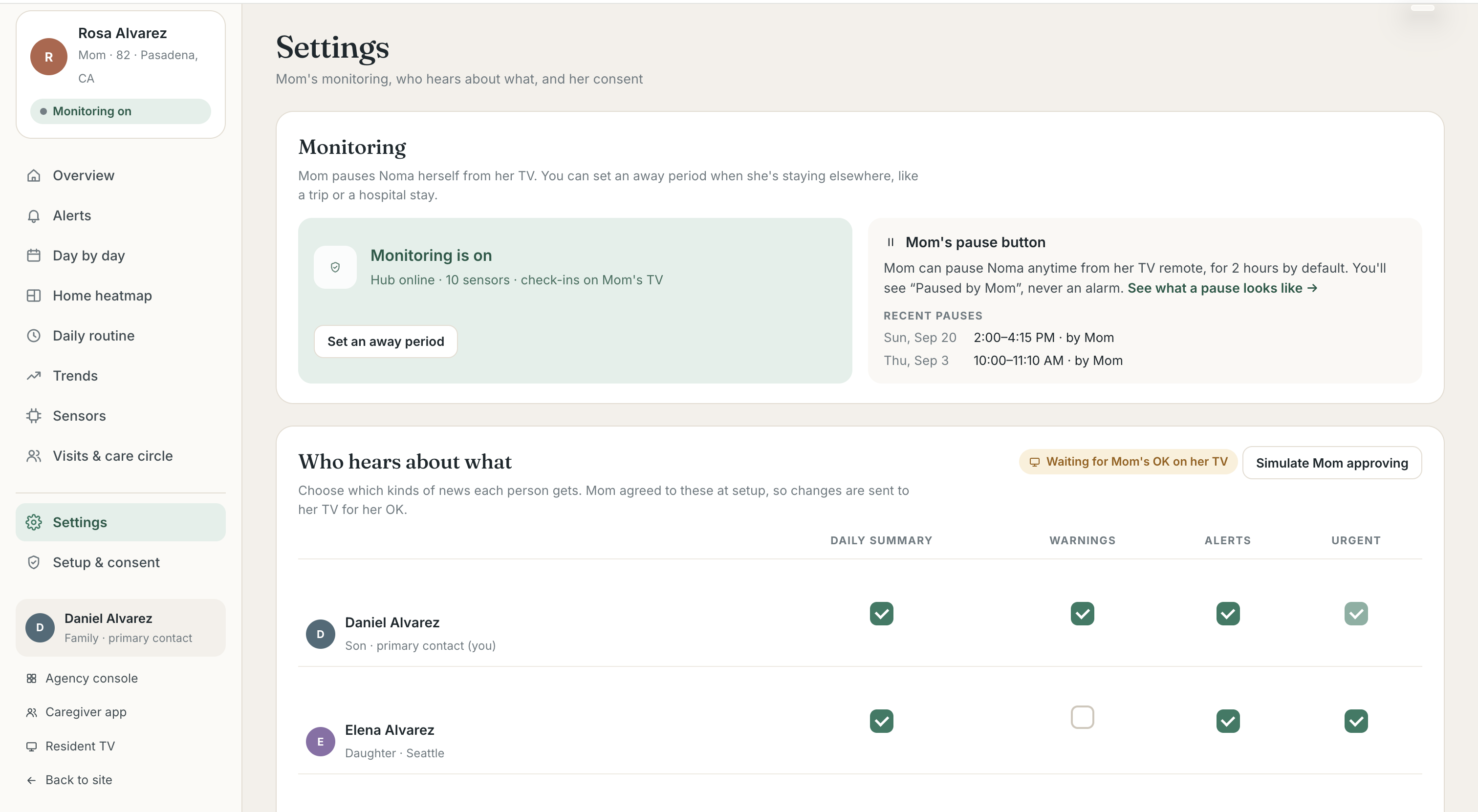
Older adults need to understand what is being sensed, who can see the information, and when someone will be contacted. Designing around consent and resident control is essential to long-term adoption.
Caregivers need clarity, not more notifications
Families and professional caregivers already manage enormous cognitive and emotional workloads. Alerts must be rare, understandable, and actionable. Noma is designed to summarize what changed and recommend a next step instead of simply sending more data.
AI should strengthen human care, not replace it
Noma does not diagnose conditions or substitute for caregivers. It helps people recognize subtle changes sooner and coordinate a human response when it matters.
What's next for Noma
- Develop personalized baseline models that adapt to each resident's habits over time
- Add bed-occupancy, door, and bathroom sensors while maintaining a camera-free design
- Explore opt-in methods for distinguishing residents from visiting caregivers
- Give residents clearer controls over what is sensed, shared, and escalated
- Test alert thresholds and check-in flows with older adults, family caregivers, and care professionals
- Pilot Noma with a home-care agency and integrate with its verified caregiver network
Our goal is simple: help older adults live independently for longer while giving the people who care about them confidence that meaningful changes will not go unnoticed.
Built With
- ai
- arduino
- c
- chatbot
- css3
- embedded
- html5
- iot
- javascript
- machine-learning
- react
- restapi
- sensors
- uart
- websockets


Log in or sign up for Devpost to join the conversation.