-
-
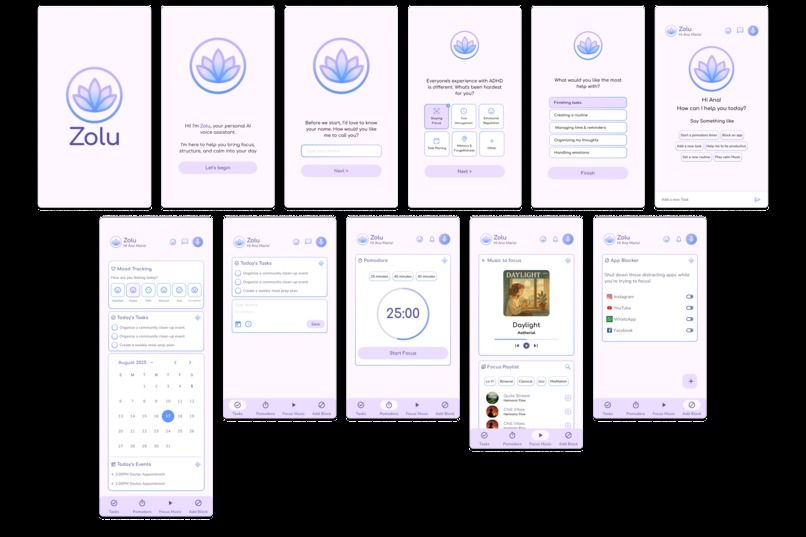
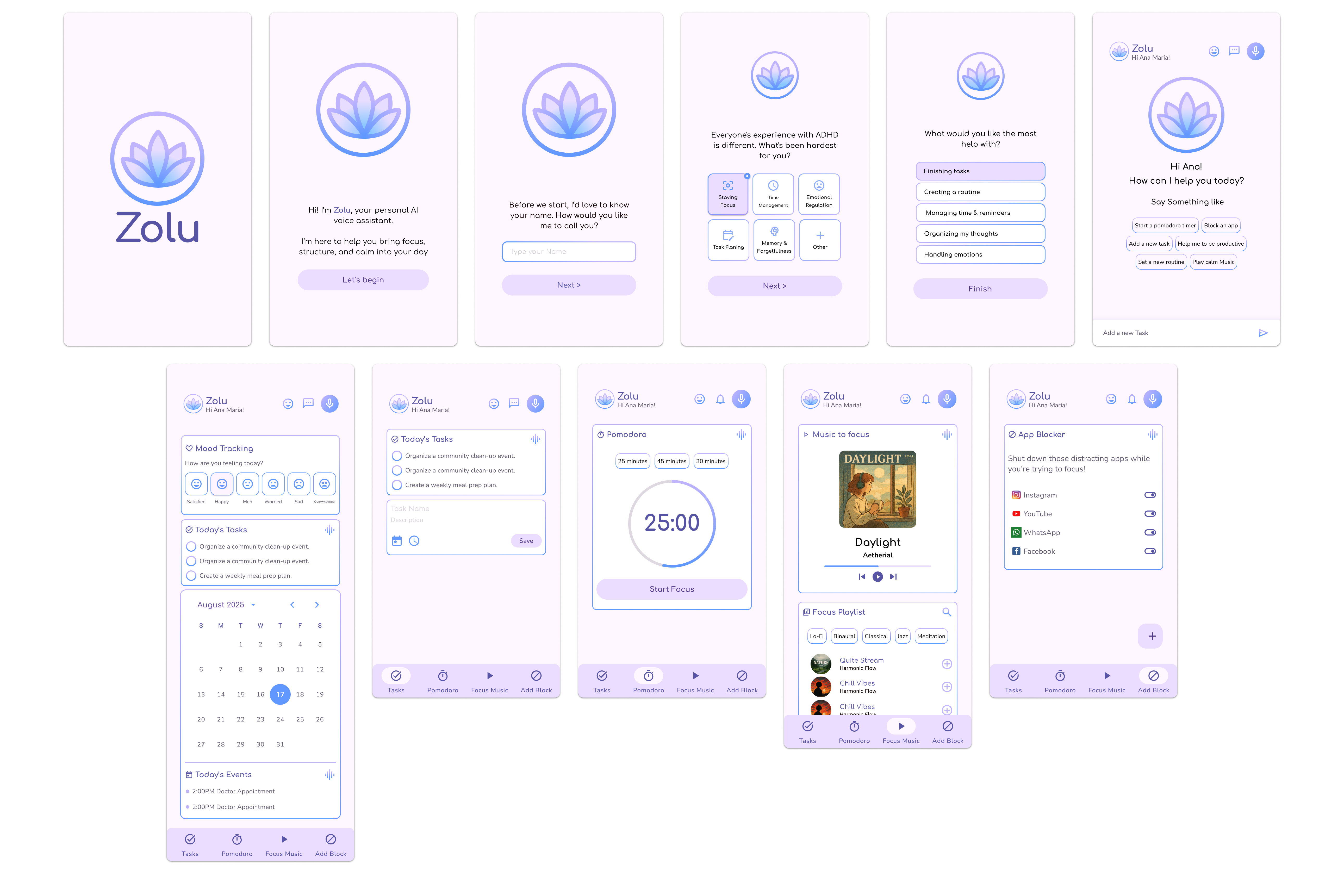
Figma UI Designs
-
Logo
💡 Inspiration
Hi, I’m Ana María, a UI/UX designer with ADHD from Colombia, living in Canada.
For years, I thought I was just messy or forgetful. I couldn’t stay organized, missed deadlines, got overwhelmed by the smallest things, and carried so much guilt for not being “on top of it.” Then one day, a doctor looked at me and asked: “Have you ever been tested for ADHD?”
I took the test, got diagnosed, and suddenly, everything made sense.
But even after the diagnosis, I still struggled. Most productivity tools felt boring, overwhelming, or just not made for how my brain works. I’d forget to even open them — or I’d get lost inside the app itself.
As a freelancer working from home, I started using ChatGPT just to help me stay on top of things. I would ask it to remind me about events, keep track of tasks, or help me plan my day. And over time, it became kind of like a friend — one that listened and helped without judgment.
That’s when I had the idea:
What if I could make my own AI assistant, one that’s actually trained for people like me?
Something that helps me keep track of my daily life, all in one place, with the tools I already use: voice, timers, tasks, focus, music.
Not a hundred apps. Just one. Built with my brain in mind.
That’s how Zolu started to be designed.
You’ll learn more about the creative process in the video.
🤖 What It Does
A beautiful, empathetic productivity companion designed specifically for ADHD minds.
Zolu understands the unique challenges of neurodivergent brains and provides gentle, effective support.
🌟 Features
🧠 ADHD-Aware Design
- Empathetic Communication: Warm, understanding responses that validate ADHD experiences
- Executive Function Support: Break down overwhelming tasks into manageable steps
- Emotional Regulation: Gentle mood tracking and supportive interventions
- Hyperfocus Management: Reminders for basic needs during deep work sessions
🎯 Productivity Tools
- Smart Task Management: ADHD-friendly task organization with gentle reminders
- Pomodoro Timer: Flexible focus sessions that work with your brain's rhythms
- Advanced Focus Mode: Intelligent app blocking with motivational interventions
- Calendar Integration: Visual scheduling that reduces time blindness
🎵 ADHD-Optimized Audio
- Brown & Pink Noise: Scientifically-backed sounds for ADHD focus
- 40Hz Gamma Waves: Binaural beats proven to enhance cognitive function
- ADHD Meditation: Guided sessions designed for neurodivergent minds
- Nature Soundscapes: Calming audio to reduce sensory overwhelm
🗣️ Voice Assistant
- Natural Conversations: Warm, empathetic AI that understands ADHD struggles
- Voice Commands: Hands-free productivity management
- Emotional Support: Gentle encouragement and validation
- ADHD-Friendly Responses: No judgment, just understanding and practical help
🎨 Design Philosophy
Zolu is built with ADHD minds in mind:
- Gentle Colors: Calming purple gradients that reduce visual overwhelm
- Clean Interface: Minimal distractions with clear visual hierarchy
- Responsive Design: Works beautifully on all devices
- Accessibility First: High contrast, readable fonts, and intuitive navigation
Zolu is made for real-life ADHD flow — voice-first, low effort, and emotionally kind.
🛠️ How I Built It
1. Research & Insights
- Researched existing ADHD apps
- Tested many, but found them hard to follow, boring, or too complex
2. Designing the Foundation
- Designed the concept and branding of the app
- Designed the UX and UI wireframes in Figma
- Focused on simplicity, clarity, and ADHD-friendly navigation using Material UI components
3. Building the Brain
- Wrote the first AI prompt in Bolt, with help from ChatGPT
- Cloned my voice using ElevenLabs and implemented it in the first prototype
- It worked at first, until I ran out of tokens and the app started crashing
- In my latest prototype, I implemented OpenAI’s GPT-4 model as the core assistant for more stability and smarter interaction
⚠️ Challenges I Ran Into
- It was my first time designing an app for mobile. I usually design for web, so adapting to mobile UX was a big learning curve.
- I had almost zero knowledge in backend and frontend development, just basic HTML/CSS from web design.
- I’m primarily a UI/UX designer, so bringing this idea to life solo was both exciting and overwhelming.
- The voice I cloned with ElevenLabs ran out of tokens, and everything collapsed on the app — it was incredibly frustrating 😮💨
- When the app crashed in Bolt, I couldn’t go back to previous stages, so I had to duplicate the app multiple times just to avoid losing my work.
- I used up a lot of tokens trying to make things work because of my limited coding experience.
- Writing effective AI prompts for Bolt took time, trial and error. I had to learn how to “write” to the AI properly.
- Managing both design and development alone felt like juggling a thousand tabs in my brain.
- I didn’t have a clear blueprint, just intuition, stubbornness, experimentation, and persistence.
- Got a domain and everything ready to launch, but didn’t have enough technical knowledge to deploy the app or publish it to the app stores.
🌟 Accomplishments That I'm Proud Of
- 🧠 Turned an idea into a working prototype from scratch, with no coding background
- 📱 Designed my first-ever mobile app, stepping out of my comfort zone as a web designer
- ✏️ Created clean, ADHD-friendly wireframes and UX flow all on my own
- 🗣️ Cloned my voice using AI tools (ElevenLabs) and brought my assistant to life
- 🤖 Successfully implemented GPT-4 as the app’s brain, making conversations smoother and smarter
- 🛠️ Built the app as a cross-platform experience (iOS + Windows)
- ✨ Balanced design, tech, and emotions and kept going even when things broke
- 💡 Taught myself prompt writing, troubleshooting, and how to think like a dev
- 🌈 Proved to myself that with creativity and persistence, I could build something meaningful even without knowing everything
📚 What I Learned
- 🌿 Simplicity is everything, especially when designing for ADHD brains. Less is more, always
- 🧩 You don’t need to know everything to start — just the courage to try, learn, and adapt
- 🔧 Trial and error isn’t failure — it’s part of the process (and sometimes the best teacher)
- 🗣️ Voice interfaces can be powerful, but they come with unexpected limits (credits and tokens)
- 📲 Mobile design is a whole different world from web — but it’s learnable with patience
- 🧠 Writing good AI prompts is an art — the clearer and more specific you are, the smarter your assistant becomes
- 💾 Backups are your best friend — seriously, always duplicate your work in Bolt
- 🤖 Working with AI means learning to co-create, not just build
- 💛 Most importantly: this project wasn’t just about building an app — it was about challenging myself, stepping out of my comfort zone, and turning my dreams into reality ✨💪📱
🚀 What's Next for Zolu
- 🗣️ Enhance the AI voice to make it sound more natural, warm, and human for a smoother and more comforting experience
- 💰 Find financial support or funding to keep developing the app
- 📱 Finish the app and launch it on the App Store and Google Play
- 👥 Get user testers to improve the experience with real feedback
- 🛠️ Work with developers to implement more advanced features and polish the experience
- 🎶 Integrate music and soundscapes as part of the app’s calming and focus-enhancing features
- 🧩 Expand Blocks (modular tools/tasks) to help users break tasks into small, ADHD-friendly steps
- 📆 Allow users to connect Zolu with their favorite calendars, like Google Calendar
- 💆♀️ Reduce development stress by having more budget, support, and collaboration
- ✨ Stay true to the vision: a beautiful, gentle AI assistant that helps people with ADHD feel understood, supported, and empowered every day
📽️ NOTE:
You can find the demo of the app at the end of the video, along with the creative process narrated by me.
Built With
- bolt
- chatgpt
- elevenlabs
- expo.io
- figma
- flutter
- github
- node.js
- openai-gpt-4
- react-native


Log in or sign up for Devpost to join the conversation.