
Inspiration
We find the technology behind noise cancellation fascinating, and it's extremely useful. You can turn any noisy place into a quiet space with headphones. But what if we don't want to wear headphones? Say you're in your room and it's noisy outside, or what if you want to sleep in silence comfortably? With Muffle Bubble, you can make your whole room into a quiet bubble.
What it does
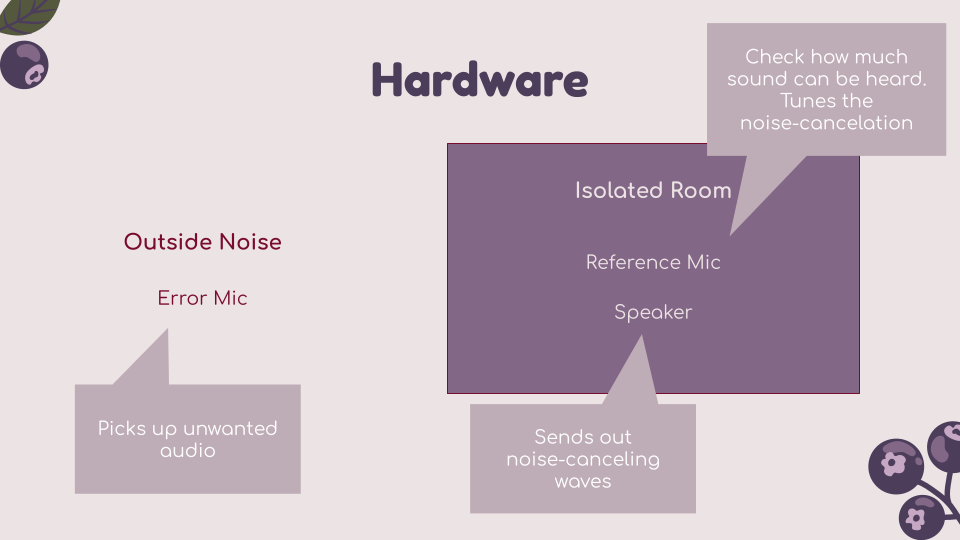
You will need an external mic and an external speaker. By placing the mic at the location where the noise comes from, and placing the speaker beside your computer, running this program will send out noise cancelling waves, so you hear nothing.
How we built it
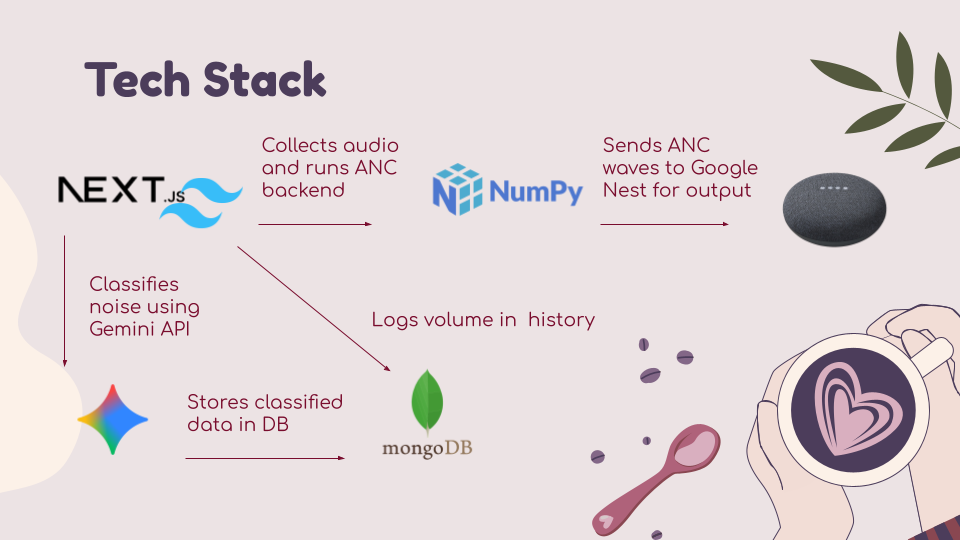
We used our phone as the mic and Google Nest as the speaker. We connect both of them to our computer so the noise that's picked up by the mic is passed though our python script, which converts it into the opposite sound waves, and is outputted through the Google Nest.
Challenges we ran into
In order to achieve a good noise cancellation, we need the audio data to be transferred extremely quickly, within 10ms. Initially we downloaded AudioRelay to use an Android phone as mic for a MacBook, but the fastest speed was 80ms, with an average of 200 ms. We were able to hear the noise, and anti waves seperately as they were not matching up. To decrease the latency, we switched to an Apple phone, using the Apple ecosystem's Camera Continuity. This decreased the latency to 10ms.
Another issue we ran into was the connection of devices. We had trouble connecting our devices to each other on the school's wifi. We later found out that it's because eduroam and UniversityofWaterloo wifi have client isolation, which meant we had to use our own hotspot.
Accomplishments that we're proud of
This is the first time we have made a hardware hackathon project, and we are super proud of working with audio waves, a very finicky element. We were able to change our audio inputs and outputs in challenging ways, such as using our built in speaker as the first mic, our phones as the second mic, and the Google Nest as an external speaker.
What we learned
The whole topic of Active Noise Cancellation (ANC) is interesting. There are two types, Air-space ANC (what this project does) and Feedforward/Feedback ANC (what noise cancelling headphones use). Air-space ANC happens within a room or in an "open space". This means waves can bounce around, travel in different directions, and for it work nicely, multiple speakers for anti waves would be needed. Meanwhile Feedforward/Feedback ANC happens within the headphone, so there's a lot more control on the audio coming in and the target of the output audio is also within the ear.
What's next for Muffle Bubble
Air Noise ANC is a lot more difficult than Feedforward/Feedback ANC given that there's there a lot more space for waves to travel in. The next step would be to improve the ANC capabilities. Currently, the data transfer between reference mic to computer to speaker takes >20ms, which means by the time the anti waves are outputted, we've had already heard the initial noise. Decreasing this latency would mean exploring better and faster hardwares.


Log in or sign up for Devpost to join the conversation.