-

-
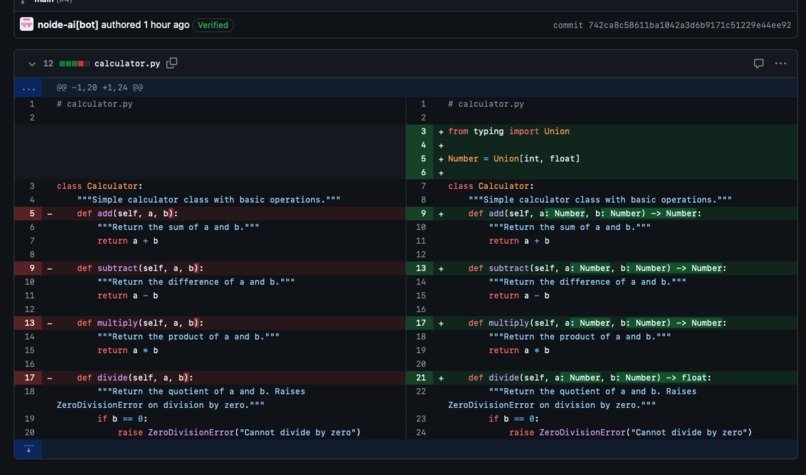
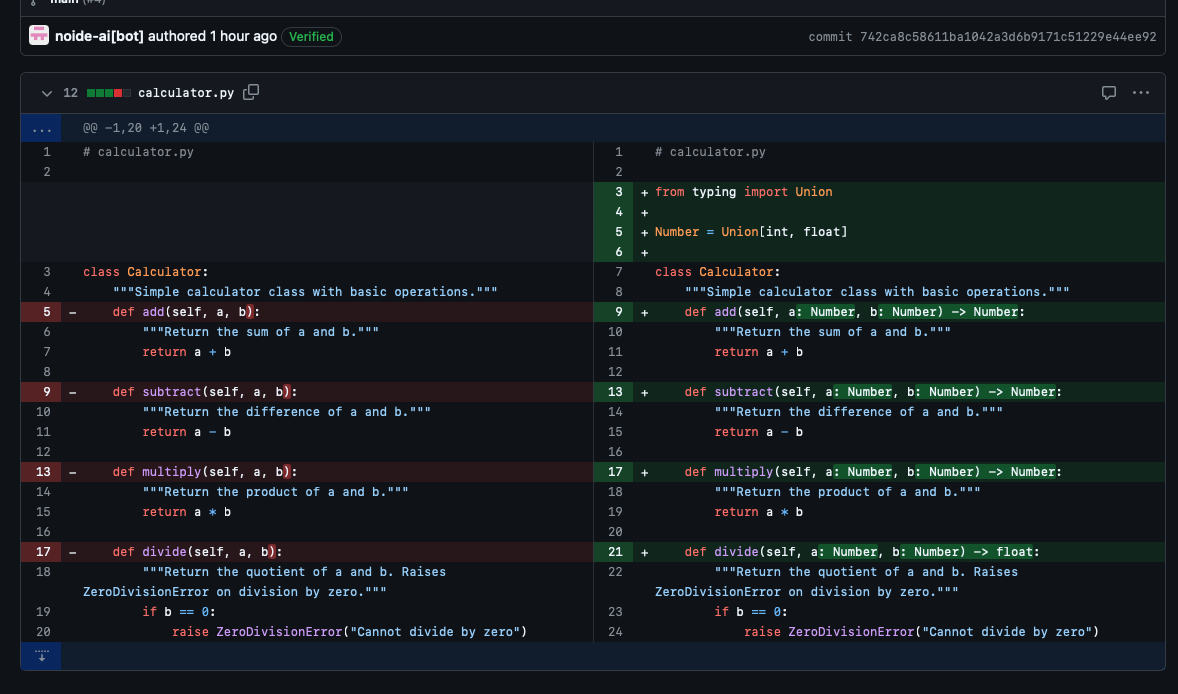
NoIDE added typehinting to the example class methods

💡 Inspiration
In fast-moving teams, small issues can cause disproportionate delays—not because they’re hard, but because the right person isn’t free to fix them. Developers are often focused on complex tasks, and minor fixes end up waiting in backlog queues. Meanwhile, team leads, PMs, and other stakeholders may spot the issue but don’t have the time or setup to make a change themselves.
We built NoIDE to break that bottleneck. It empowers teams to move faster by automating the routine and removing the overhead from well-scoped issues—whether it’s a quick typo, a data tweak, or a structured cleanup. NoIDE helps you turn “someone should fix this” into a pull request—without interrupting the flow of your developers.
🛠️ What it does
NoIDE is a GitHub app that automates the end-to-end issue-solving workflow.
Whenever a new issue is created:
- NoIDE extracts the issue content
- It analyzes the problem and the relevant parts of the codebase
- It generates and commits a solution, and
- Submits a pull-request for human review
It shines with:
- Minor issues: typos, renames, formatting, unused imports, etc.
- Patterned tasks: repetitive code changes, consistent bugfixes, or boilerplate generation.
- Structured enhancements: when the issue description is clear and scoped, NoIDE can go beyond basic fixes.
⚙️ How we built it
- GitHub App Integration: Listens to issue events via webhooks
- AI Integration: Uses LLMs to write code changes given an issue
- GitHub REST API: Creates branches, commits code, and opens pull-requests — all programmatically
🧠 Challenges we ran into
- We had to carefully optimize prompts to provide relevant context and repository code details to the LLM—while staying within strict token limits
- Faced GitHub rate limits—added token caching and optimized requests to stay within usage bounds
✅ Accomplishments that we're proud of
We were able to achieve a fast response time between creating a Github issue and generating a corresponding pull request. Our system intelligently analyzes issue context to produce relevant fixes rather than generic responses. We're also proud to have fully deployed our solution, with the landing page hosted on Vercel and the core bot infrastructure running on Google Cloud.
🎓 What we learned
- Learned to seamlessly integrate GitHub’s API into an automated application workflow
- Learned to dynamically modify prompts based on user input to best optimize AI responses for user needs
🚀 What's next for NoIDE
We're excited to keep pushing NoIDE forward. Here’s what’s coming:
- Deeper AI integration: We plan to make interactions with the AI more immersive and context-aware by expanding its role across the development lifecycle.
- Support for larger codebases: We're working on strategies like smart chunking and retrieval to help LLMs understand and operate on much bigger projects.
- Multi-platform support: Beyond GitHub, we aim to bring NoIDE to tools like GitLab, Jira, and Linear to support a wider range of workflows.
- More LLMs, more flexibility: We’re integrating support for multiple language models to improve performance, reduce costs, and give users more control over how NoIDE thinks.

Log in or sign up for Devpost to join the conversation.