-
-
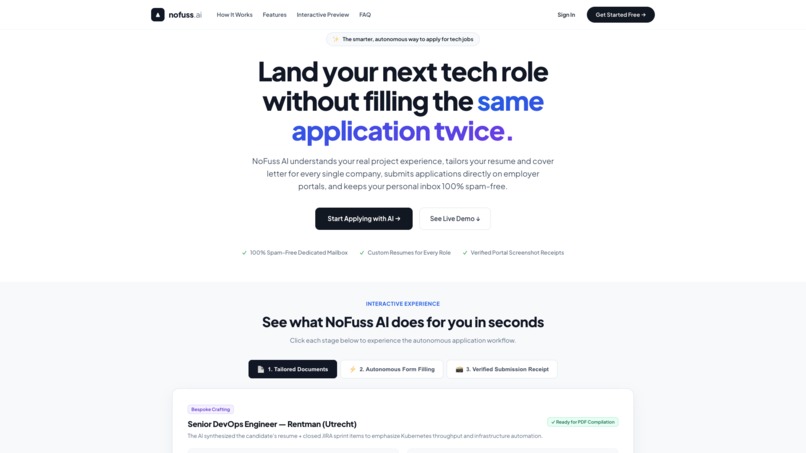
Landing Page
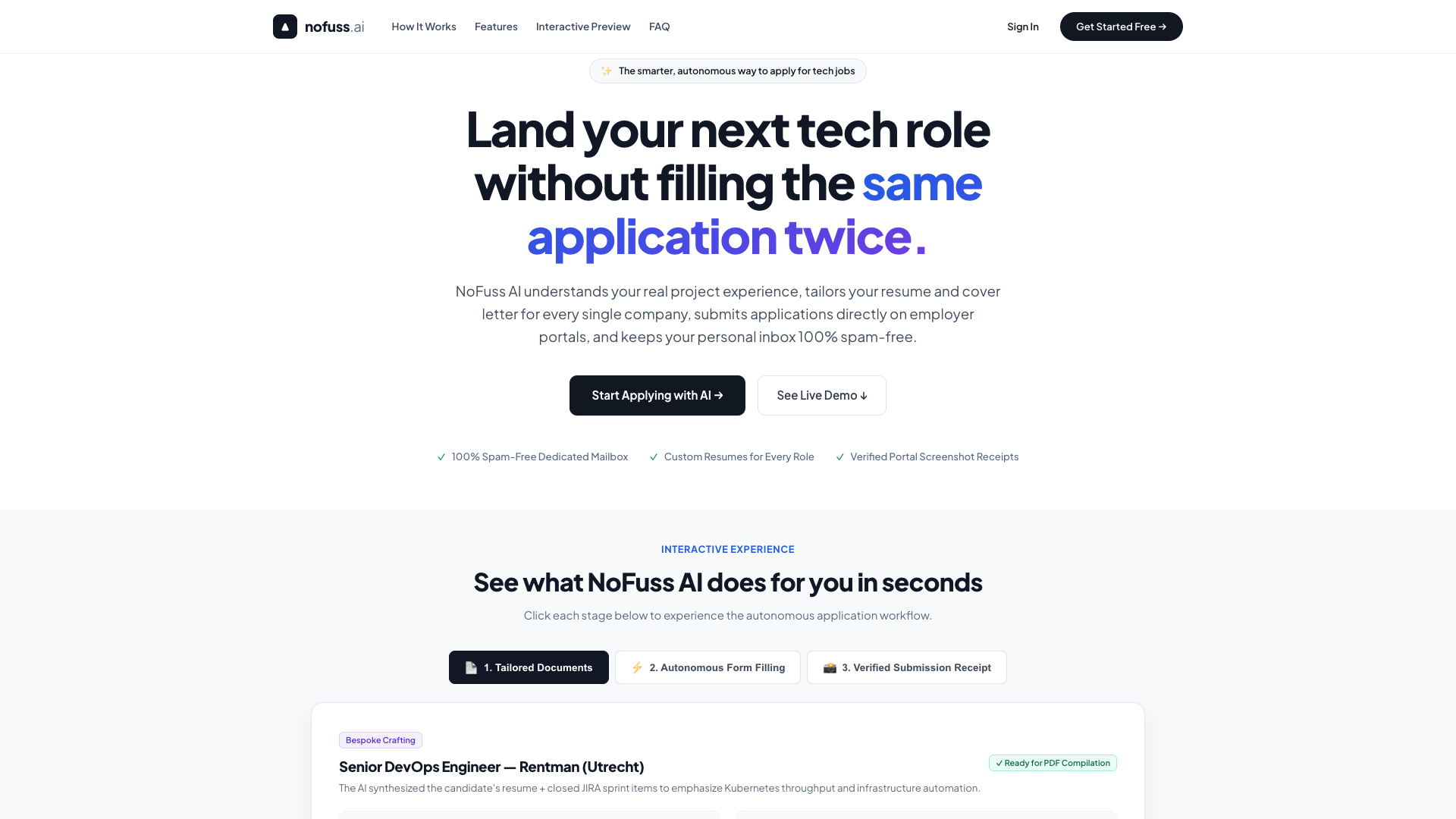
NoFuss.ai — Your Autonomous AI Job Application Agent. Think Beyond Your Resume.
Inspiration
Applying for jobs in tech had started to feel like a job in itself.
Every application meant navigating a different portal, creating or updating profiles, answering the same questions repeatedly, uploading documents, and dealing with Applicant Tracking Systems (ATS). On top of that, candidates are often expected to optimize their resume for every individual job by adding relevant keywords from the job description.
There are already AI tools that help tailor resumes and cover letters, but I noticed a fundamental limitation: most of them only know what is already written on your resume.
But a resume is only a small representation of what an engineer has actually done.
For example, my resume might say that I "improved system performance," but it doesn't contain every project I worked on, every JIRA ticket I completed, every production issue I solved, or every architectural decision I made.
That led me to one question:
What if an AI agent could actually understand what I have done—not just what my resume says I have done?
That became the inspiration for NoFuss.ai.
I built a system where candidates can provide additional real-world work context, such as JIRA work items, stories, and project information. The AI can use that context to better understand their experience, identify relevant achievements, tailor their applications, answer application questions, and ultimately apply for jobs autonomously.
And if the agent encounters a question it genuinely doesn't know the answer to, it shouldn't guess. It should simply ask the candidate once, remember the answer, and use it for future applications.
The goal was simple:
Take the repetitive work out of job applications while keeping the candidate in control.
What it does
NoFuss.ai is an end-to-end, multi-agent platform that automates the job application lifecycle—from understanding a candidate's experience to submitting applications through real employer portals.
1. Deep Work-Context Onboarding
NoFuss.ai goes beyond parsing a standard PDF resume.
Candidates can upload a JIRA work item CSV containing closed sprint tickets, stories, tasks, and PR summaries. The AI analyzes this information to identify concrete engineering achievements and measurable outcomes.
For example, instead of simply saying:
"Worked on improving application performance."
The agent can discover supporting context such as latency improvements, architectural migrations, infrastructure scale, automation efforts, or other measurable engineering outcomes.
This gives the AI a much deeper understanding of the candidate's actual work.
2. Privacy-Preserving In-App Mailbox
Job applications often result in recruiters, ATS platforms, and automated systems sending emails to a candidate's personal inbox.
NoFuss.ai provisions a dedicated disposable email address powered by MailSlurp, along with unique credentials for job applications.
Recruiter responses can then be monitored from within the NoFuss.ai application, helping keep the candidate's personal inbox separate from their job search.
3. Semantic Job Matching
NoFuss.ai converts both job descriptions and candidate competencies into vector embeddings.
Using Google Vertex AI text-embedding-004 and PostgreSQL with pgvector, the platform performs semantic matching between a candidate's experience and available job opportunities.
This allows the system to match based on meaning and skills rather than relying only on keyword matching.
4. Dynamic Resume & Cover Letter Tailoring
For every relevant opportunity, the AI generates a customized application.
It analyzes:
- The job description
- The candidate's base resume
- JIRA work history
- Previously verified answers
- Relevant engineering achievements
It then generates a tailored resume and cover letter in Markdown and dynamically compiles them into professional PDFs.
5. Human-in-the-Loop Attention Cards
Full autonomy doesn't mean the AI should guess.
When an application contains an important question that cannot be confidently answered from the candidate's existing information—for example:
- Expected compensation
- Relocation preferences
- Hybrid/remote requirements
- Visa sponsorship requirements
NoFuss.ai pauses and asks the candidate through a simple attention card.
Once the candidate provides the answer, it is stored and can be reused for future applications.
This creates a balance between autonomy and accuracy.
6. Autonomous Browser Submission
NoFuss.ai uses a Playwright-based browser automation engine to navigate real-world ATS platforms such as:
- Ashby
- Greenhouse
- Lever
- Teamtailor
The agent can navigate application forms, upload customized documents, answer questions, handle consent requirements, dismiss cookie dialogs, and submit applications.
We also implemented a 5-attempt self-healing retry loop.
When an application fails validation, the system inspects the live DOM, identifies the problematic field or missing interaction, attempts to resolve it, and retries the submission.
7. Dual-Receipt Visual Confirmation
Trust and transparency were important design goals.
For every submission, NoFuss.ai captures:
- A pre-submit form audit screenshot
- A post-submit confirmation/receipt screenshot
This provides the candidate with visual evidence of exactly what was submitted and confirmation that the application was successfully completed.
How We Built It
NoFuss.ai is a full-stack web application with an AI agent backend and an autonomous browser automation layer.
The user interacts with a React web application, while the backend orchestrates the AI agents, data processing, document generation, job matching, and browser automation.
AI & Agent Architecture
The AI backend was built using the Google Agent Development Kit (ADK) and the official google-genai SDK, running with models and services available through Google Vertex AI.
The system combines several capabilities:
- Agent-based orchestration
- Resume and work-context analysis
- Semantic vector matching
- Document generation
- Application question answering
- Browser automation
- DOM inspection
- Self-healing submission
- Human-in-the-loop interaction
Full-Stack & Cloud Infrastructure
Backend
- FastAPI
- Python 3.11+
- SQLAlchemy 2.0 AsyncIO
- Alembic
- Docker
- Playwright
Frontend
- React 18
- TypeScript
- Vite
- Vanilla CSS with a glassmorphic UI
Google Cloud
- Cloud Run
- Cloud SQL
- PostgreSQL 16
pgvector- Google Cloud Storage
- Secret Manager
- Vertex AI
The application was containerized and deployed to Google Cloud Run, with Cloud SQL providing the persistent PostgreSQL database and vector search capabilities.
Challenges We Ran Into
1. Building Reliable Browser Automation
The biggest challenge was getting an AI agent to reliably interact with real-world job application portals.
Initially, I explored Google's Computer Use capabilities through the ADK. However, I ran into compatibility issues between the ADK integration and newer Gemini models, particularly around differences in the tool definitions exposed by different model versions.
I eventually moved toward a Playwright-based browser automation approach, which gave us much more control over the browser and DOM.
But that introduced another challenge: every ATS platform behaves differently.
2. Non-Standard ATS DOM Architectures
One of the most interesting problems came from Ashby.
Traditional browser automation often expects things like:
<input type="radio">
<select>
<input type="checkbox">
But modern application portals frequently build their UI using custom components.
For example, an Ashby Yes/No question could be represented by two <button> elements inside a custom container rather than a traditional radio input.
Our automation agent could visually understand the question but still fail to actually select the answer correctly.
When the agent clicked "Submit", the application could silently reject the form because those custom buttons had not been toggled.
To solve this, we built a specialized DOM inspector that analyzes question containers, identifies interactive elements, checks attributes such as aria-pressed, and triggers the appropriate native button interactions.
This significantly improved the reliability of automated submissions.
3. Preventing AI Hallucinations in Job Applications
Another major challenge was deciding when the AI should answer and when it should stop.
LLMs are very good at generating plausible answers—which is exactly what we don't want when filling out a job application.
For example, if an application asks:
"What is your expected compensation in EUR?"
The AI shouldn't invent a number.
Similarly, questions around visa sponsorship, relocation, or work authorization can have significant consequences if answered incorrectly.
We therefore designed a strict fallback mechanism:
If an answer cannot be confidently grounded in the candidate's resume, work history, or previously verified answers, the agent stops and asks the candidate.
Once confirmed, the answer is persisted and reused for future applications.
This was an important lesson: a good autonomous agent isn't one that never asks for help; it's one that knows when it needs help.
Accomplishments We're Proud Of
The biggest accomplishment was getting the complete workflow working end-to-end.
I could provide my resume and JIRA work history, select a job, and watch NoFuss.ai:
- Understand my experience
- Match me with the job
- Identify relevant work achievements
- Generate a tailored resume
- Generate a customized cover letter
- Open the employer's application portal
- Fill out the application
- Upload the generated documents
- Handle custom form interactions
- Submit the application
- Capture a confirmation receipt
Seeing a browser autonomously navigate a real application portal and return a visual confirmation of the submission was one of the most rewarding parts of building the project.
Beyond the Resume
Another accomplishment I'm particularly proud of is the JIRA work-context integration.
By combining static resume information with real engineering work items, the AI was able to produce much richer application content.
Instead of being limited to the few achievements written on a resume, the agent could discover additional relevant experience from actual work history and use it when tailoring applications.
Built in Less Than a Week
I also managed to build the entire platform in less than a week, including the web application, AI agent architecture, vector matching, document generation, browser automation, cloud deployment, and the self-healing submission workflow.
What We Learned
This project taught me a lot about building AI agents, particularly using the Google Agent Development Kit (ADK) and the broader Google Cloud ecosystem.
Some of the biggest lessons were:
Agents Need Context
A resume alone isn't enough to understand someone's professional experience.
Giving the agent access to structured work history significantly improved the quality and relevance of the generated applications.
Agents Need Boundaries
Autonomy without guardrails can be dangerous.
For something as important as a job application, the agent should never fabricate information just because it can generate an answer.
The system needs clear boundaries around what information it is allowed to infer and when it must ask the user.
Real-World Automation Is Messy
Browser automation looks straightforward until you interact with real websites.
Different frameworks, custom components, dynamic DOMs, hidden elements, validation rules, cookie banners, and unexpected UI changes make reliable automation significantly harder than simple scripted form filling.
We learned that combining LLM reasoning with deterministic browser automation and DOM inspection provides a much more reliable approach than relying entirely on either one.
Prompting Is Only One Part of Building Agents
I also learned that building effective agents isn't just about writing better prompts.
The overall system architecture matters just as much:
$$ \text{Context} + \text{Tools} + \text{Memory} + \text{Guardrails} + \text{Reasoning} \rightarrow \text{Reliable Agent} $$
What's Next for NoFuss.ai
The ultimate goal is to take NoFuss.ai beyond a hackathon project and make it publicly available.
There are several areas I would like to explore next.
More ATS Platforms
Expand browser automation to support enterprise platforms such as:
- Workday
- Taleo
- SAP SuccessFactors
- Other multi-page authenticated application portals
Chrome Extension Companion
Build a lightweight Chrome extension that allows users to browse jobs on platforms such as LinkedIn or Indeed and trigger a NoFuss.ai application with a single click.
Better Application Intelligence
The next version could analyze application outcomes and learn which types of jobs, resumes, and application strategies generate better results.
A Truly Personal Job Agent
Ultimately, I want NoFuss.ai to become more than an application automation tool.
It should become a personal AI career agent that understands your professional history, continuously discovers relevant opportunities, prepares applications, communicates with recruiters, and helps you navigate the entire job search.
Final Thought
Job searching shouldn't feel like repeatedly filling out the same form for hours.
Your resume is only the surface-level representation of your career.
NoFuss.ai is built around the idea that AI should understand the work behind the resume—and use that understanding to do the tedious work for you.
NoFuss.ai — Your Autonomous AI Job Application Agent. Think Beyond Your Resume.
Built With
- fastapi
- gcp
- genai
- google-adk
- postgresql
- python
- react
