Inspiration
AI can answer a student before the student has had time to form a model of their own. That speed is useful, but it can collapse several possible meanings into one polished response and make fluency feel like evidence.
The project began with exactly that failure. I asked an AI whether string theory, geometry, and neural-network hallucination might connect. It replied that transformers calculate geodesics through the curvature of human thought: a beautiful explanation that collapsed supported facts, bounded mathematics, metaphor, and an unsupported mechanism into one sentence. The question was valuable. The answer had erased the labels needed to evaluate it.
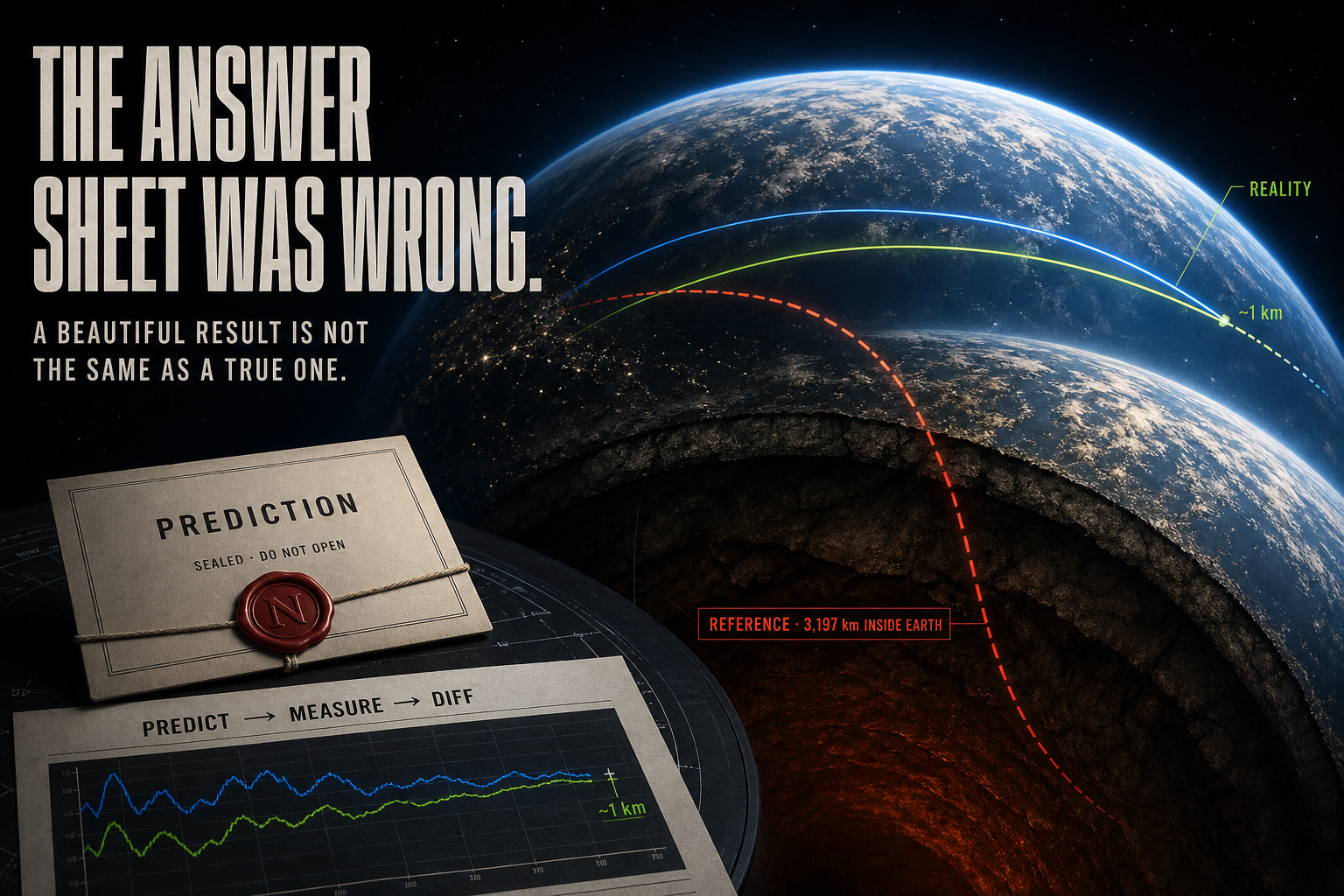
The problem became personal during an audit of an earlier orbital PINN project. A result that looked like a dramatic model failure turned out to be a worse failure in the answer sheet: the legacy reference path went about 3,197 km inside Earth and missed the analytic trajectory by about 1,463.75 km, while the exported hybrid was about 1.02 km away. The model was limited, but the benchmark behind the headline was broken. That experience became NOETHER's method: preserve the question, predict before reveal, measure with independent machinery, and inspect the difference.
What it does
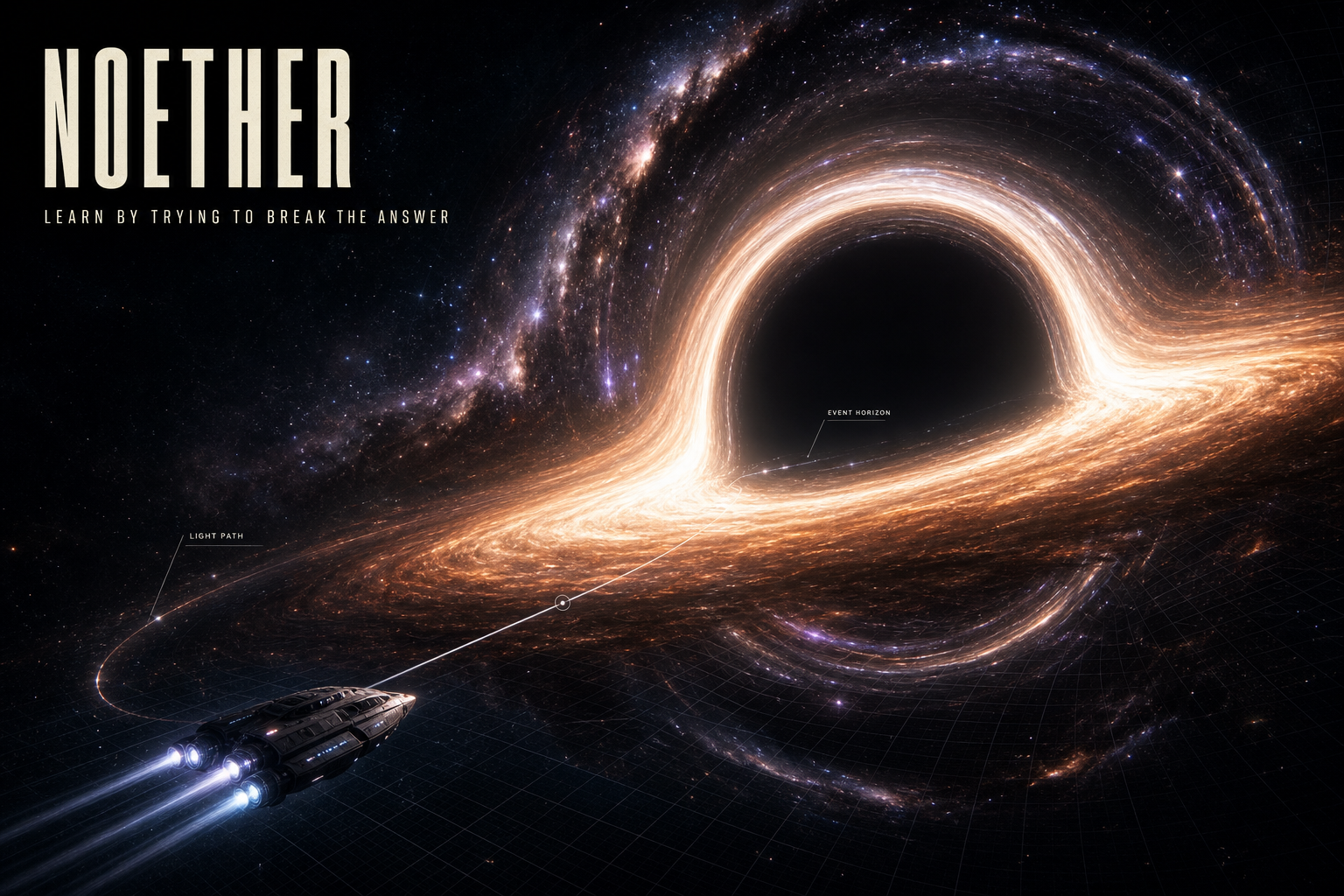
NOETHER is an interactive AI-literacy course and scientific playground. It teaches one reusable reflex:
Before accepting a confident answer, ask what was compressed, make a prediction, run a test, and label what the result cannot establish.
The public course moves through four connected acts:
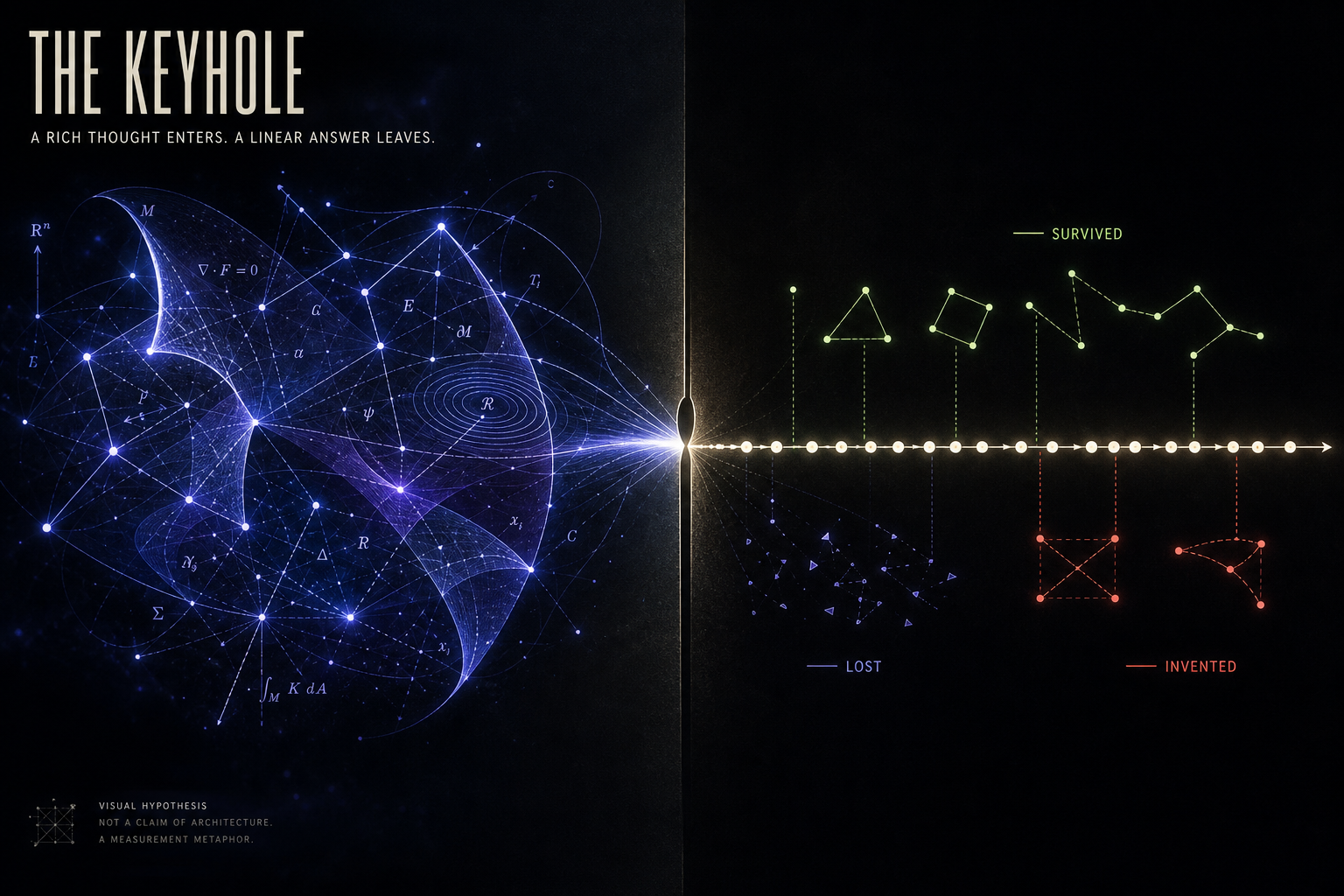
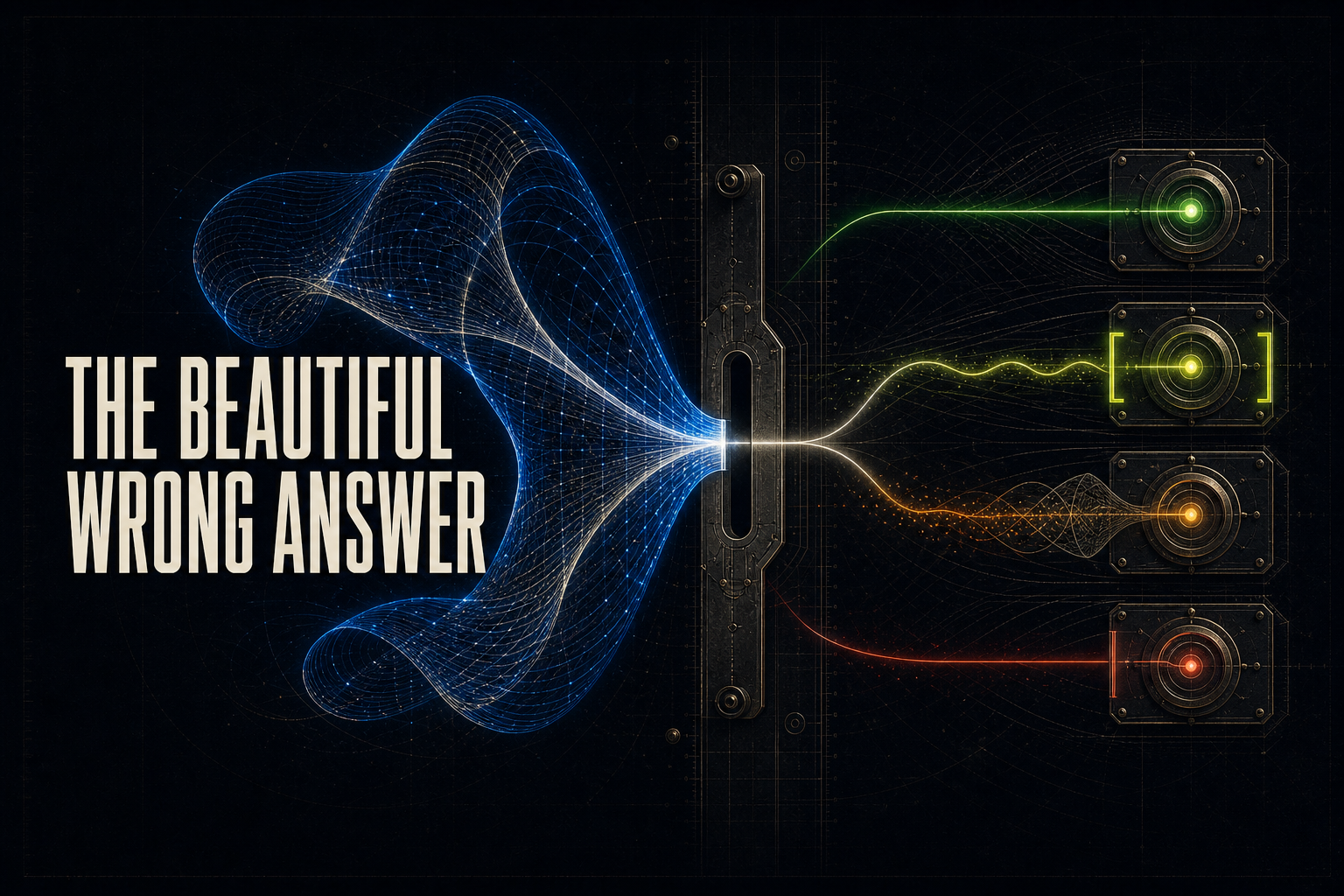
- The Keyhole makes serialization visible. A cinematic thought graph is forced into a one-dimensional token stream; relationships are lost, merged, or reconstructed. THE BOUNDARY then contrasts lossy encoding with the structured boundary descriptions studied in black-hole thermodynamics and holography. A prepared case, THE BEAUTIFUL WRONG ANSWER, audits the hypothesis that inspired NOETHER: high-dimensional representation geometry survives; ReLU piecewise-linear regions survive only as a bounded statement; a “geodesic through human thought” remains analogy; and physics-forced hallucination is not established. The learner then runs a counterexample showing that fewer dimensions need not lose information when capacity and a shared codebook make exact reconstruction possible.
- The Detector turns intuition into play. Learners predict before changing a sealed bottle, firing Newton's cannonball, steering an Artemis-inspired mission, or bending light around a Schwarzschild black hole. Every success forks into VARY IT / CARRY IT / FREE PLAY instead of becoming a dead end.
- The Case tells the real June benchmark story before opening the Orbit Law Duel. A sealed, preregistered synthetic experiment then compares a structure-preserving Hamiltonian learner with a same-data unstructured baseline without choosing the winner in advance.
- The Question Lab lives in ChatGPT through the official Apps SDK and MCP. GPT-5.6 maps a learner's exact question into materially different meanings. The learner chooses. Five typed, read-only tools must then end with either a compatible playable world or a bounded Learning Probe specifying what to change, hold fixed, measure, predict, and reflect on. “Unsupported” is never the final activity, and an unrelated Orbit experiment is never substituted.
Our deliberately narrow novelty is the complete chain: keyhole compression → an audit separating analogy from mechanism → prediction in a physics world → a named, audited real benchmark lie → live host-model tools under a constitution.
NOETHER does not decide that an idea is true, grade a learner's intelligence, or treat GPT prose as numerical evidence. The learner owns the question and prediction; GPT owns interpretations and probe proposals; deterministic code owns calculations; named evidence owns only a scoped comparison.
How we built it
Codex was the primary implementation environment. The long-running CORE-CODEX-01 task contains
the majority of the core build: product architecture, interactions, typed state machines, MCP
server, Apps SDK widget, deterministic engines, numerical cross-checks, responsive visual systems,
release tooling, and tests. The OWNER supplied the learning problem, scientific intuitions, prior
projects, evidence boundaries, product verdicts, and repeated unbriefed first-touch feedback; Codex
turned those judgments into executable acceptance criteria and working software.
The standalone product uses TypeScript, React, Vinext, Cloudflare Workers/Sites, Canvas 2D, SVG, and
self-hosted fonts. The ChatGPT companion uses the official OpenAI Apps SDK and Model Context
Protocol. map_question returns interactive branch cards when the host supports widgets and a
complete numbered transcript when it does not. The other tools validate concept bridges, supported
world configurations, evidence challenges, and bounded Learning Probes. The server accepts no
OpenAI API key, ChatGPT cookie, or account credential; ChatGPT hosts the model.
Numerical authority stays outside the language model. The project includes Velocity Verlet and RK4 cross-checks, analytic Kepler references, domain gates, a deterministic Schwarzschild light-ray instrument, and a sealed CPU-float64 PINN/Hamiltonian comparison. The black-hole lesson now opens inside a live GPU-computed Schwarzschild ray field; the exact capture-edge experiment remains a separate measurement instrument with its own limits.
Fable and Grok contributed adversarial planning and review. During an explicit, owner-authorized
late polish window, Fable also implemented a bounded visual/copy pass for Hawking motion,
Alcubierre flow, and the black-hole shader. CORE-CODEX-01 reviewed and integrated that work, added
the final Boundary claim audit, and owns the validated release. Codex with GPT-5.6 remains the
primary implementation task and model for the majority of the core functionality.
Challenges we ran into
The hardest challenge was not adding features; it was making every feature teach. Early builds were technically dense, visually impressive in places, and confusing to their own maker. Tiny controls, too many verbs, hidden stories, and dead-end question branches turned an Education entry into a filing cabinet. We rebuilt the product around one action at a time, worked examples before blank states, prediction-before-reveal gates, earned receipts, and an always-visible Free Play exit.
We also had to keep spectacular visuals honest. The holography lesson cannot claim that string theory explains transformers. A pair-particle cartoon is not a derivation of Hawking radiation. A Schwarzschild disk is not a Kerr simulation. Those limits became visible labels rather than footnotes.
Finally, browser animation uncovered a subtle production failure: requestAnimationFrame could
freeze important scenes in background-tab conditions. We replaced timing assumptions with a
visibility-safe wall-clock loop, added opt-in pixel-difference probes, and tested the actual public
deployment instead of trusting local screenshots.
Accomplishments that we're proud of
- A working any-question loop that reaches a playable world or a designed Learning Probe instead of ending at “unsupported.”
- An Apps SDK branch-card widget with one-tap learner choice and a complete text fallback.
- A prediction-before-reveal architecture enforced by code, not motivational copy.
- A prepared claim audit that attacks the project's own founding hypothesis and preserves a useful intuition without promoting its false mechanism.
- A real audited benchmark failure presented as Case File No. 1, with the exciting but unsupported legacy headline quarantined.
- A preregistered six-run neural dynamics comparison whose frozen classifier returned
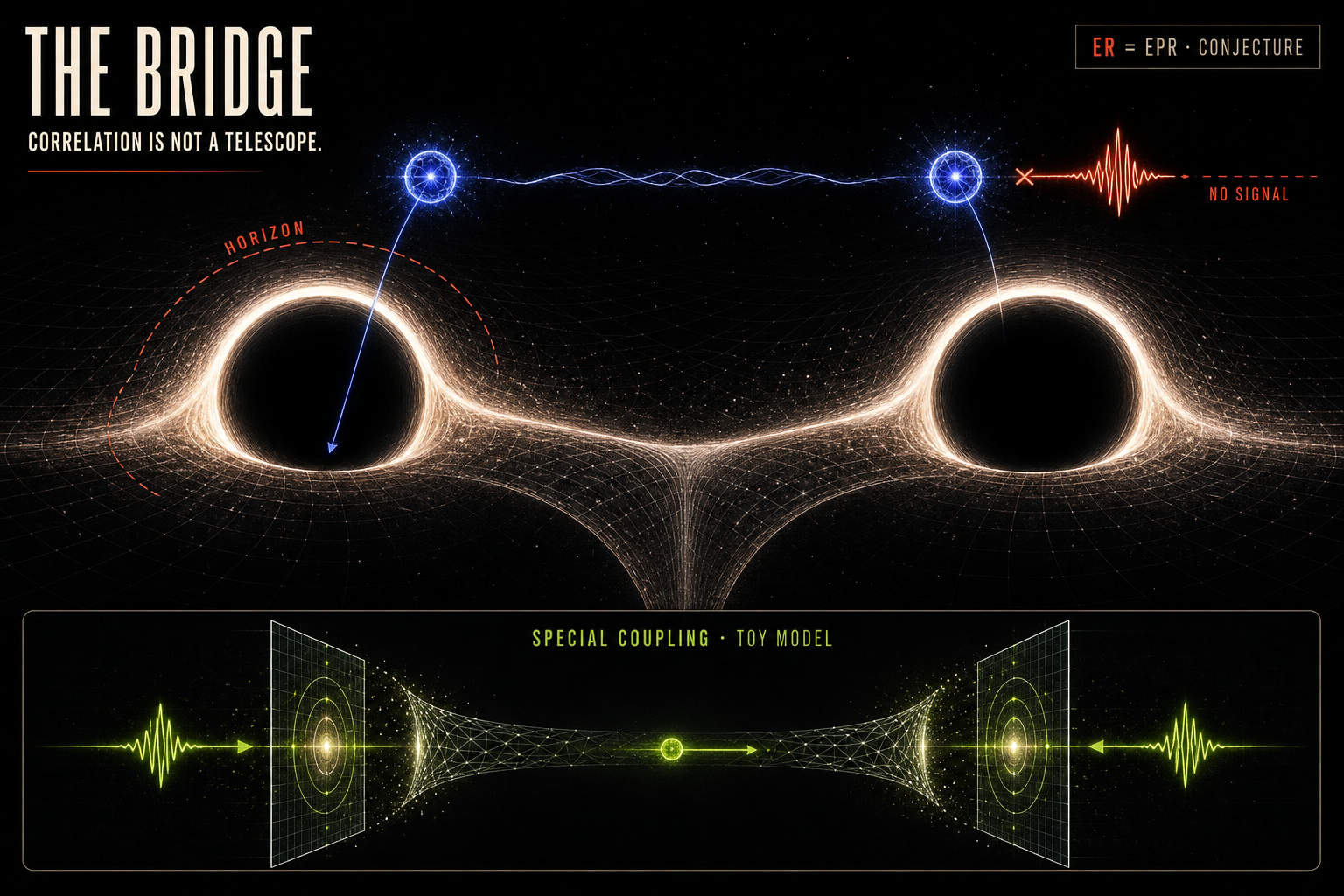
STRUCTURED_ADVANTAGE, including all baseline escapes rather than dropping failed rollouts. - An eight-chapter Black-Hole Flight spanning a live lensed universe and volumetric disk, pre-horizon decision, causal diagram, explicit Alcubierre counterfactual, animated Hawking future, Page-curve/island experiment, ER=EPR/no-signalling lesson, and deterministic Schwarzschild capture-edge instrument.
- 209/209 application tests and 15/15 MCP tests, plus clean typechecks, lint, production build, public motion probes, legibility checks, and a ten-question zero-dead-end matrix on the W5 release.
What we learned
Prediction-before-reveal is not a slogan; it has to be a state transition. A useful analogy is not a mechanism, and a lower-dimensional representation is not automatically lossy. The danger is under-specified compression followed by confident reconstruction without a check. A model can conserve energy and still learn the wrong thing. A low numerical error can hide a bad domain. A benchmark can be the weakest part of an evaluation. Fewer dimensions do not automatically imply loss: exact recovery can exist when enough capacity and a shared code are present. Without such a guarantee, the honest response is not panic or blind trust—it is to predict, measure, and inspect the diff.
We also learned something about human–AI collaboration from building NOETHER itself. Tests could prove that a feature worked, but only a person using it without a script could reveal that it had no purpose. The product improved when human confusion became release-blocking evidence rather than feedback to explain away.
What's next for NOETHER
After Build Week, we want to test the course with students and teachers, study whether its receipts transfer to unfamiliar AI answers, and publish new Question Lab adapters only when they have honest measurement contracts. We also want to extend the scientific worlds carefully: Kerr rotation, stronger Hamiltonian baselines, richer mission dynamics, and educator-authored Learning Probe templates. A quote-backed Thought Atlas would preserve the source questions as a branching graph of derivations, analogies, conflicts, and open experiments instead of collapsing months of thought into one canonical summary. These are directions, not claims about the current release.


Log in or sign up for Devpost to join the conversation.