-
-
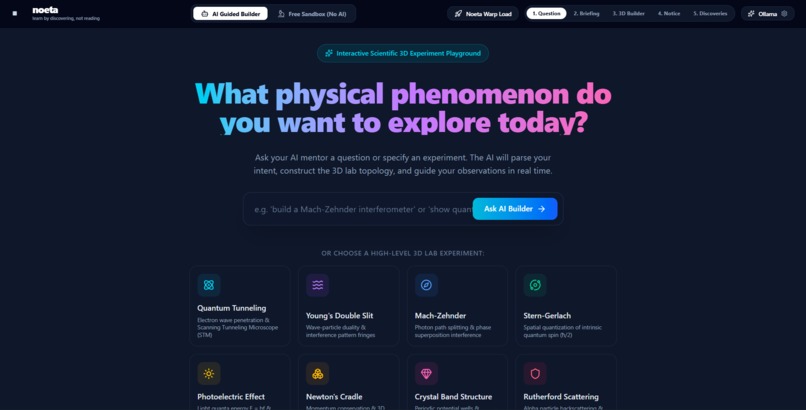
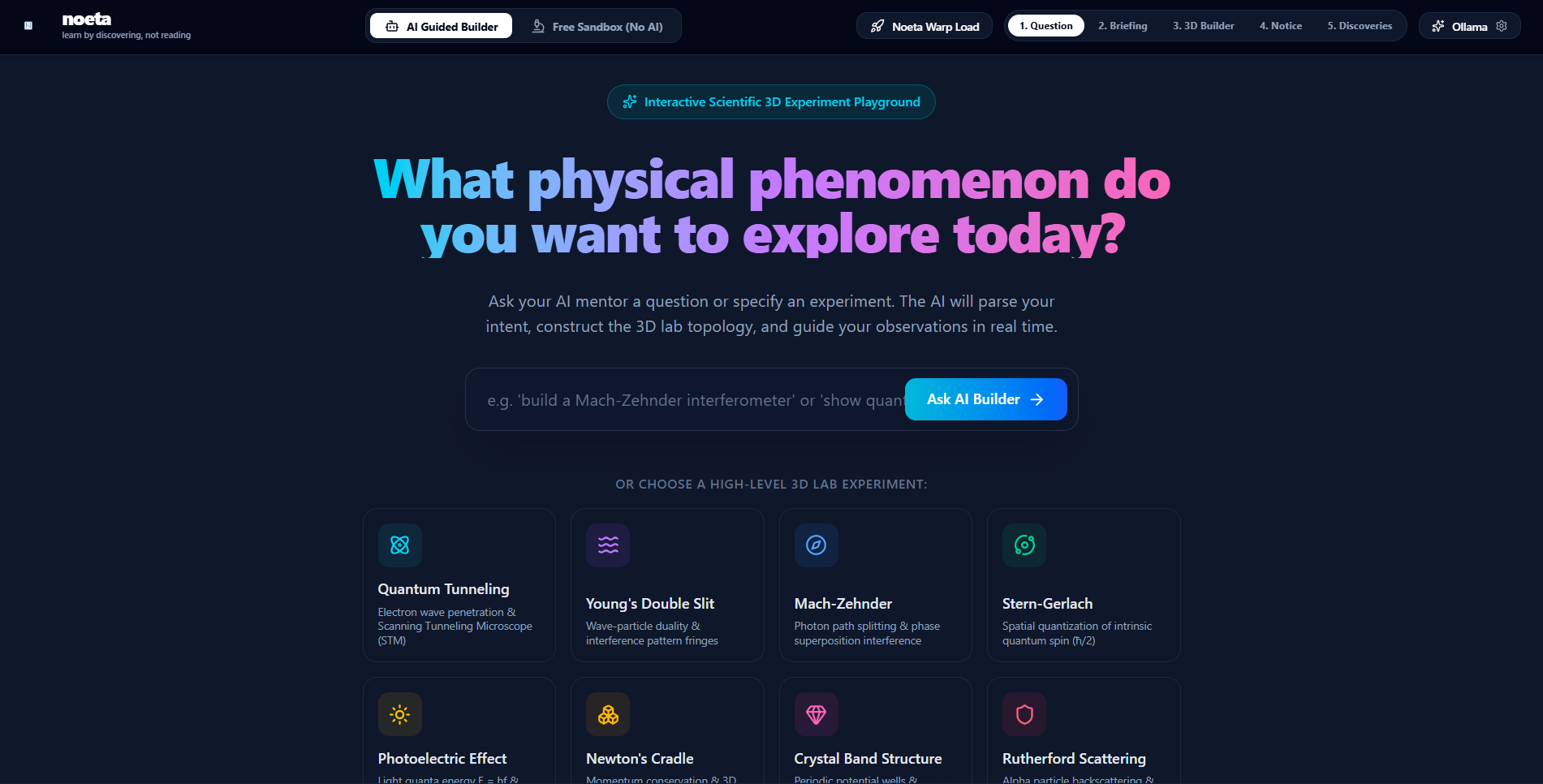
Home page
-
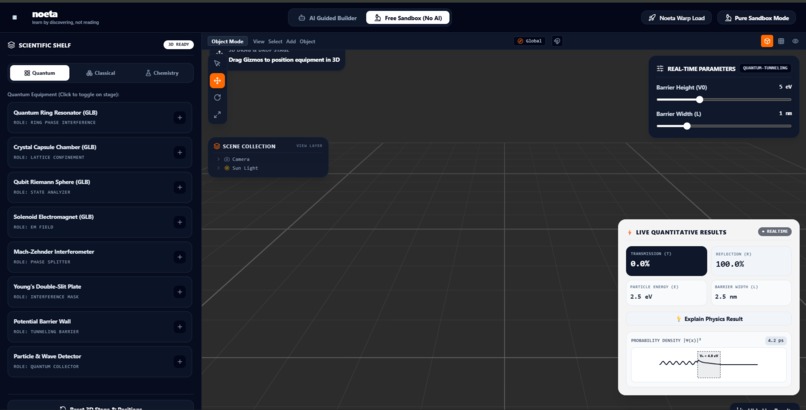
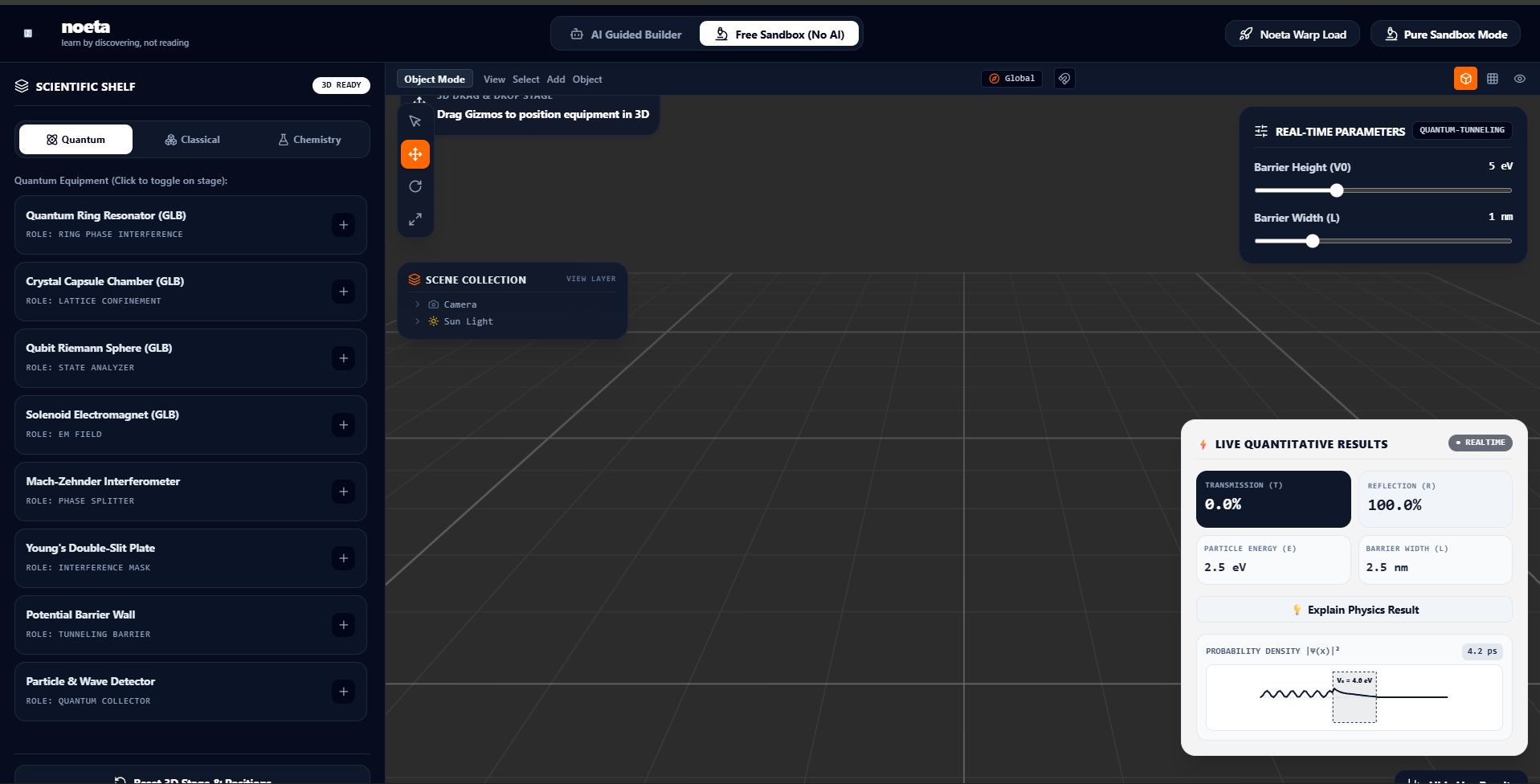
sandbox
-
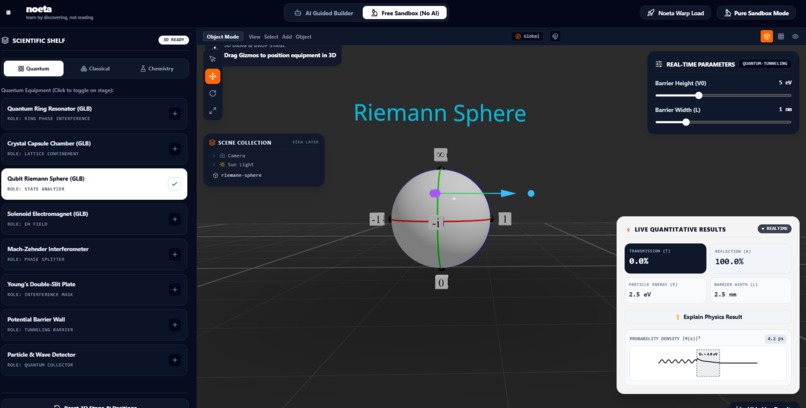
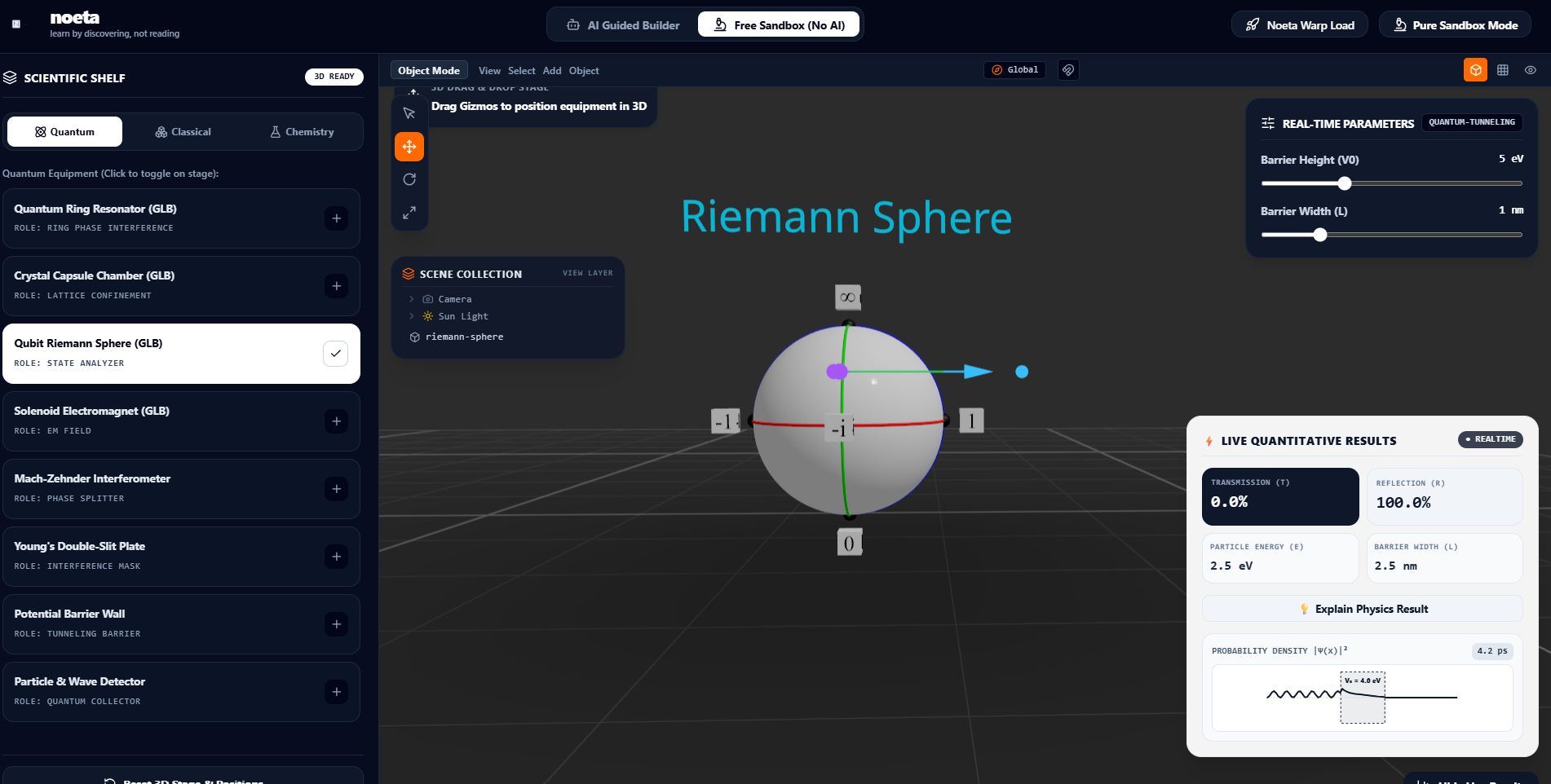
3d models- riemann sphere
-
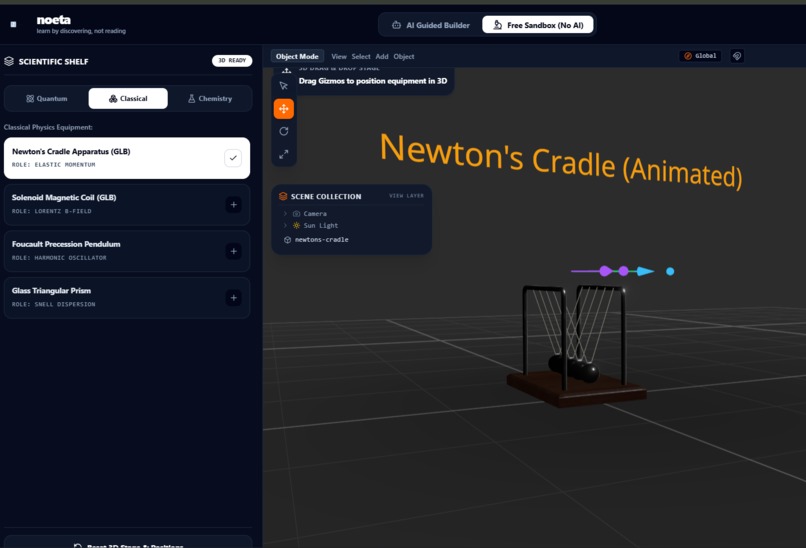
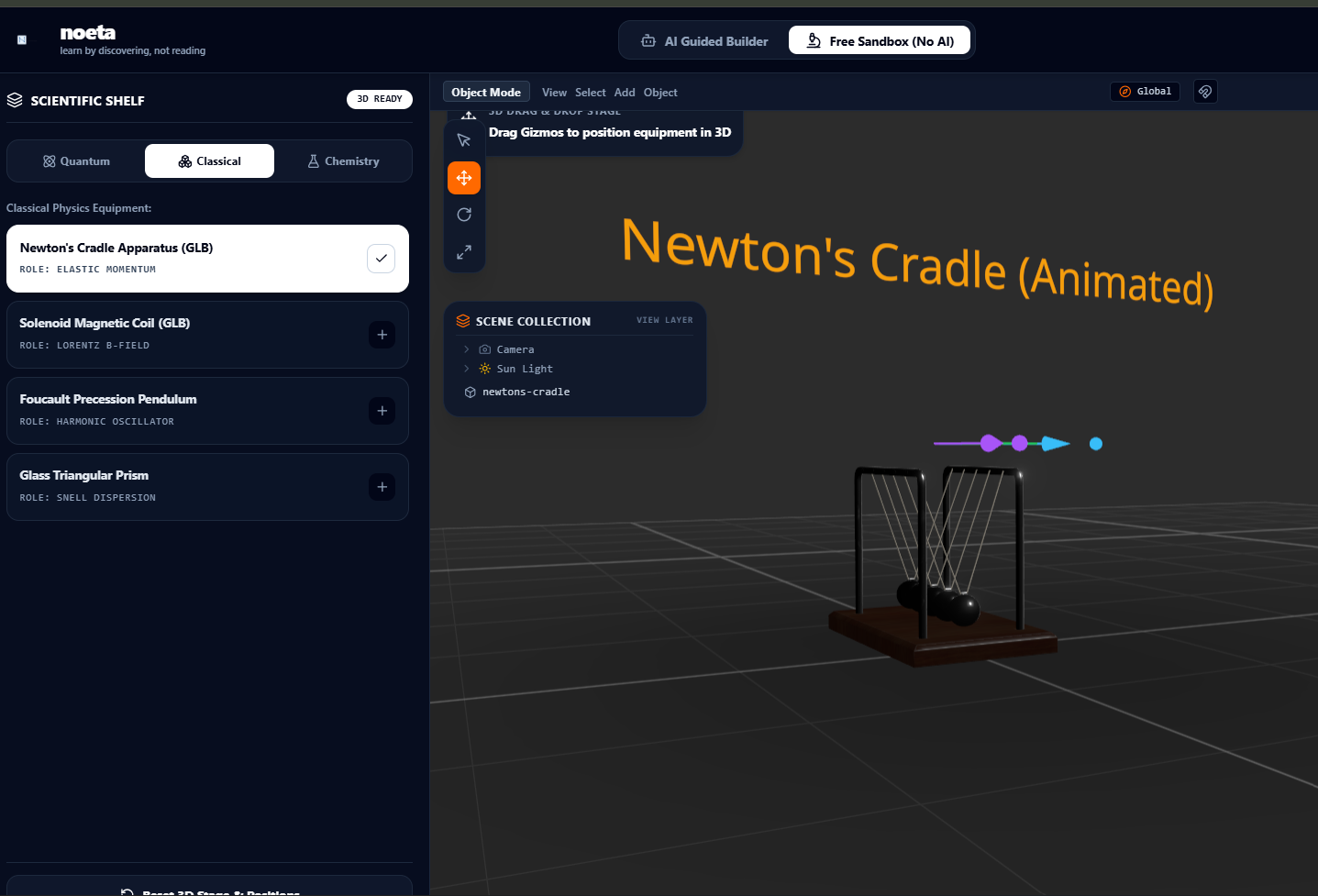
3d model- newtons cradle
-
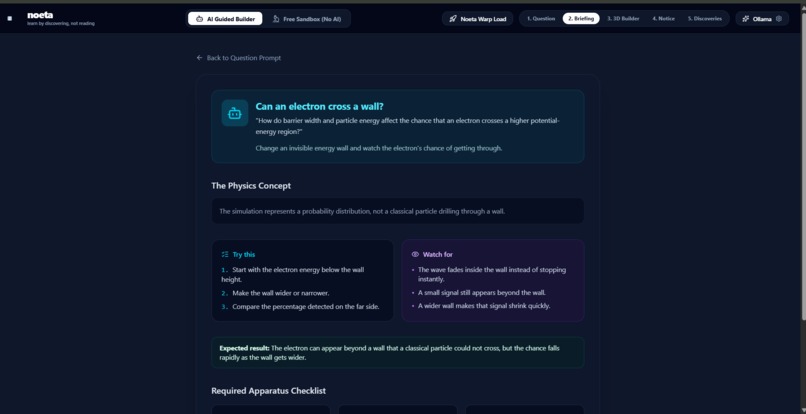
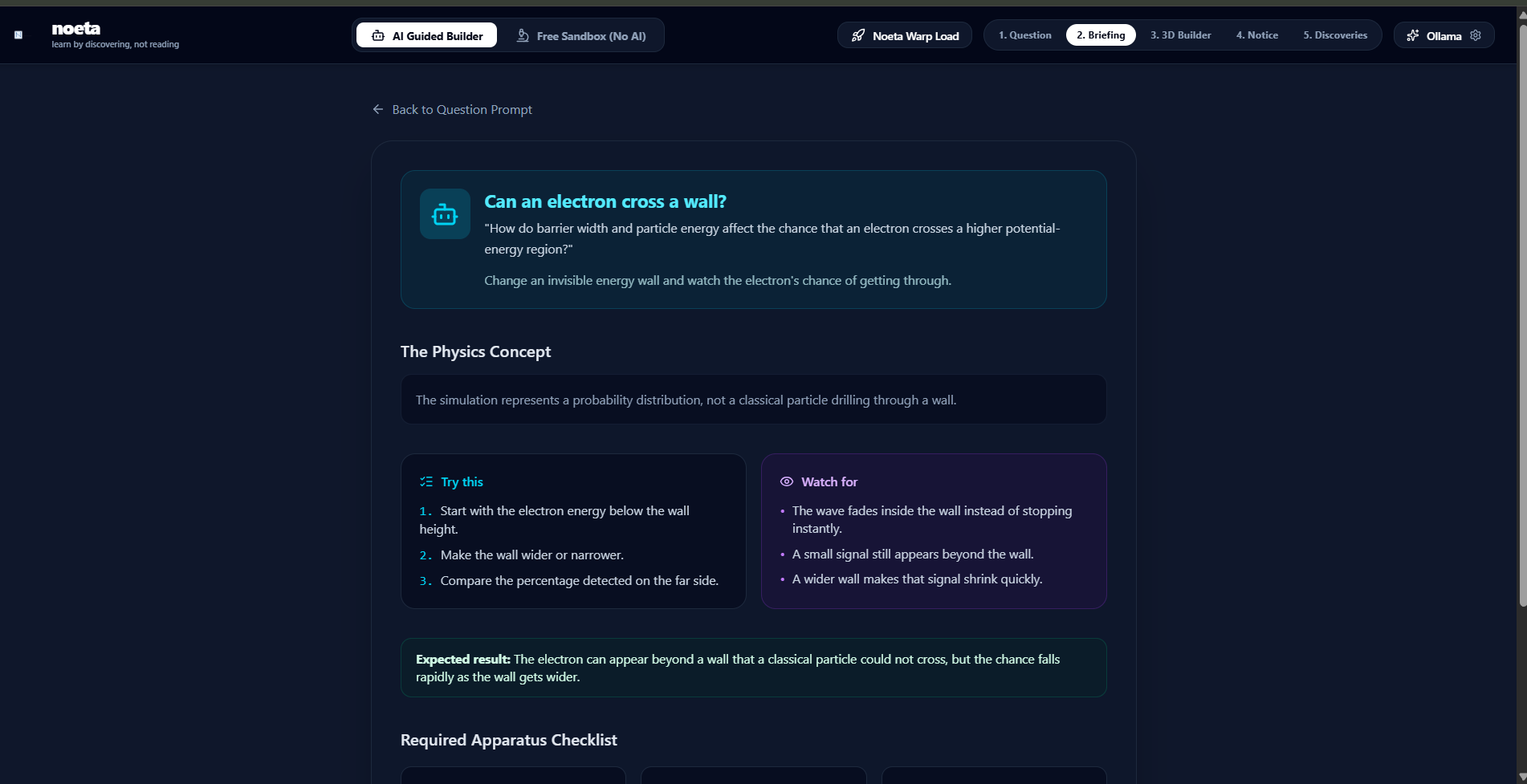
Ai guided builder
-
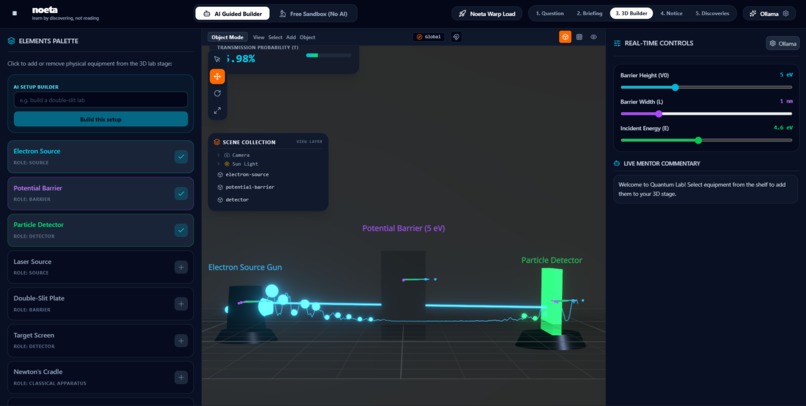
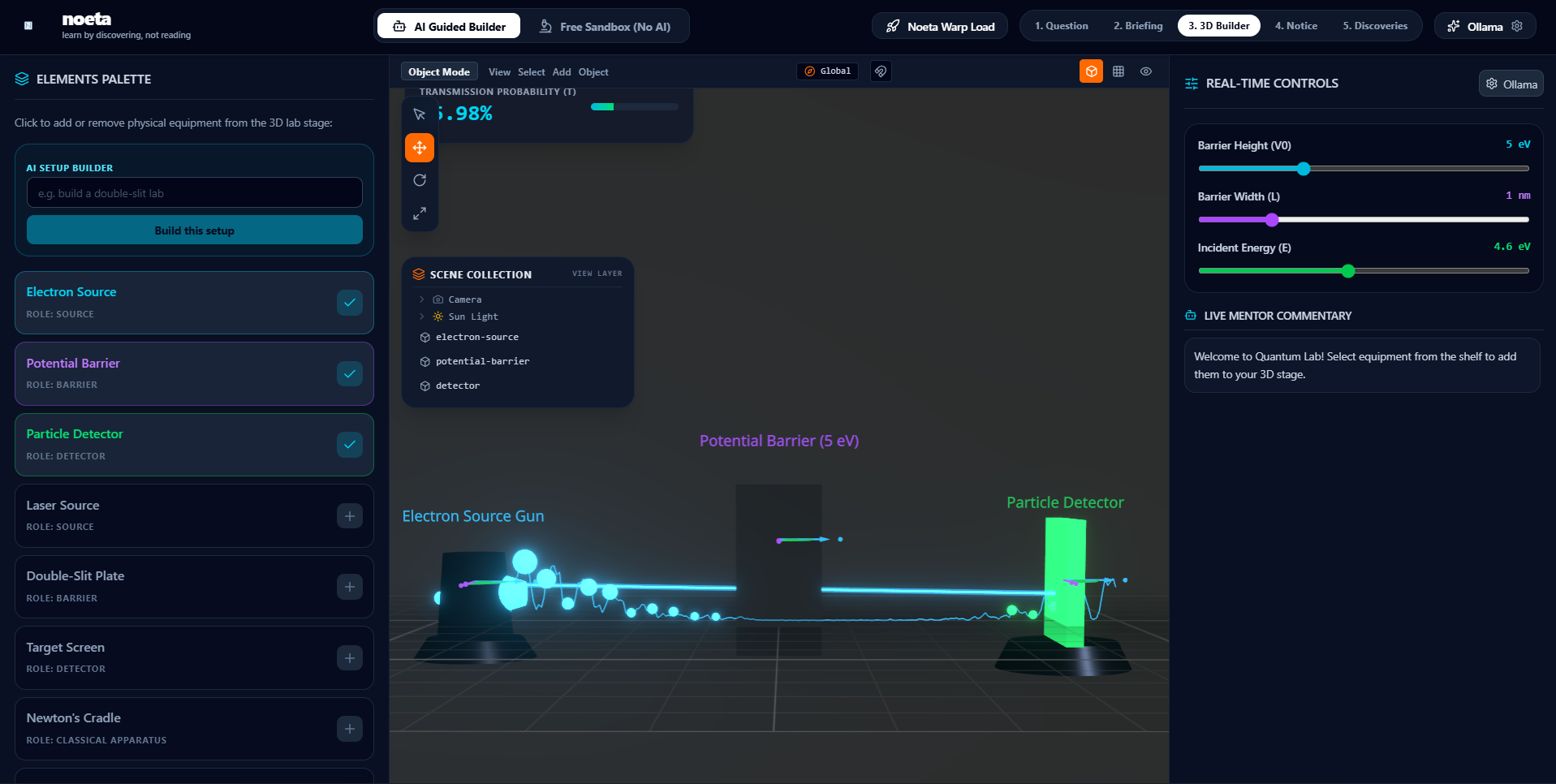
final output of experiment
Noeta
Inspiration
This started from a simple frustration: textbooks explain quantum tunneling with a single formula and a flat diagram, and that's it. You're told that a particle can sometimes pass through a barrier it shouldn't have enough energy to cross, you see one static picture, and you're expected to just... believe it. That's not how anyone actually builds understanding.
We wanted something you could touch. A sandbox where you could drag the height and width of a barrier yourself and instantly watch a wave bend, bounce back, or slip through — in a real 3D scene, not a textbook page — with an AI standing next to you making sure you're actually setting the experiment up right.
What it does
Noeta is a 3D science lab you talk to. Ask it about a phenomenon like quantum tunneling, and three things happen together:
- It pulls up a structured description of that experiment — what pieces you need, what to expect, common mistakes people make — instead of just guessing an answer on the spot.
- It drops you into a real, interactive 3D lab where you can see the wave packet, the barrier, and the probability of it getting through, all rendered live and moving in real time as you adjust things.
- An AI mentor watches what you're doing. If you set something up wrong — say, you forgot to add a barrier — it tells you, explains why that won't work, and helps you fix it. When something changes, it explains what happened using the actual numbers from that exact moment, not a generic script.
The goal is one smooth loop: ask, build, watch, understand — not ask, read, forget.
How we built it
Three layers work together under the hood:
The physics engine. The real math behind quantum tunneling is genuinely complex to solve moment-by-moment, so we run that calculation in the background on its own separate thread instead of on the same thread that's drawing the screen. That way, when you drag a slider, the animation stays smooth instead of freezing while the math catches up.
A trained model that predicts the physics fast. On top of the exact solver, we trained a neural network (using PyTorch) on thousands of examples generated by that solver, so it can predict what the wave will do almost instantly, rather than solving the full equation from scratch every single time. Think of it as the solver teaching a faster apprentice to make quick, accurate predictions.
The 3D lab itself. Built with React Three Fiber, which lets us render actual 3D objects — the wave packet, the barrier, lab equipment — in the browser, styled like a clean, professional lab workspace (control panels, a scene list showing what's currently in view, and so on).
Challenges we ran into
- Some 3D models loaded pitch black. The format we used for 3D objects has a "glowing" material style, but the tool we used to load them into the browser was silently stripping out the glow color, leaving objects looking flat and dark. We had to write a small fix that puts that color information back in manually.
- Animated models kept resetting their position. Some of our 3D assets came with built-in animations that, every single frame, would override where we'd manually placed them on screen. We fixed this by applying our adjustments at a lower level than the animation, so our changes and the animation could coexist instead of fighting each other.
- The on-screen panels kept overlapping. With multiple floating control panels (sliders, a list of scene objects, etc.), things would visually collide on smaller screens. We solved it by deliberately splitting panels to opposite sides of the screen, giving everything room to breathe.
What we're proud of
- The heavy physics math runs completely in the background without ever making the visuals stutter or freeze — dragging a barrier's width feels instant and smooth.
- We got real, detailed 3D lab equipment (things like a Newton's cradle, a quantum ring model, and other physical objects) working inside the same interactive scene, all synced up so moving something in 3D updates its listing in the scene panel too.
- We actually trained a working model on real physics data, with real accuracy numbers and training charts to back it up — not just a demo that looks convincing.
What we learned
- How to split heavy calculations onto a background thread so they don't compete with what's happening visually on screen, and how to pass data back and forth between the two without slowing things down.
- How 3D file formats and the tools that load them can quietly break things (like color) in ways that aren't obvious until you go looking, and how to fix that at the source.
- How to design a screen with a lot of moving, adjustable parts so everything stays organized and nothing overlaps, no matter the screen size.
What's next for Noeta
Right now we've deliberately kept this focused on just a couple of experiments — quantum tunneling and wave interference — so the AI mentor and the physics underneath it are actually solid, instead of stretched thin across too many topics. The way it's built means we can grow it without starting over: more experiments, other areas of science (space, optics, chemistry), different environments to run experiments in (a vacuum, the Moon, deep underwater), and eventually letting other people contribute new experiments that get reviewed before they're trusted and added in.


Log in or sign up for Devpost to join the conversation.