-
-
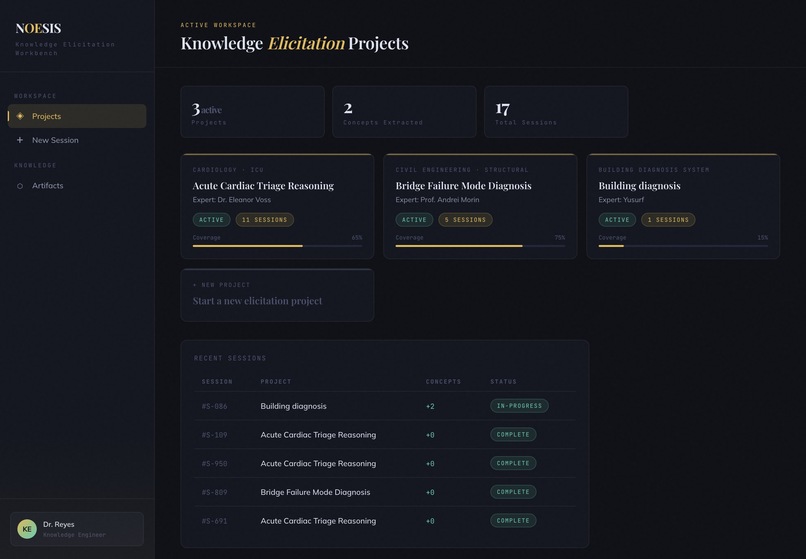
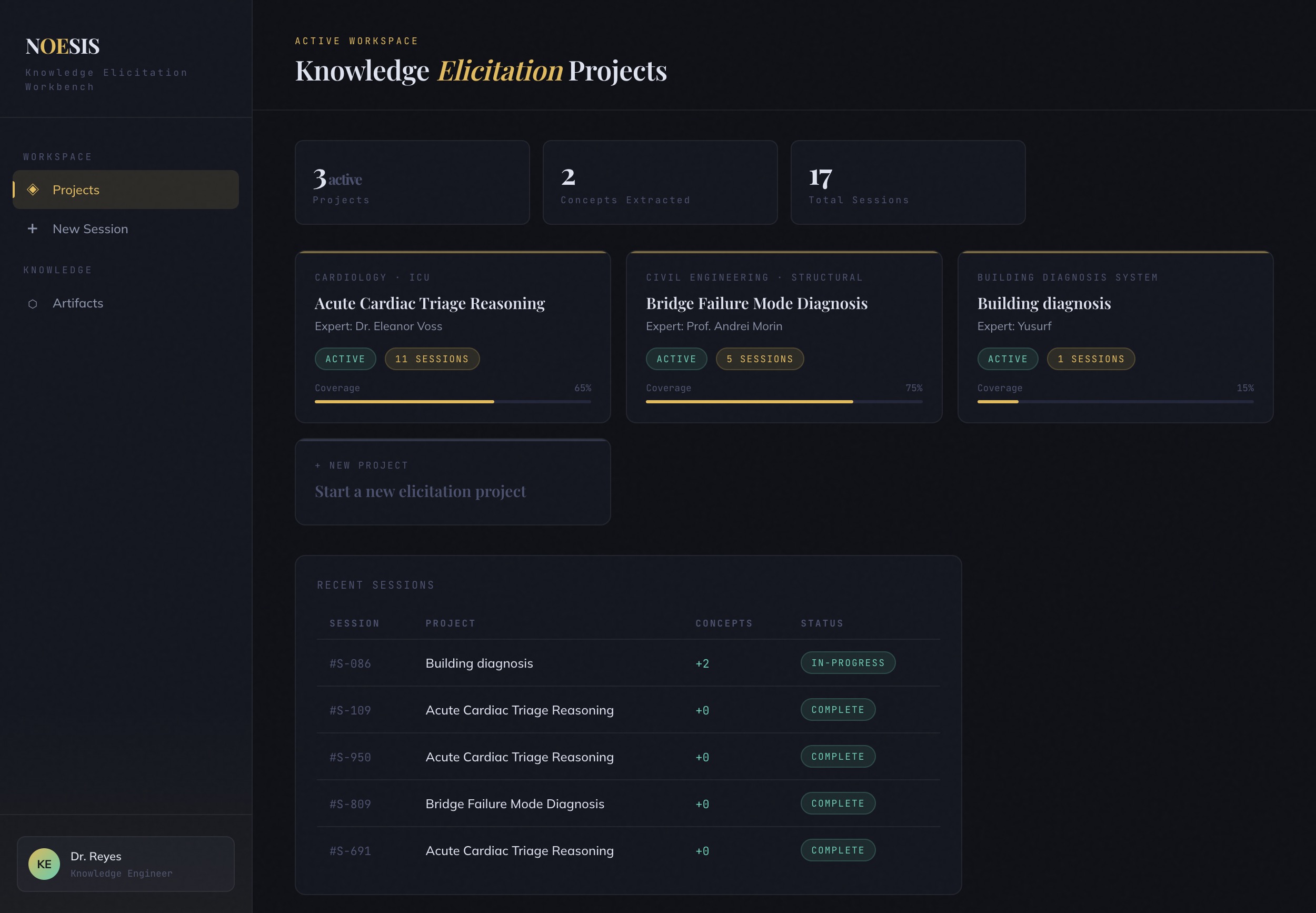
home page
-
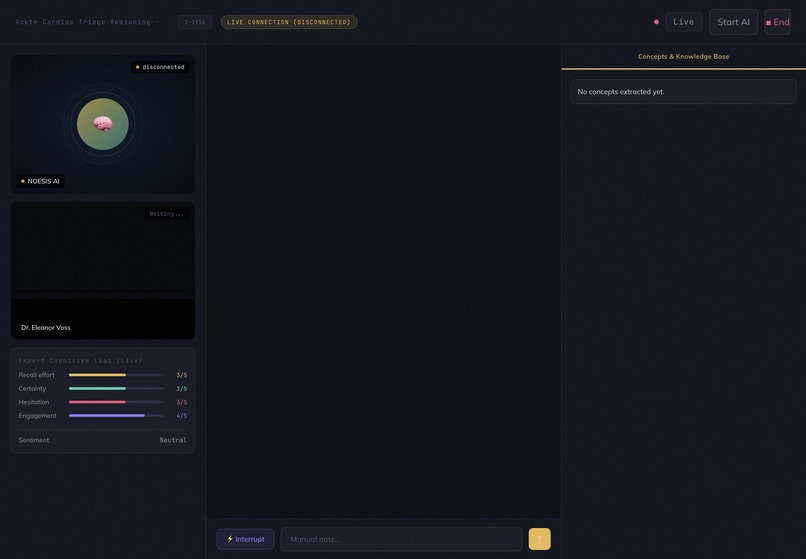
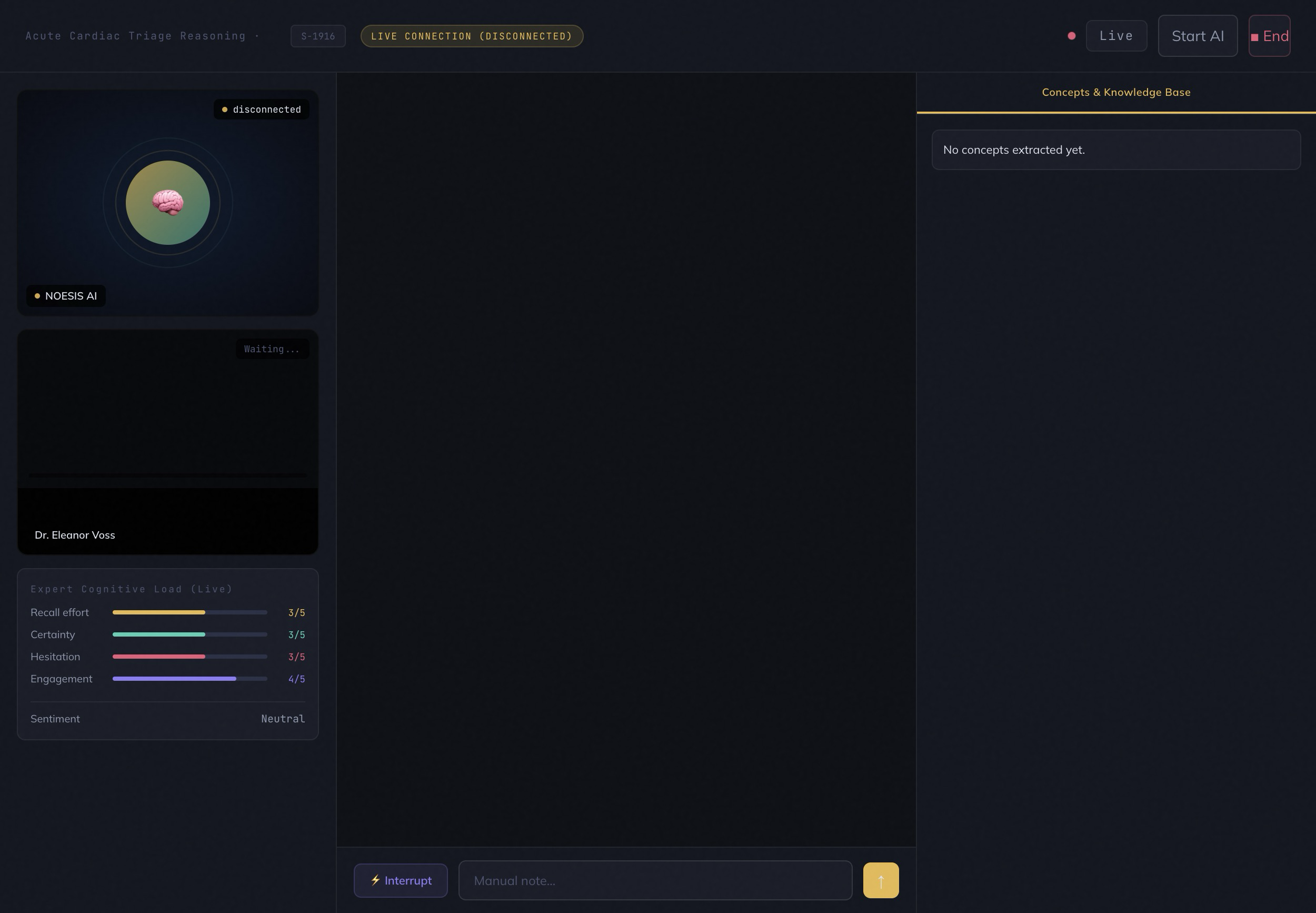
session page
Inspiration
Every small business has someone who can diagnose problems, make decisions, and solve issues that others can't. Their knowledge isn't written down; it lives in experience, intuition, and years of practice.
When these experts retire, leave, or simply aren't available, businesses lose more than an employee; they lose how things actually work.
Traditional knowledge elicitation requires consultants, cognitive scientists, and months of interviews, making it inaccessible for most organisations.
We built Noesis to make capturing expert knowledge simple, affordable, and scalable.
What it does
Noesis is an AI-powered knowledge elicitation interview platform.
It conducts structured interviews with experts to extract the knowledge behind how they think, diagnose problems, and make decisions.
Instead of static documentation, Noesis produces: structured expert knowledge, searchable reasoning and decision rules, evolving knowledge graphs, which can be integrated into internal RAG system.
Experts only need to talk whenever and wherever they like. Noesis asks the right questions and turns experience into structured knowledge.
How we built it
We combined several technologies to create an intelligent interviewing system:
Gemini Live API for real-time conversational interviewing
Automatic voice activity detection for natural dialogue flow
LLM-driven elicitation strategies based on cognitive science techniques, laddering, concept probing, critical incident analysis, etc.
Structured knowledge extraction pipelines to convert interviews into graphs and decision rules
Lightweight web interface for experts to interact naturally during sessions
The system continuously listens, asks follow-up questions, and organises insights into structured knowledge.
Challenges we ran into
One of the biggest challenges was extracting tacit knowledge: the things experts know but rarely articulate.
Experts often say things like:
“I just know when the system sounds wrong.”
Translating those instincts into structured, usable knowledge required designing interview prompts that gradually uncover the reasoning behind their decisions. Also, we integrate some interview techniques from cognitive science to help probe deeper into the expert knowledge.
We also had to solve:
managing real-time conversation flow
detecting when an expert finished speaking, both automatic detection by Gemini and a manual threshold of microphone activity
structuring unstructured dialogue into useful knowledge models
Accomplishments that we're proud of
Built an AI system that can conduct knowledge elicitation interviews
Captured complex expert reasoning through natural conversation in flexible time and location
Converted interview responses into structured knowledge representations, which can be integrated into the internal RAG system for direct document reference
Created a platform that small businesses could realistically use
Demonstrated how AI can preserve decades of experience
Most importantly, we showed that knowledge elicitation doesn't need to be expensive or exclusive to large enterprises.
What we learned
We learned that capturing expertise is not just about asking questions — it’s about asking the right questions at the right moment.
Experts often don't realise how much they know until someone guides them through their reasoning.
We also learned that AI can play a powerful role as a knowledge interviewer, helping organisations surface insights that would otherwise remain hidden.
What's next for Noesis: knowledge elicitation interview platform
Next, we want to expand Noesis into a full organisational knowledge system.
Future developments include:
automatic knowledge graph generation
expert reasoning simulations
onboarding assistants trained on captured knowledge
domain-adapted interview models
enterprise integrations with internal documentation systems
Our long-term vision is simple:
No organisation should lose its knowledge when an expert leaves. Noesis ensures that experience becomes shared intelligence.


Log in or sign up for Devpost to join the conversation.