-
-
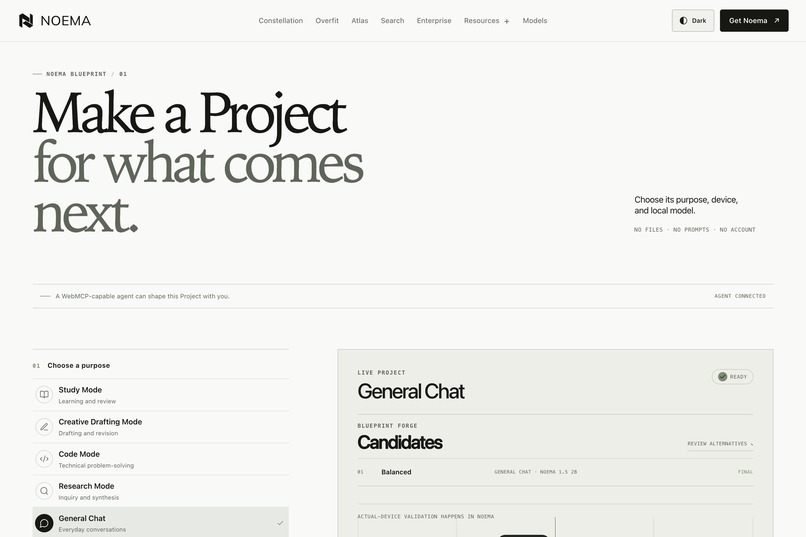
Create a private on-device Noema project from the web: without sharing files, prompts, conversations, or account data.
-
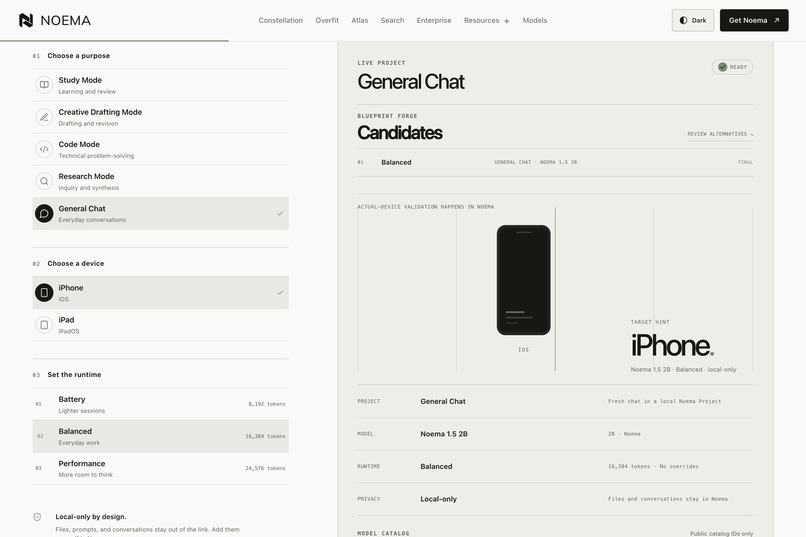
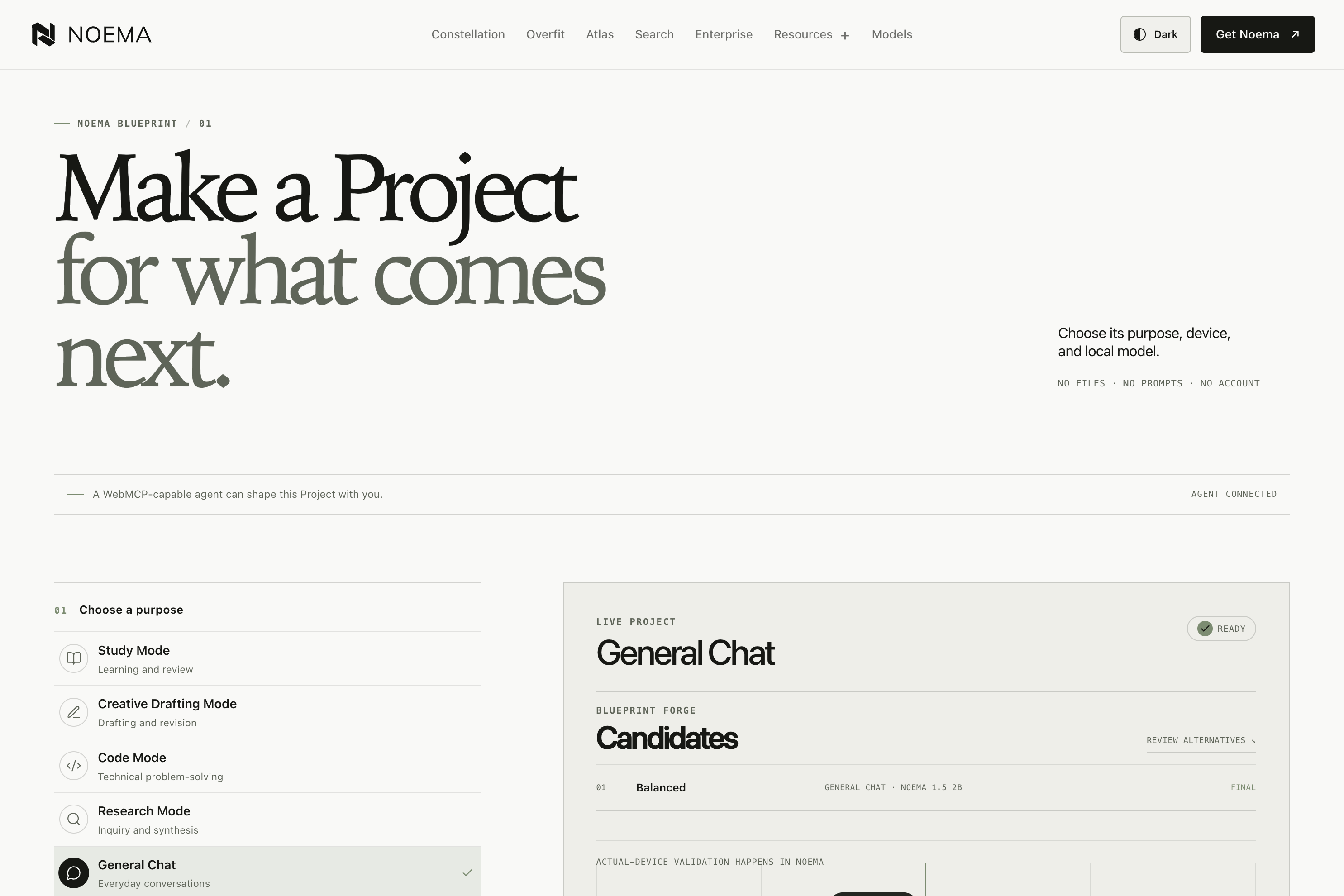
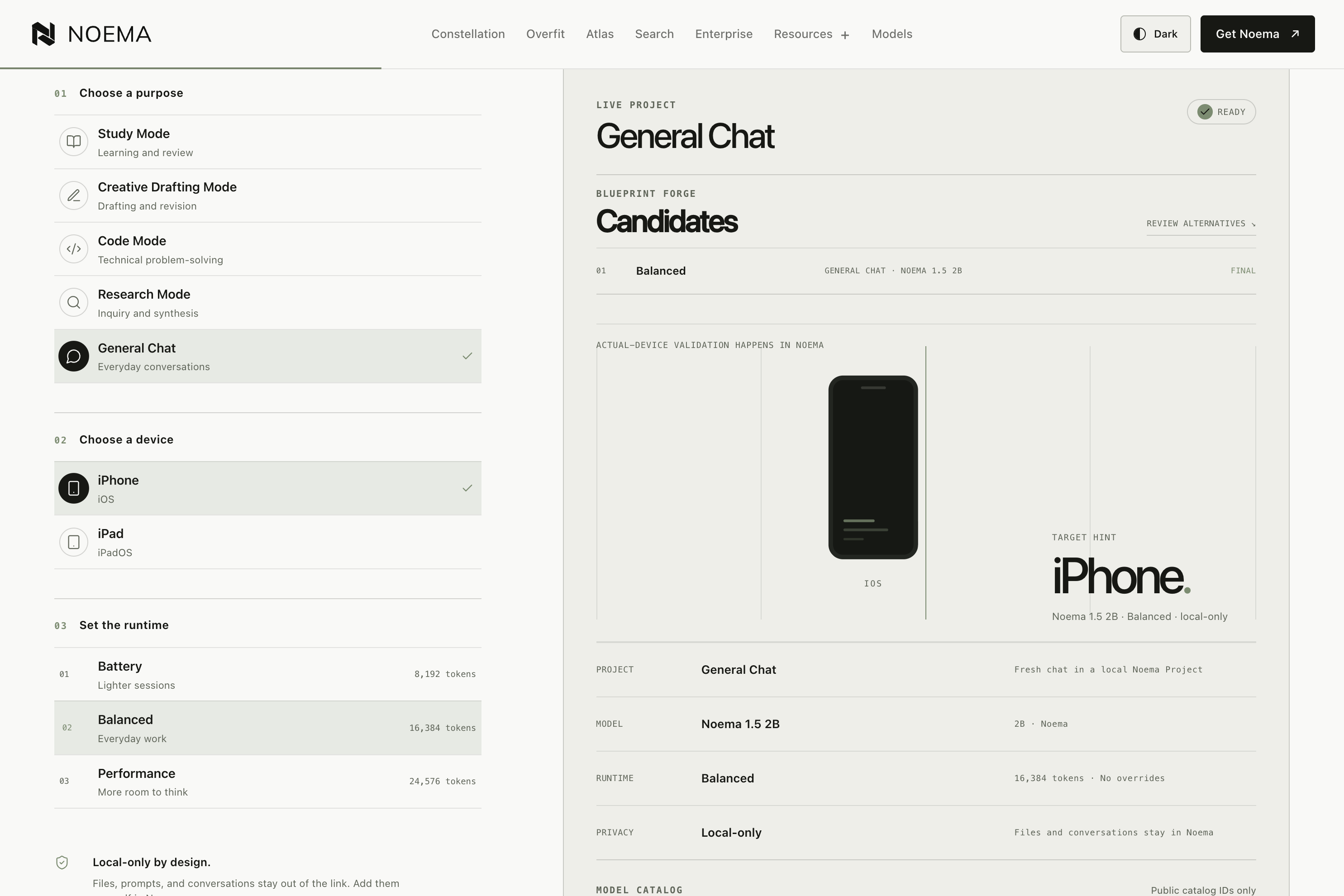
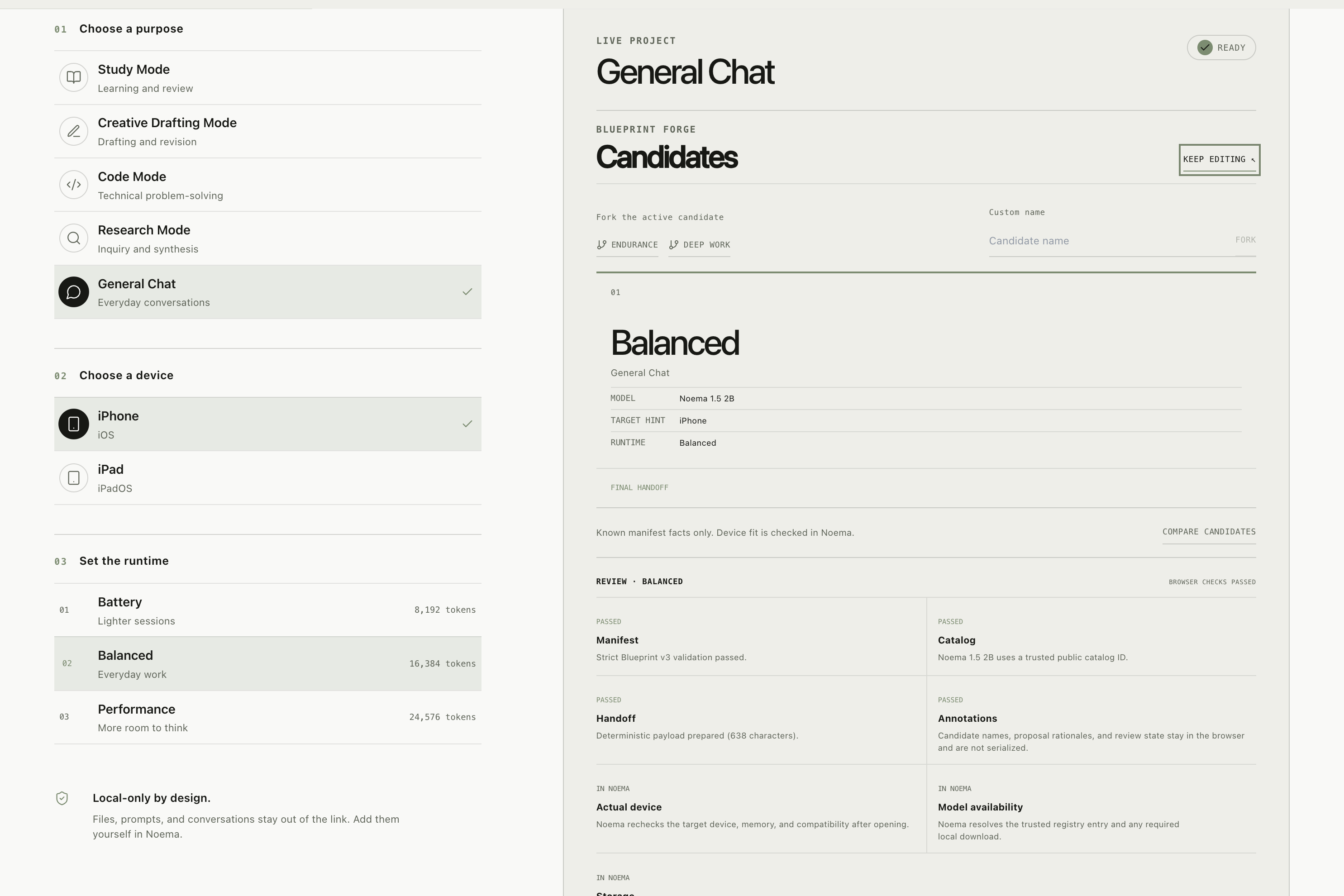
Choose a purpose, device, local model, and runtime while the final Blueprint updates live.
-
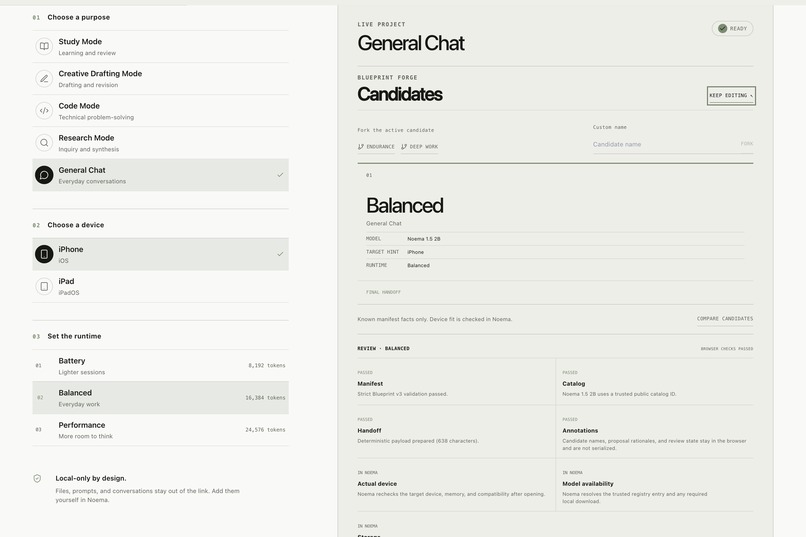
Blueprint Forge validates the manifest, model catalog entry, and handoff payload before sending anything to Noema.
-
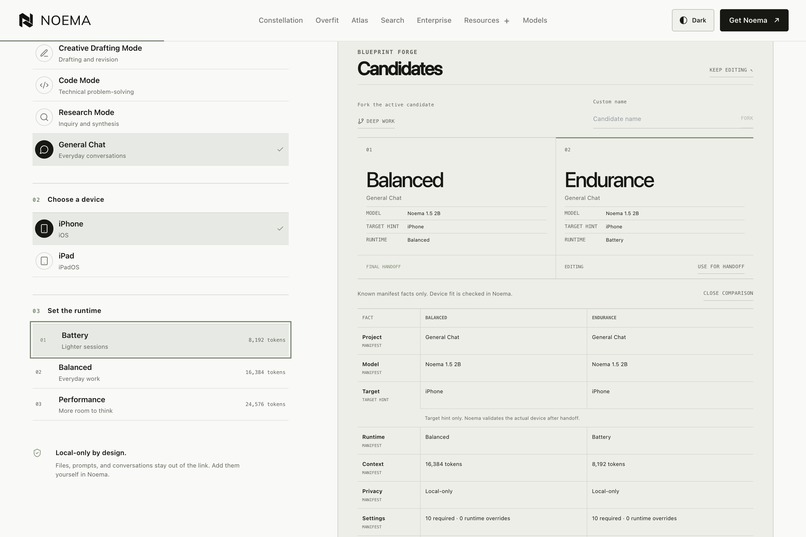
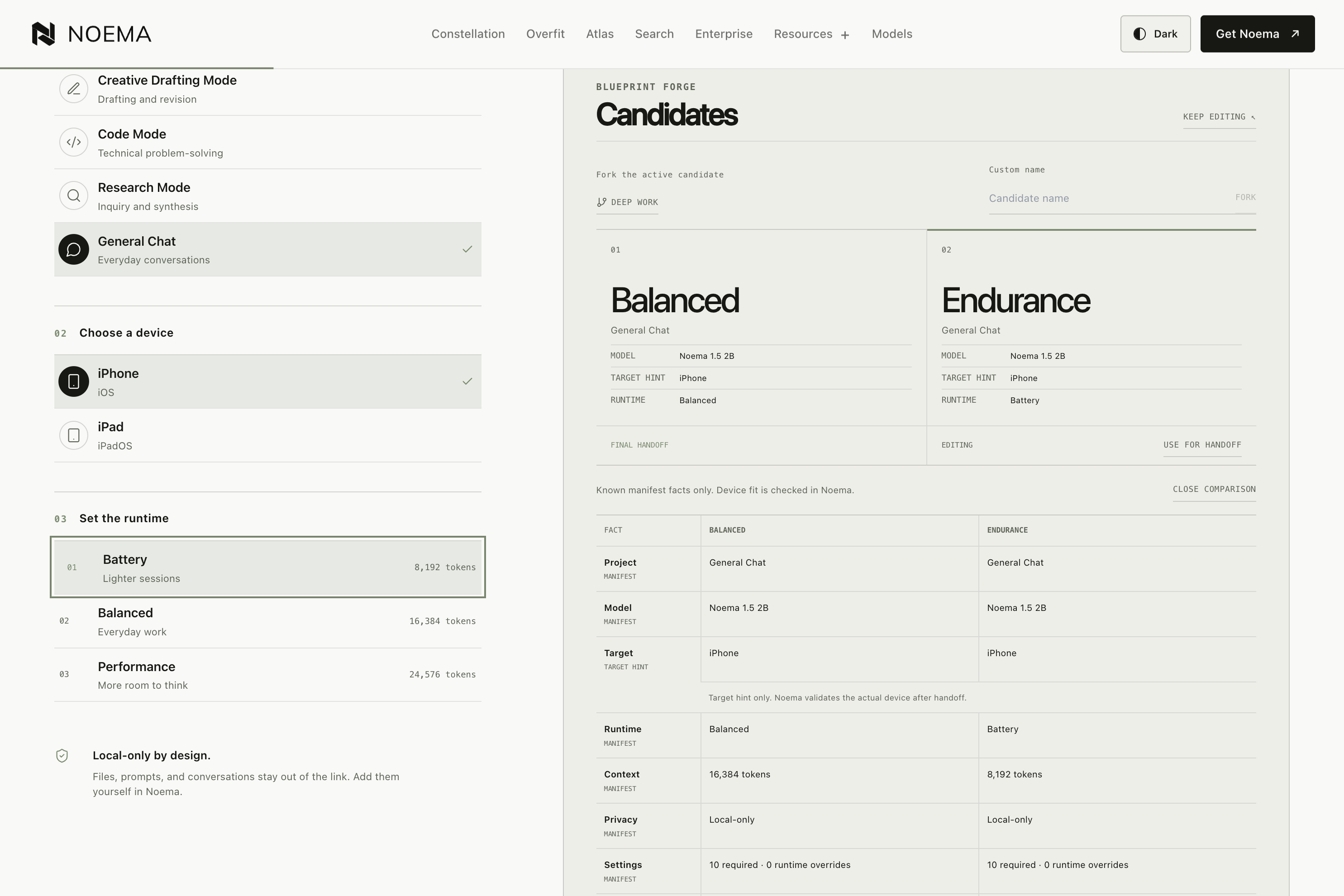
Compare candidate runtimes, context sizes, privacy, and settings before choosing the final Blueprint.
-
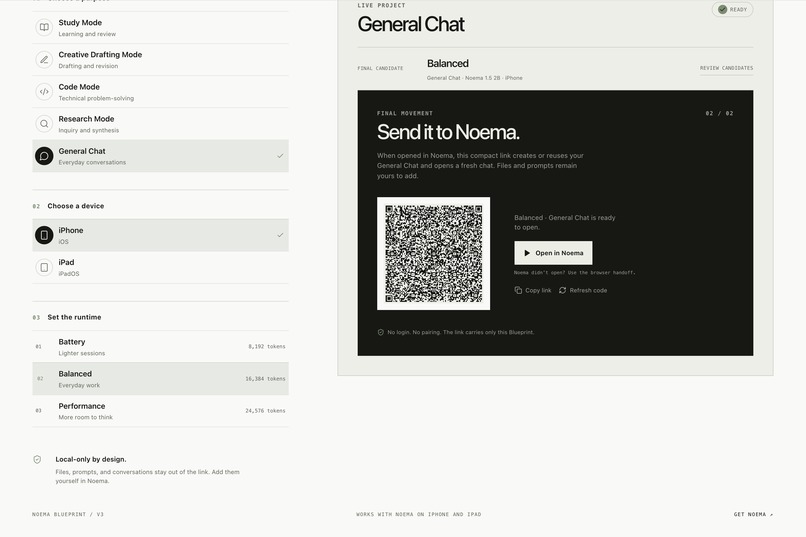
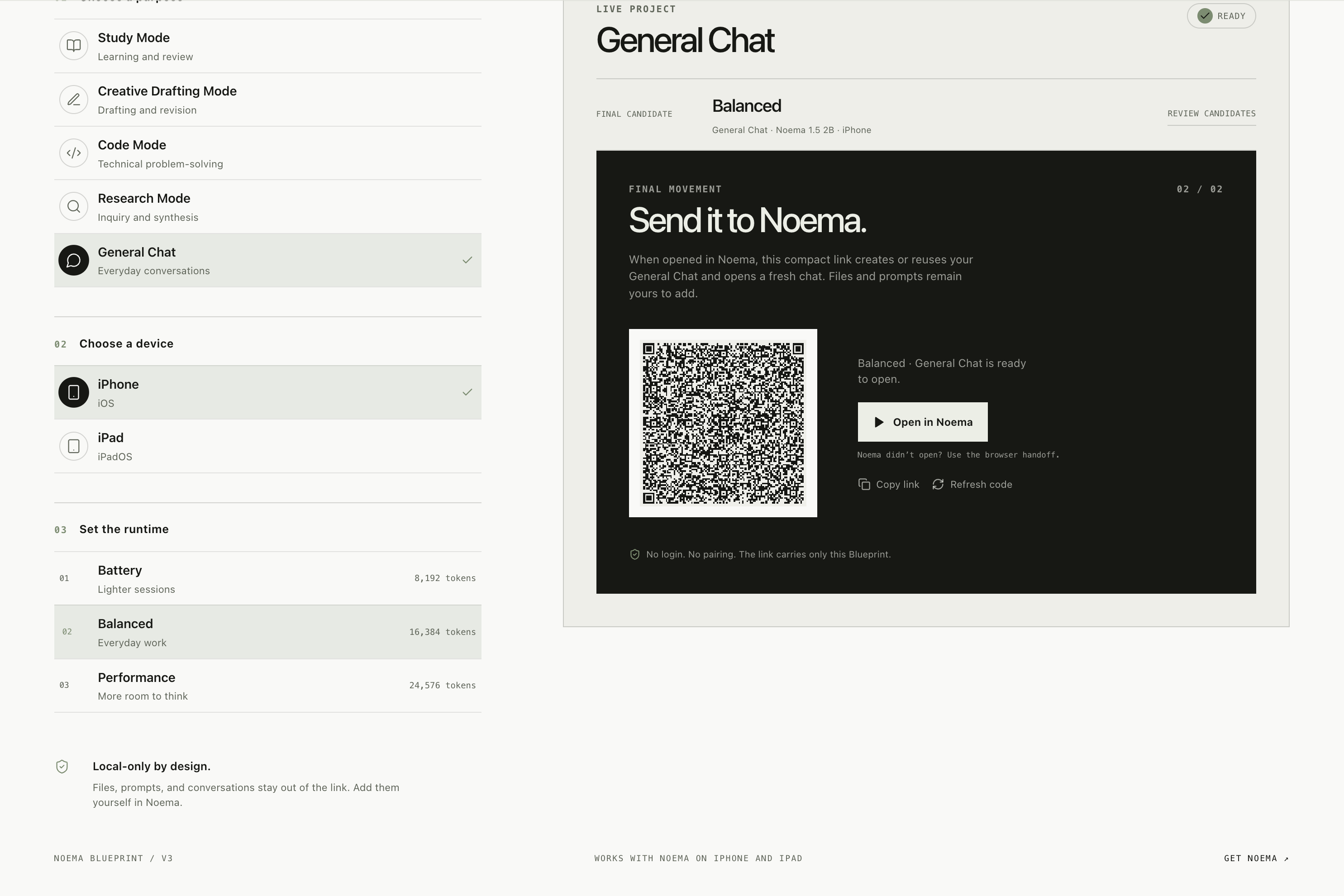
Send the Blueprint by QR code or deep link: no login, pairing, files, prompts, or conversations included.
-
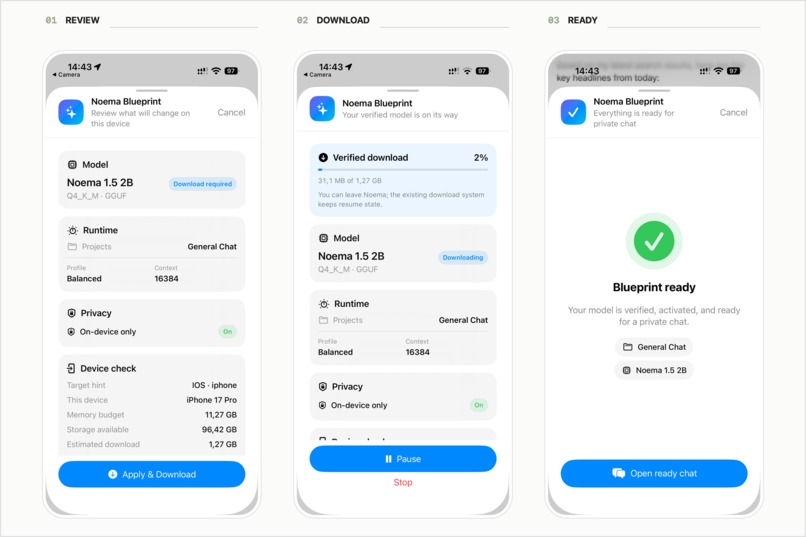
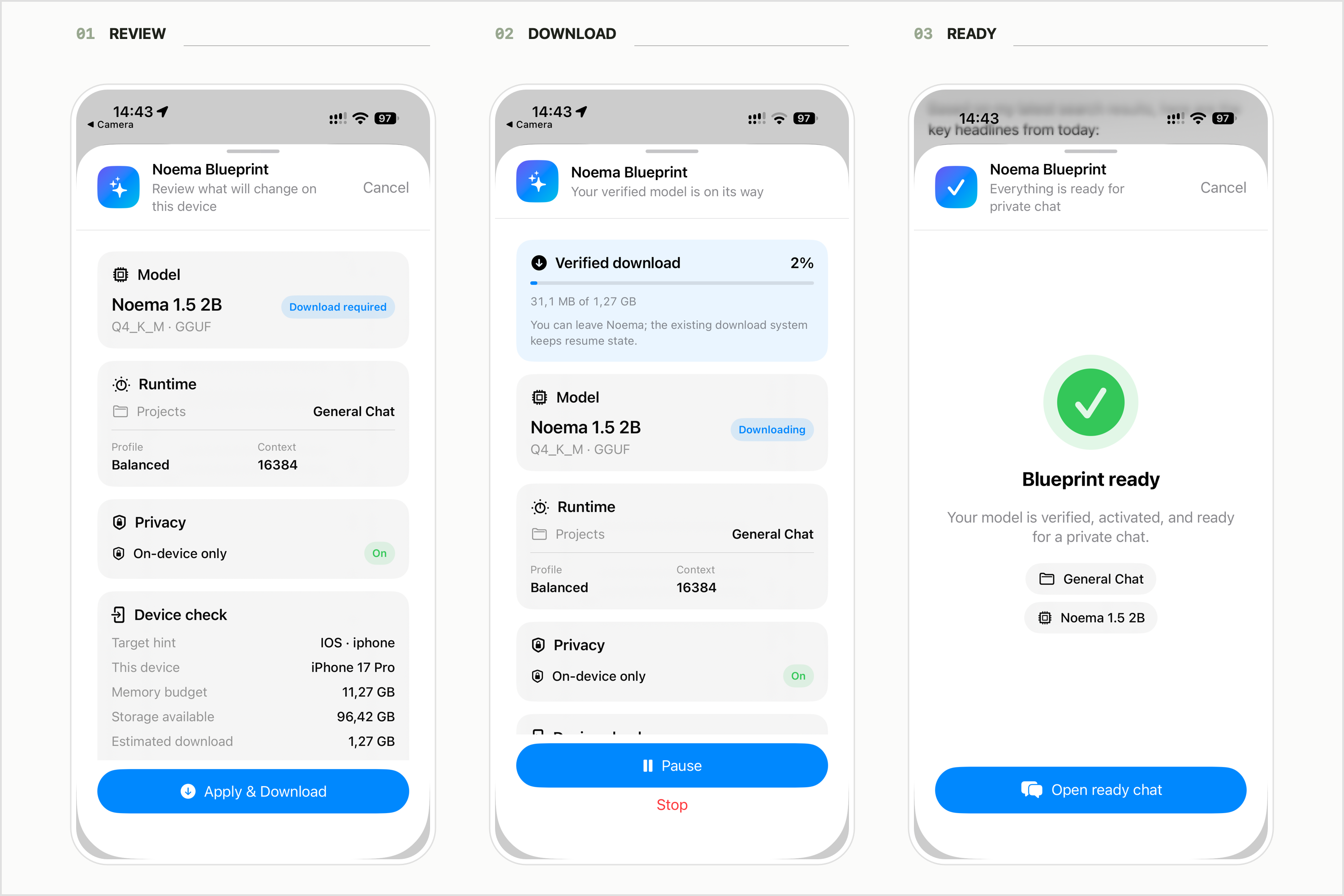
1. Noema checks the iPhone, verifies the local model download, and opens a private, ready-to-use chat.
Noema Blueprint
Inspiration
Wanting to run local and private AI should not require people to become infrastructure experts. Today, setting up a local model means researching compatibility, device limits, runtime behavior, and download size before even sending a prompt.
We wanted setup to feel like designing a workspace with an expert beside you. WebMCP turns the page into a shared workspace for both the person and the agent. The person can directly choose the Project goal, target device, runtime preset, model, and final Blueprint. The agent can inspect that same visible state, tune advanced model settings, fork and compare alternatives, audit candidates, and stage recommendations. Every agent suggestion remains visible, and only the person can approve it or choose what gets handed off.
What it does
Noema Blueprint is a visual studio for creating a private local AI Project.
A person chooses what they want to accomplish and where they want to run their AI. Agents can then inspect the live Blueprint, change supported settings, fork alternative candidates, compare them, and stage recommendations directly on the page.
Every proposed change appears visibly. The person remains the only one who can choose the final candidate.
When the Blueprint is ready, the website creates a QR code and a same-device link containing a validated configuration. The agent can also return the QR code directly inside the conversation.
Scanning the code opens Noema on your device (iOS, iPadOS). The app checks the configuration against the actual device before asking for approval. If the selected model is missing, Noema downloads it. The settings are then applied and the finished Project opens ready for a private conversation.
The handoff is stateless. The link contains no files, prompts, credentials, or personal data.
Why WebMCP
Without WebMCP, an agent could recommend settings, but the person would need to reproduce them manually inside a different interface.
With WebMCP, the agent operates the exact page the person is viewing. The Blueprint becomes a shared source of truth. The agent can explore possibilities while the person sees the consequences before anything becomes final.
This makes setup faster without turning it into invisible automation. It also enables a workflow that was previously more opaque: an agent can help construct and evaluate a local AI environment, then hand the reviewed result to the device where it will actually run.
How we built it
The website is a React application written in TypeScript. It registers 12 narrowly scoped tools using document.modelContext.registerTool.
Those tools operate on the same Blueprint state rendered by the interface. They let an agent inspect the current configuration, edit supported values, create candidates, compare them, stage proposals, validate the result, and prepare the handoff.
The tool schemas accept only known models and bounded configuration values. Tool registration uses AbortSignal lifecycle handling. If WebMCP is unavailable, the complete interface remains usable manually.
The final Blueprint is canonicalized and validated before being encoded as a versioned base64url manifest. The website places that manifest inside a Noema universal link and renders it as a QR code.
The native receiver is built with SwiftUI. Noema accepts only the dedicated Blueprint route and maps public identifiers through its trusted model catalog. The app performs its own compatibility checks and preserves explicit download consent.
Challenges
The hardest design problem was deciding what the agent should be allowed to do. If the agent could silently select the final candidate or deploy it, the page would stop being collaborative. We separated proposals from approval so agent assistance remains visible and reversible.
WebMCP is still experimental, so the page also needed a complete manual path. Feature detection keeps the experience functional in browsers without the API.
The cross-device link created another trust boundary. We rejected arbitrary model URLs and unsupported settings. The native app treats every website value as a request rather than an instruction.
We also had to balance helpful planning with hardware reality. The website can guide the person, but only the destination device can make the final compatibility decision.
What we learned
WebMCP is strongest when the webpage is a shared object and when it doesn't act as merely a front end for a hidden API. The person should be able to see what the agent understands and watch the result change.
We also learned that local setup can feel magical without hiding important decisions. The right abstraction should be a clear plan that requires approval.
Hackathon scope
NoemaAI existed before the challenge. Noema Blueprint and its WebMCP tool surface were built during the submission period. The Blueprint Forge workflow and cross-device handoff were also created as part of this work. The public repository includes dated commit history showing the challenge implementation.
Built With
- cloudflare
- css
- face
- framer
- hugging
- links
- llama.cpp
- motion
- node.js
- qrcode
- react
- router
- swift
- swiftui
- tailwind
- typescript
- universal
- vite
- webmcp
- xcode
- zod

Log in or sign up for Devpost to join the conversation.