-
-
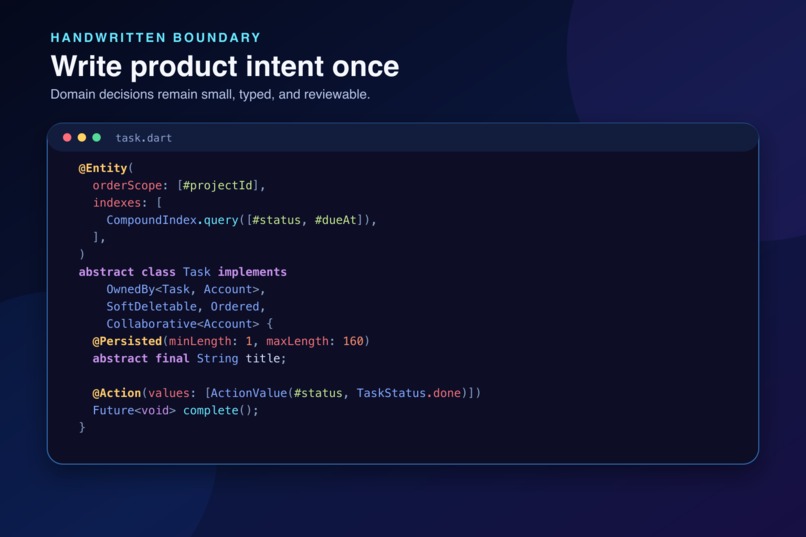
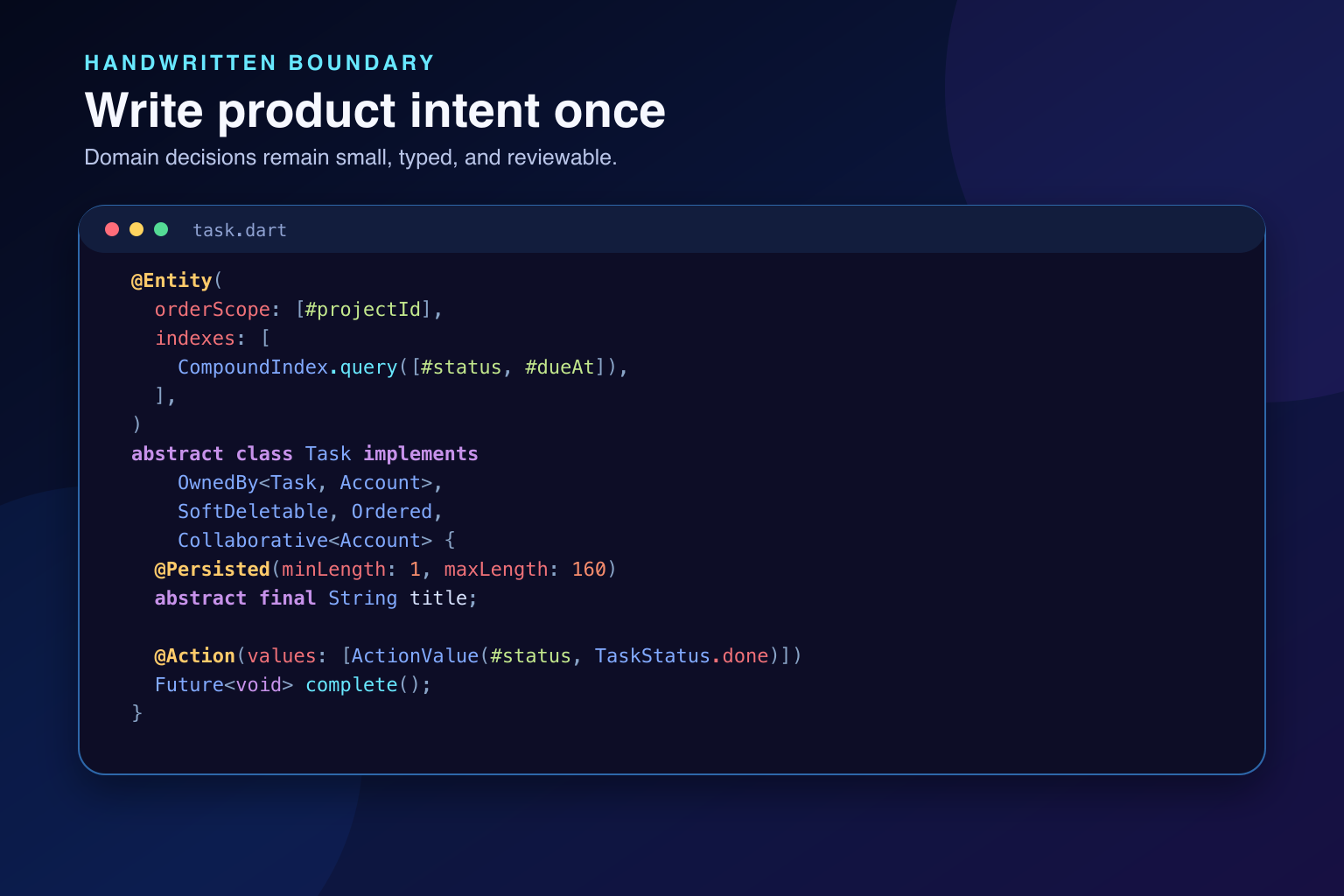
Domain intent — a concise typed entity declaration is the human-and-agent editing boundary.
-
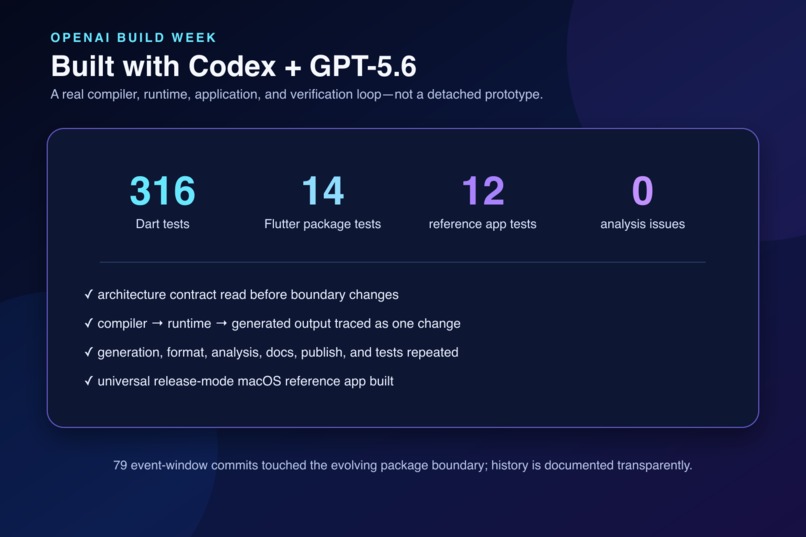
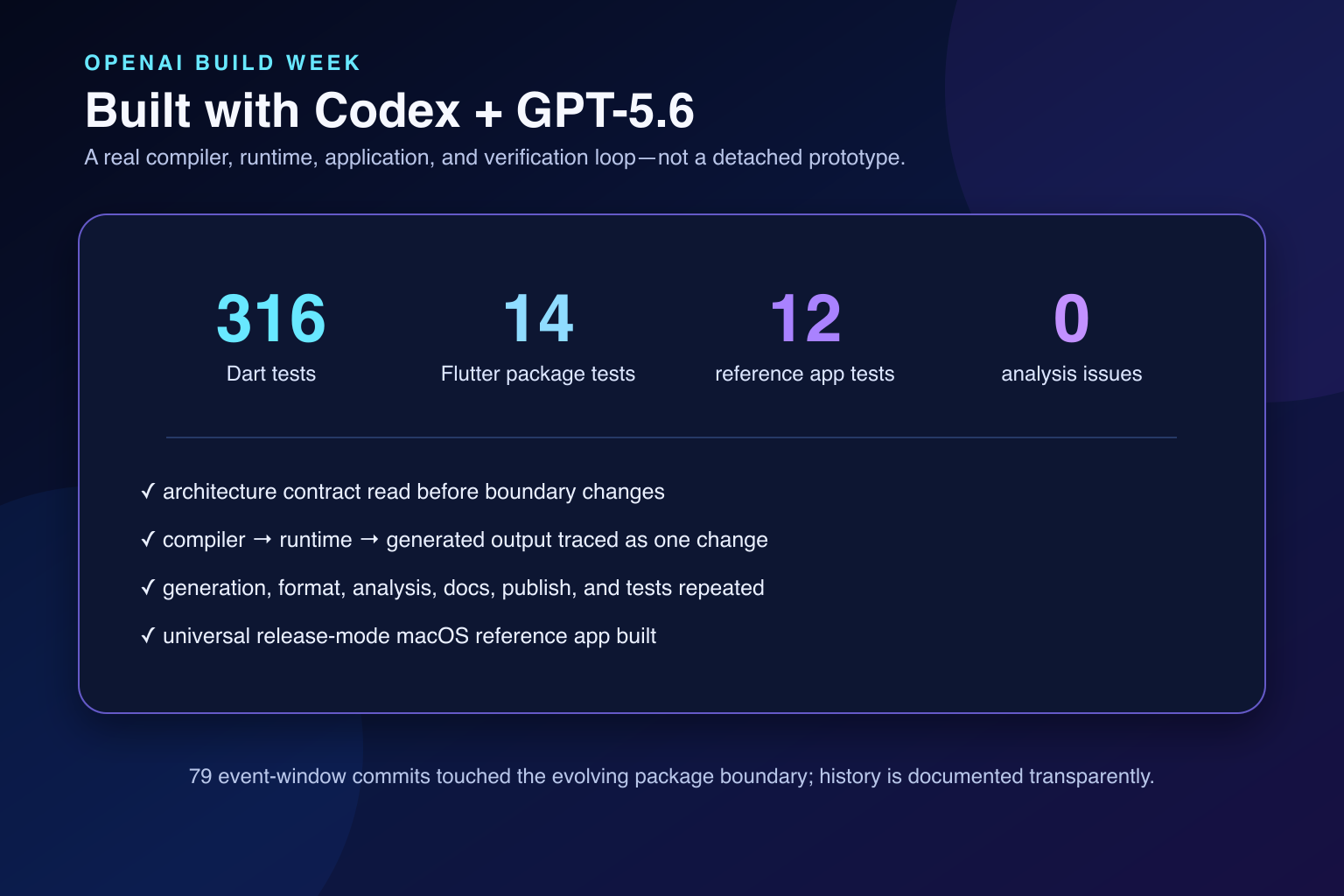
Build Week verification — 342 tests plus analysis, docs, generated-output, and publish checks.
-
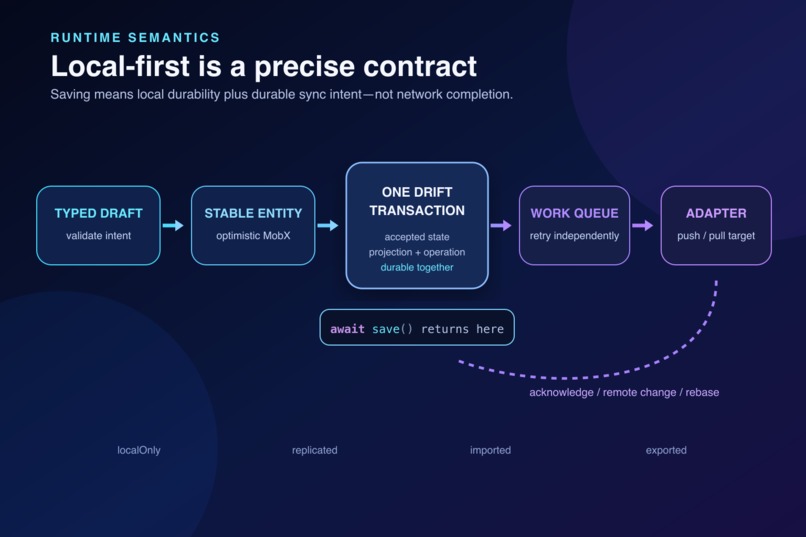
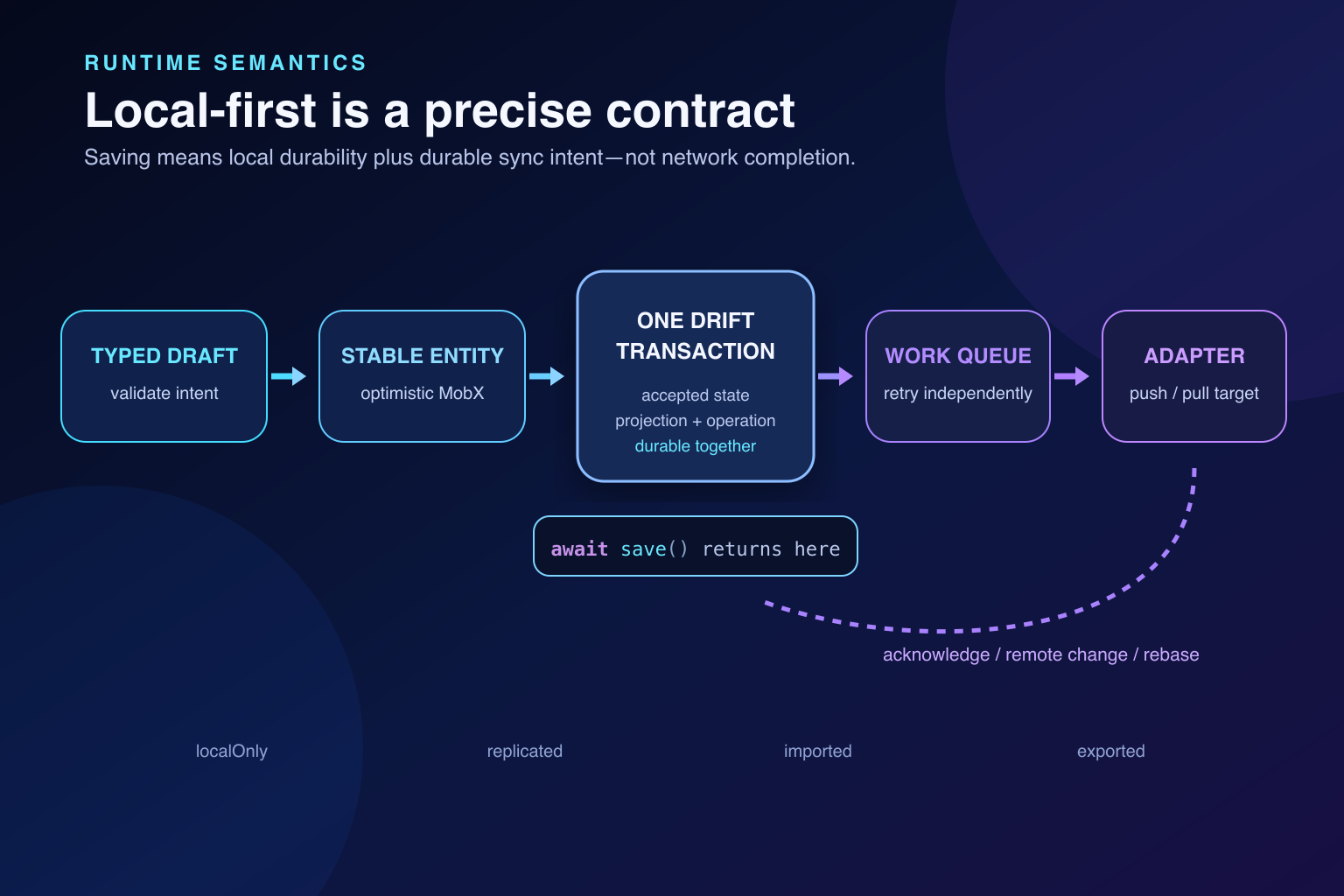
Local-first is precise — accepted state, optimistic projection, and durable sync intent commit before networking.
-
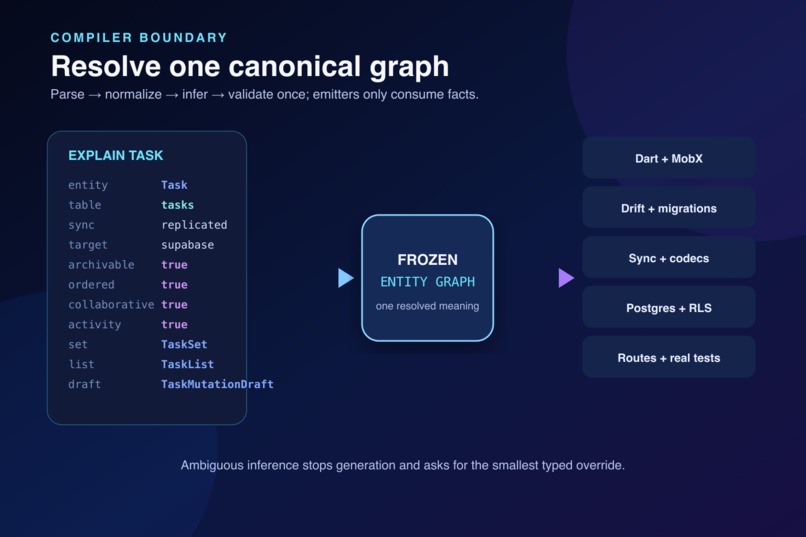
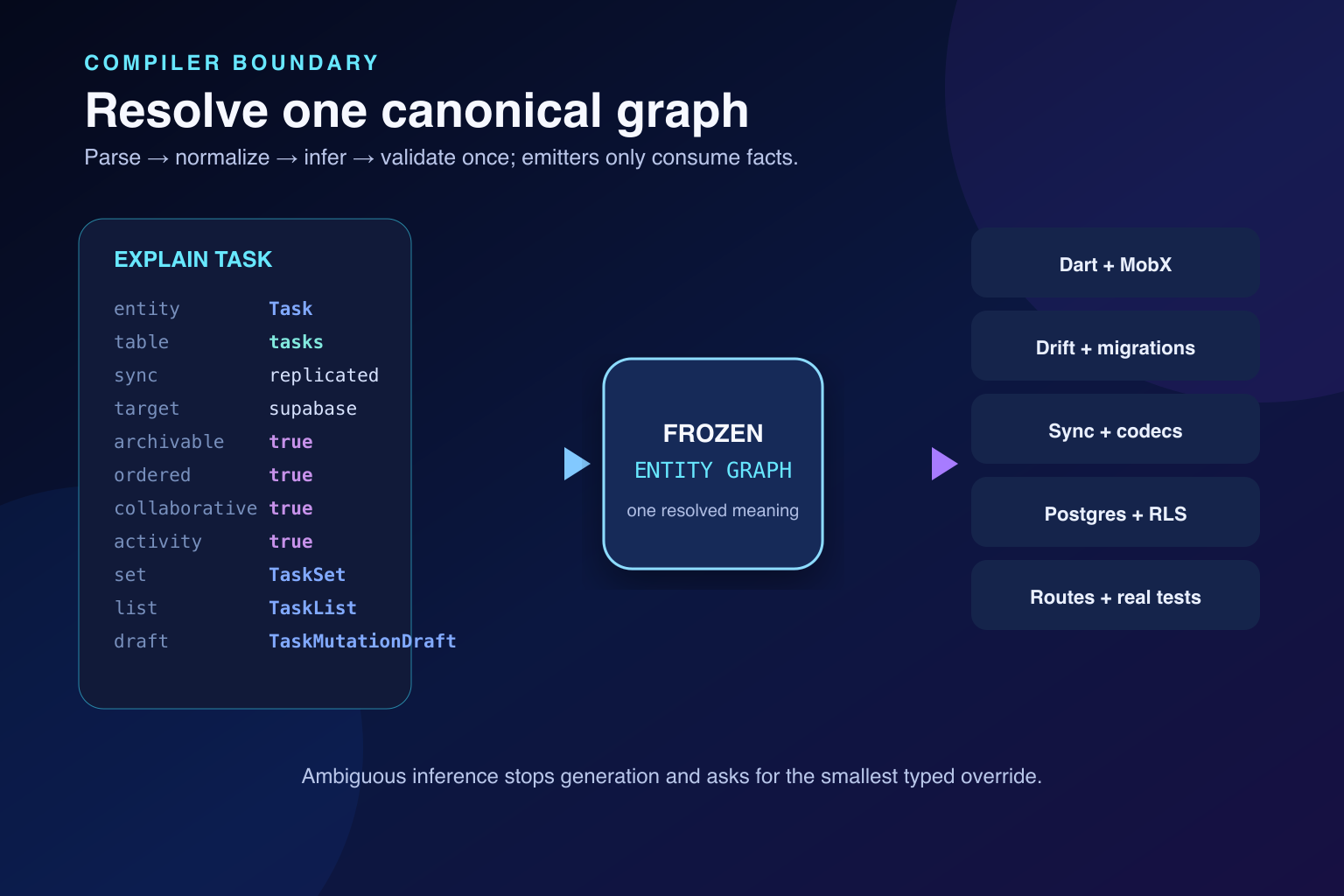
One resolved meaning — independent emitters consume the same frozen EntityGraphDefinition.
-
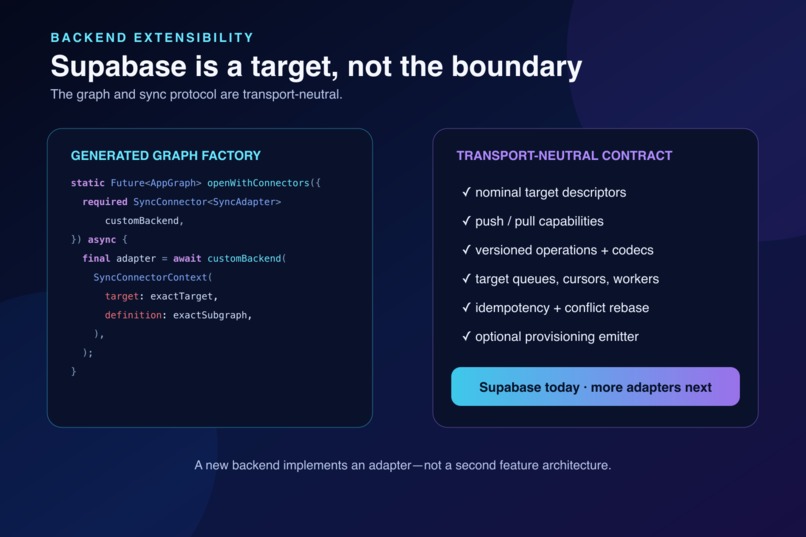
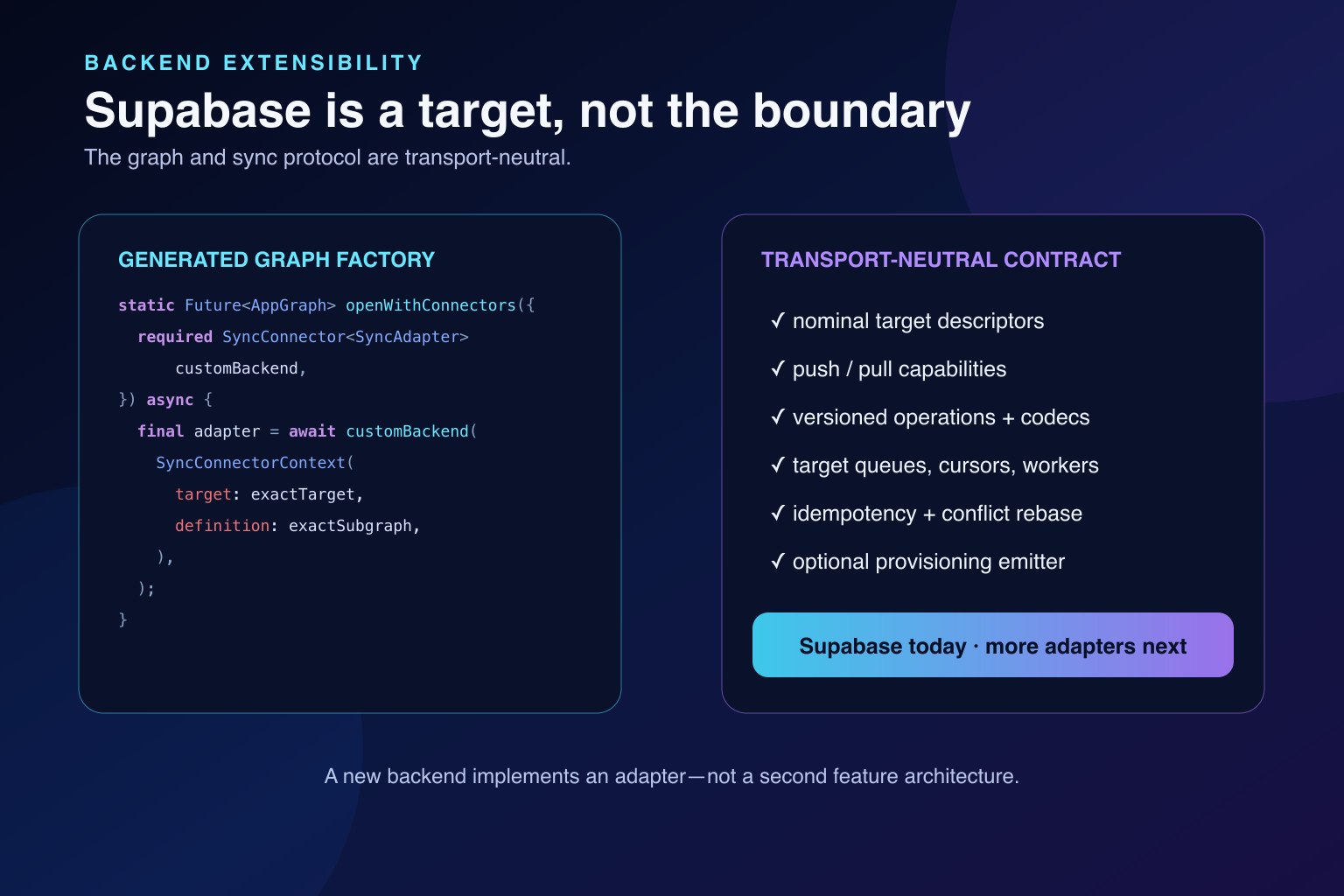
Supabase is a target, not a lock-in — other backends plug into the connector and emitter contracts.
-
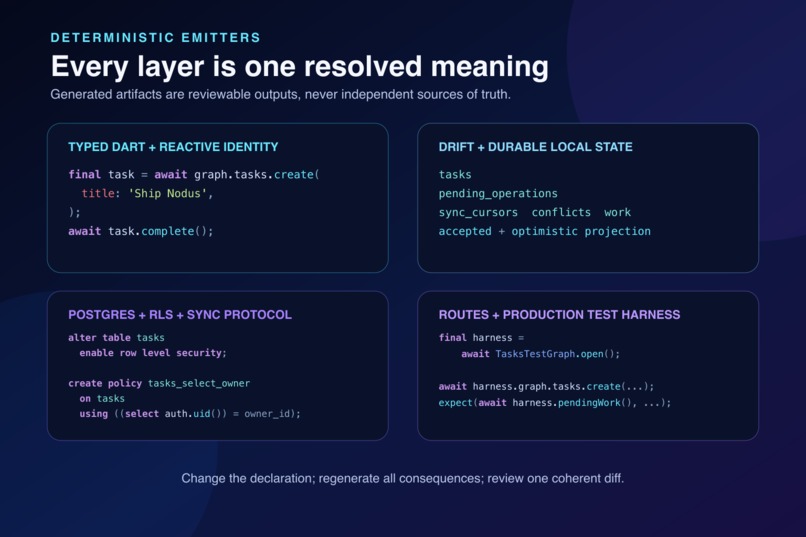
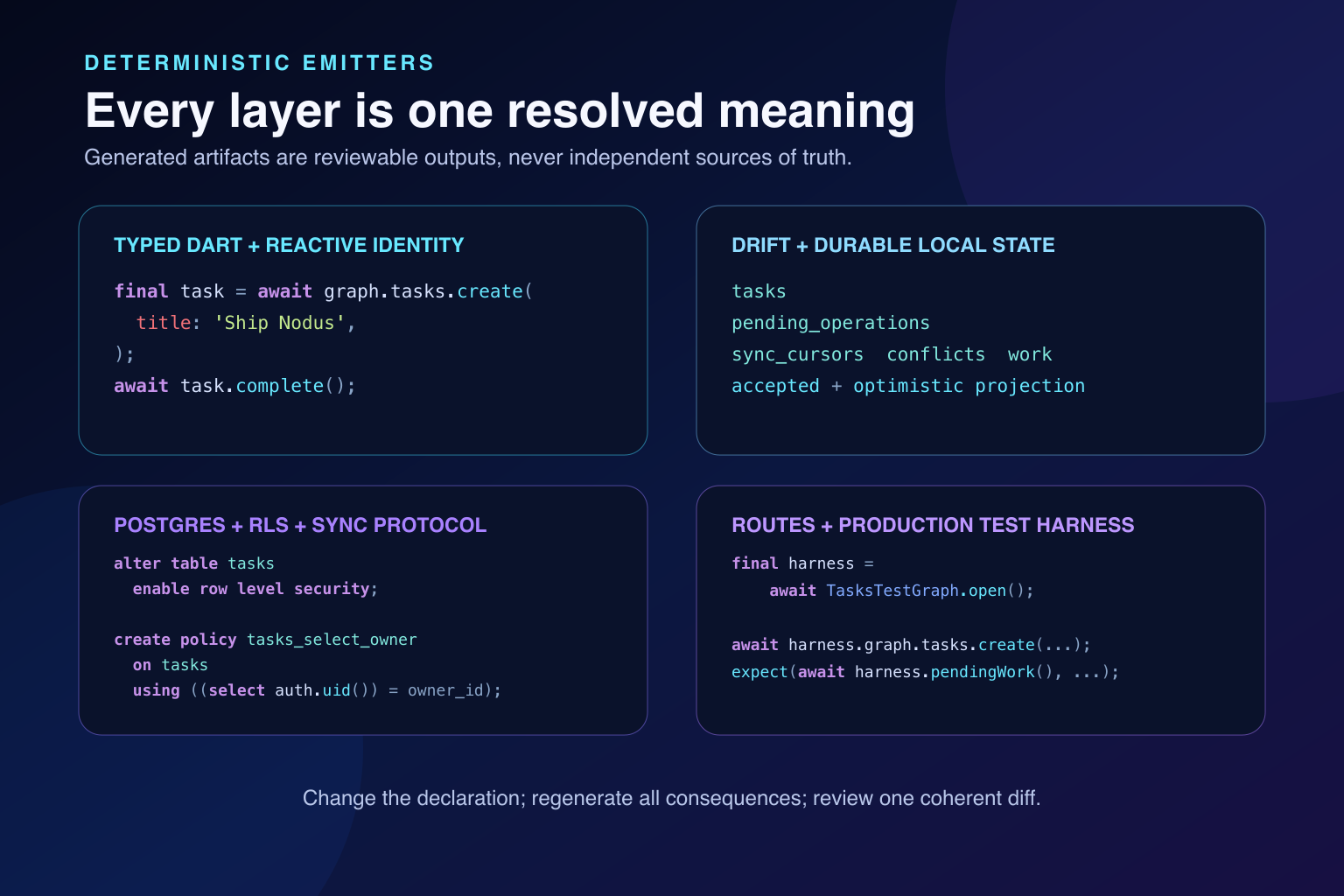
One graph, every layer — typed Dart, Drift, sync, PostgreSQL/RLS, routes, and tests.
Inspiration
Flutter removed a major source of multiplatform duplication: teams can build one interface and run much of the same code across platforms. But the product behind the screen is still repeated across state models, local tables, API payloads, sync logic, backend constraints and permissions, routes, and test doubles. The UI may be shared while the application meaning drifts.
AI makes that seam more visible. A coding agent can produce a screen quickly, but it also inherits every duplicated model and configuration, only faster.
Nodus begins with a different question: what if a product decision were written once, kept typed and reviewable, and compiled into every mechanical layer?
What it does
Nodus builds on Flutter's multiplatform foundation with a local-first application architecture and compiler. A developer declares an abstract entity with fields, constraints, relationships, capabilities, and actions. Nodus resolves those declarations once into a canonical entity graph and deterministically emits:
- reactive, identity-stable Dart entities and typed create/edit/action APIs;
- Drift tables, constraints, migrations, observable queries, and durable work;
- a transport-neutral sync protocol with operations, codecs, cursors, retries, idempotency, and conflict rebase;
- Supabase PostgreSQL schema, checks, grants, RLS, push functions, change history, and receipts;
- typed file-system routes and a production-runtime in-memory test harness.
The result is more than one UI codebase. It is one product model whose state, offline behavior, persistence, backend policies, and tests stay coherent as the application moves between platforms.
The generated Tasks app demonstrates offline creation, editing, transitions, ordering, collaboration, activity, tombstones, paging, deep links, and durable sync scheduling. It is evidence of Nodus, not the project being submitted.
Supabase without Supabase lock-in
Supabase is the first built-in schema-capable target, not the runtime boundary.
Entities resolve to typed target descriptors. Generated graphs construct
connectors through SyncConnectorContext; target-partitioned queues, cursors,
workers, operation IDs, codecs, and conflict policies speak a generic Nodus
protocol. A new backend implements a directional adapter and, if it provisions
schema, its own emitter. Feature code and entity declarations do not change.
Supabase is the only production-ready provisioning target in 0.1.0. The
extension contract is ready; Firebase, REST, and other adapters are not bundled
yet.
How I built it
Nodus uses a multi-phase compiler: discover declarations, parse and normalize
them, infer safe facts, validate ambiguity and graph invariants, freeze one
EntityGraphDefinition, then run independent emitters. Emitters are forbidden
from reinterpreting annotations. If a choice is genuinely domain-specific,
generation stops and asks for the smallest typed override.
Nodus was created during Build Week, informed by earlier experiments in Pacely's
model_first package. Codex with GPT-5.6 worked inside the real repository:
reading the architecture contract, tracing changes across
compiler/runtime/generated boundaries, implementing scoped changes, reviewing
diffs, and running generation, formatting, analysis, documentation validation,
publish validation, and 342 package-plus-example tests.
Why this is good architecture for vibe coding
Nodus narrows what a coding agent must invent. The prompt becomes typed domain intent; the compiler owns repetitive cross-layer mechanics; and stale output, invalid inference, schema drift, type errors, and behavioral regressions become fast executable feedback.
Research supports the ingredients, with important caveats. Test-guided intent clarification has improved developers' ability to evaluate AI code in a user study; repository-level code generation benefits from full dependency context and iterative debugging; and OpenAI's Codex guidance emphasizes durable repo instructions and executable gates. Other research shows AI tools can slow experienced maintainers in mature repositories and can generate insecure code. So the claim is not “AI is automatically faster.” It is that AI-assisted work needs an architectural boundary that is coherent, inspectable, and falsifiable. The README links every source and states what Nodus has not yet measured.
Challenges
The hard part was preserving one meaning across very different systems. A relationship affects the Dart API, local foreign keys, inverse collections, remote access, sync patches, delete policy, ordering scopes, and tests. The tempting solution is to let each generator infer independently; that creates drift. I instead built one canonical graph, made ambiguity fatal, and kept the emitters deliberately boring.
Local-first semantics were another challenge. await save() cannot honestly
mean “the server accepted this” while offline. In Nodus it means the local
projection and durable sync intent committed atomically. Networking, retry,
acknowledgement, remote changes, and rebase happen independently.
Accomplishments
- Created Nodus as a standalone documented package, CLI, CI project, and executable reference application during Build Week.
- Built a canonical graph that drives Dart, Drift, sync, PostgreSQL/RLS, routes, migrations, and tests.
- Kept the core backend-neutral while shipping a complete Supabase target.
- Passed 316 package Dart tests, 14 package Flutter tests, 12 application tests, static analysis, dartdoc validation, generated-output checks, and pub dry-run.
- Built the Tasks demo as a universal release-mode macOS application.
What I learned
The useful boundary between human/AI intent and generated mechanics is not “model versus boilerplate.” It is “real domain decision versus safely derivable fact.” Nodus became simpler whenever a product choice stayed explicit and every mechanical consequence moved into the graph.
I also learned to be careful with the vibe-coding claim. Architecture should make AI output easier to test and review, but that benefit must be measured. The submission includes the evidence behind the thesis and a proposed controlled evaluation rather than presenting inference as a benchmark.
What's next
- Publish
0.1.0to pub.dev and stabilize the API from external feedback. - Ship a second production adapter and provisioning emitter to demonstrate the transport contract end to end.
- Add Windows, Linux, web, Android, and iOS reference builds.
- Benchmark equivalent features with and without Nodus: time, human edits, cross-layer defects, security-policy defects, and test pass rate.
- Grow explainability tooling so every generated line traces to a declaration, inferred rule, or explicit override.
Try it
Repository: https://github.com/sidux/nodus
Judge launch command:
cd example/tasks
flutter pub get
flutter run --dart-define=ALLOW_IN_MEMORY_DEMO=true
No Supabase credentials are required for the in-memory demonstration. The Sync
center intentionally exposes durable pending work. Full verification commands
are in BUILD_WEEK.md.
Built With
- build-runner
- code-generation
- codex
- dart
- drift
- flutter
- gorouter
- gpt-5.6
- mobx
- postgresql
- supabase

Log in or sign up for Devpost to join the conversation.