-
-
1
-
2
-
3
-
4
-
5
-
6
-
7
-
8
🛡️ NodeArmor: a shared bank book that survives 80% packet loss
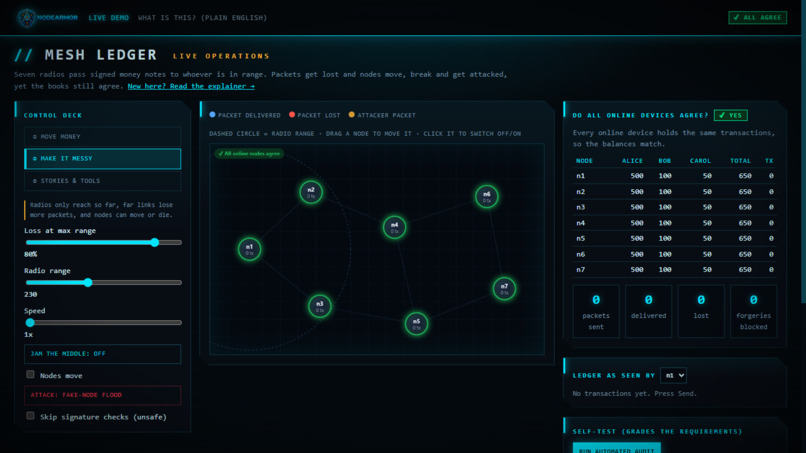
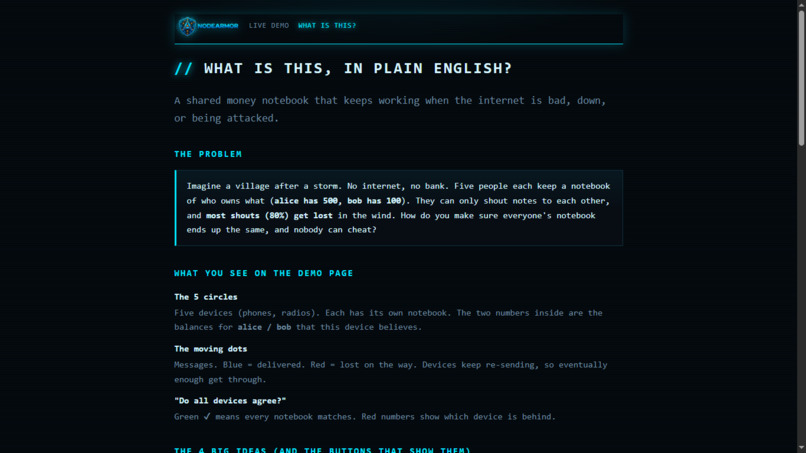
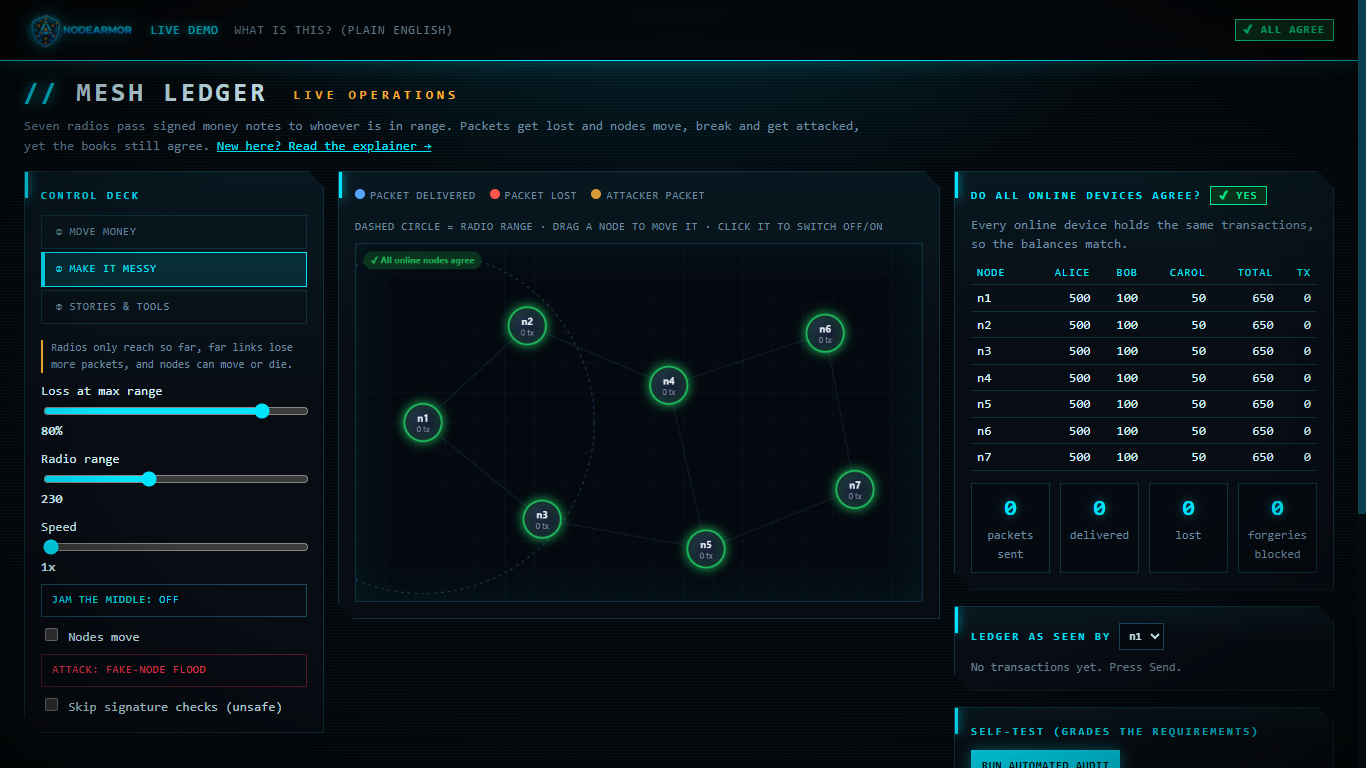
NodeArmor is our entry for the Cryptographic Singularity 6-hour sprint. It is a mesh ledger where nodes pass signed transfers to whoever is in radio range, lose most packets on the way, and still end up with identical books.
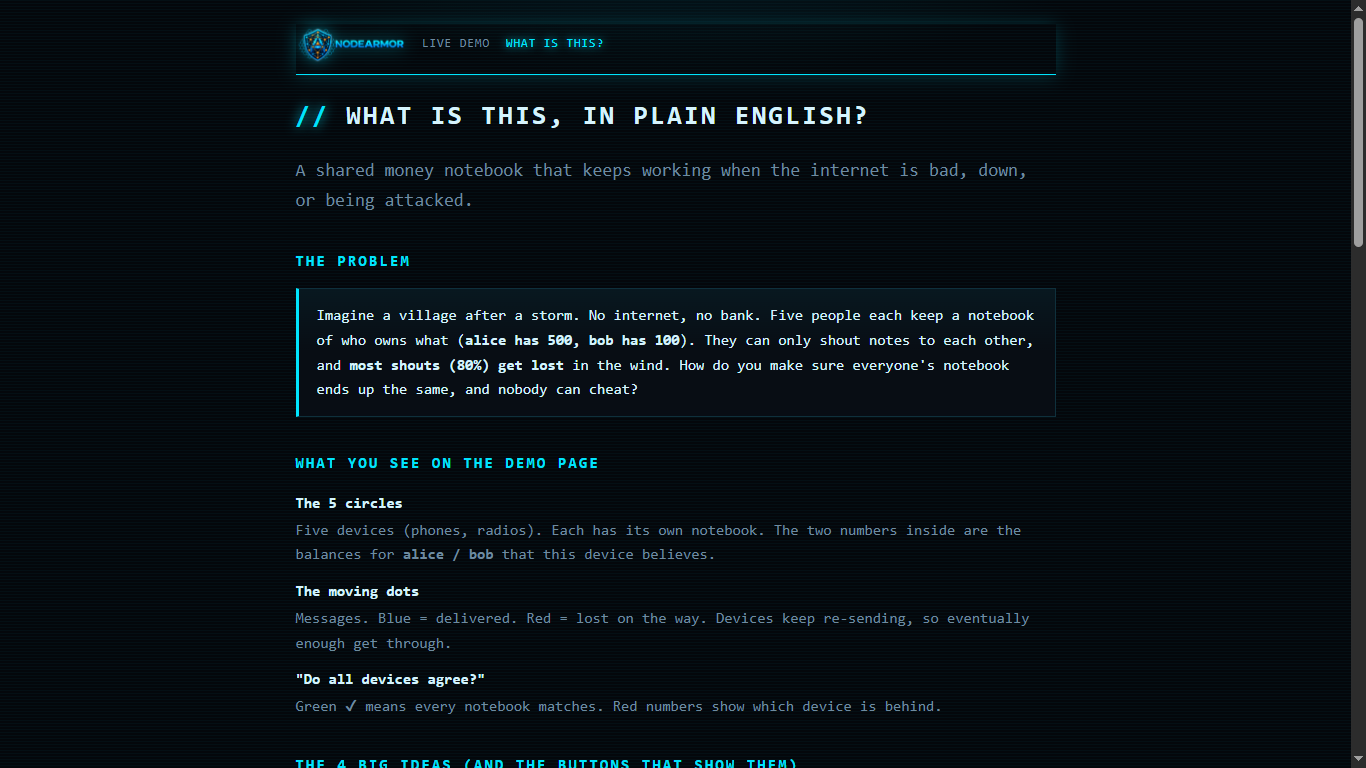
Think of a village after a storm. No internet, no bank. Everyone keeps a notebook and shouts notes to neighbours, and most shouts get lost. NodeArmor makes sure all the notebooks end up the same and nobody can cheat.
🎮 Try it out
- Live demo: aevsge.vercel.app
- Code: github.com/akulsaju/aevsge
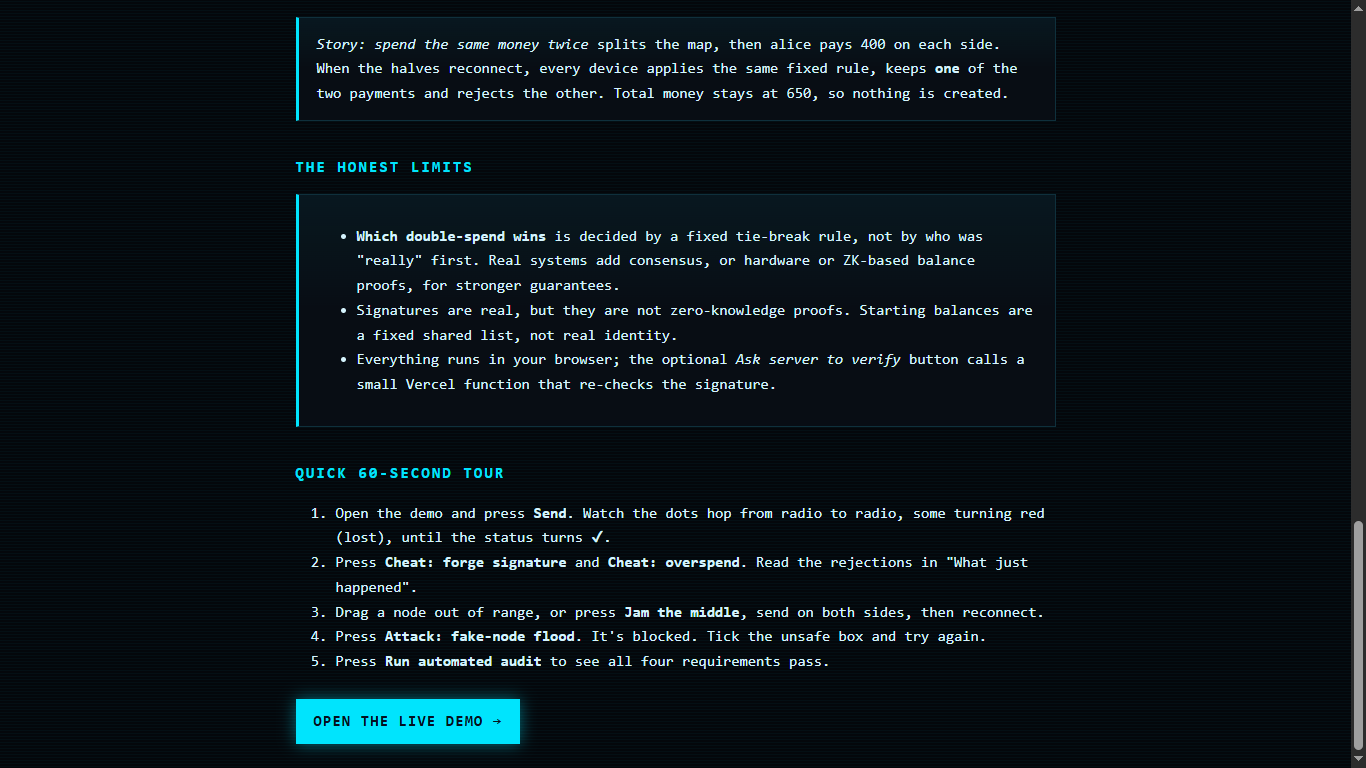
Buttons to press in the demo:
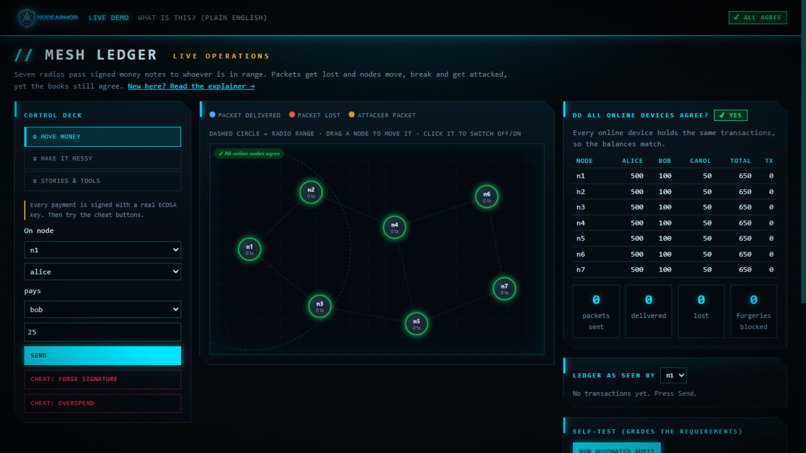
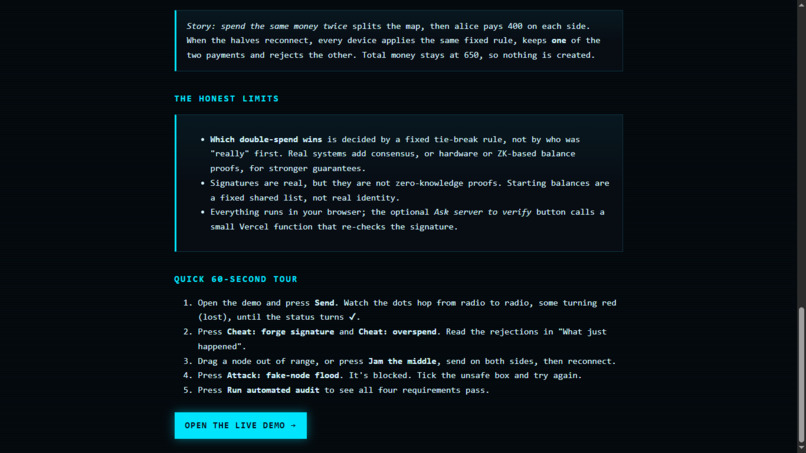
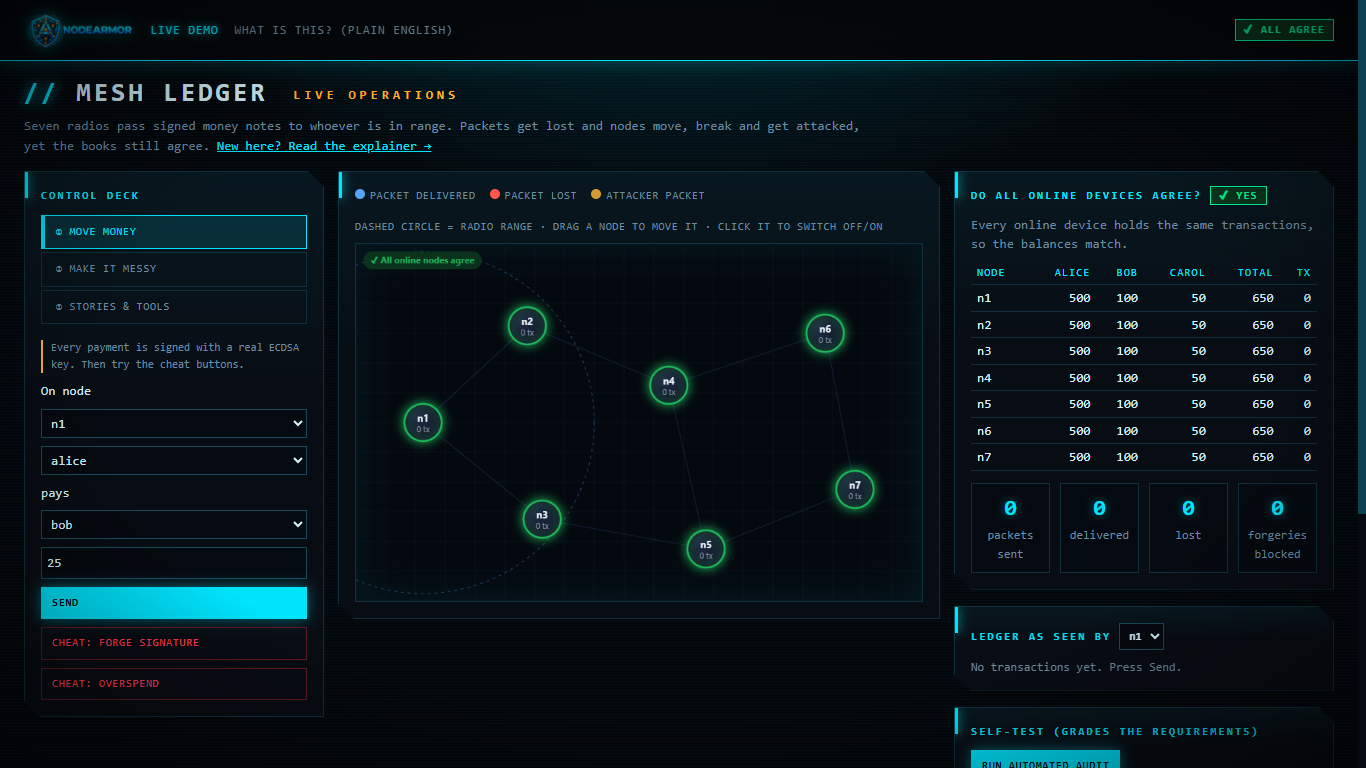
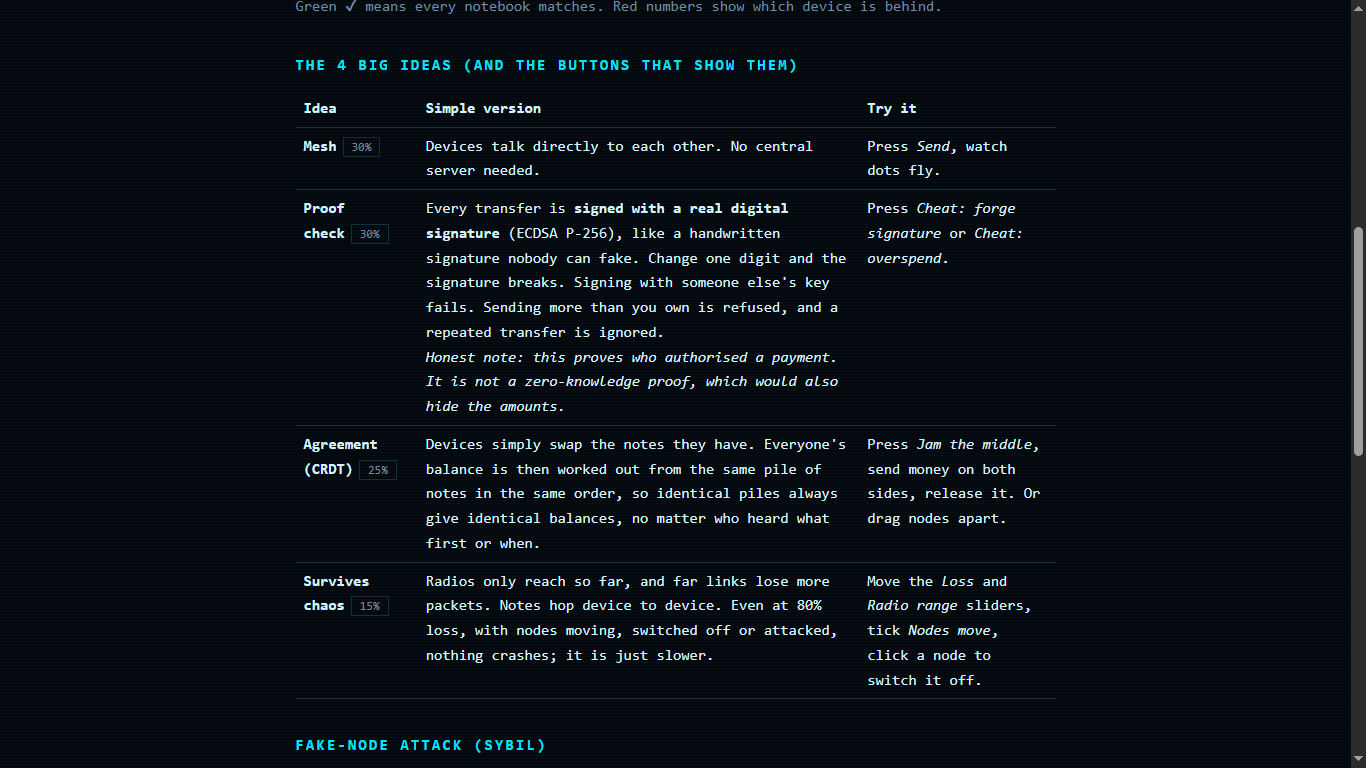
- Send: a signed payment hops across the mesh.
- Cheat: forge signature: every node rejects the forged payment.
- Cheat: overspend: signed, but more than the sender owns, so it is refused.
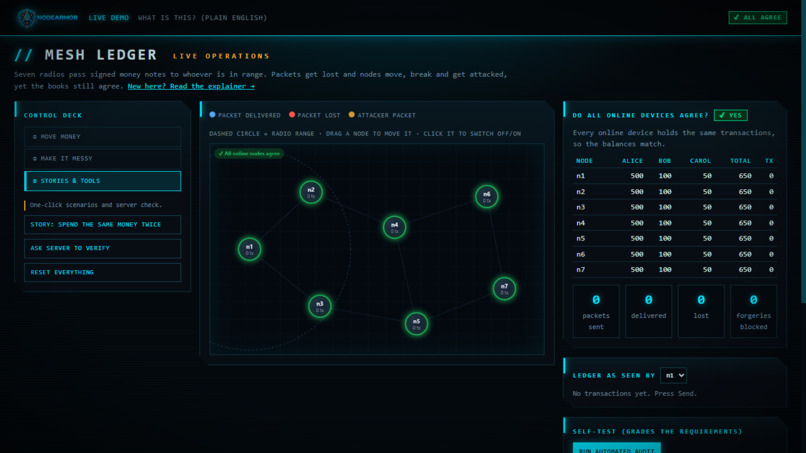
- Jam the middle: the network splits, the books diverge, then heal.
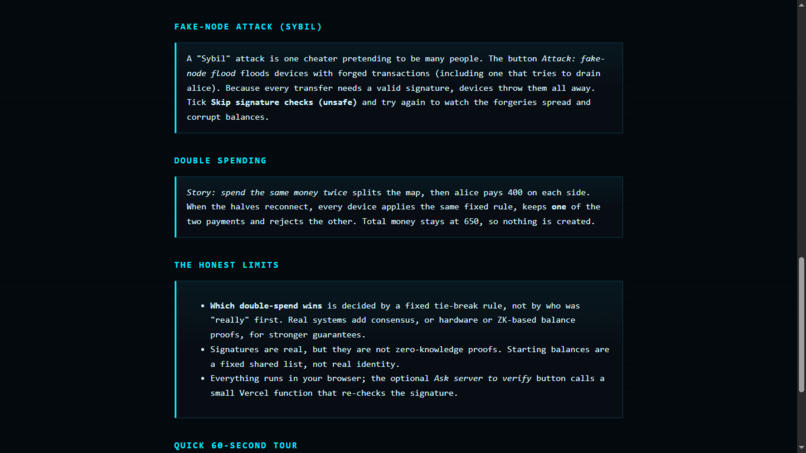
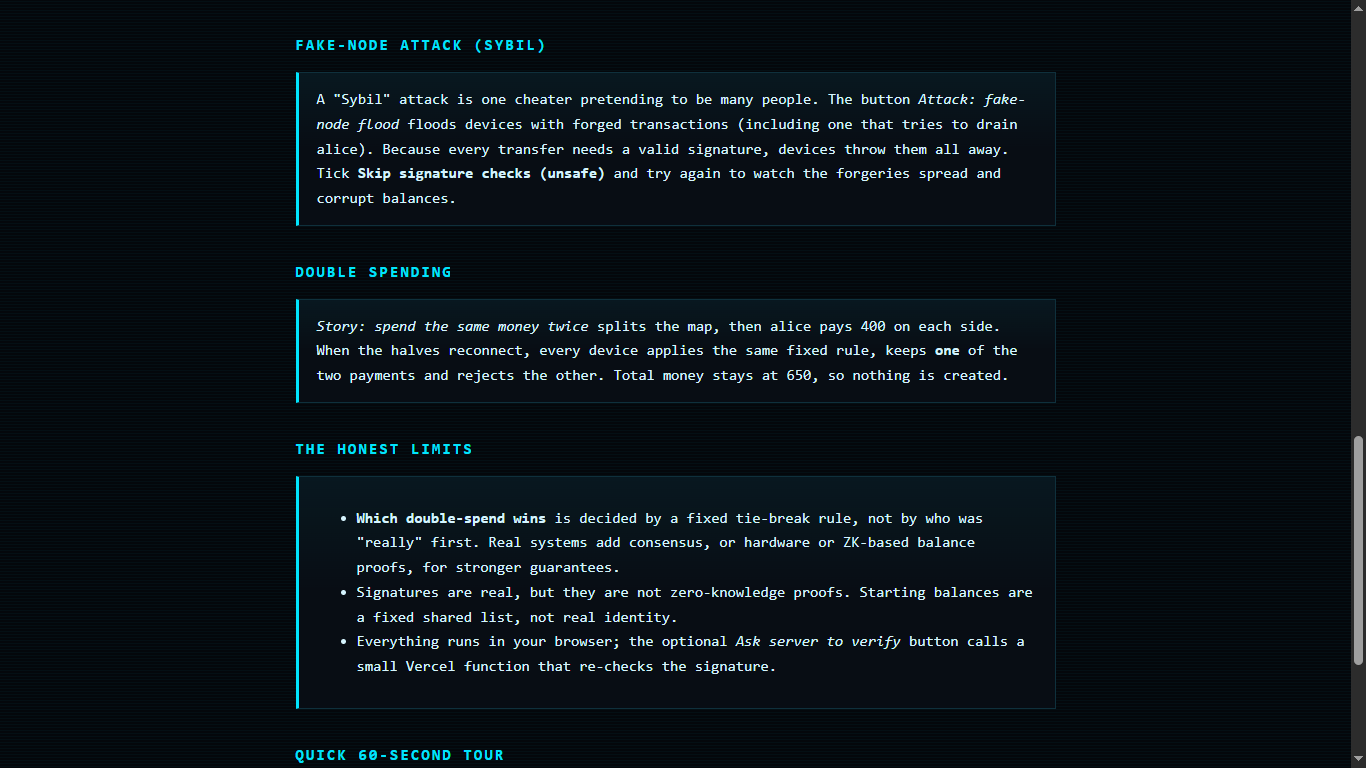
- Attack: fake-node flood: a fake node spams forgeries and gets blocked.
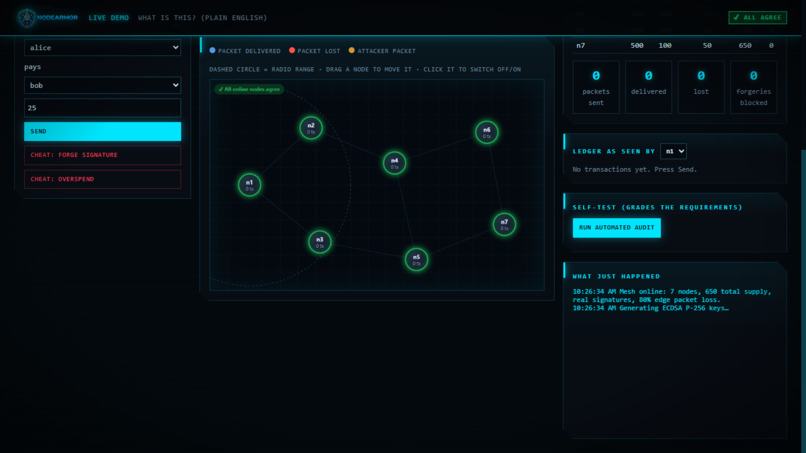
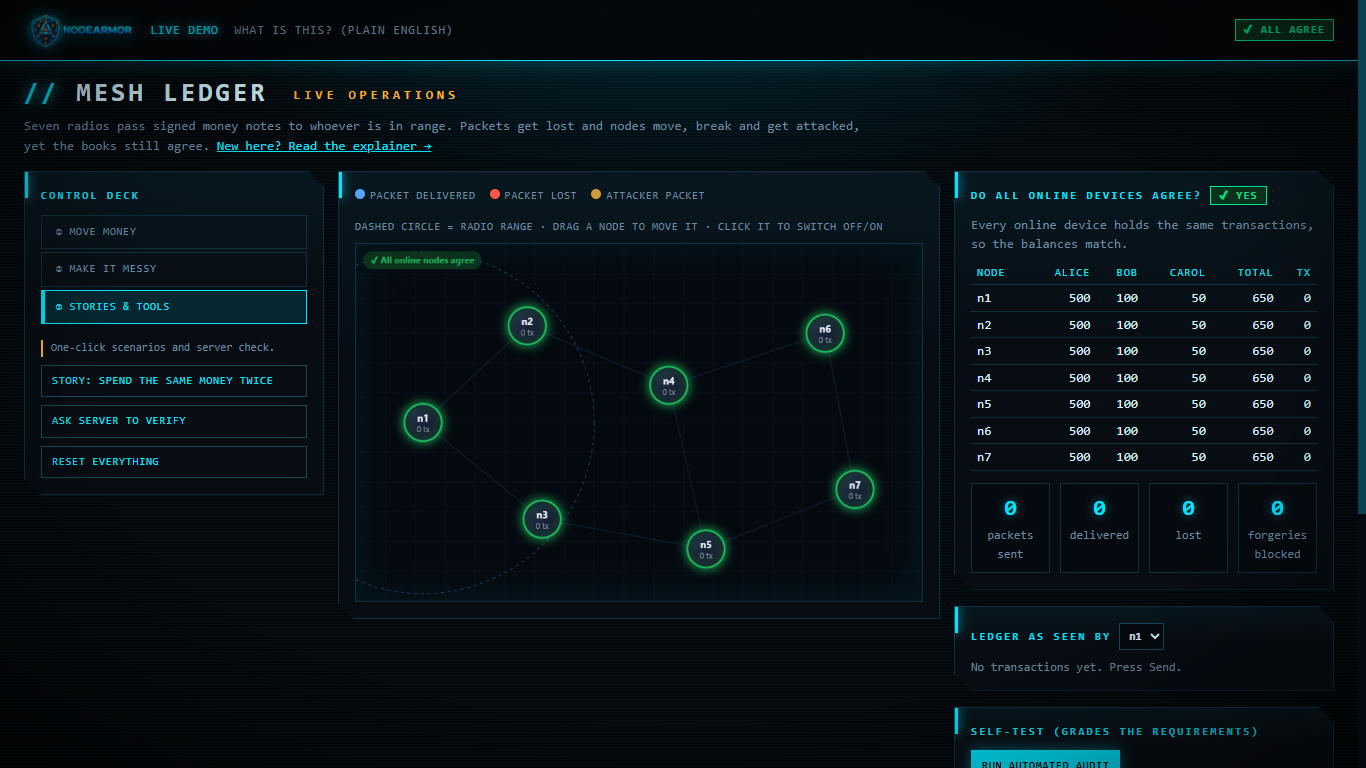
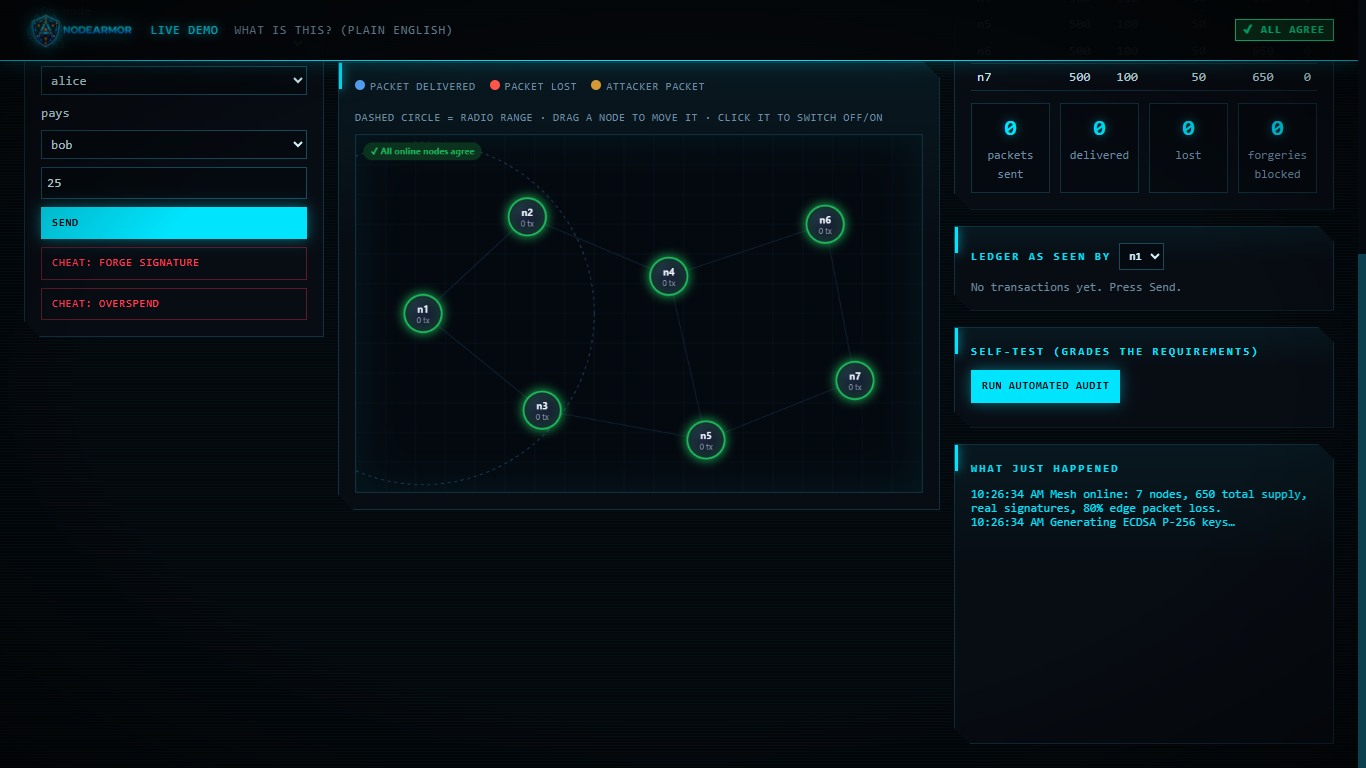
- Run automated audit: grades all four rubric items live.
✅ Rubric coverage
| Deliverable | Weight | Status |
|---|---|---|
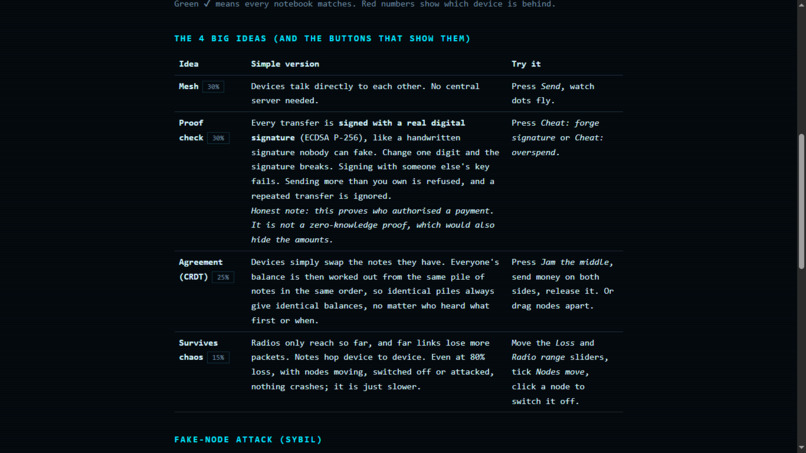
| Mesh socket connectivity (CBOR over UDP, multi-hop gossip) | 30% | Done |
| Proof / signature verification, rejects invalid input | 30% | Done |
| CRDT convergence after a partition | 25% | Done |
| Chaos survival at 80% packet drop | 15% | Done |
🧠 How it works
- Alice signs a payment with a real ECDSA P-256 key (WebCrypto).
- The payment is gossiped over a lossy, range-limited radio mesh.
- Every node checks the signature. Forged, tampered, wrong-key, malformed and overspending transactions are rejected.
- Valid transactions go into a grow-only set, ordered by Lamport clock then id.
- Every node computes the same balances from the same set, so replicas converge and a double spend keeps exactly one payment. Total supply stays 650.
📡 Realism
- Range-limited links, distance-based loss and latency
- Draggable and moving nodes, node outages, jammed-middle partitions
- Fake-node flood attack, plus an unsafe mode (signature checks off) to show the damage
🐍 Python reference node
Pure Python, stdlib only: CBOR over UDP, proof stub, per-key LWW CRDT, 80% drop simulation and a trusted-writer Sybil filter.
- sprint_node.py: MeshNode, CBOR codec, proof stub, CRDT merge
- test_sprint.py: tests for CBOR, proofs, partition and convergence under loss
- demo.py: 4-node chaos demo (partition, heal, Sybil injection)
Run it:
python demo.py
node tests/api.test.js
Deploy it:
vercel --prod
The file api/node.js is a Vercel serverless function that re-verifies ECDSA transactions on the server.
⚠️ Honest limits
- Signatures prove who authorised a payment. This is not a zero-knowledge system.
- A double spend is resolved by a fixed tie-break rule, not true global ordering.
- The Python verify_zk_proof is a structural stub. A real ZK-STARK verifier would replace it in production.
- Ledger state is not persisted. Keys are generated fresh on each page load.
Built in a 6-hour sprint 🔥 Mesh. Prove. Converge. Survive.

Log in or sign up for Devpost to join the conversation.