-
-
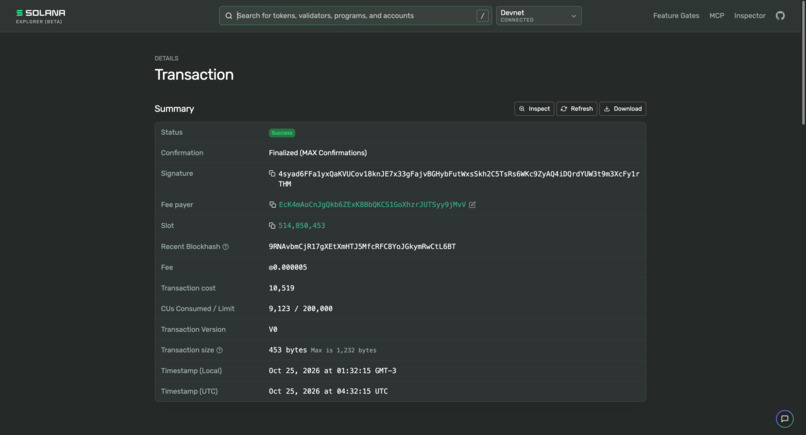
Solana documentation transaction (devnet)
-
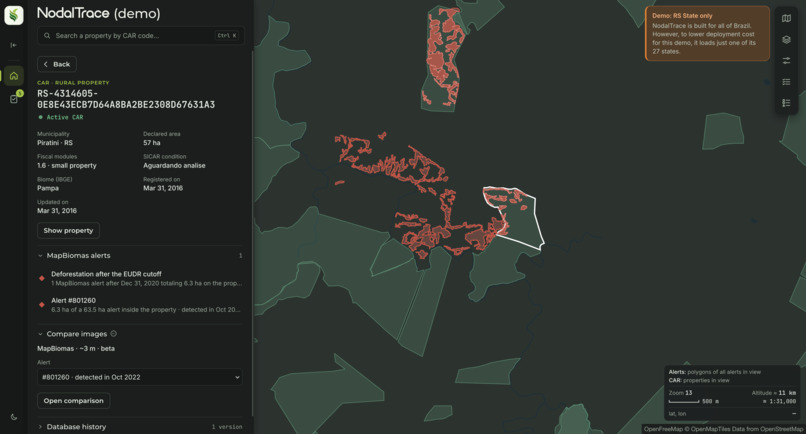
Property Inspection
-
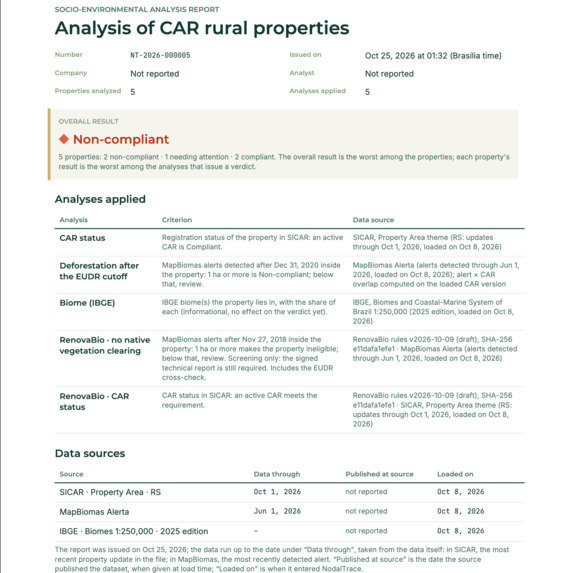
PDF analysis report
-
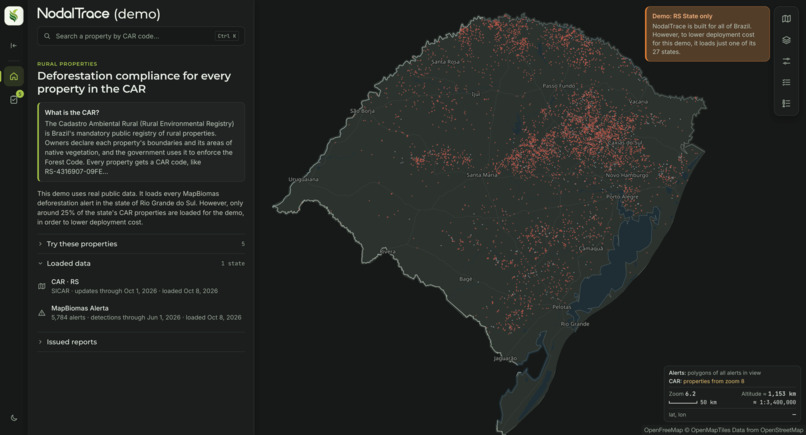
Overview
-
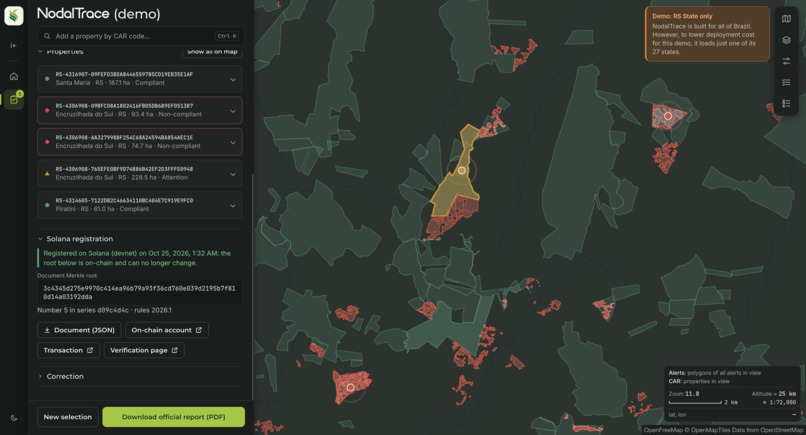
Analysis overview
-
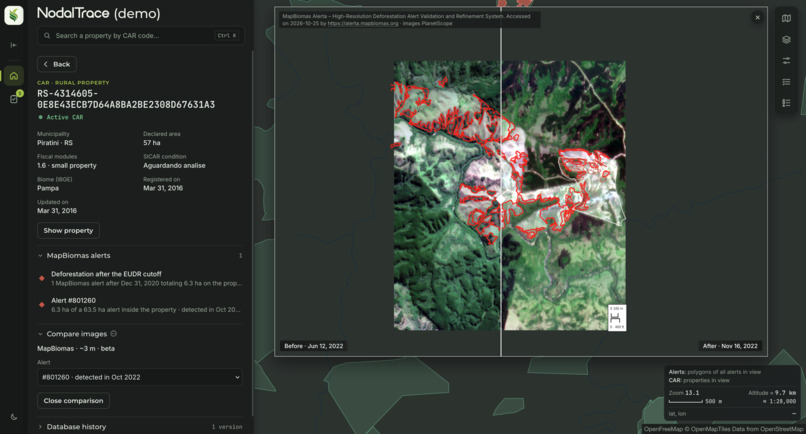
Satellite image analysis
-
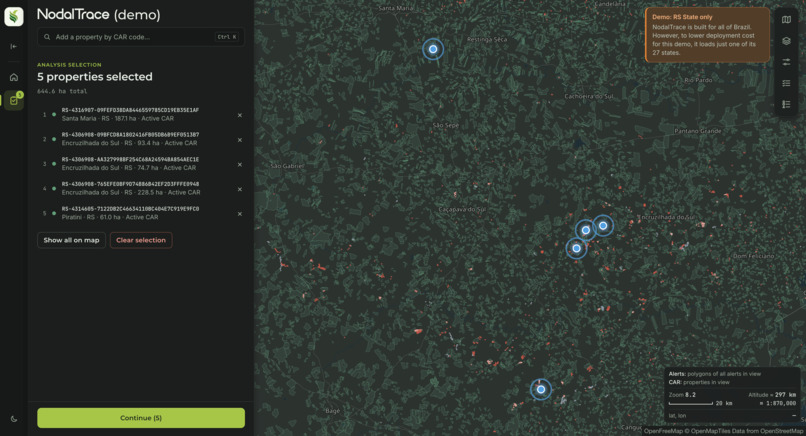
Property selection for analysis
-
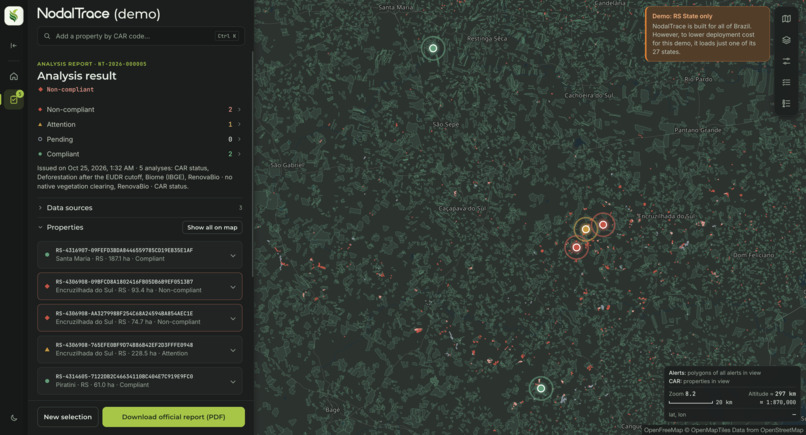
Property analysis
Track
Sustainable Supply Chains
NodalTrace makes the first link of agricultural supply chains traceable: the farm where the commodity is grown. Soy, beef, coffee and other Brazilian commodities pass through cooperatives, traders and processors before they reach a buyer. Every link is now being asked to show that the product did not come from recently deforested land. Today that proof is assembled by hand, in emails and spreadsheets, and no one further down the chain can check it.
NodalTrace addresses this in three ways:
- Traceability to the source. Each supplier is identified by its official rural registry entry (CAR). It is checked against public deforestation alerts (MapBiomas Alerta) and the rules of each regulation (EUDR, RenovaBio), with the evidence for every result.
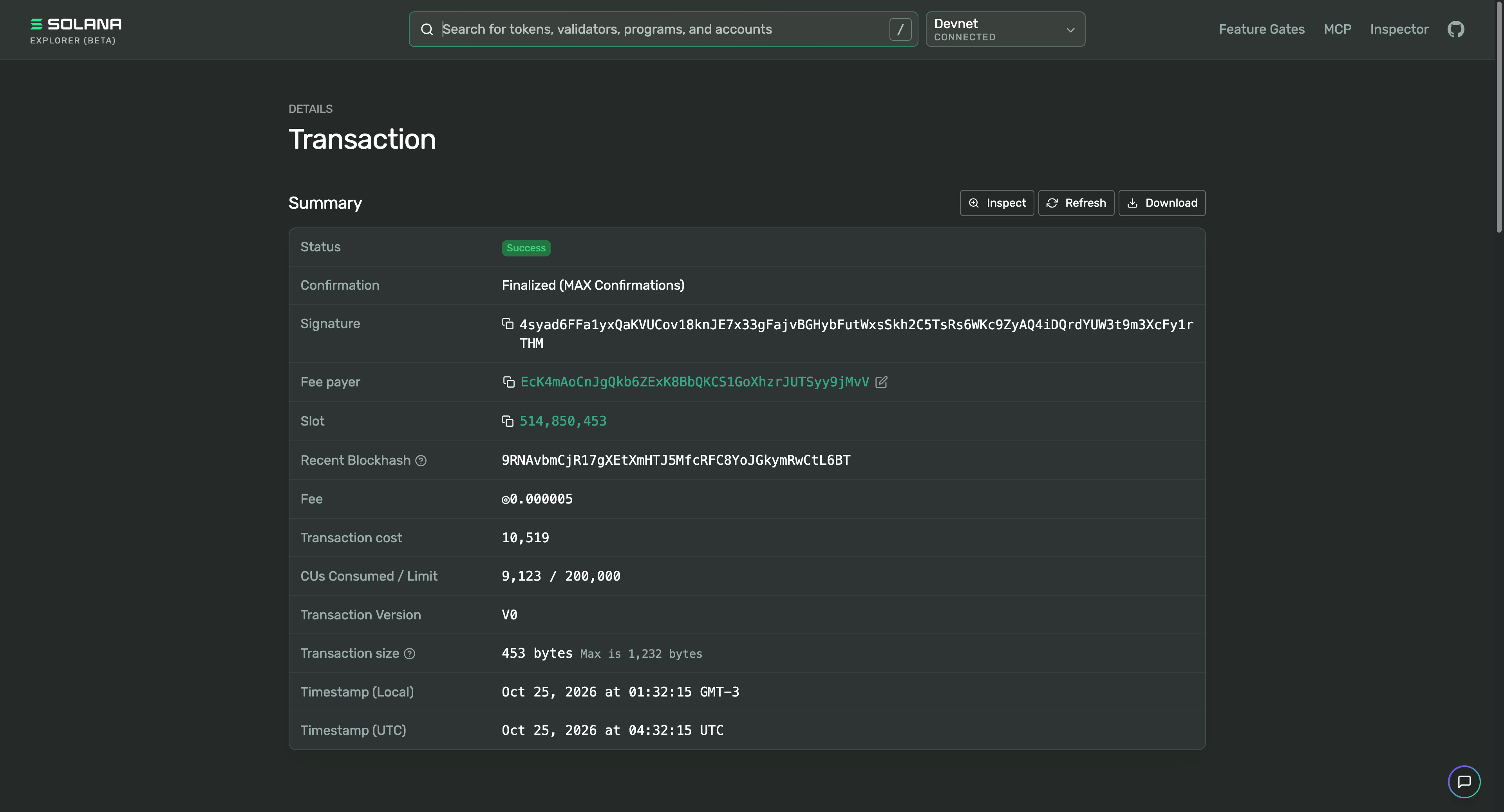
- Records that can be verified anywhere along the chain. Every report is registered on Solana, so a buyer, auditor or regulator can confirm it is authentic and unchanged without trusting us. A farmer can share proof for just their own property. The report works as the verified origin record a product's sustainability passport needs.
- Rewarding sustainable production. Farms that comply can prove it cheaply and repeatedly. Buyers can see deforestation before they buy, instead of after.
The environmental outcome is forest protection. When deforestation becomes visible at the moment of purchase, products from newly cleared land lose access to the markets that demand deforestation-free sourcing.
Problem
Buyers in the EU, and programs in Brazil like RenovaBio, are starting to require proof that soy, beef, coffee and other commodities don't come from recently deforested land. The EUDR, for example, starts applying on 30 December 2026 and requires the location of every plot of land. That proof starts at the farm, but cooperatives and traders still assemble it by hand, from many public datasets, in emails and spreadsheets. The result is slow, expensive, and almost impossible to audit later. Deforestation slips through, and compliant farmers struggle to prove they're compliant.
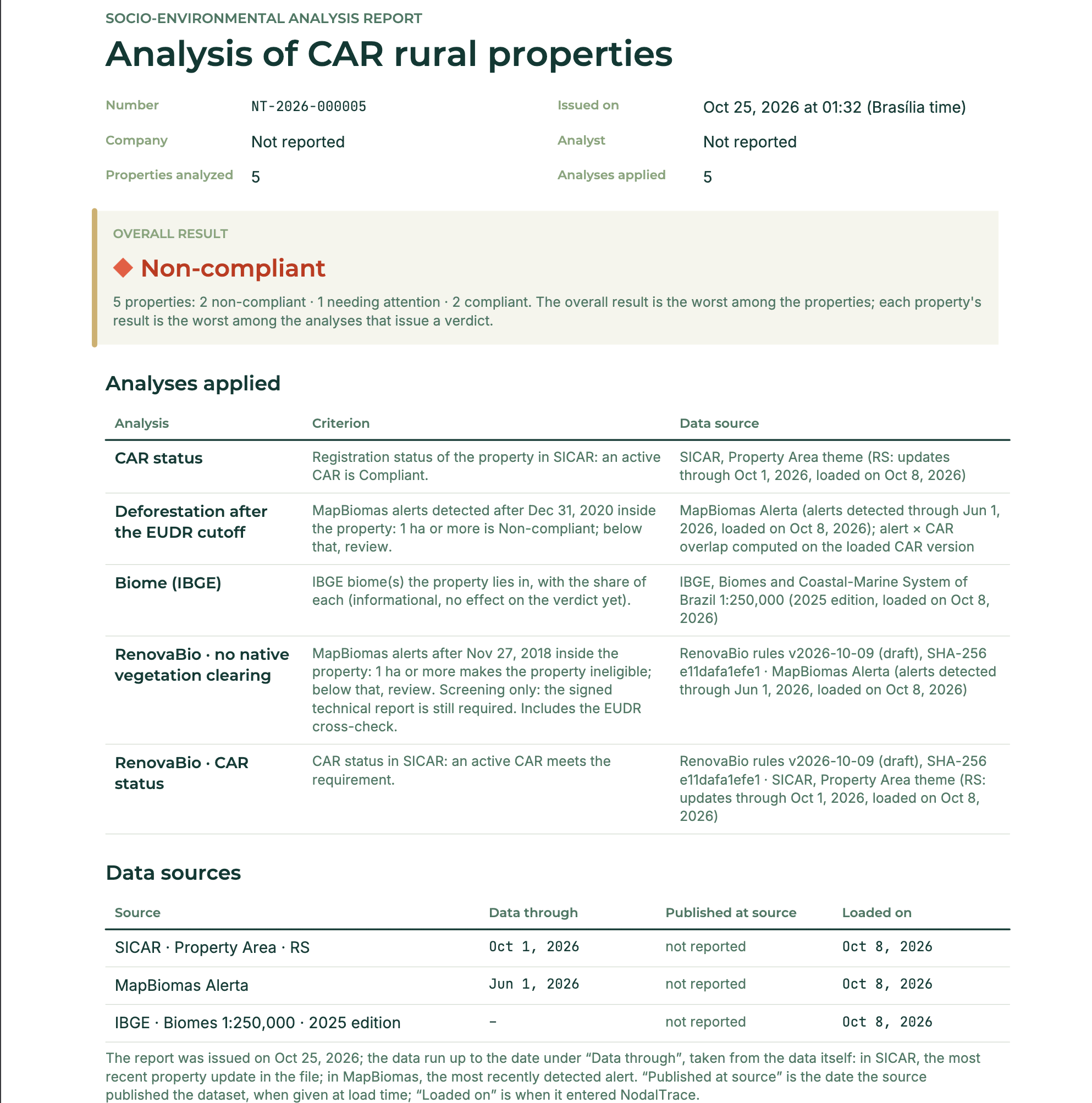
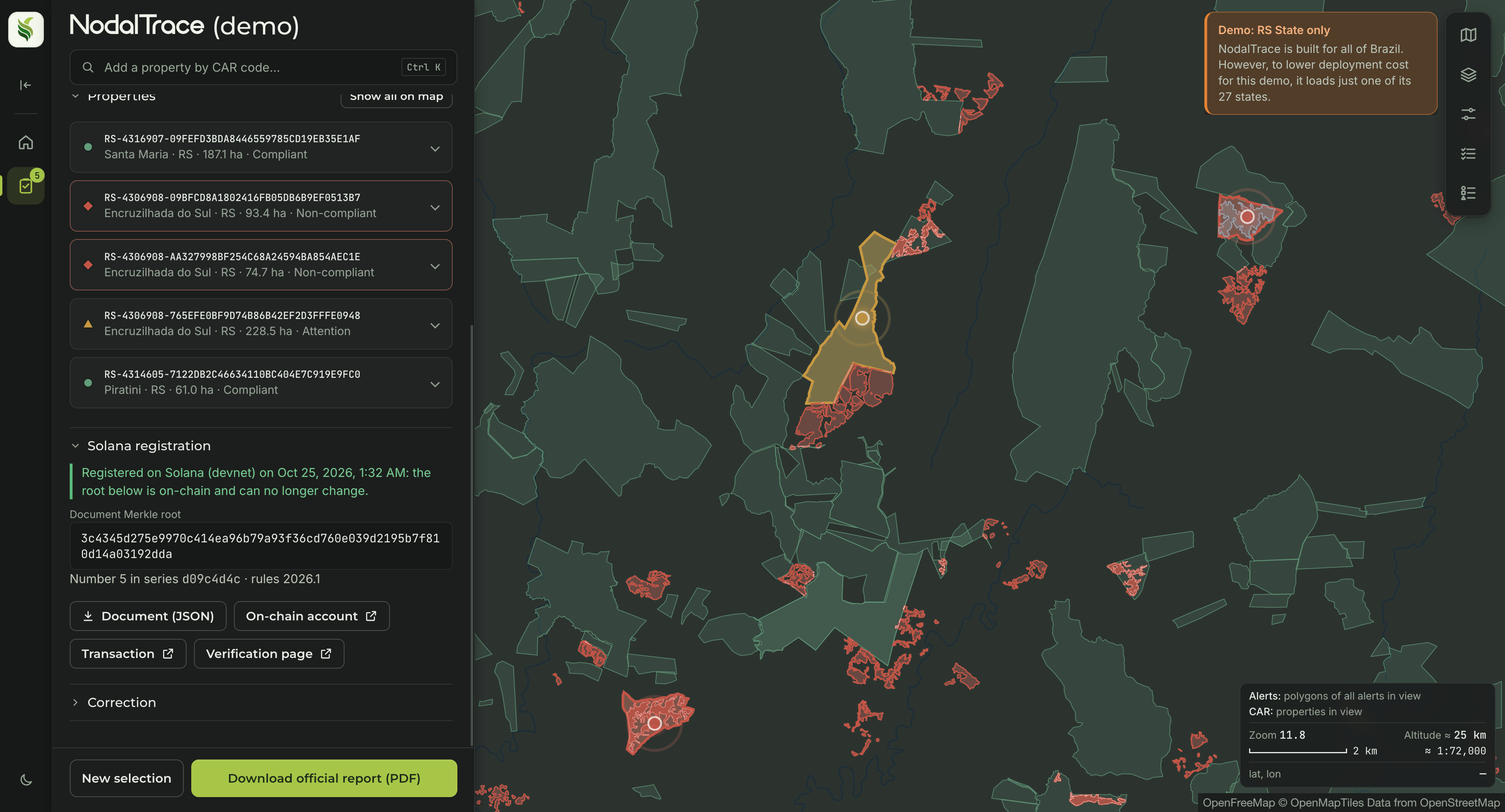
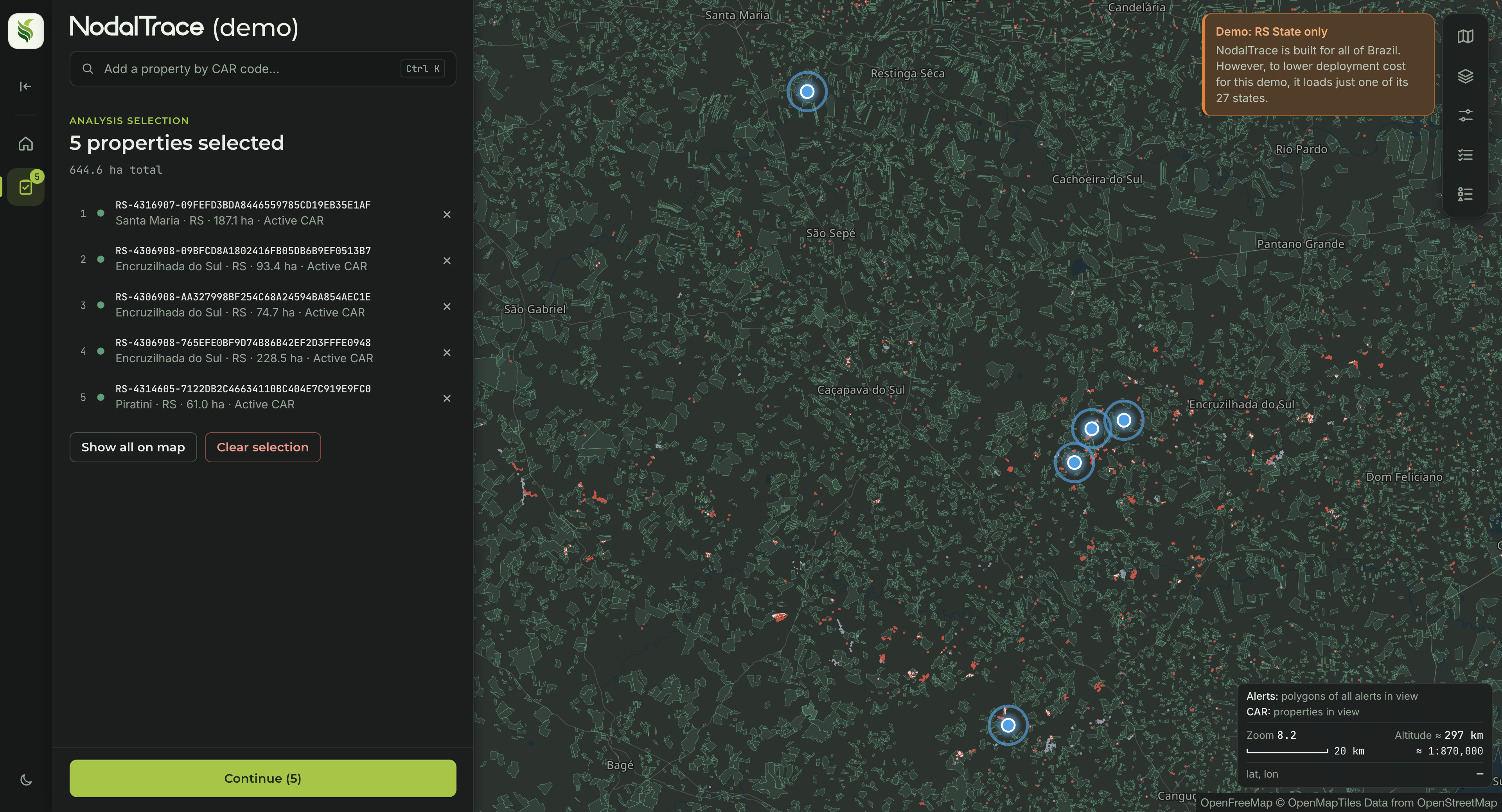
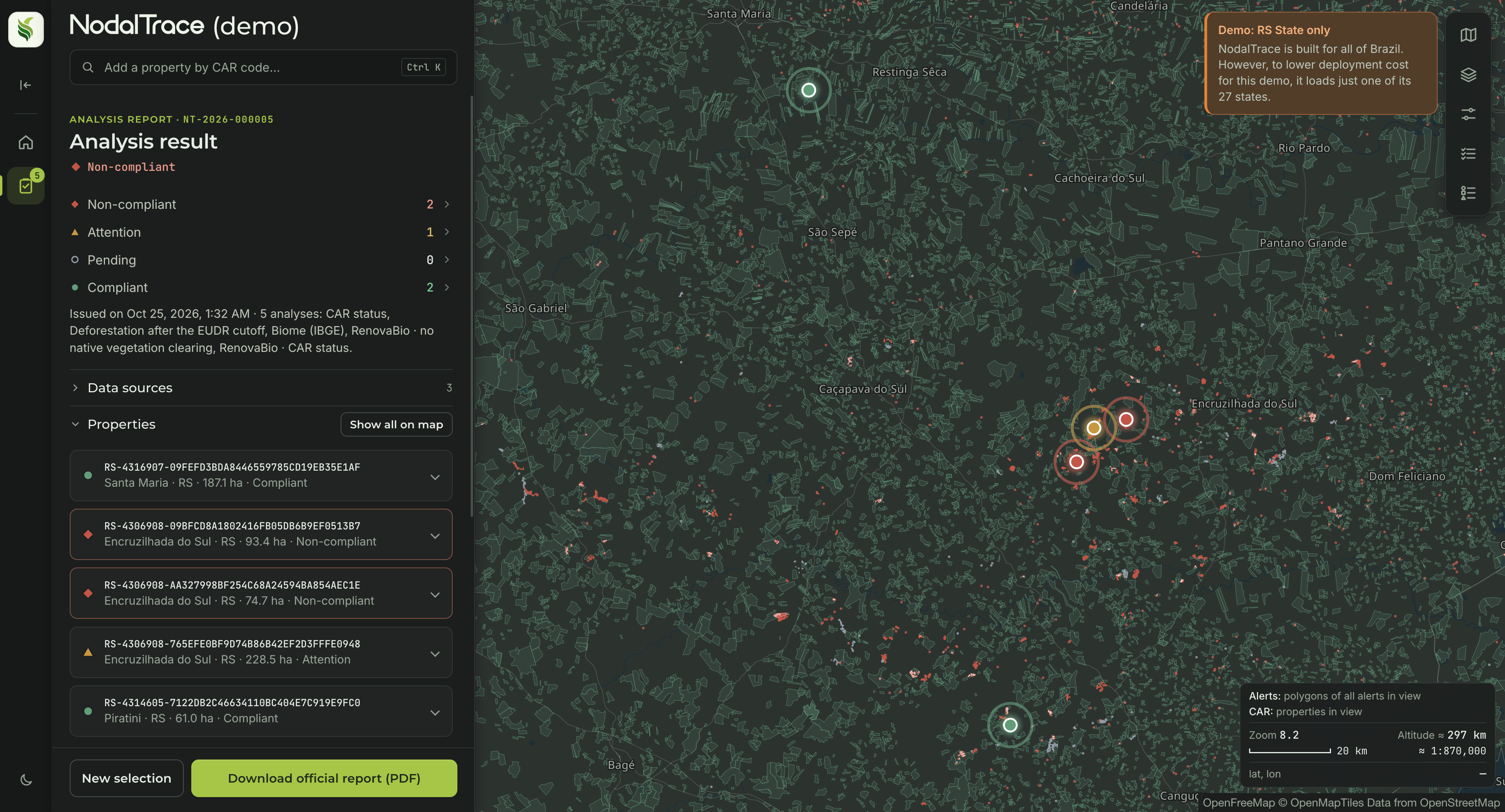
Our solution, NodalTrace, checks rural properties against official public data: Brazil's rural registry (CAR), MapBiomas deforestation alerts, and IBGE biomes and municipalities. Users select up to 200 suppliers and get a result for each regulation (EUDR, RenovaBio, CAR status), with the evidence behind it. Every report is immutable, comes with an official PDF, and is registered on Solana. Anyone can verify it without trusting us, and a farmer can share proof for just their own property.
Our target users are compliance and sustainability teams at agricultural cooperatives, traders and exporters, along with the buyers and auditors further down the chain. Farmers benefit too, because a single verified record answers every buyer.
NodalTrace is built to scale. The CAR covers every rural property in Brazil, and all of our data sources are public and nationwide. Adding a state means loading its data, not writing new code. Adding a regulation means adding versioned rules, not building a new product. On chain, each report costs the same whether it covers one property or two hundred, because only a single fingerprint is registered.
It is also easy to adopt. Every Brazilian rural property already has a CAR code, so a supplier list is all a client needs to start. NodalTrace runs in the browser, with no installation, no crypto wallet and no blockchain knowledge required. Reports come as PDFs that fit into existing audit and email workflows, and checking a report is free and open to anyone.
Inspiration
What initially inspired us to start the project was the EUDR, which starts applying at the end of 2026. The EUDR is a European Union law that stops companies from selling cattle, soy, coffee, cocoa, palm oil, rubber and wood (and products made from them, like leather, chocolate or furniture) in the EU, or exporting them from it, unless they can prove those products did not come from land deforested after December 31, 2020 and were produced legally in their country of origin. That proof has to include the exact location of the plots where they were grown, so in practice the pressure travels down the supply chain until it reaches the farm, and Brazil is one of the biggest suppliers of several of these commodities to Europe. It made us wonder if the local cooperatives and farmers were ready for not only this, but many other upcoming deforestation regulations, and most of them are not. Basically the problem is that not only are there tons of different rules from different places, but also the amount of data sources needed to be checked is huge and then storing it reliably so it can be audited later is a process with many moving parts and most players in the country only have very manual and slow solutions to it. We interviewed these industry players and their answers shocked us. It is still done via emails, Excel sheets, handmade documents with little automation and poor auditability and traceability capacity. This showed us there was an opportunity to make something better that would benefit the entire supply chain from small farmers to big cooperatives. Now we are building it.
What it does
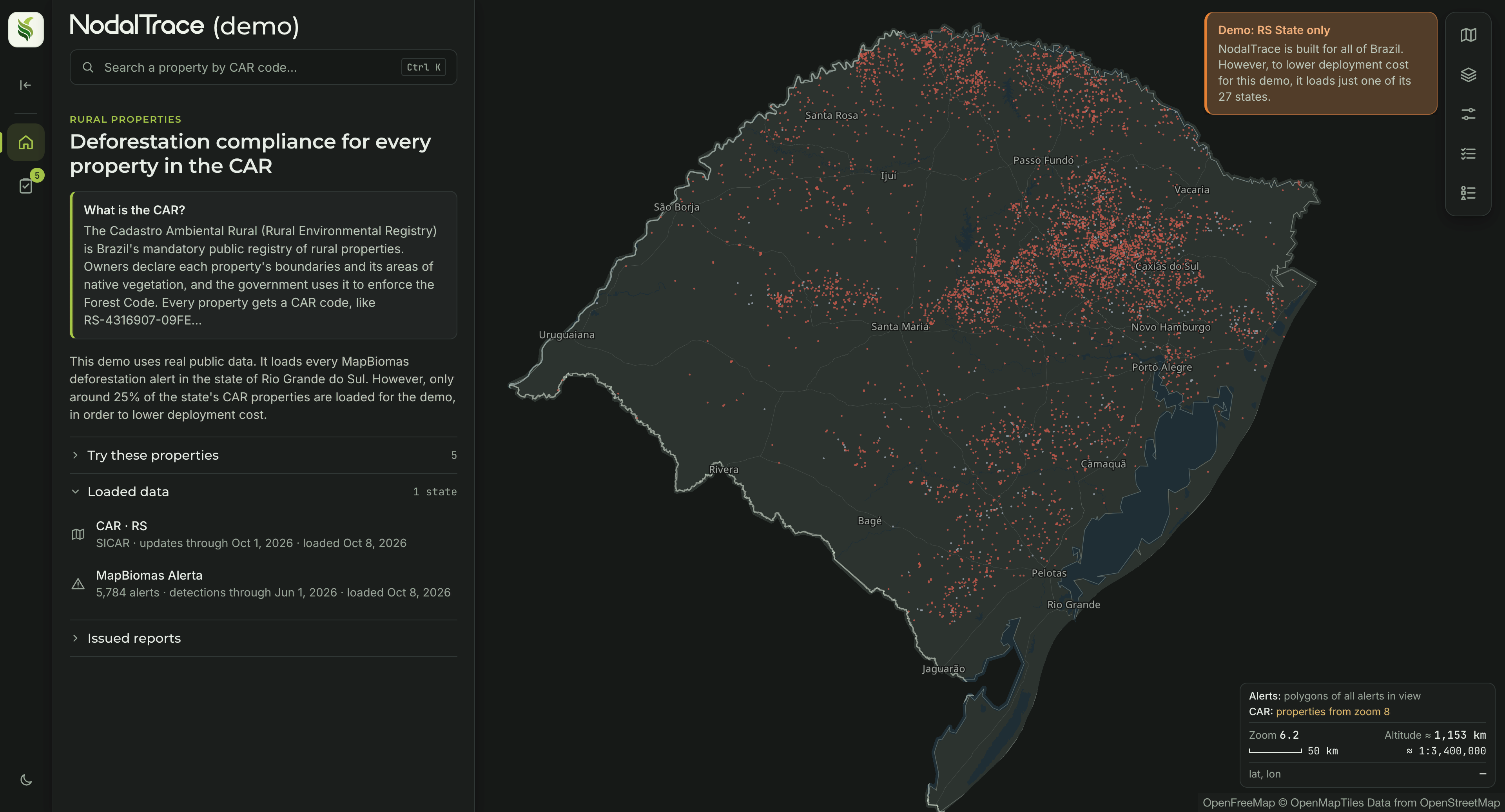
NodalTrace is built to map every rural property in Brazil, and today holds 6.6 million properties from 14 states, with the data needed to tell if each one is compliant or not. The properties come straight from the official rural environmental registry (CAR), the deforestation alerts from MapBiomas Alerta and the biomes and municipalities from IBGE. Everything is real public data, nothing is simulated.
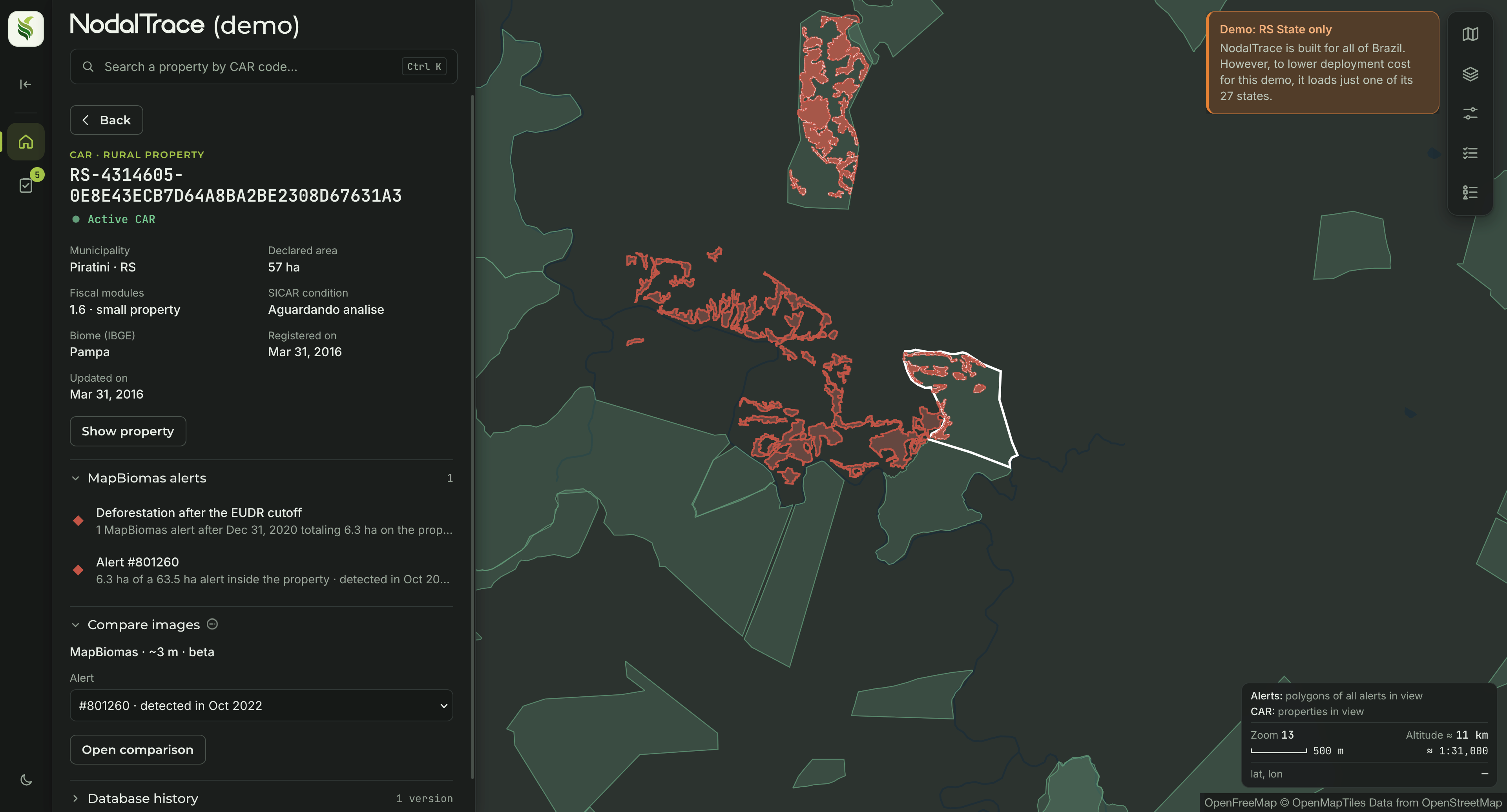
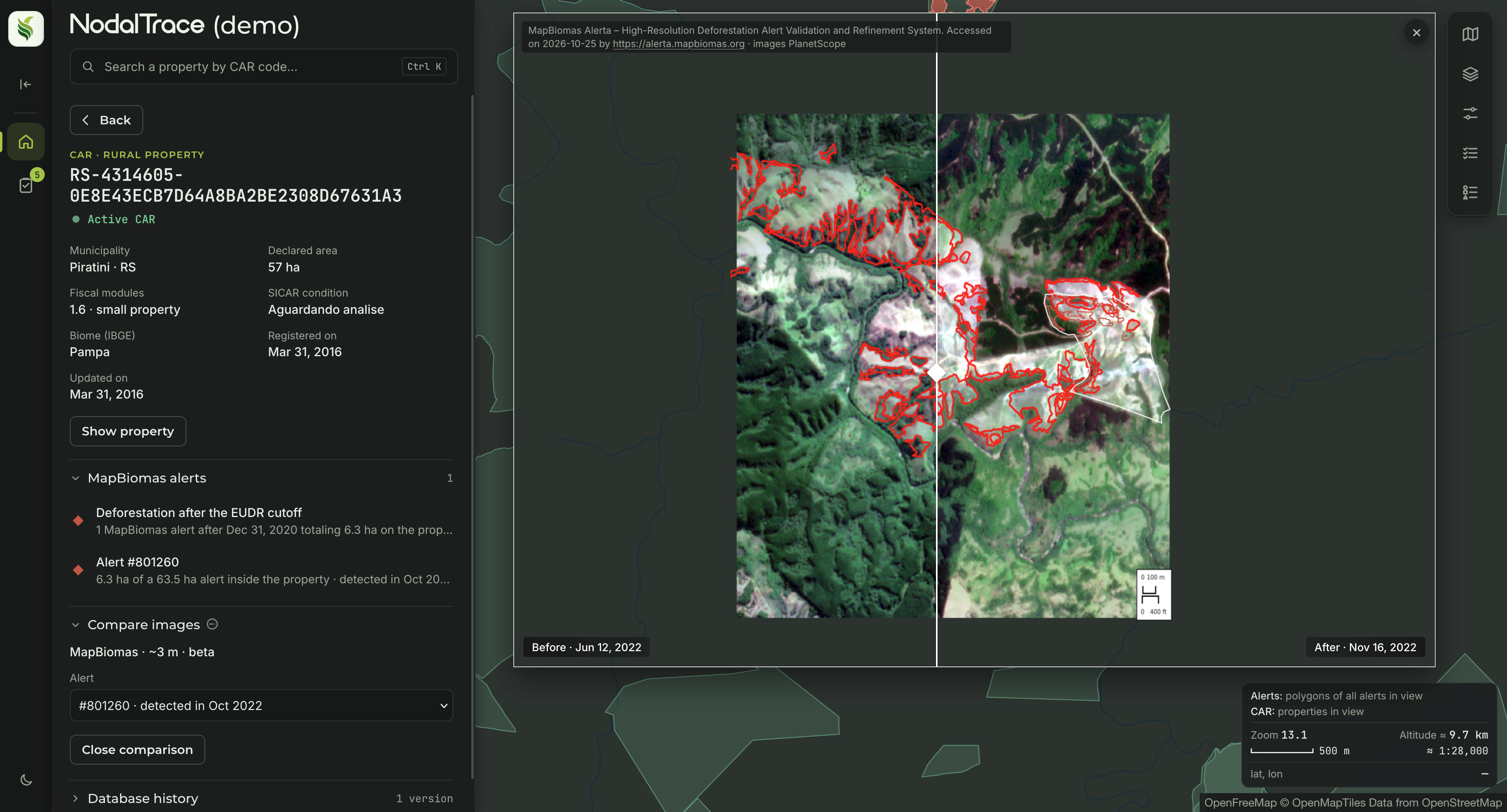
An analyst at a cooperative, a trader or a buyer can find a property on the map or by its CAR code and see in one place its status in the registry, every deforestation alert that touches it, its biomes and satellite images from before and after an alert, side by side with a slider. Then they can select up to 200 properties, for example all the suppliers of a cooperative, and run the analyses for all of them at once. Today we check the EUDR (no deforestation after 2020), Brazil's RenovaBio biofuel program (no deforestation after November 2018 and a valid registry) and the property's status in the CAR. Each property gets a result (compliant, attention, non-compliant or pending) together with the evidence behind it. The rules are versioned and every report records which version it used, so adding a new regulation means adding its rules, not building a new product.
The result is an immutable report with an official PDF, and right after it is issued the report is registered on Solana. Only a fingerprint of the report goes on chain, nothing about the farms or the client, so anyone holding the report can check it against the blockchain on our public verification page, without having to trust us or our servers. A farmer can also share the proof for just their own property without revealing the rest of the report. And if a report has a mistake, it is never edited: a correction is issued pointing to the old one, and both stay on record.
How we built it
We split NodalTrace into a few pieces that each do one job. A data pipeline in Python downloads the public datasets (the CAR state by state, 14 states so far, more than 500 thousand MapBiomas alerts, the IBGE biomes and municipalities) and loads them into PostgreSQL with PostGIS, where the heavy geographic work happens, like crossing every alert with every property. On top of it there is an API in Python with FastAPI that holds every business rule in one place and generates the PDF reports, so the frontend only displays what the API decides.
The frontend is React and TypeScript with MapLibre for the map. The CAR has millions of properties, so the browser never downloads the whole base: Martin serves vector tiles straight from the database and the map only loads what is on screen. For imagery we use Mapbox for the base map, historical images from INPE (Sentinel-2 and CBERS-4A), which the API crops to each property and caches, and MapBiomas' own before-and-after images of each alert.
For the blockchain part we used the Solana Attestation Service. Each report becomes a Merkle tree, with a header and one leaf per property, and only its root is sent to Solana devnet. That is done by a separate service written in TypeScript with Solana Kit, the only piece that can touch the signing key, which lives in an encrypted vault. We tested it against a local Solana network with Surfpool before moving to devnet. The verification page reads the attestation directly from Solana in the browser and recomputes the root from the report file, so it does not depend on our API at all. Locally everything runs on Docker, and the app is deployed on Google Cloud (Cloud Run and Cloud SQL) in the São Paulo region.
Challenges we ran into
The initial challenges were to understand what the industry actually needed and what would be our competition. Naturally, we were not the first ones to think about software solutions to ESG in Brazil. So it took us many interviews - with real industry players, cooperative leaders, and potential clients that we are still in talks with - to properly understand what is the gap of automation, traceability and management the industry still has. It is a complex business and there are many moving parts, but now we feel aligned on what has to be done and what would bring true innovation to ESG business in Brazil. One of the main points of innovation we are bringing is the use of blockchain. But this would be our next big challenge, because we had very little blockchain development experience. We learned Solana from scratch and shipped report attestation on devnet, with Merkle proofs that let anyone verify a report without trusting us.
Accomplishments that we're proud of
- Successful interviews with many players and farmers that expanded our knowledge and understanding of the industry we are getting into.
- 2nd place in two national hackathons.
- Learned and implemented Solana in our solution.
- Were invited to and attended an exclusive Solana event for developers (The/Garage, SuperteamBR).
- In active talks with huge industry players to start beta test pilots.
- A working app on real data for 6.6 million properties where every report is registered on Solana and can be verified by anyone.
What we learned
This is our first ever attempt at a startup project. We cannot stress how much we learned in our journey so far. From understanding what it takes to build a real solution from scratch, talking to clients, planning a business model, learning blockchain, improving our backend and software architecture skills, learning how to pitch our product and create compelling marketing material and more.
What's next for NodalTrace
We are now very close to starting our first beta test pilot with some clients. With our business model and software solution more aligned, we will focus on actively iterating our app to meet client expectations and demands. With the scope now narrowed we know what can be immediately useful. NodalTrace is heavily focused on shipping the features that will allow the solution to start making a real-world difference in how farmers and cooperatives communicate and operate for environmental compliance.
On the product side, three things are at the top of our list. First, moving the report attestation from Solana devnet to mainnet, so every report issued during the pilots is recorded permanently and not on a test network. Then, adding more regulations with new data sources like IBAMA's embargoed areas, so a single analysis can answer every buyer and rule a farmer has to deal with. And finally, providing custom operation presets for companies, with their own criteria and thresholds on top of the regulations, their own supplier lists and user accounts so each team can run and manage its own analyses and reports.
Built With
- fastapi
- googlekms
- maplibre
- martin
- postgis
- python
- react
- solana
- typescript
