-
-
Official strategic alignment framework with Vyoma HQ to deliver institutional-grade cybersecurity audits and fractional vCISO coverage.
-
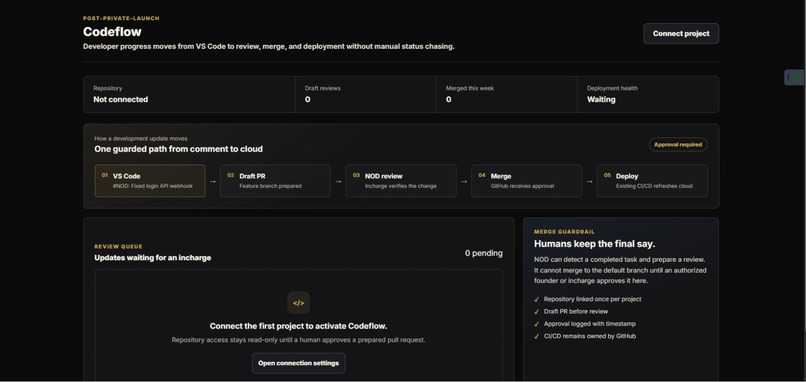
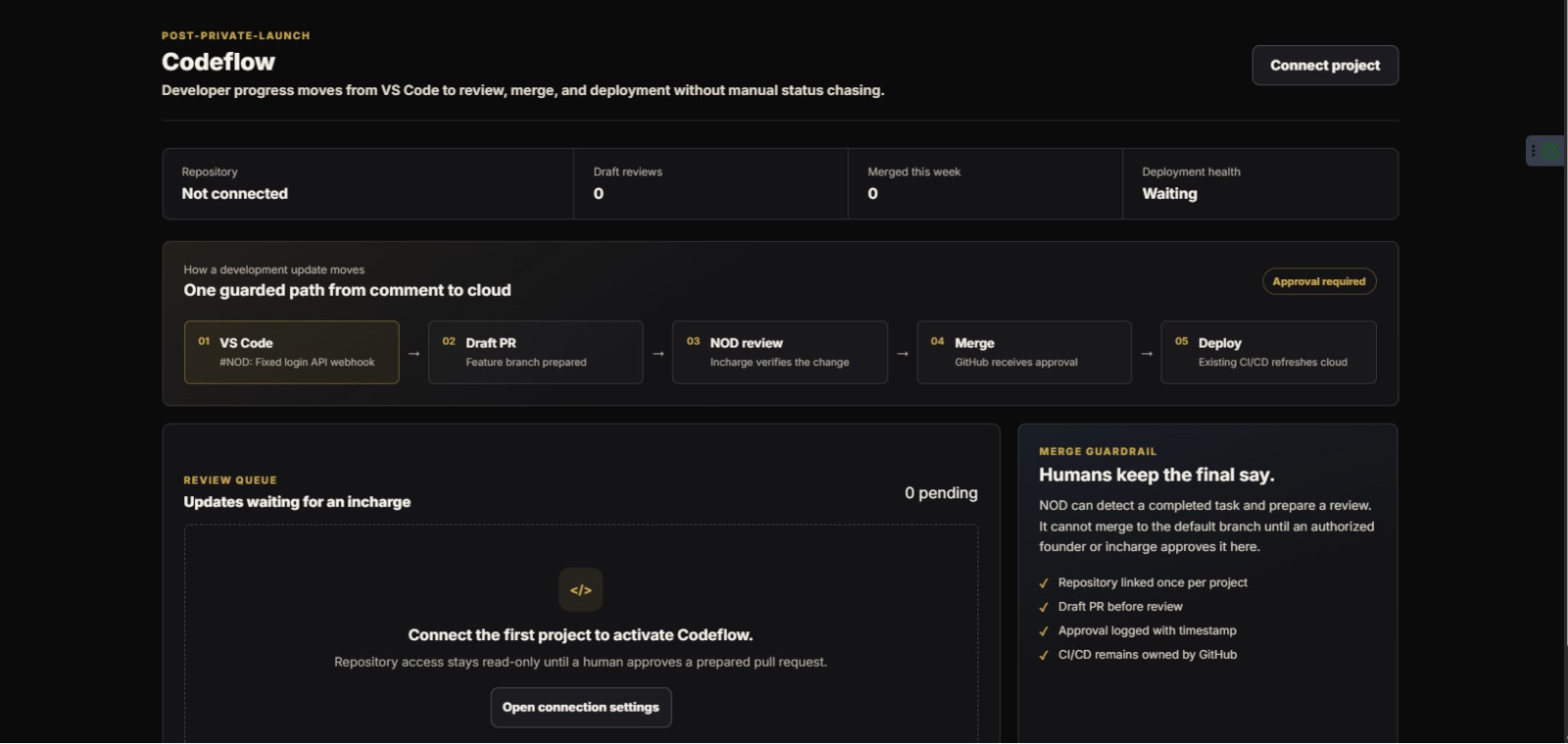
Automated development pipeline routing asynchronous #NOD inline tasks from VS Code straight through to production server deployment health.
-
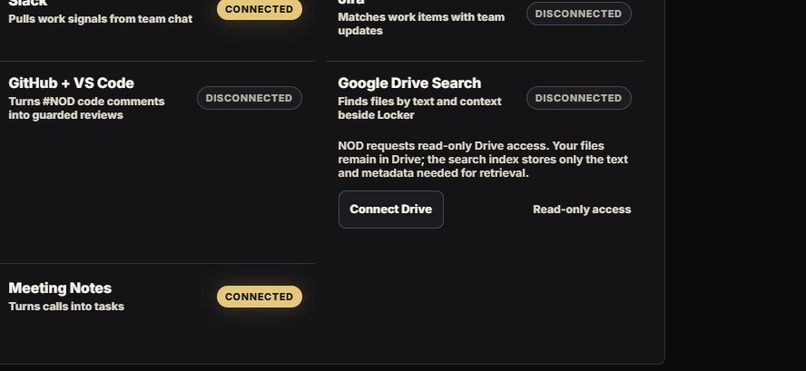
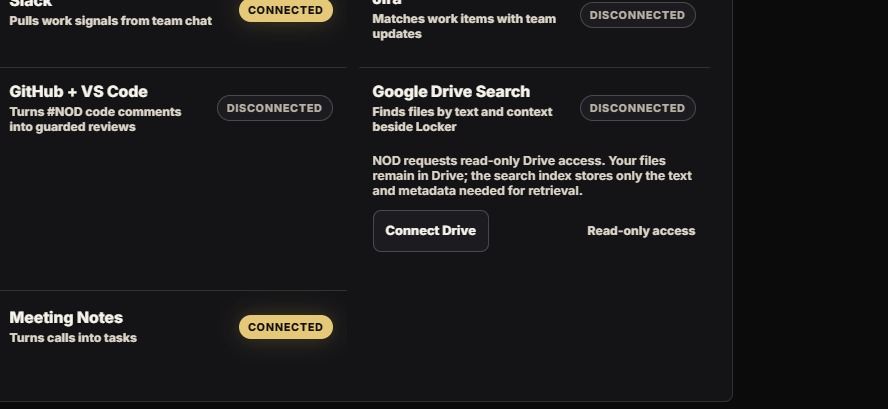
Our centralized ecosystem connection grid linking Slack webhooks, meeting telemetry, and read-only Google Drive contextual data layers.
-
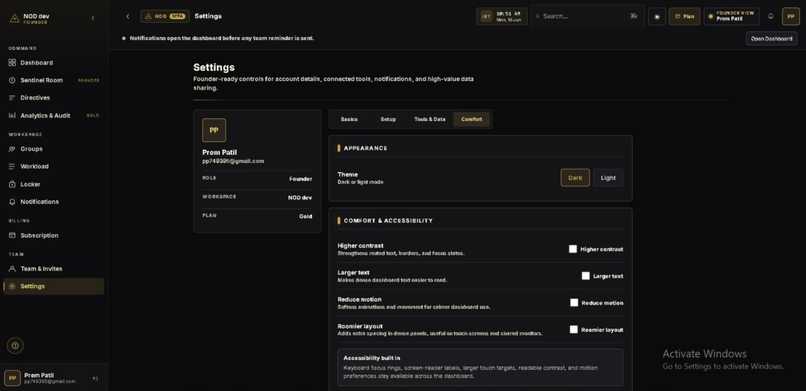
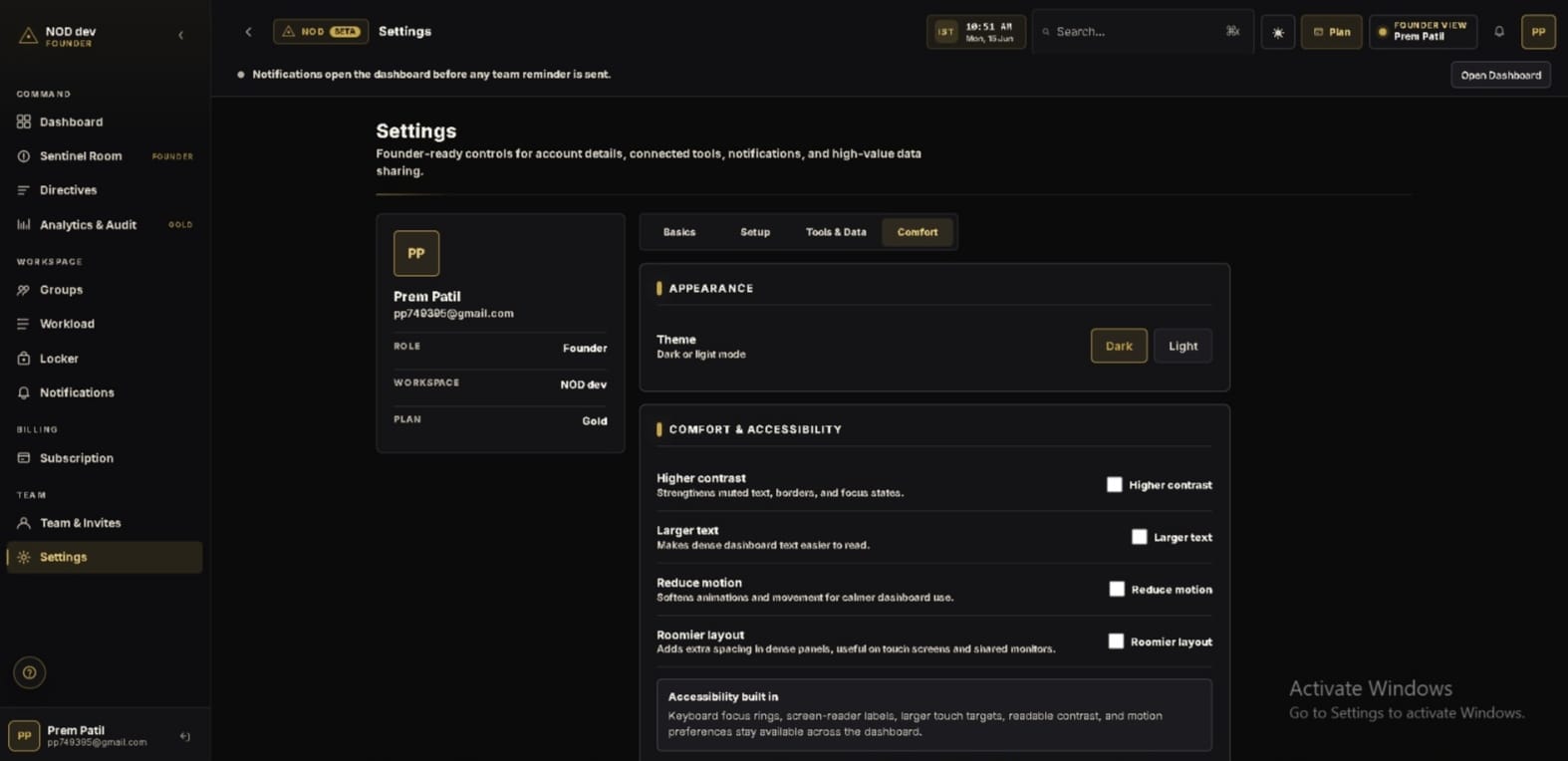
Dedicated comfort controls featuring higher contrast, text scaling, and roomier layouts built for low-vision and high-velocity leaders.
Inspiration
Our journey began with a failure and a fundamental truth about human collaboration. In December 2025, fueled by raw entrepreneurial excitement, I submitted an early conceptual framework to a startup platform and faced an immediate rejection. That rejection was the best thing that could have happened to us. It forced me to realize a core operational law: in the early stages of a venture, clarity beats intelligence. As I observed fast-moving execution teams, I realized that professionals don't burn out because an objective answer is "no"—they burn out because there is no answer at all. Context fragmentation across Slack, Jira, and WhatsApp creates a silent, expensive erosion of strategy. When the Wall Street Journal published that Meta and Mark Zuckerberg were internally building an "AI Chief of Staff," it completely validated our thesis. We weren't just building another productivity wrapper; we were pioneering a new enterprise paradigm: Executive Intelligence (EI).
How We Built It NOD was engineered to serve as a non-exploitative, ambient nervous system that sits silently cross-ecosystem over existing corporate structures. The Core Ingestion Layer: Built on a robust, asynchronous cloud architecture using Supabase to capture ambient data streams without contaminating team workflows. Bi-Directional Velocity: We decoupled application logic from a single interface. Instead of trapping data inside a closed platform, NOD pulls work signals and actively pushes structured updates back into Jira tickets, Slack channels, and developer codeflows in real-time. Digital Accessibility: To ensure uncompromised usability for high-end, busy, or low-vision executives, we natively baked high-contrast UI parameters, automated text scalability, and hands-free voice-command loop infrastructure directly into the production server.
Challenges Faced Operating on an absolute zero-dollar budget meant our resource allocation had to be flawlessly optimized. For four months, it was a grueling solo grind refining the core Minimum Viable Product (MVP). The primary engineering challenge was managing cross-platform API synchronization without triggering rate limits or platform insulation protocols. When the university semester concluded, I scaled the vision into a fully integrated team of four. We had to learn to adapt like water—managing rigorous academic schedules during the day while executing codebase updates deep into the night.
Accomplishments We Are Proud Of National Accelerator & Institutional Validation: We cleared 7 out of 10 highly competitive IIT startup summits we applied for including IIT Madras, Patna, Jammu etc, validating our business model and core value proposition in front of national panels and venture networks. Live 24/7 Cloud Architecture: We successfully transitioned from an isolated local MVP into a fully deployed production server running 24/7 on a permanent cloud network, tracking active multi-tenant workspace telemetry across Slack, Jira, and Google Drive. Zero-Dollar Corporate Alignment: Operating with zero external capital, we legally executed a formal B2B strategic compliance and fractional vCISO advisory agreement with Vyoma HQ to insulate our data pathways and secure our enterprise technical due diligence from day one. Unified Execution Velocity: We built a hyper-focused, uncompensated core engineering and research team that managed to maintain academic commitments while shipping robust infrastructure updates under tight timelines.
What We Learned We learned that the market does not care about fancy, isolated systems; it cares about absolute friction-free integration. Our initial private launch taught us that busy executives have zero tolerance for complex onboarding. This realization forced us to pivot away from passive user configuration to a complete, manual "Concierge Onboarding" model where our software conforms completely to the user's existing habits, not the other way around. By keeping our egos aside and viewing every data point bluntly, we proved that a young, hungry team can build enterprise-grade, vCISO-compliant architecture capable of competing on a global level. The game is on, and we are just getting started.
What's Next for NOD Bi-Directional Synchronicity: Finalizing our real-time push/pull webhook architecture so that any milestone or strategic directive updated inside NOD automatically patches team Slack channels and Jira tickets natively. Deepening Codeflow Analytics: Actively testing and debugging our VS Code extension and GitHub PR automation to turn #NOD code comments into guarded, trackable enterprise reviews without manual status chasing. Market Expansion into Legacy Sectors (EI ERP): Tasking dedicated R&D to map out integration pipelines for Enterprise Resource Planning (ERP) systems like SAP and Oracle NetSuite, allowing NOD to capture unstructured data from traditional heavy industries that don't operate on standard software sprint trackers. Concierge Distribution Scaling: Executing a high-velocity, founder-led manual onboarding campaign to deploy NOD directly into our next five target startup pilot cohorts, refining our product-market fit before scaling toward major incubation programs
What it does
How we built it
Challenges we ran into
Accomplishments that we're proud of
What we learned
What's next for NOD
Built With
- css3-frameworks:-next.js
- dark-themed
- dashboard
- designed
- digital
- drive
- for
- fully
- github-actions-apis-&-integrations:-slack-api
- html5
- interface
- javascript
- jira-api
- languages:-typescript
- node.js
- react
- responsive
- scalable
- server-based-background-ingestion-and-processing-logic-running-24/7.-tailwind-css:-for-engineering-the-premium
- tailwind-css-database:-supabase-(postgresql)-cloud-&-deployment:-vercel
- user
- web
- whatsapp-api

Log in or sign up for Devpost to join the conversation.