Inspiration
Comics are one of the most visual kinds of storytelling, and that makes them one of the least accessible. A blind reader can listen to an audiobook, but there's almost no way to listen to a comic. Dyslexic readers struggle with dense speech bubbles, and anyone who can't easily use their hands has to fight with tiny page-turn buttons. We wanted a comic to feel like a show you watch, one you can control just by moving your head.
What it does
Nod & Read turns comic pages into an accessible, hands-free experience:
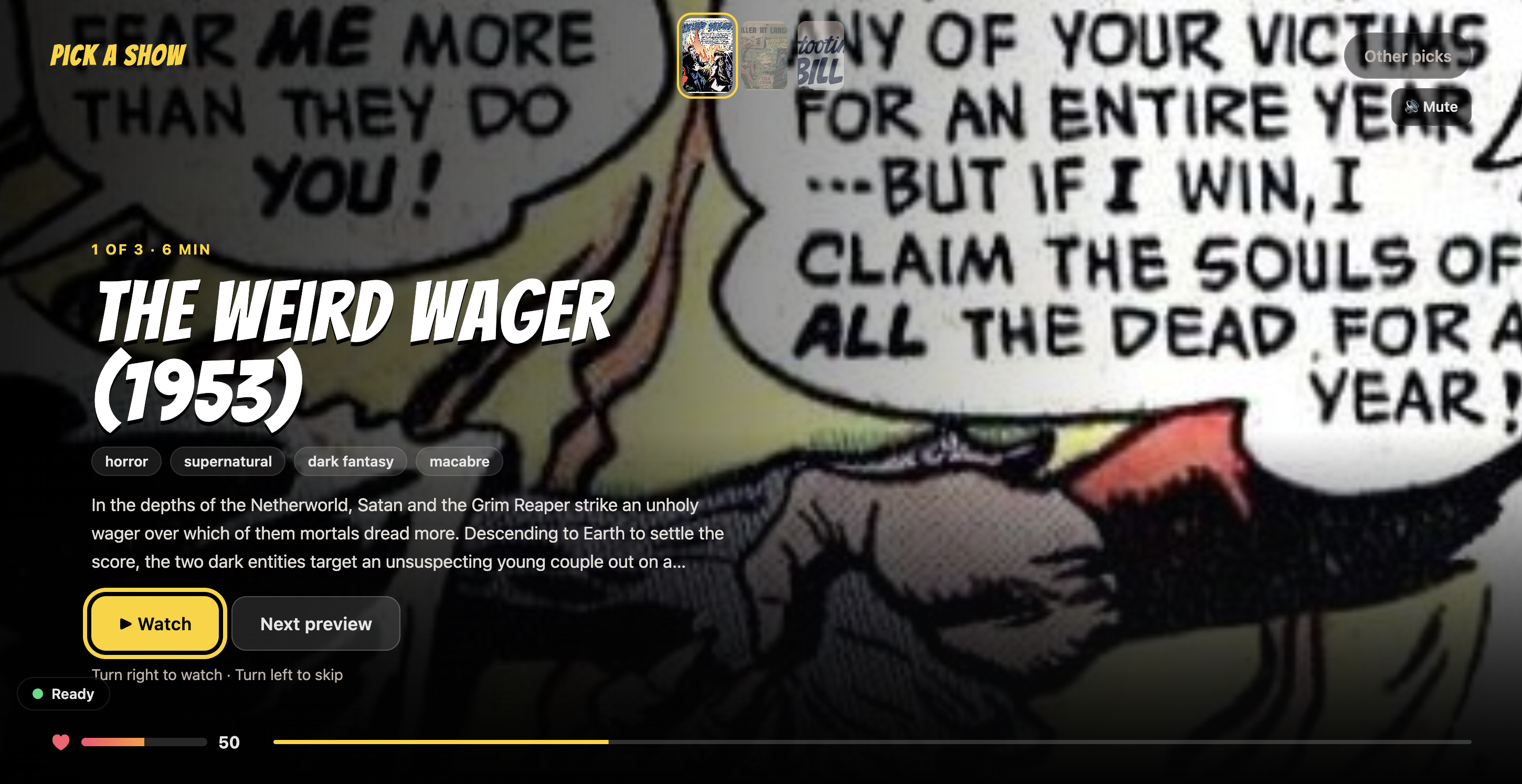
- 🎬 One panel per screen. It finds every panel, puts them in reading order, and a camera glides across the page from panel to panel, like a motion comic.
- 🗣️ A voice for every character. Each character gets their own voice, with emotion ("[whispers]", "[urgently]"), plus sound effects under each panel.
- 🎧 Audiobook mode. A narrator describes the setting, the action, and each character's expression and body language.
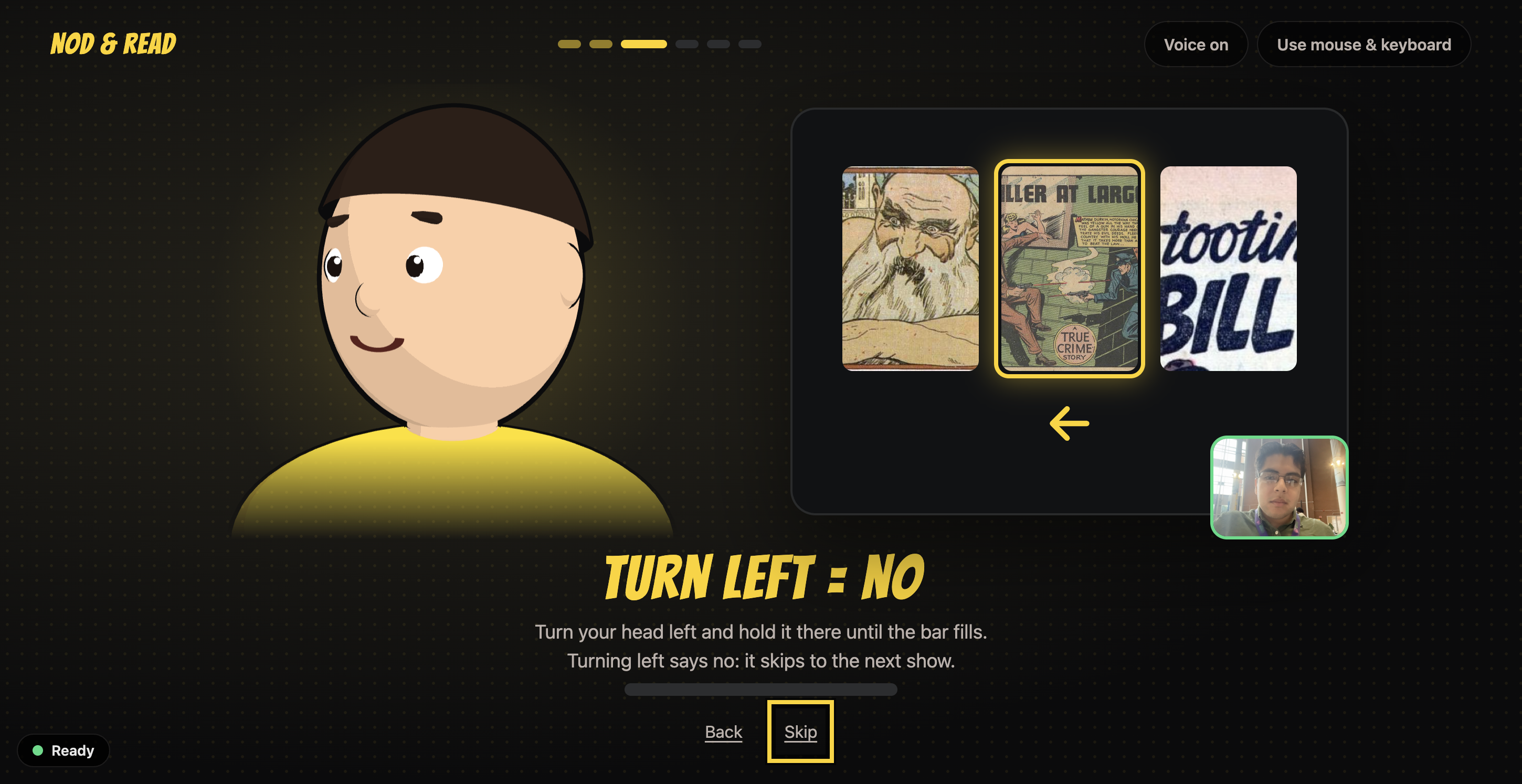
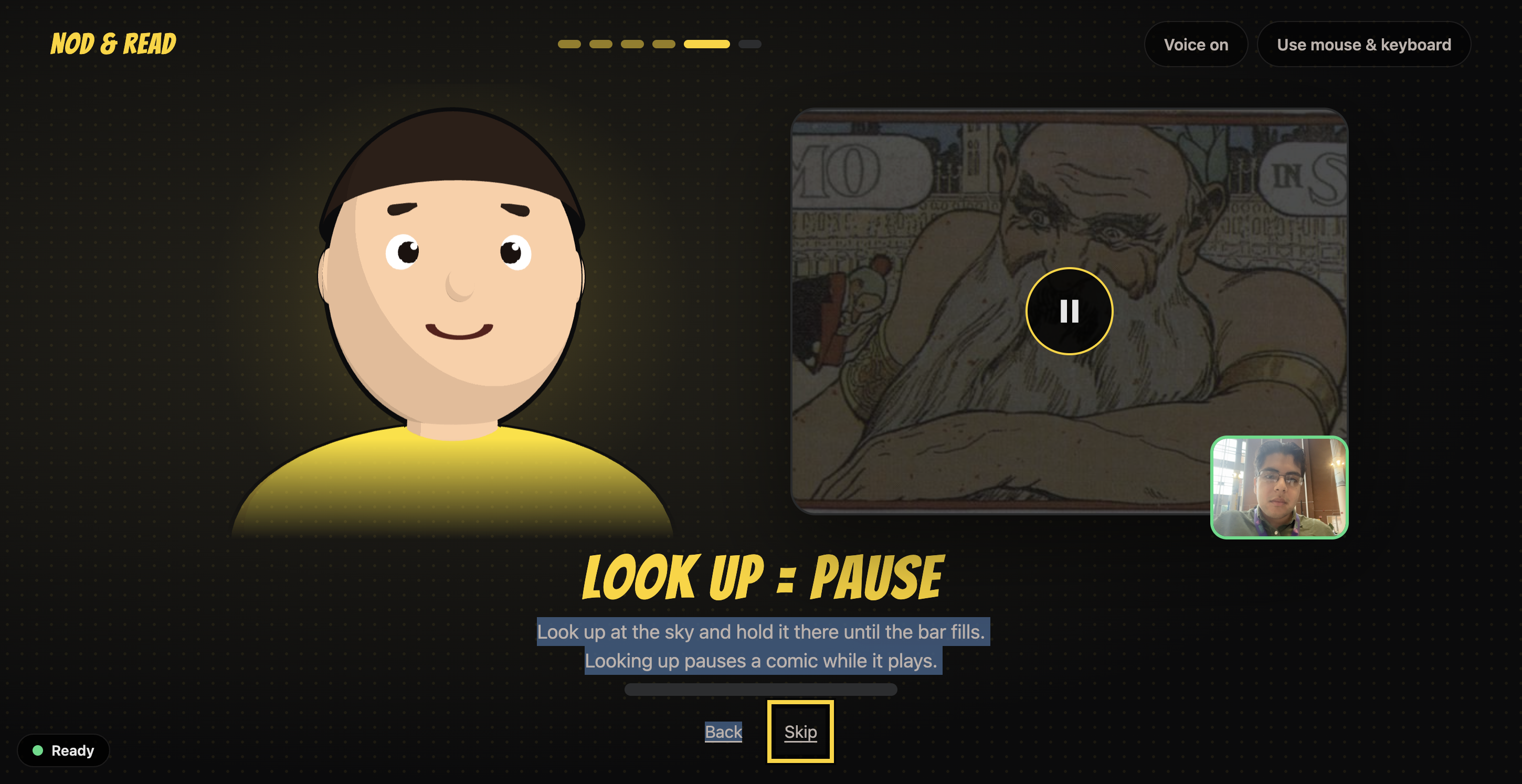
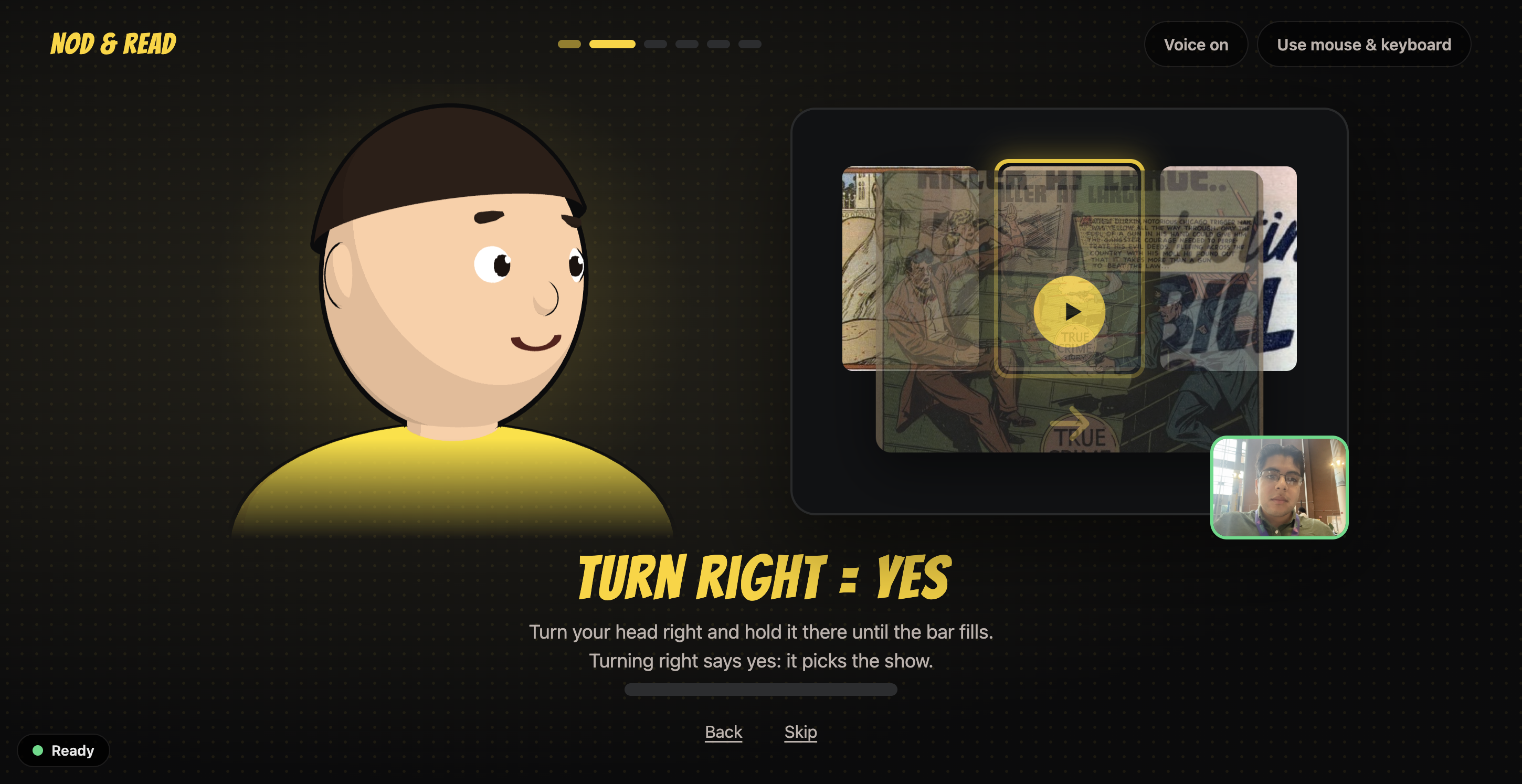
- 🙂 Face control. Turn your head right for yes / next panel, left for no / back, close your eyes to toggle the narrator, and look up to pause. Face tracking runs entirely in your browser, so no video ever leaves your device.
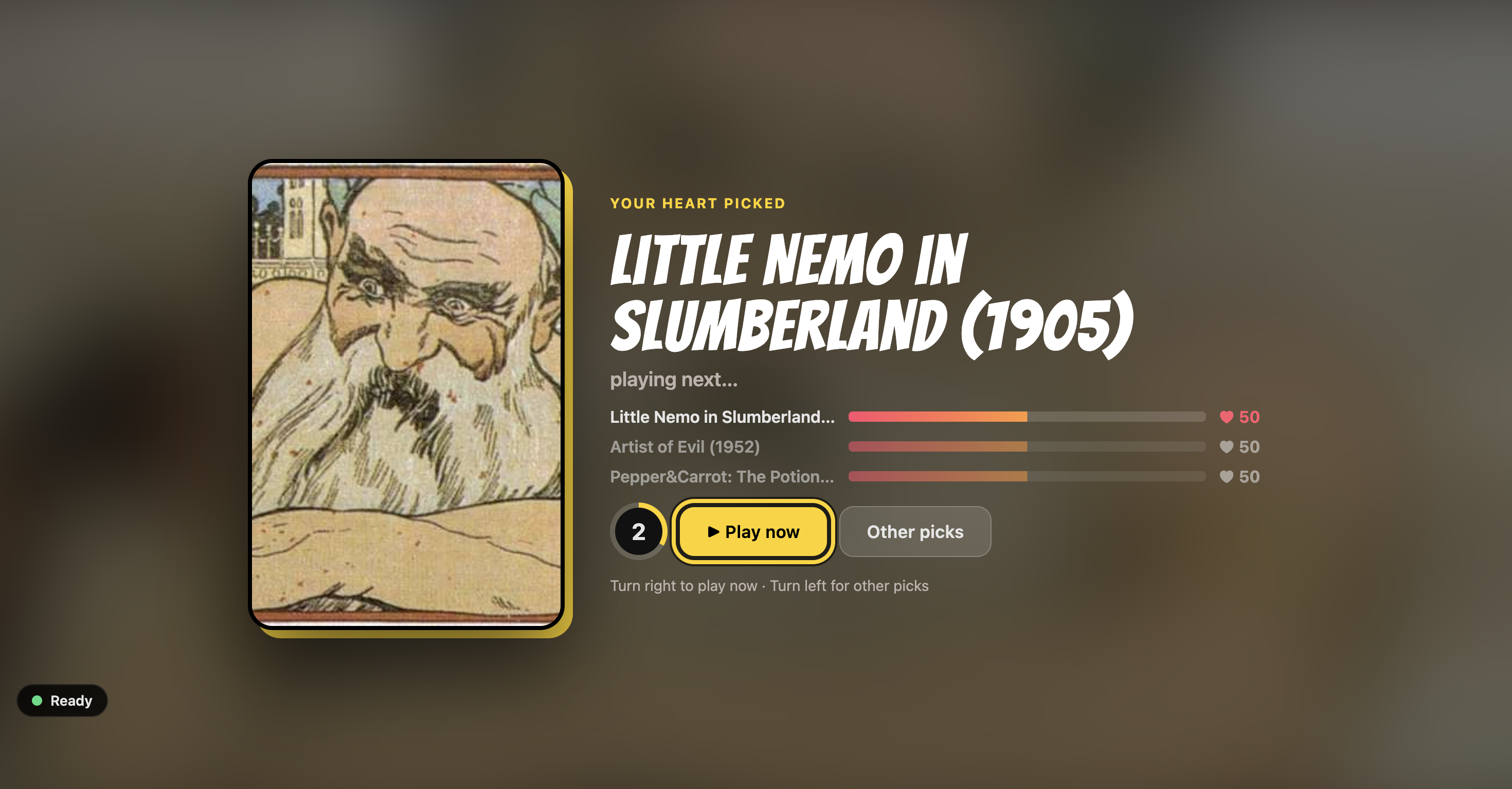
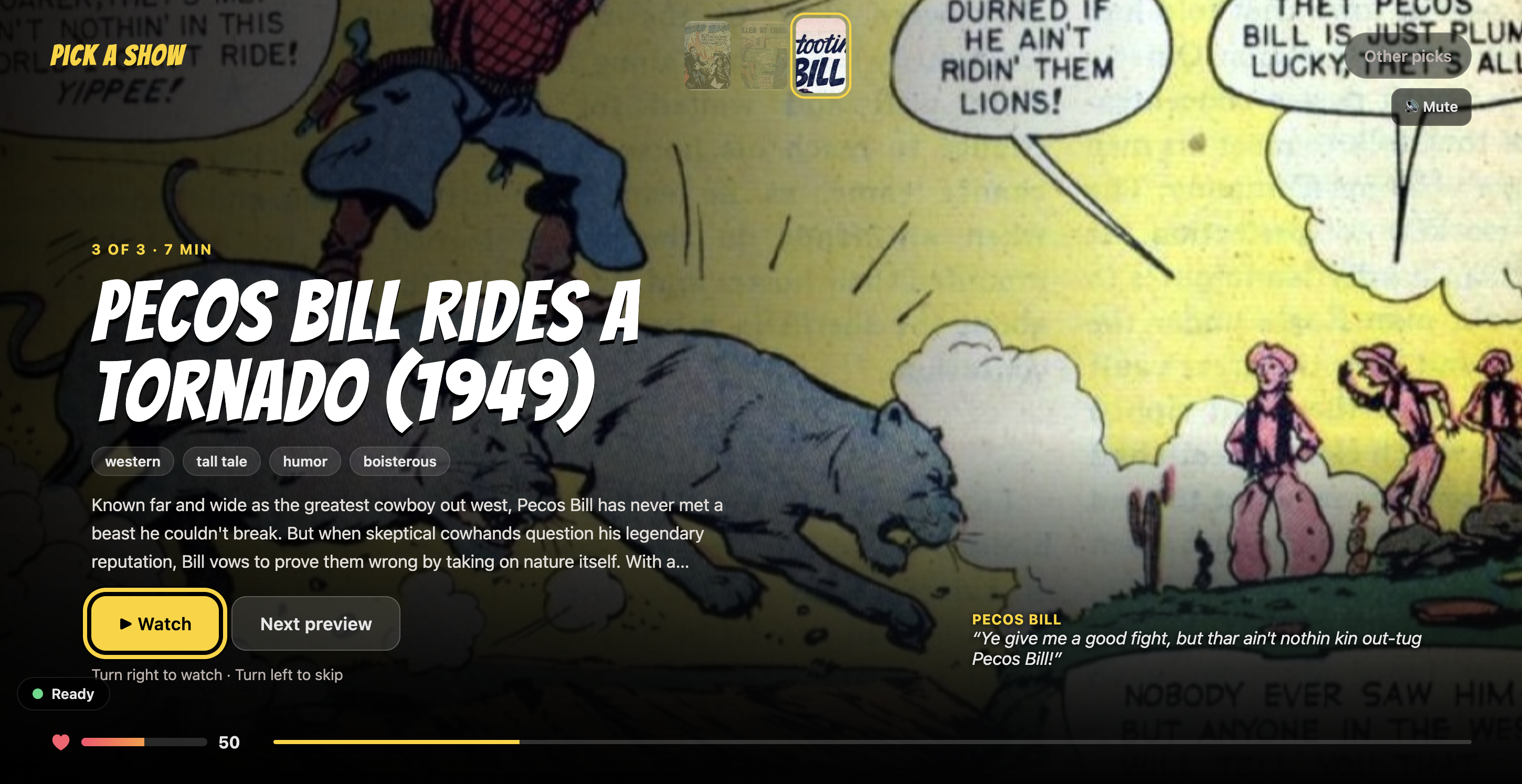
- ❤️ A heart meter. Smiles and nods fill it, shakes drain it, and it picks what to watch next: more of what you liked, or a change of mood if you didn't enjoy it.
- ♿ Accessibility built in. Dyslexia-friendly and low-vision fonts, colour-blind correction applied to the artwork itself, emotion labels for readers who find expressions hard to read, full screen-reader and keyboard support, and translation into 7 languages, voiced by the same cast.
The library is curated: only public-domain and Creative Commons comics, like Little Nemo in Slumberland (1905) and Pepper&Carrot.
How we built it
Every page goes through an AI pipeline:
- Magi v2 (Hugging Face) detects the panels. It was trained on manga, so we re-sort its right-to-left order into Western rows read left to right.
- Google Gemini reads the whole page once to build a consistent cast list, then writes each panel's script in parallel: scene description, narration, dialogue with speakers and emotion tags, and sound-effect prompts. If one model is overloaded or rate-limited, requests fall back to another Gemini Flash model.
- Gemini casts one ElevenLabs voice per character. ElevenLabs v3 performs the dialogue and generates the sound effects, and edge-tts voices the narrator in each language.
- Everything is stored in Neon (Postgres plus object storage). Pages are cached by their SHA-256 hash, so nothing is generated twice.
- The FastAPI backend streams pipeline progress over Server-Sent Events into a live visualization of the comic being read, which zooms seamlessly into the reader.
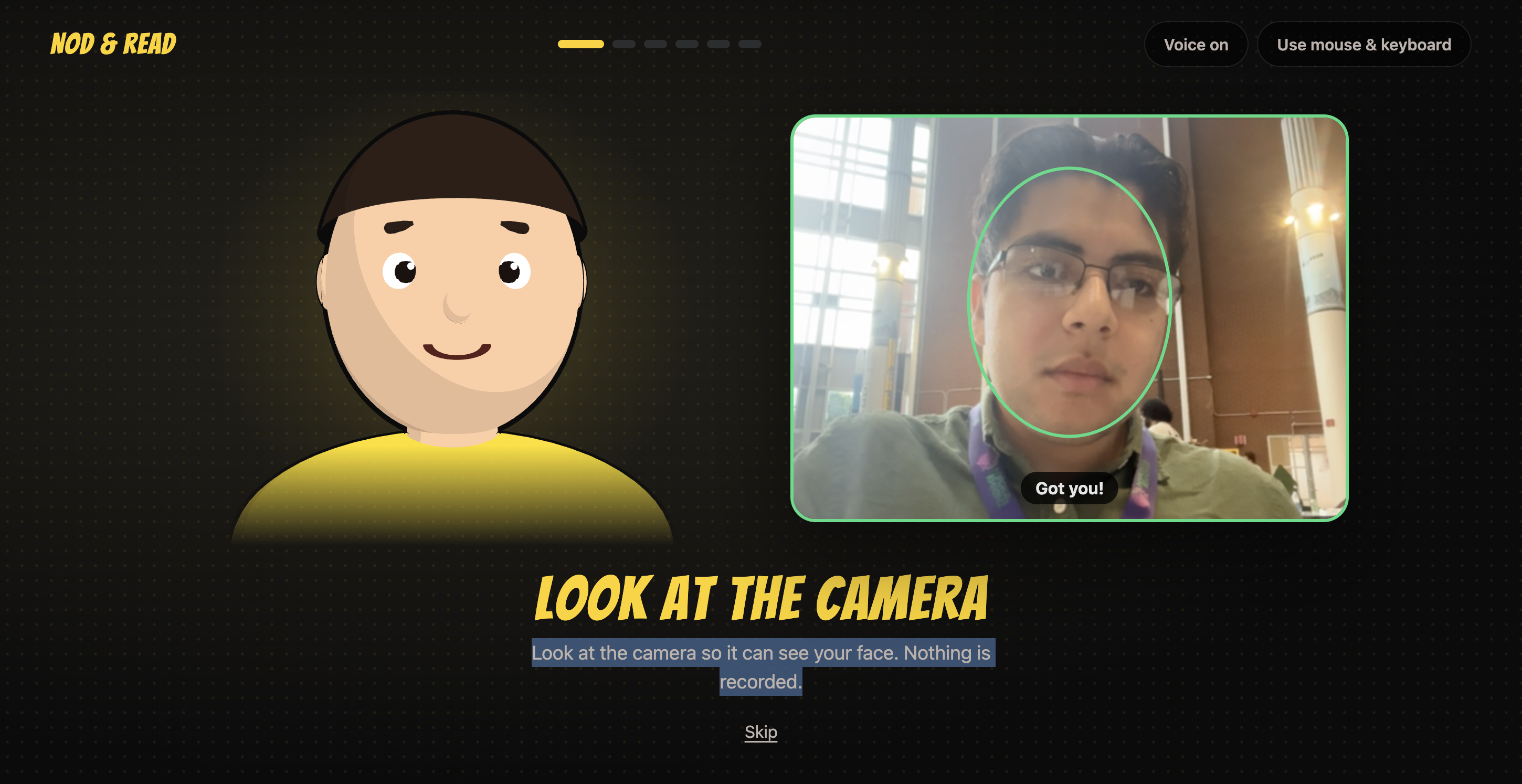
The front end is React 19 + TypeScript + Vite. MediaPipe Face Landmarker tracks 478 face points on-device, and three.js renders an animated 3D guide that teaches each gesture.
Head turn (yaw) comes from the face's rotation matrix:
$$\text{yaw} = \operatorname{atan2}!\left(-m_{8},\ \sqrt{m_{9}^2 + m_{10}^2}\right)$$
$$\text{yaw} = \operatorname{atan2}!\left(-m_{8},\ \sqrt{m_{9}^2 + m_{10}^2}\right)$$
During setup you hold each turn until a bar fills, and we set your own threshold from how far you held it:
$$\theta = \operatorname{clamp}!\big(0.6 \cdot \operatorname{median}(\text{held}),\ 10^\circ,\ 24^\circ\big)$$
That way, people who can only turn a little can still use the whole site.
Challenges we ran into
- Gestures are noisy. Head turns were misread as shakes, the "neutral" position drifted, and talking or another face walking into the frame set off false triggers. We added re-arming, grace periods, a stillness check, and auto-pause when you look away.
- Winks didn't work for everyone. Many people can't wink with one eye, so we switched to closing both eyes for one second.
- Too many gestures. We first had nods, shakes, gaze and winks all issuing commands. It was confusing, so we cut it down to two simple ones: right = yes, left = no. Nods now only fill the heart meter.
- Left and right got flipped. The webcam image is mirrored, so we flipped head-turn direction more than once before confirming it on real hardware.
- Old comics broke panel detection. Little Nemo's ornate 1905 layouts confused Magi, so we marked those panels by hand.
- Keeping voices consistent across pages and separate uploads of the same comic took a whole-page cast list with stable character IDs.
- Hosting cheaply. PyTorch is huge, so we made the server reading-only: it serves everything already stored, with no PyTorch and no model API keys, in about 1–2 GB of RAM.
- Licensing. We dropped every comic we couldn't legally use, so the library is public domain and Creative Commons only.
Accomplishments that we're proud of
- You can watch a full comic with character voices, sound effects and a narrator without touching anything.
- Face tracking is private by design: it runs entirely in the browser.
- Per-user calibration makes face control work for people with limited movement.
- The live visualization shows the AI reading the comic, then zooms straight into the reader with no cut.
What we learned
- Accessibility features help everyone. Captions, narration and hands-free control made the app better for all of us, not only the people we built it for.
- Fewer, clearer gestures beat clever ones. Every gesture we removed made the app easier to use.
- Testing on real webcams, real faces and real lighting catches bugs no simulation will.
- Caching AI output by content hash keeps costs down and makes replays instant.
What's next for Nod & Read
- A bigger library, through partnerships with public-domain archives and Creative Commons creators.
- User testing with blind, low-vision and motor-impaired readers.
- A mobile app with the front camera as the controller.
- More languages and more expressive narration.
- Letting creators submit their own licensed comics for review.
Built With
- caddy
- docker
- edge-tts
- elevenlabs
- fastapi
- google-gemini
- hugging-face
- magi-v2
- mediapipe
- neon
- object-storage
- postgresql
- python
- pytorch
- react
- render
- three.js
- typescript
- uv
- vite
- vultr


Log in or sign up for Devpost to join the conversation.