Inspiration
NoCry
I began with a practical observation: there are brief moments when a parent or caregiver hears a baby but cannot respond physically at once. A mother may be feeding, recovering, preparing food, caring for another child, or completing something nearby. The goal was not to replace the caregiver. It was to help familiar comfort arrive sooner while the caregiver responds.
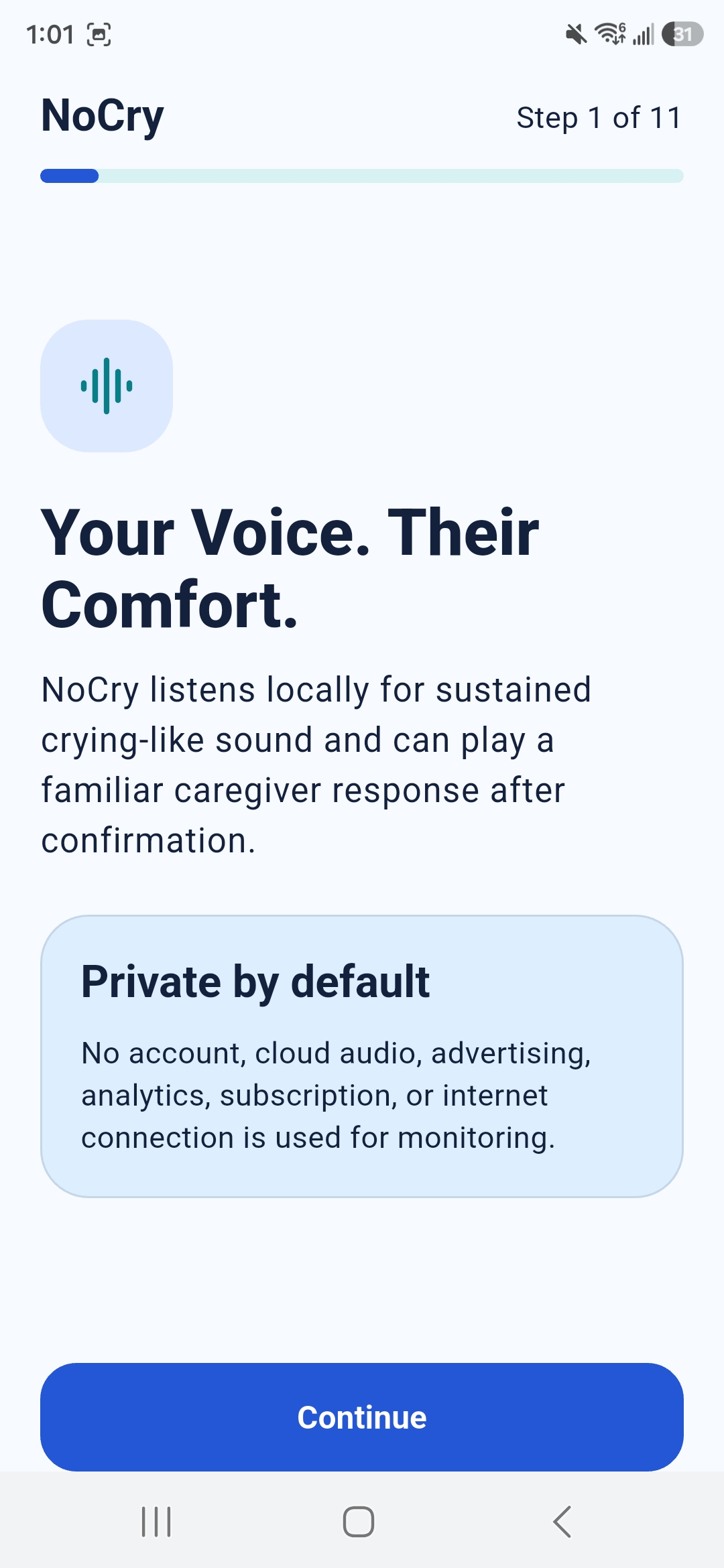
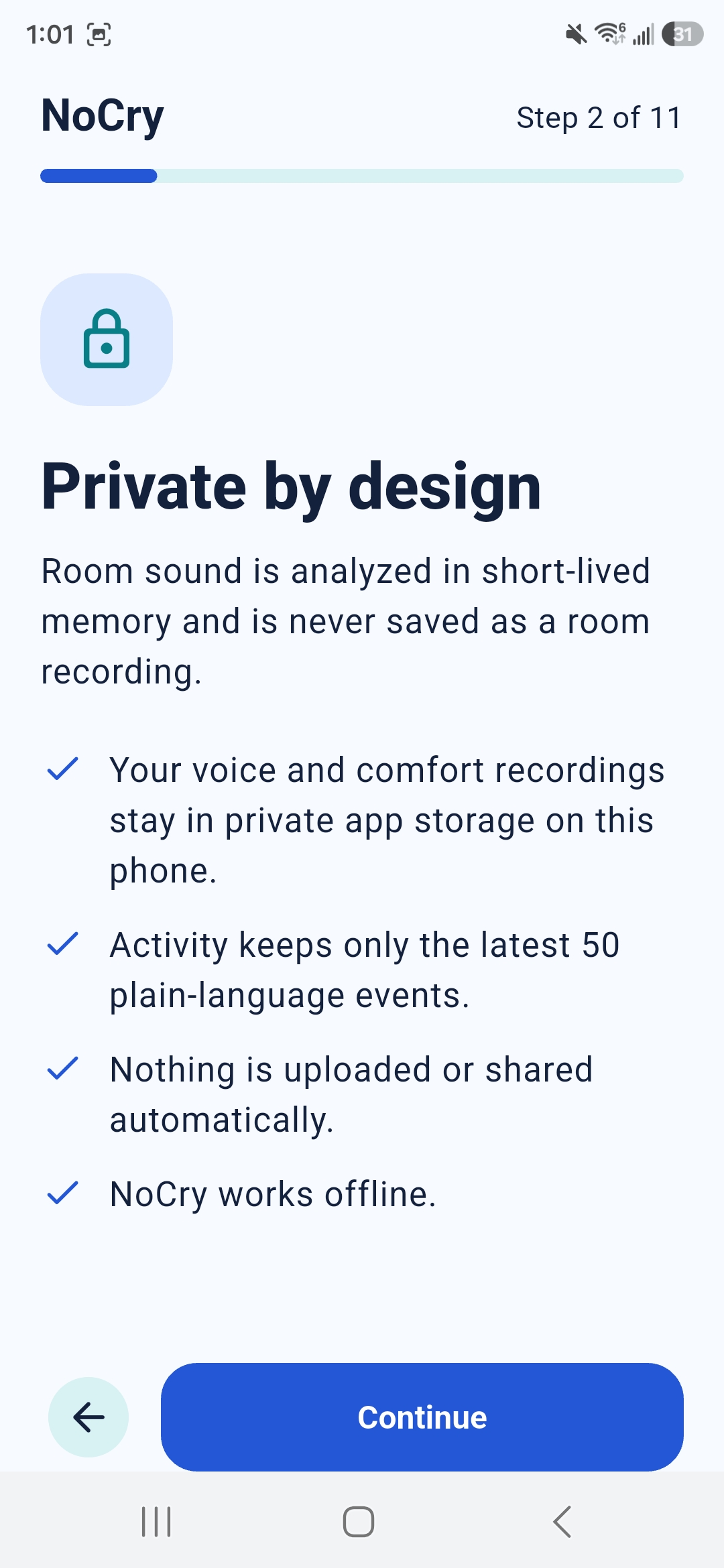
The product was designed around a simple human truth: a familiar voice can carry reassurance. NoCry gives families a private way to prepare that familiar voice and make it responsive without uploading the family's room audio or caregiver recordings to a cloud service.
The product is built for what we describe as life's first citizens: babies and young children whose needs should be considered when technology is designed.
What it does
NoCry is a privacy-first Android comfort assistant.
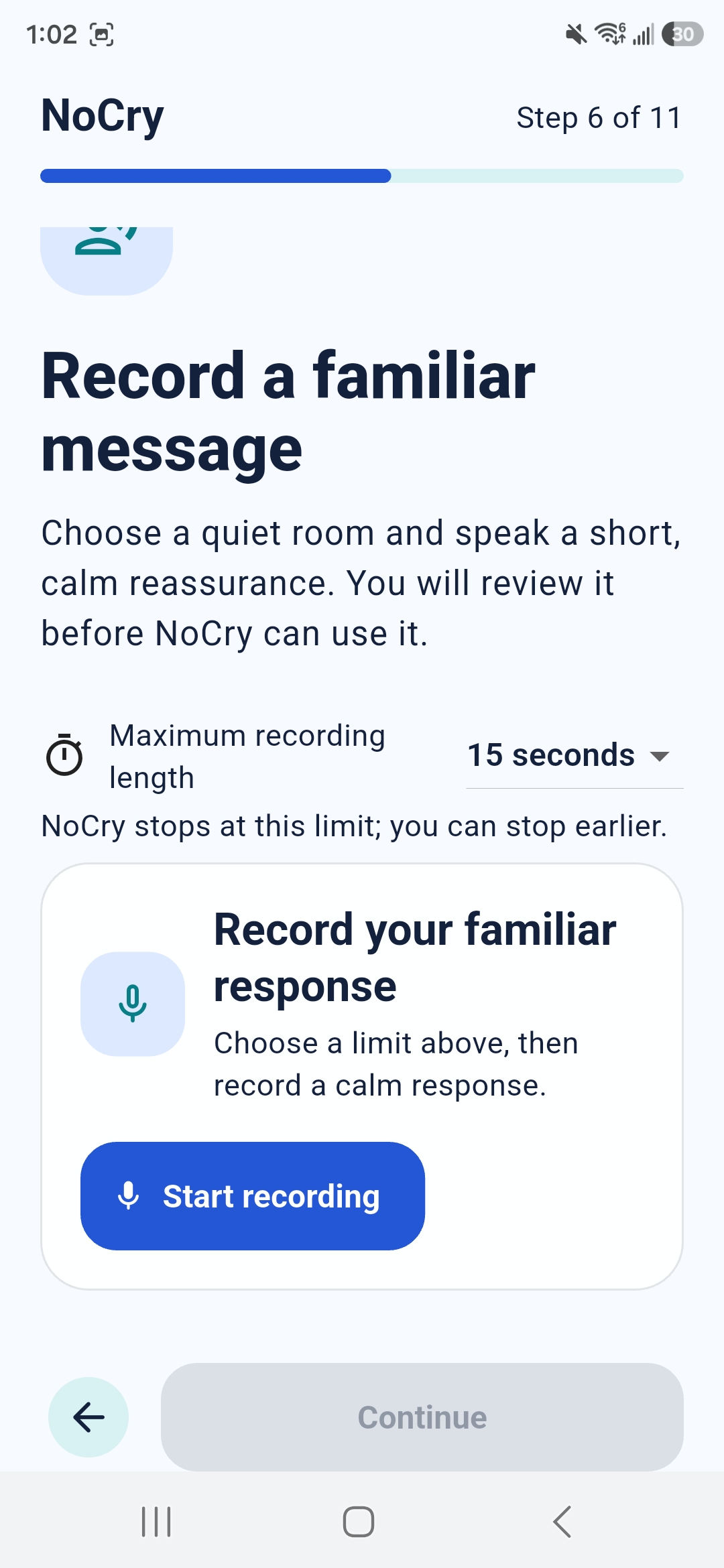
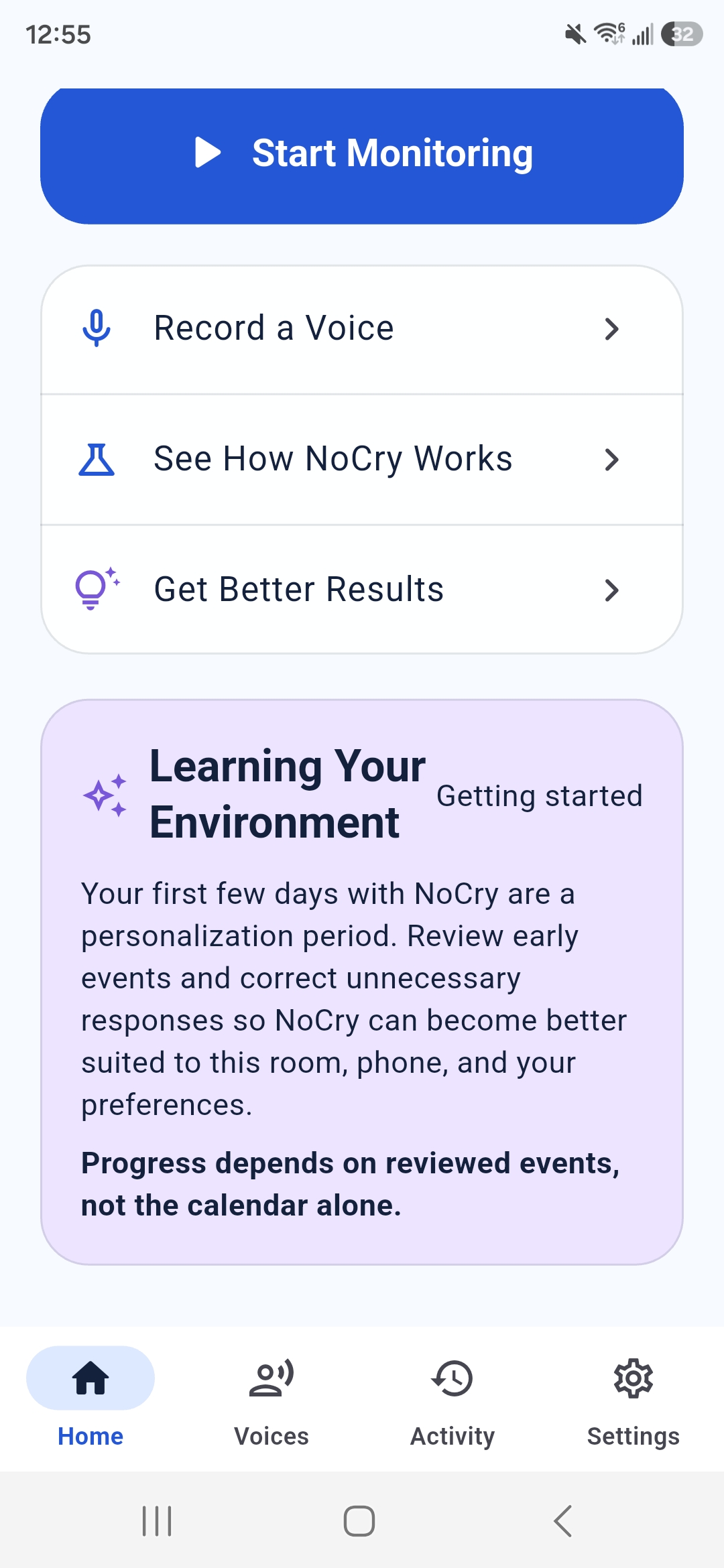
A caregiver can record a familiar message, listen to the complete recording, replay it, re-record it, adjust the response level, and confirm when it is ready. The response may come from a mother, father, grandparent, or another trusted caregiver. A built-in sample allows the experience to be understood before a personal recording is added, when that feature is verified in the final build.
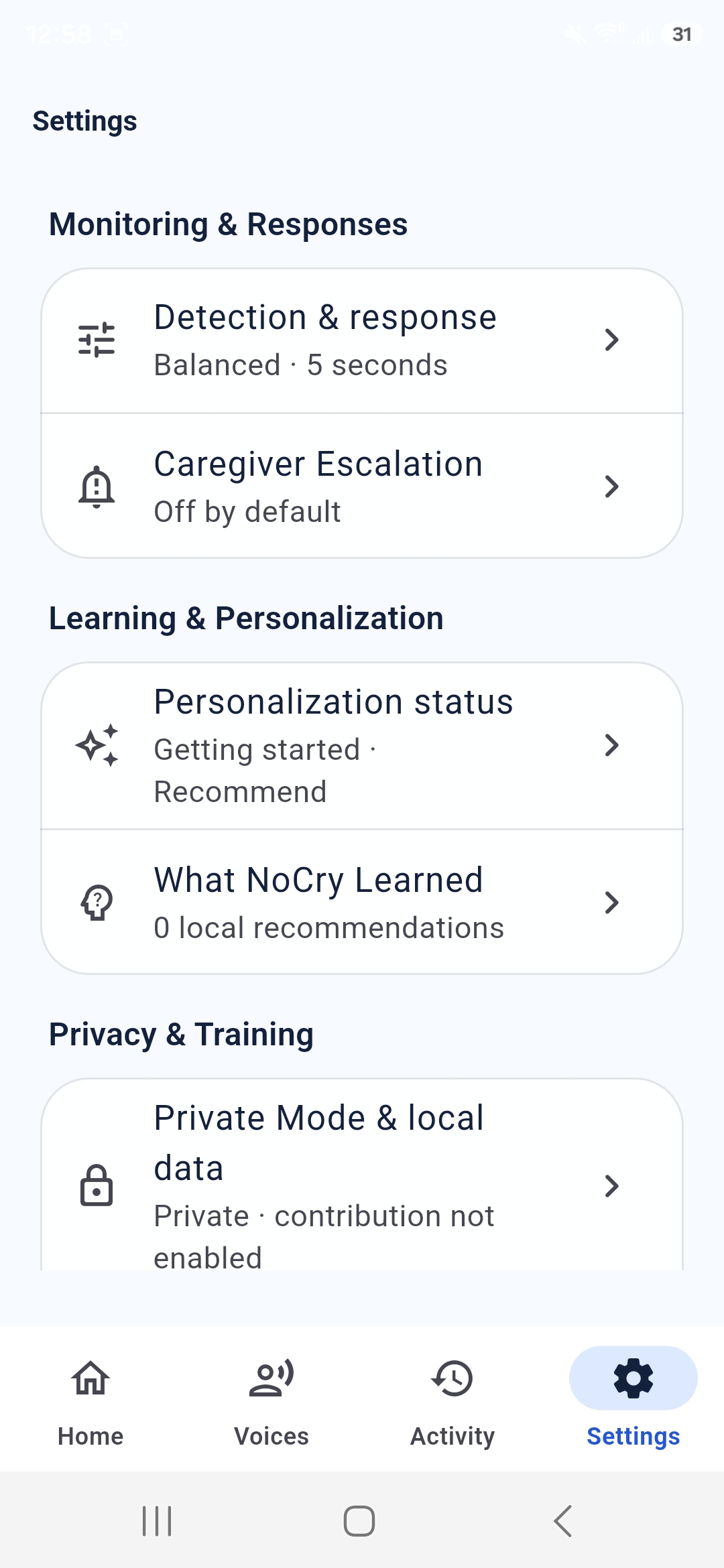
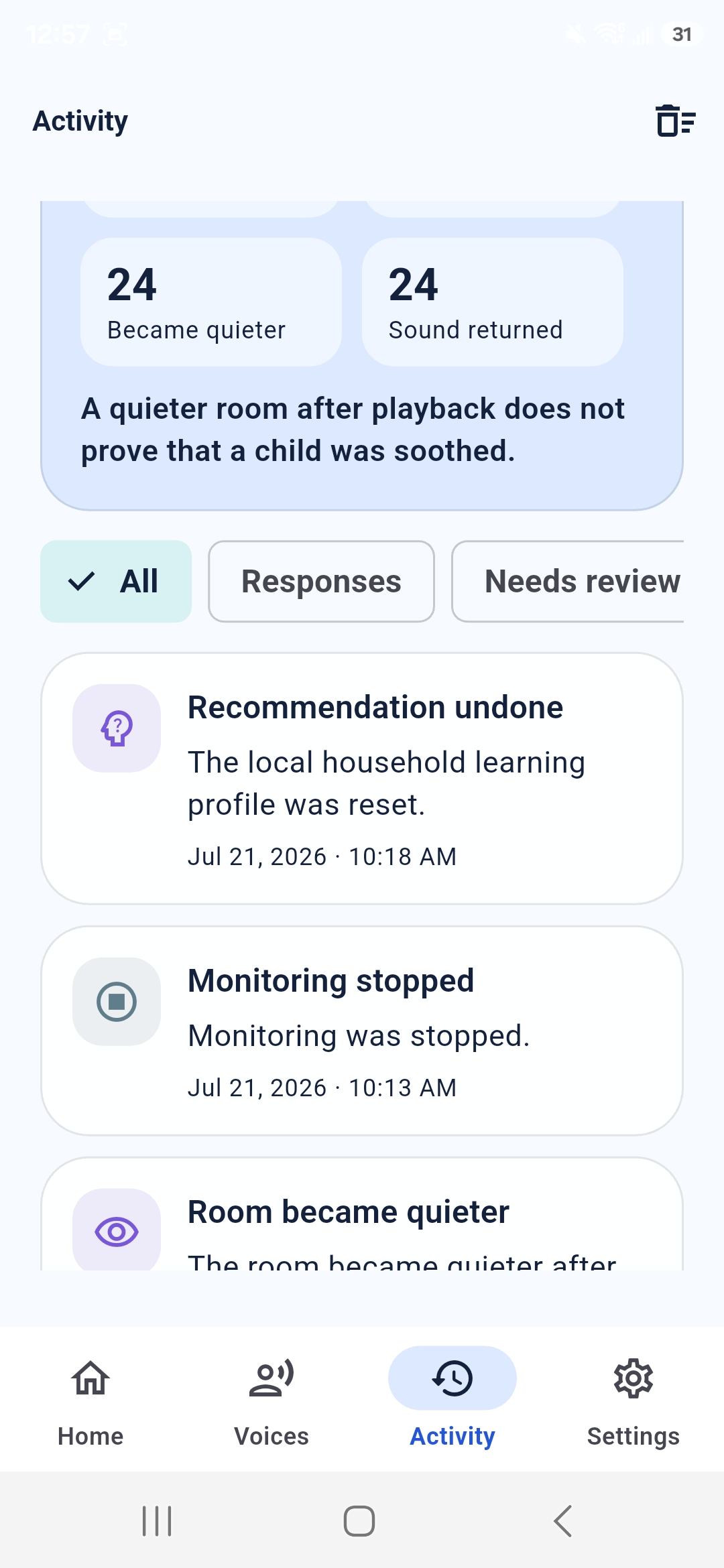
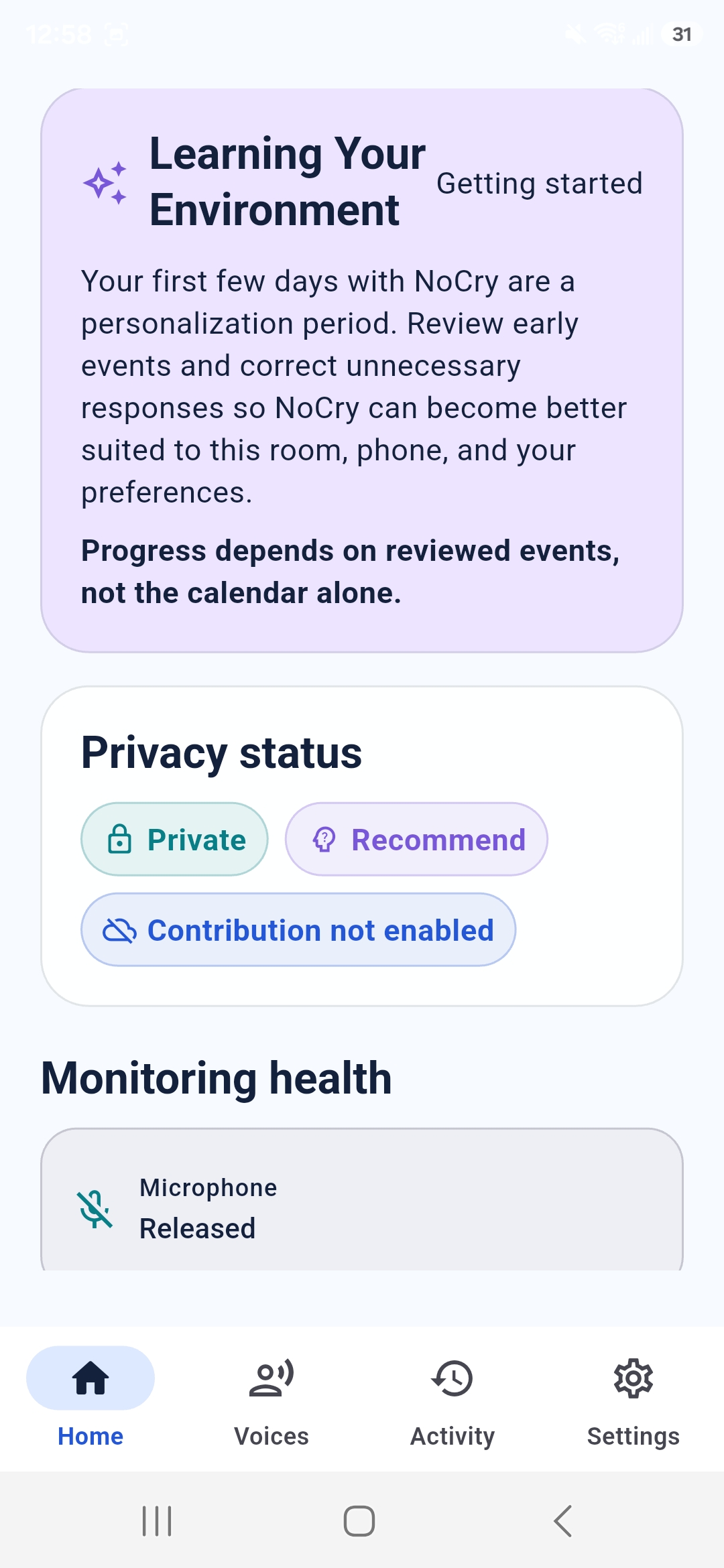
After room calibration, NoCry monitors locally for sustained crying-like sound. It confirms that the sound continues, applies the selected response timing, and plays the chosen familiar response. The system manages playback as a controlled routine, observes between responses, avoids treating its own playback as a new trigger, and remains under caregiver control through visible monitoring and stop actions.
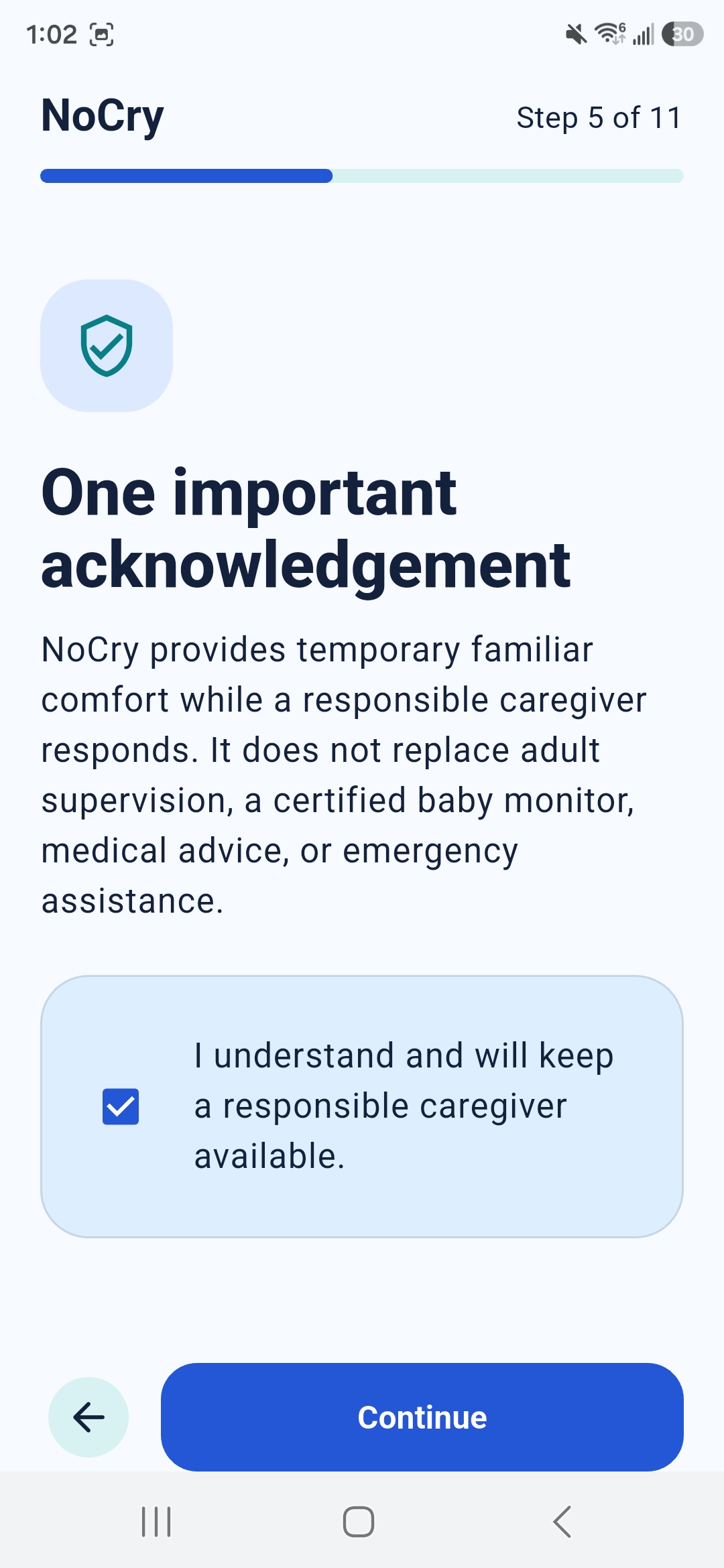
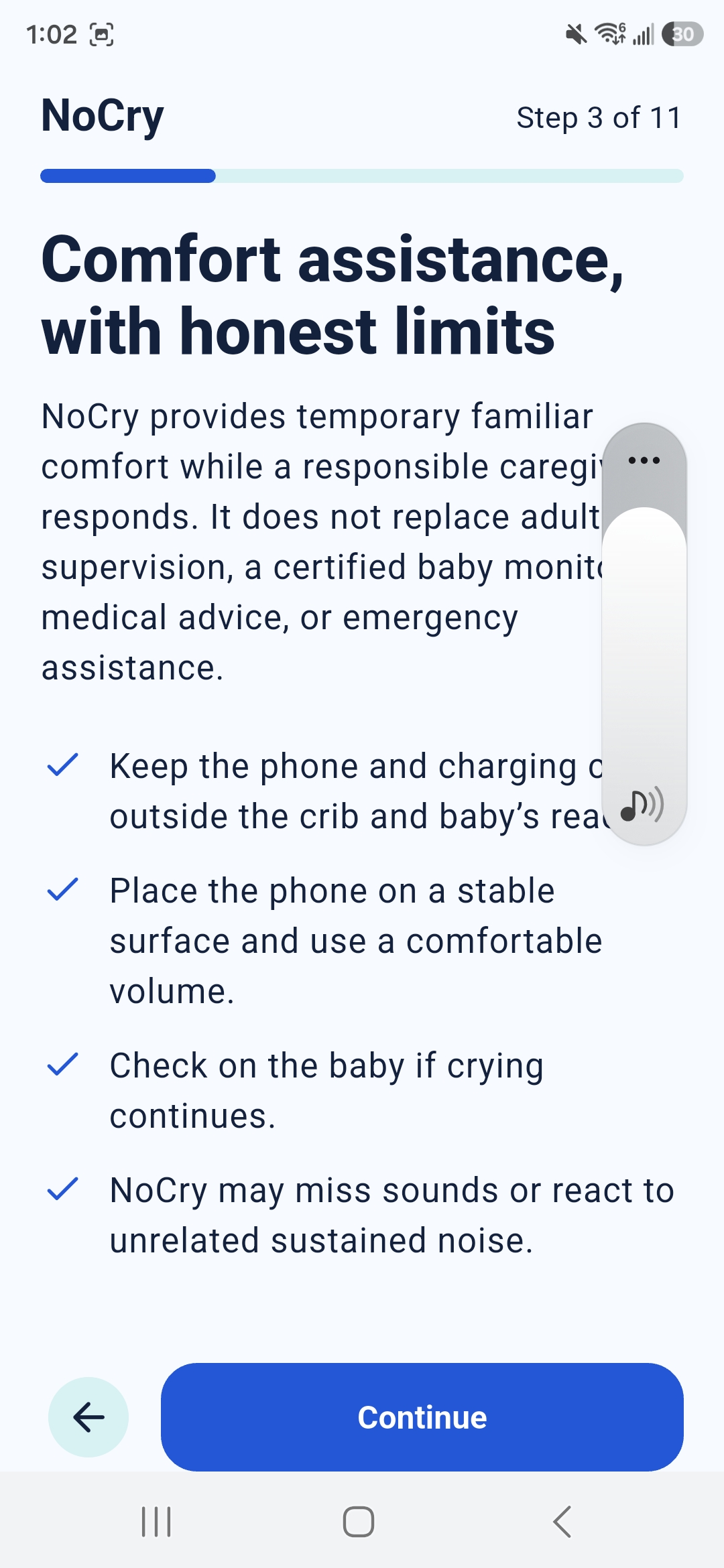
The final verified feature list must be taken from the executable and 07_TEST_AND_RELEASE_RECORD.md. NoCry is a comfort-assistance application, not a medical device, certified baby monitor, emergency system, diagnostic tool, or replacement for adult supervision.
How we built it
NoCry was developed through a human-directed, agentic workflow using ChatGPT, Codex, and GPT-5.6.
I defined the product purpose, practical caregiver scenarios, privacy boundaries, safety language, interaction principles, and acceptance criteria. ChatGPT helped challenge assumptions, structure the specifications, document the product, and prepare the submission. Codex worked directly in the repository to inspect the existing state, implement the Flutter and native Android layers, run tests, repair regressions, build Android artifacts, and refine the product. GPT-5.6 was used for long-horizon reasoning and repository-wide implementation work.
The Android application uses Flutter and Dart for the product experience, with native Kotlin and Android services for microphone, foreground monitoring, audio lifecycle, and platform-specific behaviour. The final codebase, dependency list, state machine, and build commands are documented in the repository.
Creator declaration:
No AI model outside ChatGPT, Codex, and GPT-5.6 was intentionally used in the product build.
The final Codex report must confirm the actual environment and model information available to it without inventing information that cannot be verified.
Challenges we ran into
The hardest work was making a simple caregiver experience reliable across complex Android behaviour.
Key challenges included:
Listening for sustained crying-like sound without reacting to every brief noise
Preventing NoCry's own playback from retriggering the detector
Coordinating recording, playback, observation, delay, and cooldown states
Keeping monitoring truthful when the screen is locked or the app is backgrounded
Recovering from a released or interrupted microphone without repeatedly sending the user to Android settings
Managing Android audio focus and media output
Allowing a caregiver to hear and replay a recording before confirming it
Preserving a previously valid recording when a replacement fails
Reducing CPU, storage writes, UI updates, and battery impact during long sessions
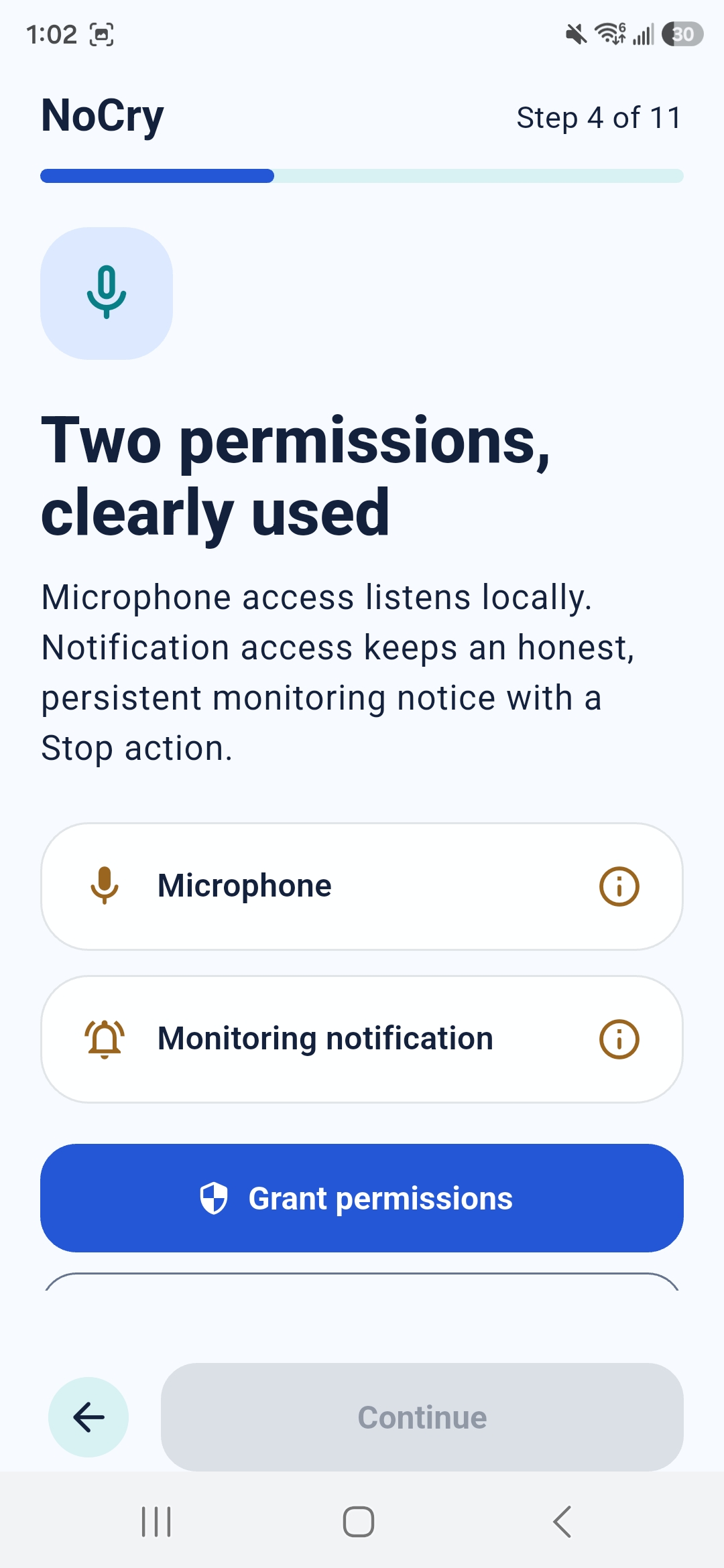
Keeping phone permissions separate from NoCry's internal settings
Presenting battery guidance once without repeatedly alarming the caregiver
Applying privacy and security claims only when verified by the final APK and dependency audit
Renaming the product from CrySync to NoCry without breaking stable internal identifiers or existing data
Accomplishments that we're proud of
Turning a detailed product specification into an installable Android application
Building a real microphone-to-response cycle rather than a simulated interface
Creating a parent-friendly experience over a non-trivial Flutter and native Android implementation
Keeping the core product offline-first and caregiver-controlled
Producing Android APK and App Bundle artifacts
Building automated tests and release documentation
Preserving a working foundation while making repository-wide refinements
Creating a public page that explains the product, demonstrates its privacy model, and provides the working build
Demonstrating how Codex and GPT-5.6 can compress a multidisciplinary product cycle involving product design, Android engineering, audio-state management, privacy review, testing, and release preparation
What we learned
The biggest lesson was that the quality of an AI-built product depends on the quality of the decisions given to the coding agent.
A useful prompt is not simply a list of features. It must define the user's real environment, failure states, privacy boundaries, state transitions, emotional experience, platform constraints, test requirements, and what the product must never claim.
We also learned that a simple interface can conceal substantial engineering. The user sees Record, Listen, Calibrate, and Monitor. Underneath, the application must manage continuous audio input, Android foreground-service rules, audio focus, interruption recovery, response timing, buffer clearing, state synchronization, and efficient long-session operation.
Codex was most valuable when it could inspect the existing repository, preserve working behaviour, implement across Flutter and Kotlin, run tests, and continue until the same integrated state produced the final release artifact.
What's next for NoCry
As we move ahead NoCry would surely test an IOS version and would be simultaneously followed as immediate next step by evidence-led product validation:
Broader physical-device testing
More acoustic environments and phone models
Better measurement of false triggers and missed events
Battery and long-session testing
Carefully reviewed accessibility and caregiver research
Production signing and store preparation
The wider NoCry vision is a caregiver-controlled audio world that can grow with a child:
Multiple trusted family voices
Lullabies and loriyan
Poems and nursery rhymes
Bedtime stories
Interactive lessons
Language learning
Age-appropriate routines
Carefully designed calming and grounding experiences
These are future directions, not claims about the current executable. Any wellbeing or trauma-related use would require appropriate clinical, educational, ethical, and safeguarding partners.

Log in or sign up for Devpost to join the conversation.