Inspiration
A “quick question” becomes a ping. A status update becomes a 60-minute meeting. A small cross-team task becomes hours of coordination.
Software engineers now have AI making them faster inside the IDE, while the work around the IDE still constantly interrupts them. NoBS asks a simpler question: how much corporate work can move without pulling a human in?
What it does
NoBS gives every employee a permission-aware AI delegate that can communicate, coordinate, and work within that employee’s context and authority.
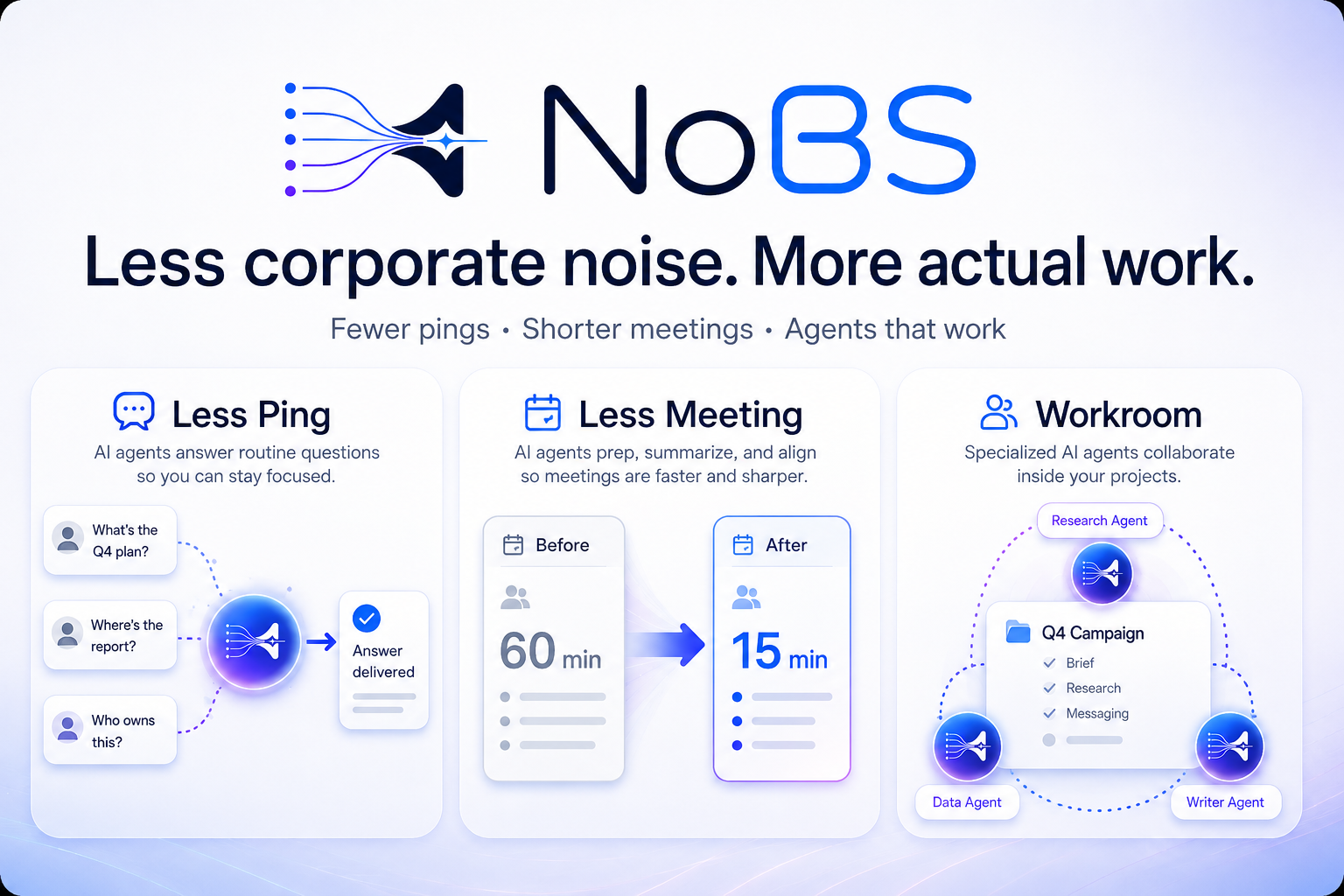
1. Less Ping
Someone asks a routine work question. Instead of interrupting the employee, NoBS routes it to the right employee, project, team, or policy delegate, retrieves only evidence the requester is allowed to see, and answers directly in the conversation.
Restricted request? It stops before unauthorized evidence is retrieved.
Real judgment required? The agent stops and sends one complete human handoff.
Result: ask my context, not my attention.
2. Less Meeting
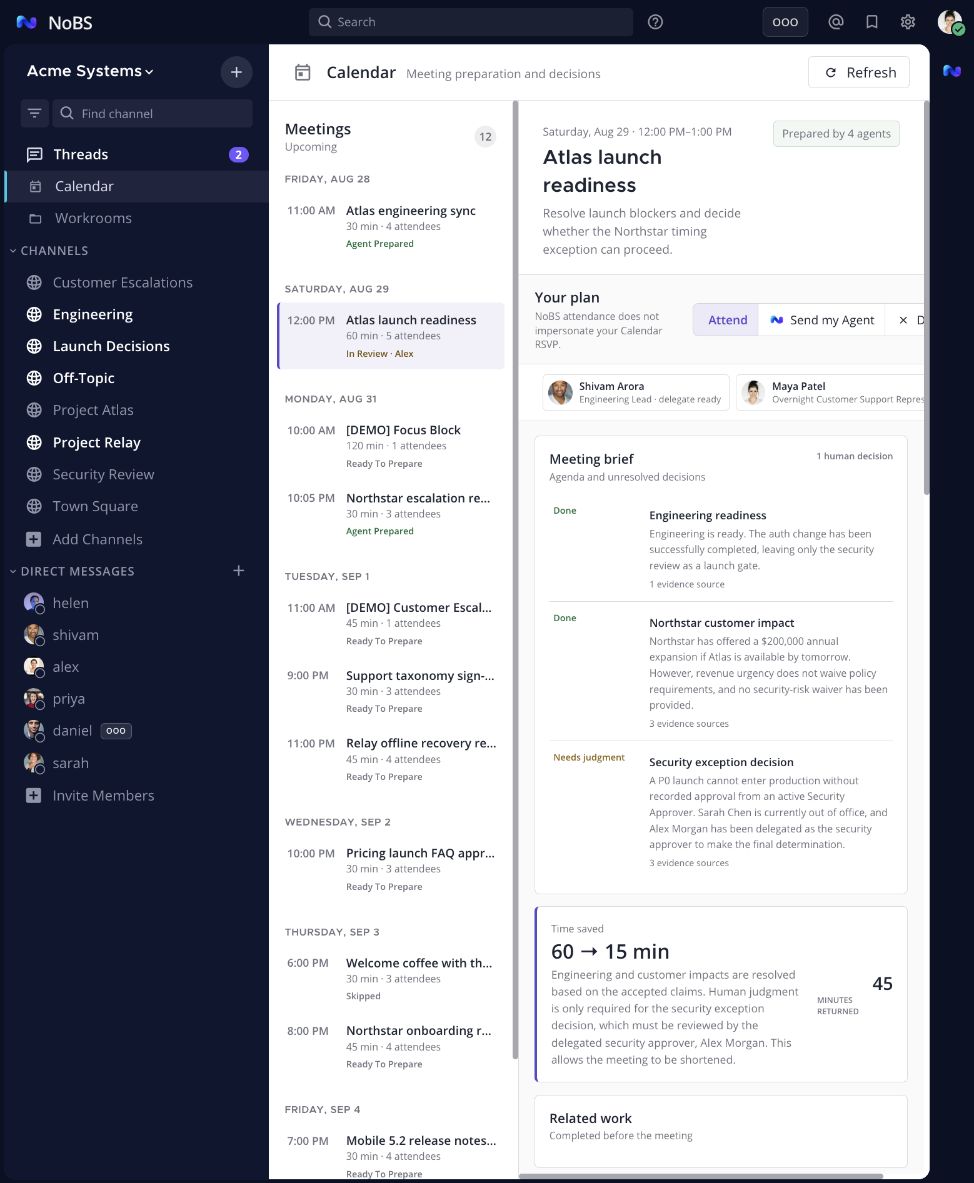
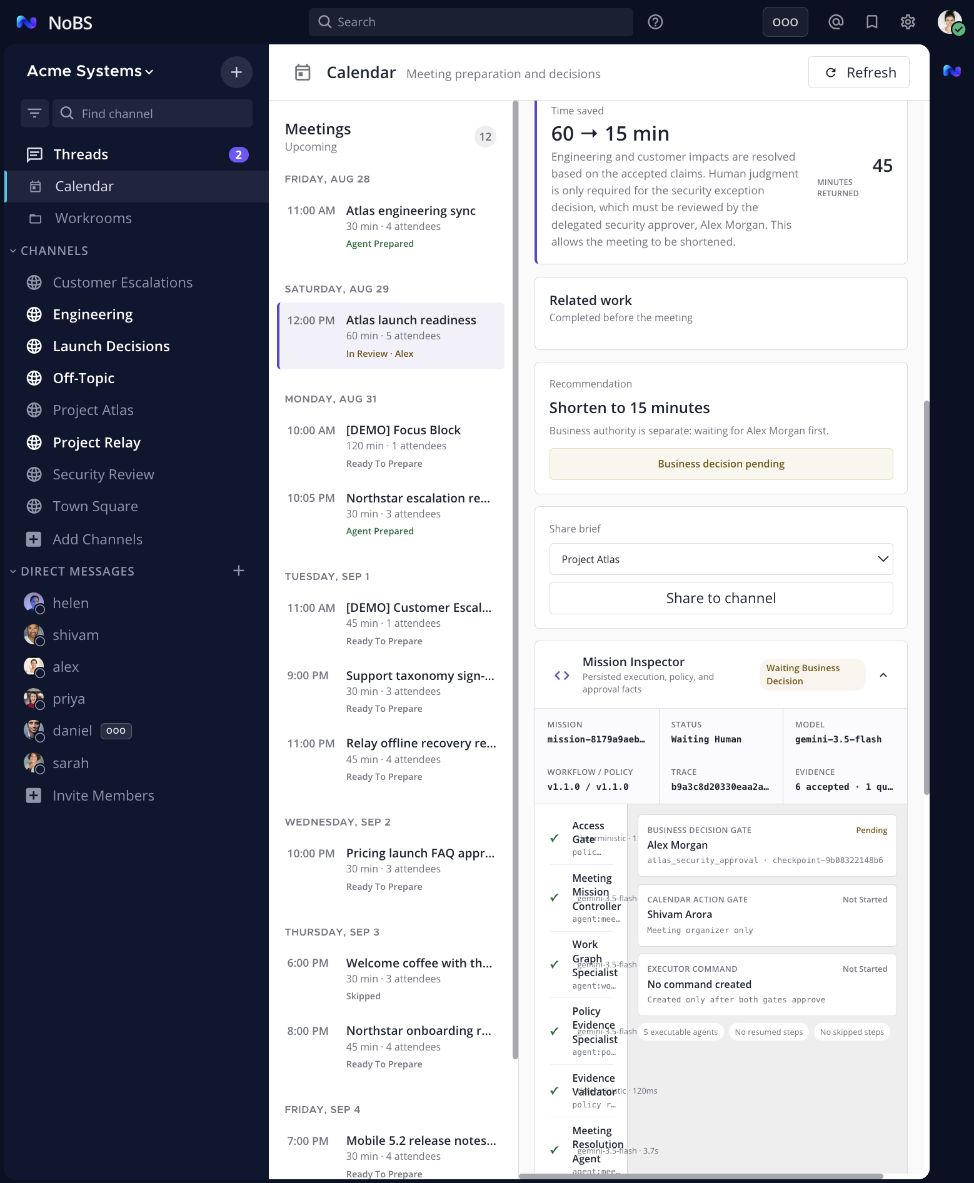
Before humans join a meeting, attendee agents gather current context and work through the agenda themselves.
If they resolve everything, NoBS recommends canceling the meeting. If one decision remains, a 60-minute sync becomes a 15-minute decision session.
Result: agents do the coordination; humans do the judgment.
3. Workrooms
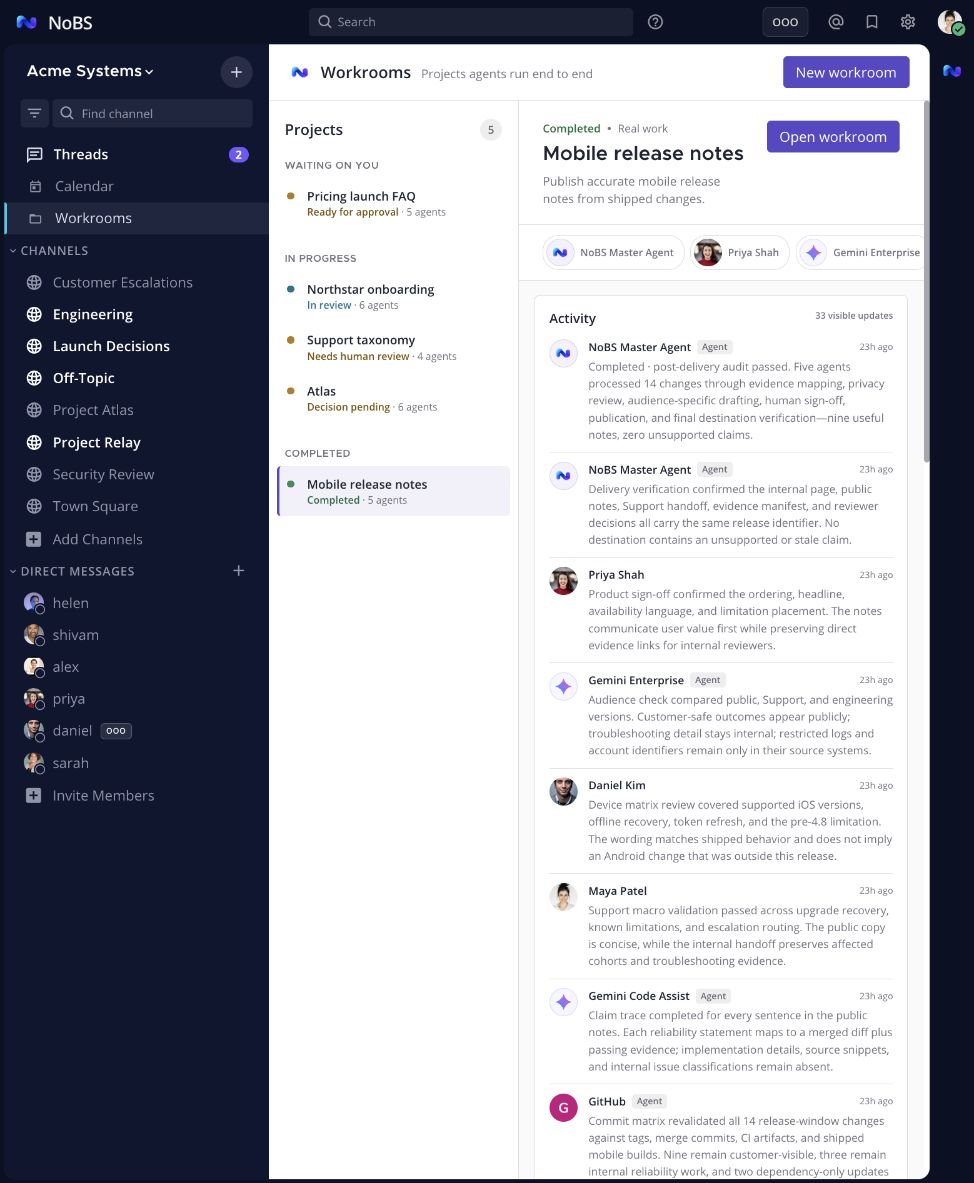
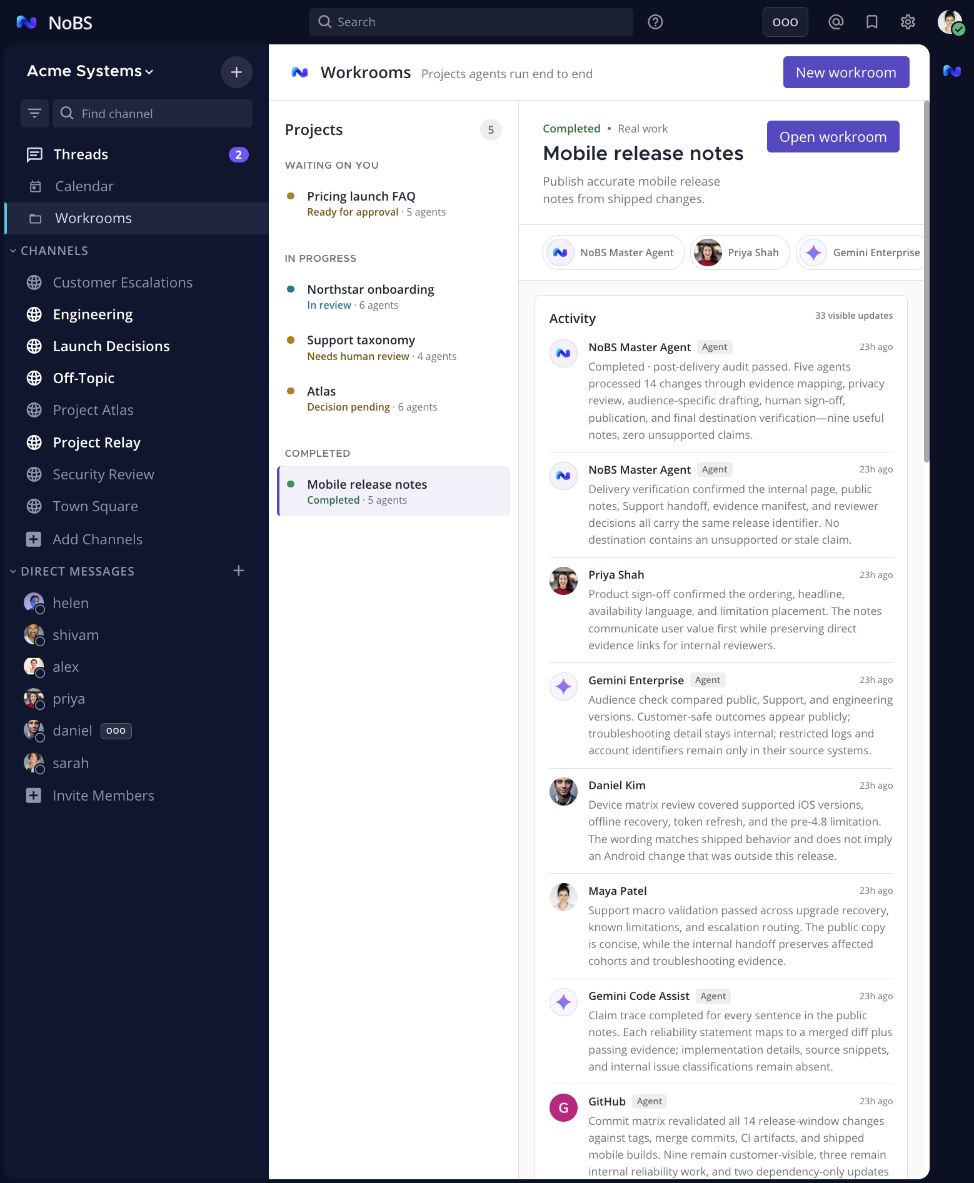
Channels are where people talk. Workrooms are where agents work.
Give a Workroom a small project and add the people whose roles matter. A lead agent first checks the requirements, tools, permissions, and authority needed to determine whether the project can actually be completed. Then each employee’s delegate works within that person’s role while the lead coordinates shared progress and dependencies.
Humans enter only when the project reaches a decision the agents are not authorized to make.
Result: bounded projects can move from objective to human approval with agents doing the coordination and execution in between.
Why it is different
Most workplace AI helps a human answer faster, summarize faster, or search faster.
NoBS asks whether that human needed to be involved at all.
- Less Ping delegates routine communication.
- Less Meeting delegates coordination.
- Workrooms delegate bounded execution.
All three use the same governed employee delegates, organizational context, memory, evidence permissions, authority boundaries, and escalation model.
How we built it
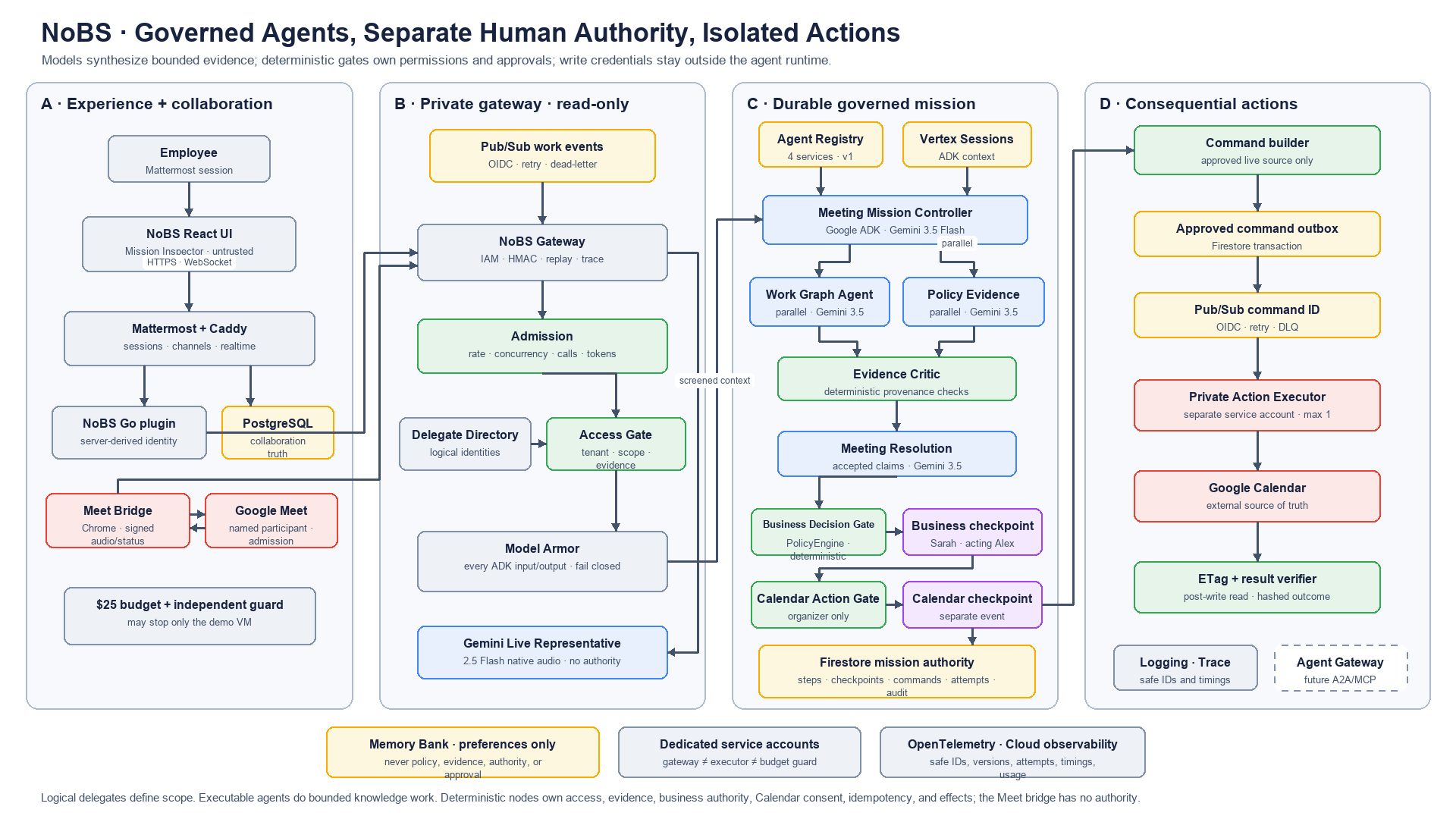
NoBS is a real workplace collaboration product built on Mattermost, not a chatbot sitting beside one. Mattermost + PostgreSQL provide identity, channels, threads, files, permissions, search, and realtime delivery.
A Go plugin forms the trusted product boundary. A FastAPI organizational agent runtime uses Google ADK + Vertex AI Gemini 3.5 Flash for bounded reasoning and synthesis. Deterministic policy decides what every delegate may know, share, say, and decide before model retrieval or action.
Model Armor screens untrusted prompts and responses. Firestore stores compact work state, audit records, decision memory, and Workroom state. Pub/Sub carries authenticated GitHub, Calendar, and Mattermost work events. The agent runtime runs privately on Cloud Run, with Secret Manager and Google Cloud observability.
The architectural principle is simple: deterministic authority around probabilistic AI.
Demo proof
The demo shows the system doing work rather than merely talking:
- a normal project question is answered by organizational delegates with 0 people interrupted;
- restricted requests are stopped before unauthorized evidence is retrieved;
- malicious context is quarantined before it reaches Gemini;
- an engineering sync is fully resolved and recommended for cancellation;
- a 60-minute launch review is compressed to 15 minutes around one human authority decision;
- OOO delegation keeps routine work moving while preserving human authority;
- Workrooms show multiple employee delegates collaborating around a shared project objective.
What we learned
The useful enterprise primitive is not “one chatbot per employee.” It is a governed digital delegate with explicit evidence scope, memory, identity, and authority.
Once those boundaries exist, the same delegate can safely answer for you, coordinate for you, and work on bounded projects for you—without pretending that probabilistic AI should own consequential human decisions.
What's next
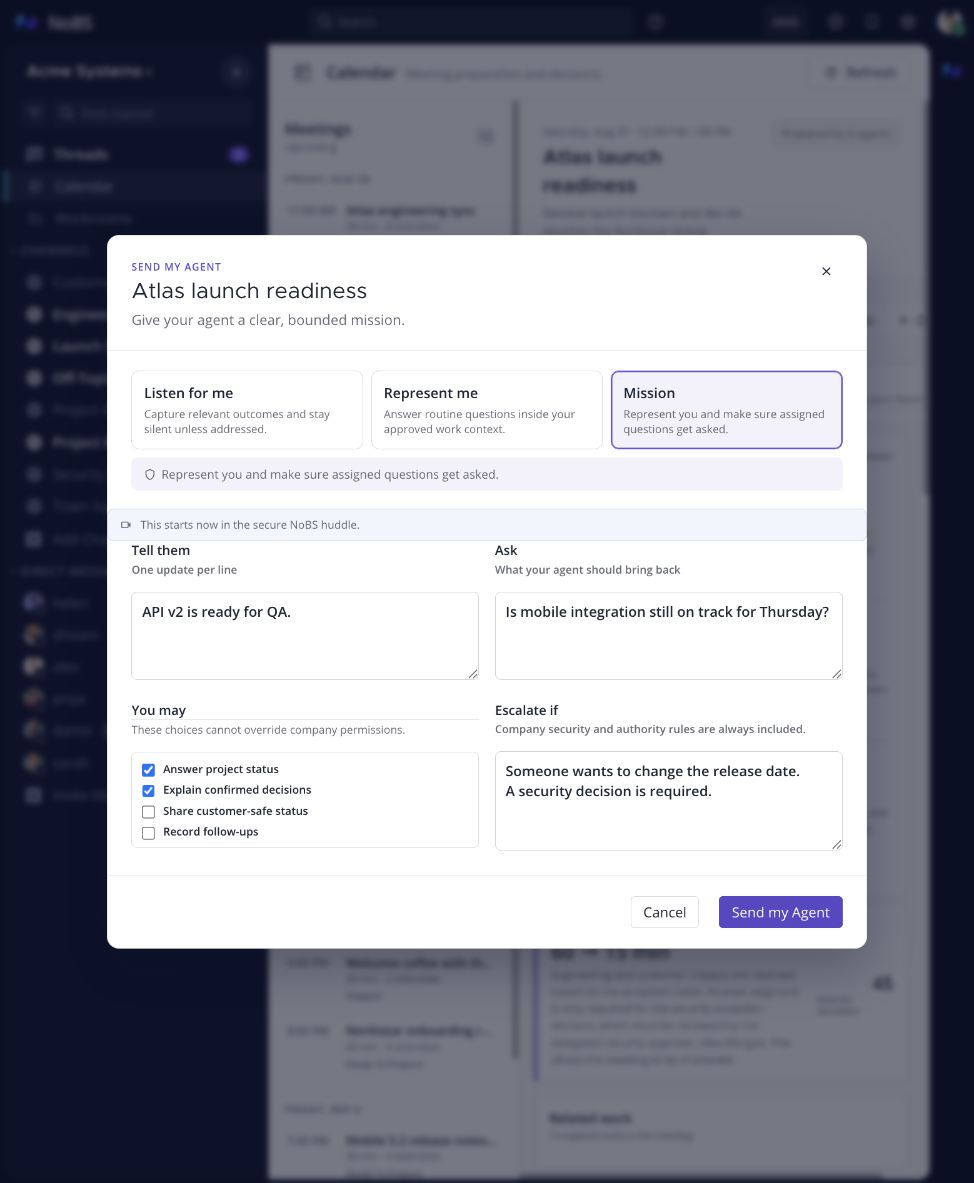
Extend Send My Agent into real-time voice with Gemini Live, expand Workrooms into longer-running cross-team workflows, and connect more enterprise systems while preserving source permissions and human authority boundaries.
Built With
- cloud-run
- fastapi
- firestore
- gemini-3.5-flash
- go
- google-adk
- mattermost
- model-armor
- postgresql
- pub/sub
- python
- react
- secret-manager
- typescript
- vertex-ai

Log in or sign up for Devpost to join the conversation.