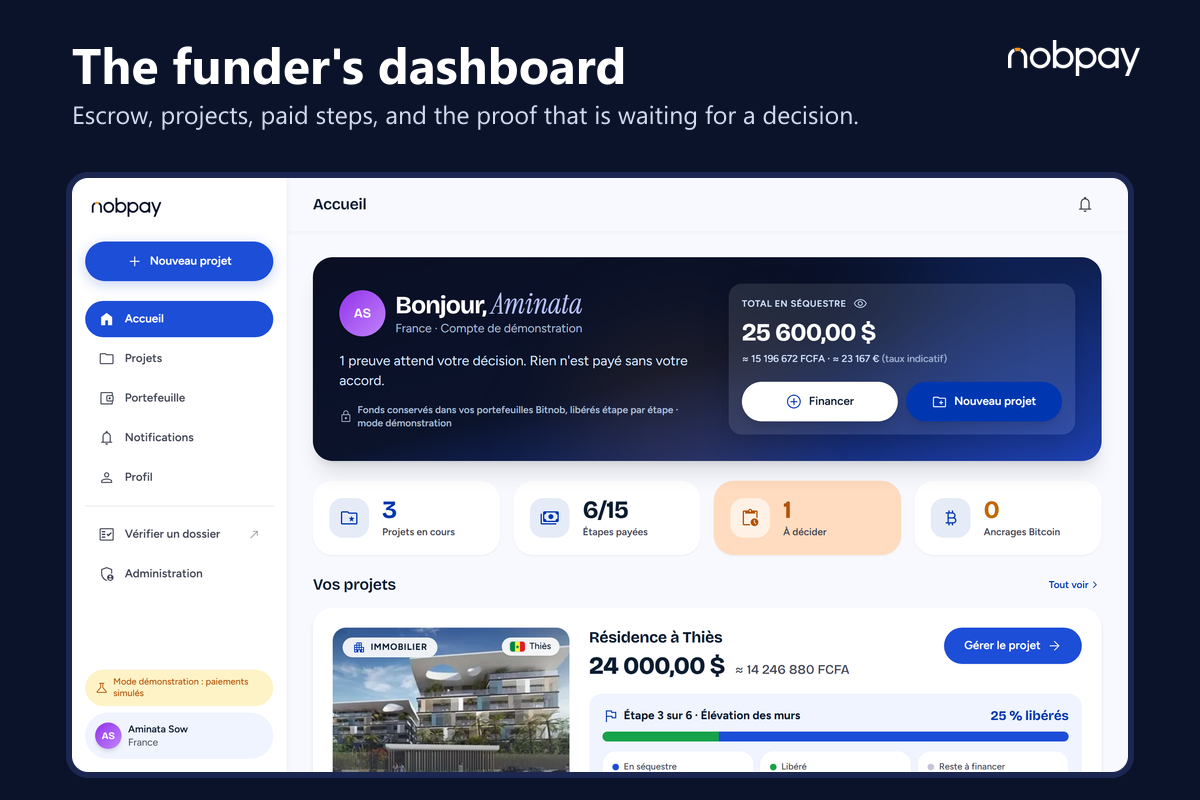
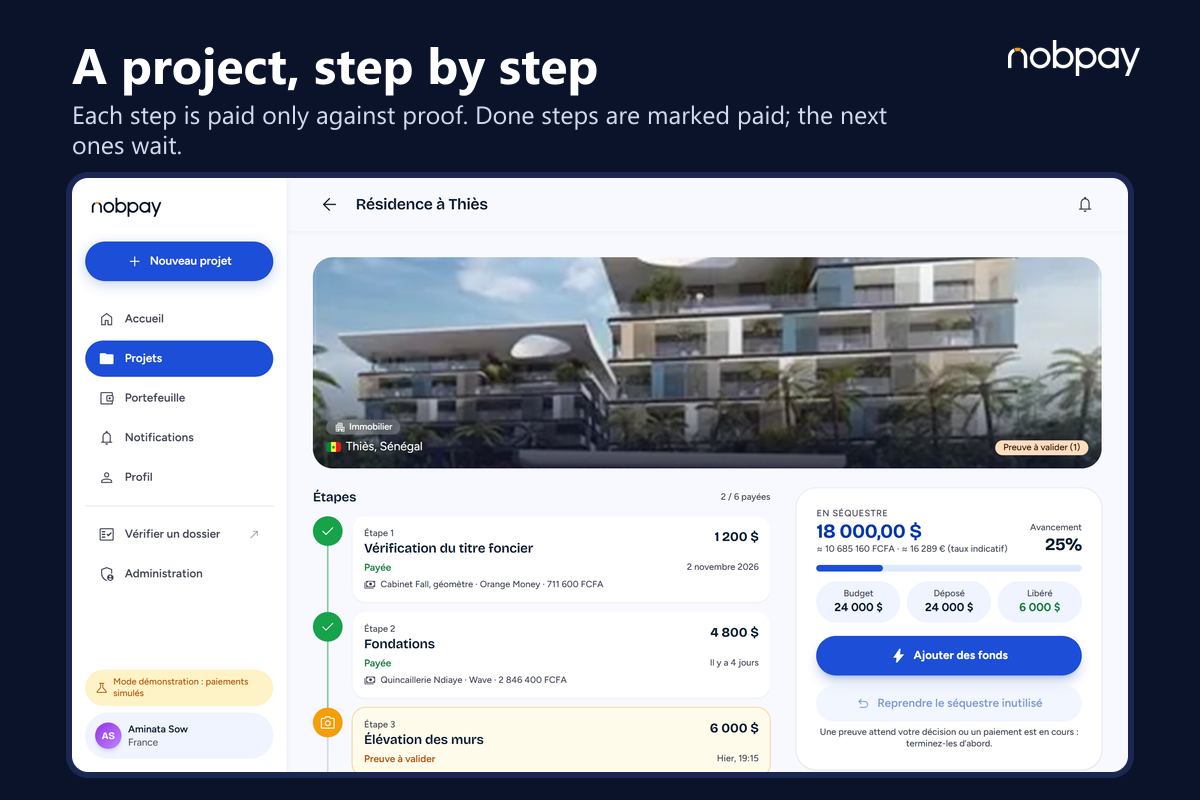
Try it now: https://nobpay.onrender.com. Tap "Try with the demo account", then "Quick trial". It is a demo instance with simulated payments, on a free hosting plan: after a period without visits the first load can take about a minute. Source code (MIT): https://github.com/mouhaa-md/NobPay
Inspiration
A transfer moves money; it does not control what the money is used for. A family abroad paying a builder, a school or a wholesaler in Senegal has two bad options: send it all and hope, or send nothing. The IFAD report published on 14 September 2026 puts remittances to Africa at USD 124.2 billion for 2025 and says close to a third of the money to low and middle income countries reaches rural areas (sources: UN News, IFAD). These figures describe the market, not results of NobPay.
NobPay was born at the Code & Chain Dakar hackathon (17-18 October 2026). Everything described below that is marked new was built after the opening of this hackathon (26 October), and is listed in docs/CHANGELOG-DBD4.md; git diff pre-dbd4..HEAD shows all of it.
What it does
One engine, three corridors:
- A project back home: a house, a field, a shop (the original NobPay).
- School fees: the family abroad pays the school, term after term, against the school's receipt. (new)
- A merchant's restock: the wholesaler is paid when the goods are in the shop, not before. (new)
How a payment goes:
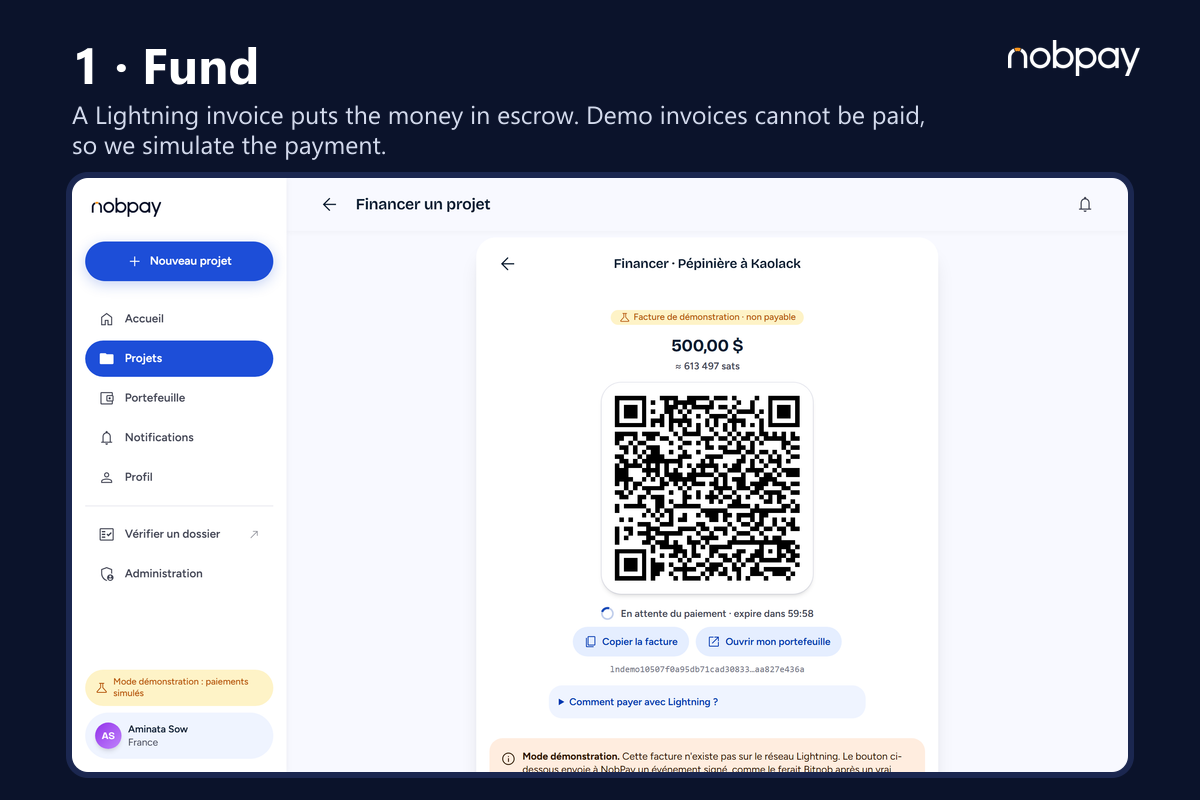
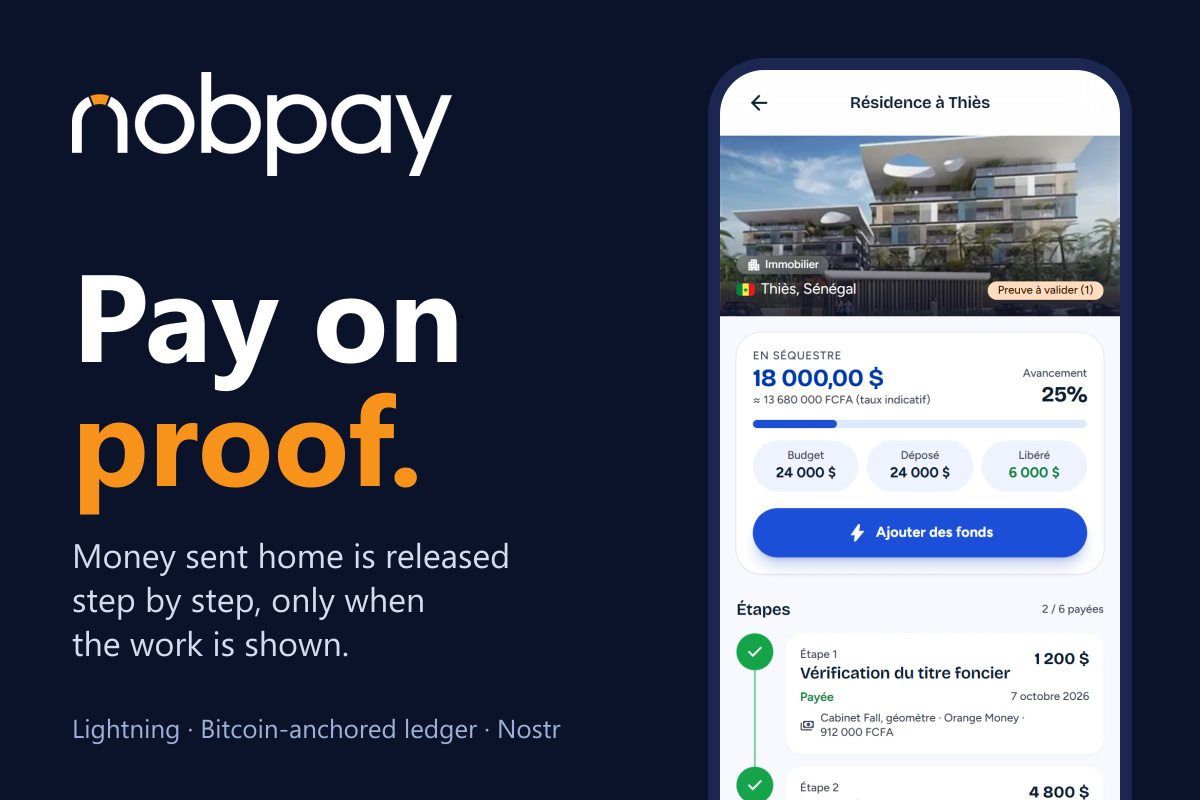
- The funder creates a project, split into steps (templates for each corridor, editable), and funds it with a Lightning invoice. The money sits in escrow, counted per project.
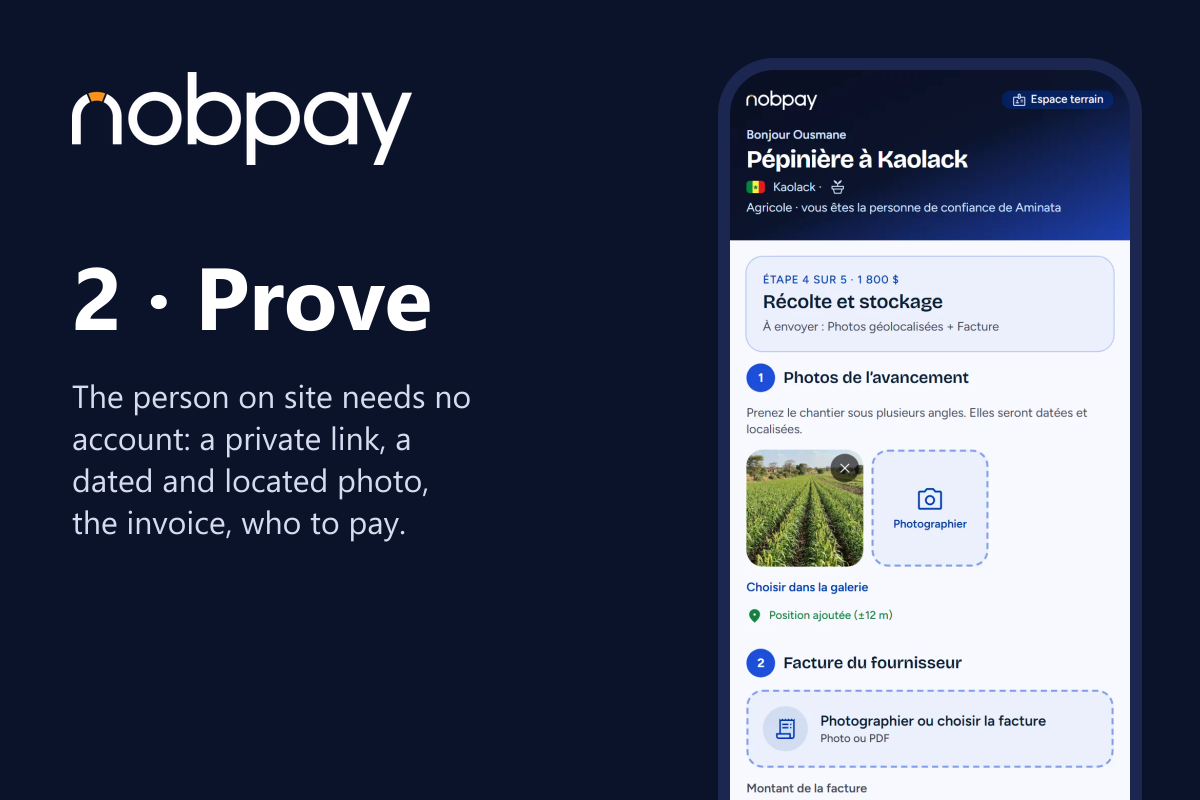
- The person on site, who needs no account, opens a private link and sends dated, geotagged photos, the invoice, and who to pay.
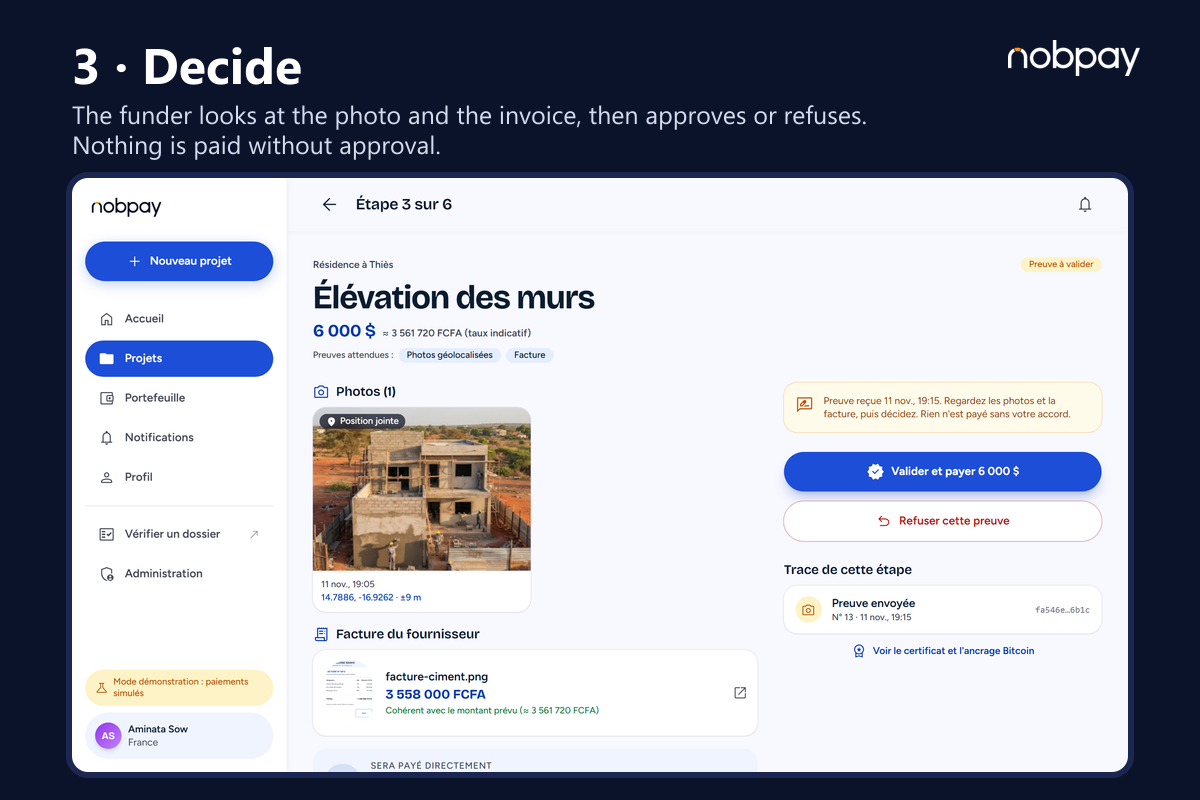
- The funder gets a second opinion before deciding: automatic checks (is this photo or invoice already used somewhere else, even cropped or re-saved? was the phone in Senegal when it sent the proof, and are the photos recent according to their own Exif date? does the invoice match the step?) and, on request, Claude's advice on the photos and the invoice. (new) The AI reads; plain code compares; the funder decides. The advice never blocks or triggers a payment.
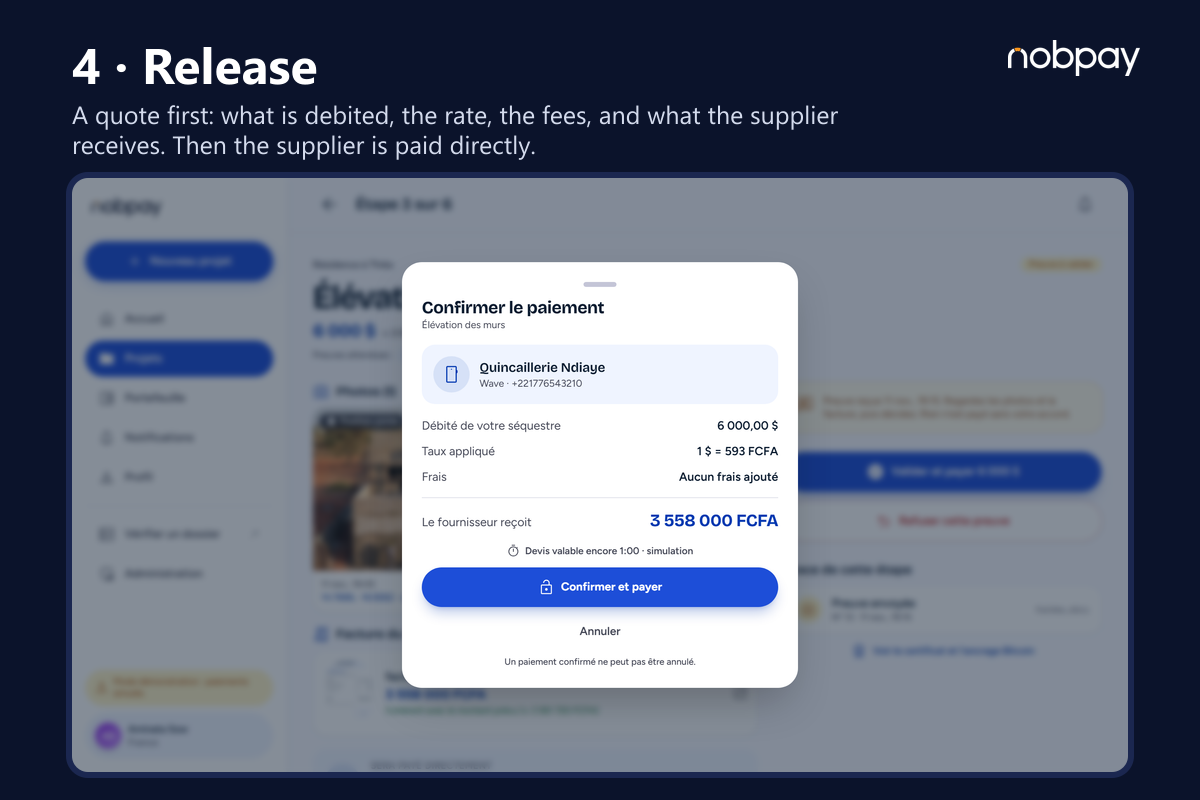
- On approval, the supplier is paid in sats at their Lightning address, and the receipt shows the preimage, the cryptographic proof of payment. Unused escrow can be refunded. (new)
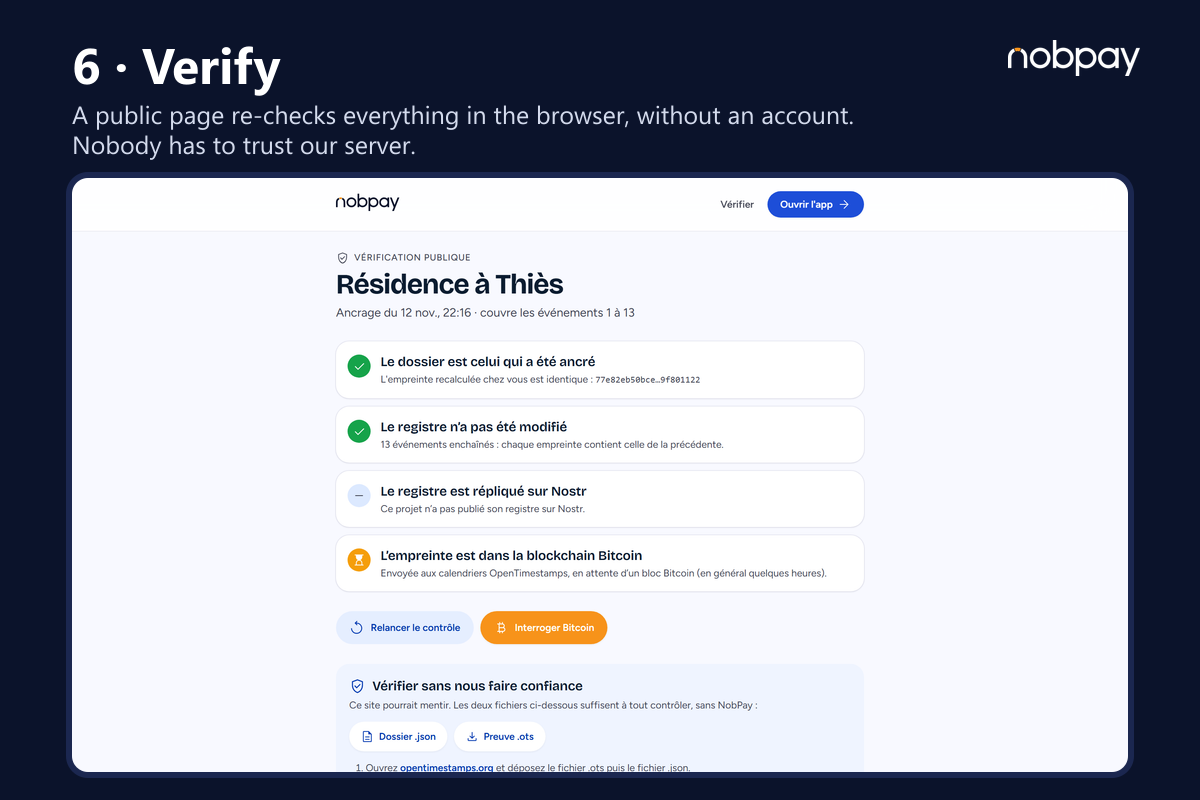
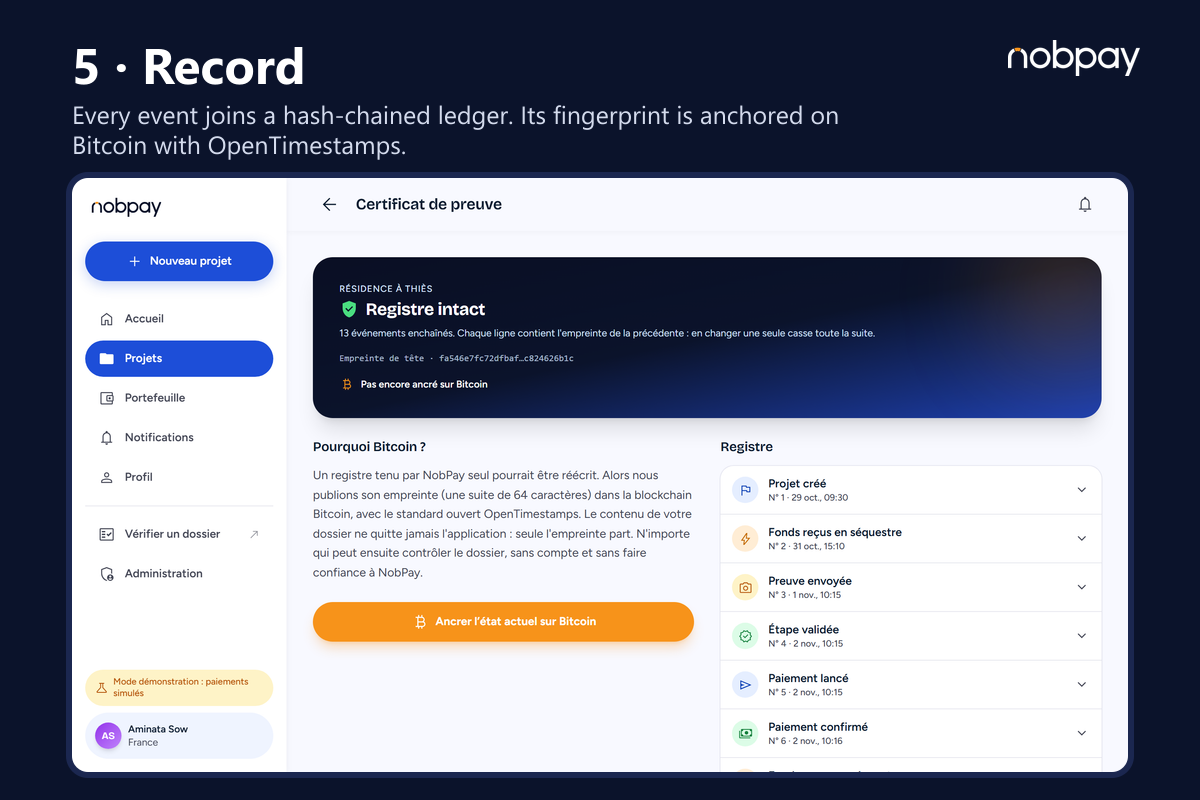
- Every event goes into a hash-chained ledger. Its fingerprint is anchored on Bitcoin with OpenTimestamps, and each event is also published on Nostr relays as a signed commitment that carries no name and no amount. A public page re-checks everything in the visitor's browser, including asking the relays itself. Nobody has to trust our server. (new)
Around the project (new). The funder can name an independent witness who sees each proof from outside and answers "confirmed" or "disputed" (written in the ledger); the funder can make that confirmation a condition of payment. A family link lets relatives add to the escrow from any Lightning wallet, with no account, and without any power to release or take back. Web Push notifications (no SMS) tell the funder, the field team and the witness when something needs them. This is what paid platforms sell with salaried inspectors, as a private link and a ledger entry.
Manage the plan (new). Until money touches a step, the funder can rename it, re-price it, add or remove steps; the server refuses to change a step that is funded, waiting for proof or paid. Every change is a ledger event, so the public record explains why the final plan differs from the first. A project can be closed: no further payments, and unused escrow can be refunded as usual.
A one-click "Quick trial" (Essai rapide in French) creates a 15 USD trial (three steps of 5 USD) so a juror can see the whole path in a few minutes. (new)
The whole interface, the landing page and the public verification page are in French and English (one dictionary, and a test fails if a sentence shown has no English). (new)
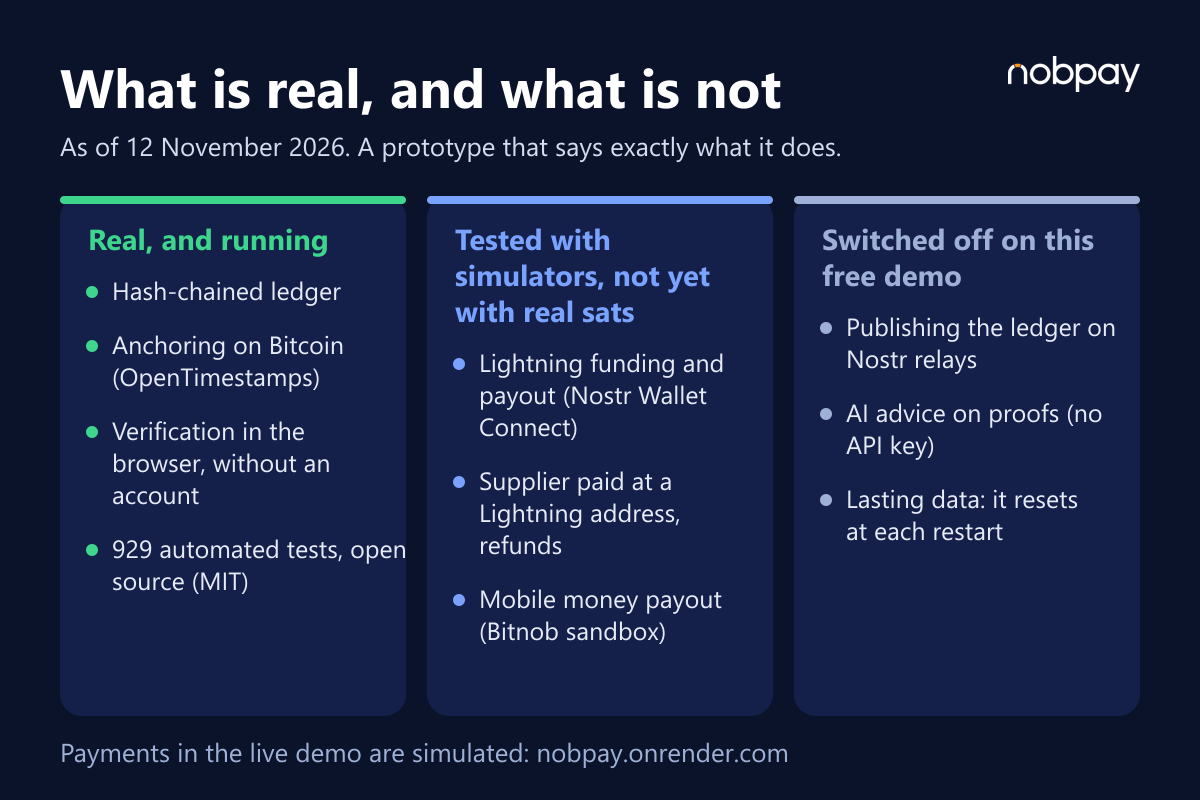
What is real, and what is not (as of 12 November 2026)
We say it plainly, because a prototype that states exactly what it does is stronger than one that says more.
- Funding over Lightning (Nostr Wallet Connect, NIP-47), credited only when the wallet confirms the invoice at the invoice amount, and supplier payout to a Lightning address (LNURL-pay, invoice checked before paying, preimage as proof): implemented and tested end to end against a scripted wallet, and the adapter against a real NIP-47 wallet service (from Alby's SDK) on a simulated relay. Not yet run with a real wallet and real sats: the live demo uses simulated payments, and no real-sats instance is running yet.
- Refund of unused escrow: implemented and tested against the scripted wallet.
- Mobile money payout (Wave / Orange Money / Free Money) through Bitnob: run end to end in the Bitnob sandbox earlier in the project; not part of the live demo, which simulates payments.
- Hash-chained ledger, browser-side verification, OpenTimestamps anchoring: real (public calendars, downloadable
.otsproof). Automatic anchoring is switched off on the live demo. - Nostr commitments (kind 8421) and NIP-03 attestations: tested against fake relays, and the verification page was checked in a browser against real relays in read-only mode. Publishing to real relays has not been tried yet, and it is switched off on the live demo.
- AI advice on proofs (Claude): tested with a fake client. Never run against the real API yet, and switched off on the live demo (no API key).
- Custody: the escrow is held by the instance's own wallet (a custodial design, bounded by pilot ceilings and a solvency check that pauses payments if what we owe exceeds what the wallets hold). It is not a licensed financial service.
- Live demo and deployment: a Docker image (built in about two minutes) on Render's free plan: 512 MB of memory, asleep after 15 minutes without a visit, data reset at each restart, payments simulated. The deployment and backup scripts were run in a clean GitHub Codespace.
How we built it
- Next.js 16, React 19, TypeScript (strict), zod 4; a single process with an append-only, hash-chained ledger; a file database for now (SQLite is planned). 929 automated tests, run on every push by GitHub Actions; a Docker + Caddy deployment script, tested in a clean Codespace.
- Lightning without an intermediary: Nostr Wallet Connect (NIP-47) with two connections of different rights: one that can only make and look up invoices (it cannot spend), and one that pays and carries a budget. Our own BOLT11 decoder (the invoice libraries did not expose the description hash that LNURL-pay requires) and an SSRF-safe HTTPS client for Lightning addresses.
- Money safety under uncertainty: a payment is only believed with a preimage that hashes to the invoice; a lost answer keeps the funds reserved and the payment is looked up by its hash, never repeated; "never sent" is concluded only after five minutes without a trace.
- Nostr: one signing key per project derived from a master key, named in the first ledger event (so the Bitcoin anchor also commits to it), regular (non-replaceable) events so a forged second version appears next to the first, and NIP-03 proofs reduced to a single Bitcoin attestation.
- AI: the official Anthropic SDK with structured output; privacy by minimisation (no funder name or phone, no GPS positions, only when asked); a daily cap and per-account limits; refusals and failures show plain messages.
Challenges we ran into
- Not having a wallet to test with. We built a fake relay and drove our adapter with the real wallet-service implementation from Alby's SDK, with the real encryption. It found no bug, but it proved the messages we send are understood.
- Relays are not a database. A replaceable event kind would have let an operator silently overwrite a commitment, so we chose a regular kind. Our first choice (8173) was already used by another application, which we only found by reading the relays.
- Lightning addresses are URLs typed by users. A server that fetches them can be made to call its own network. The client checks the address it connects to at connection time, refuses redirects, and bounds size and time.
- Small amounts. Lowering the minimum budget so a trial costs 15 USD exposed a template that produced a 0 USD step; fixed and tested.
Accomplishments that we're proud of
- A payment path where every claim a wallet or another server makes is checked before it is believed.
- A verification page that works without our server (it asks Bitcoin calendars and Nostr relays itself).
- An AI feature that is honest about its role: it reads, code compares, the person decides.
- Everything is in the open: MIT licence, a changelog that separates this hackathon's work, tests that say what is real.
What we learned
Escrow is a bookkeeping promise until the books can be checked by someone else. Publishing hashes on Nostr and on Bitcoin turns "trust us" into "check us". And the hardest part of paying over Lightning is not paying, it is what to believe when the answer is lost.
What's next for NobPay
- Run a pilot with real sats (it needs a wallet connection and a few sats) and publish its results.
- A mobile money adapter for Senegal behind the same interface, so the supplier can be paid in FCFA where Lightning is not yet usable (Bitnob today; Banxaas, a Dakar startup, is the local option we want to talk to); USSD for people without a smartphone.
- Wolof in the interface (it needs a native speaker to translate and review it), SMS and Nostr (NIP-17) notifications.
- SQLite, and a standalone open-source NWC test harness and OpenTimestamps helpers for other builders.
Built With
- anthropic-claude
- bitcoin
- docker
- github-actions
- lightning-network
- lnurl-pay
- next.js
- nip-03
- nip-47
- node.js
- nostr
- nostr-wallet-connect
- opentimestamps
- react
- render
- typescript
- vitest
- web-push
- zod

