Inspiration
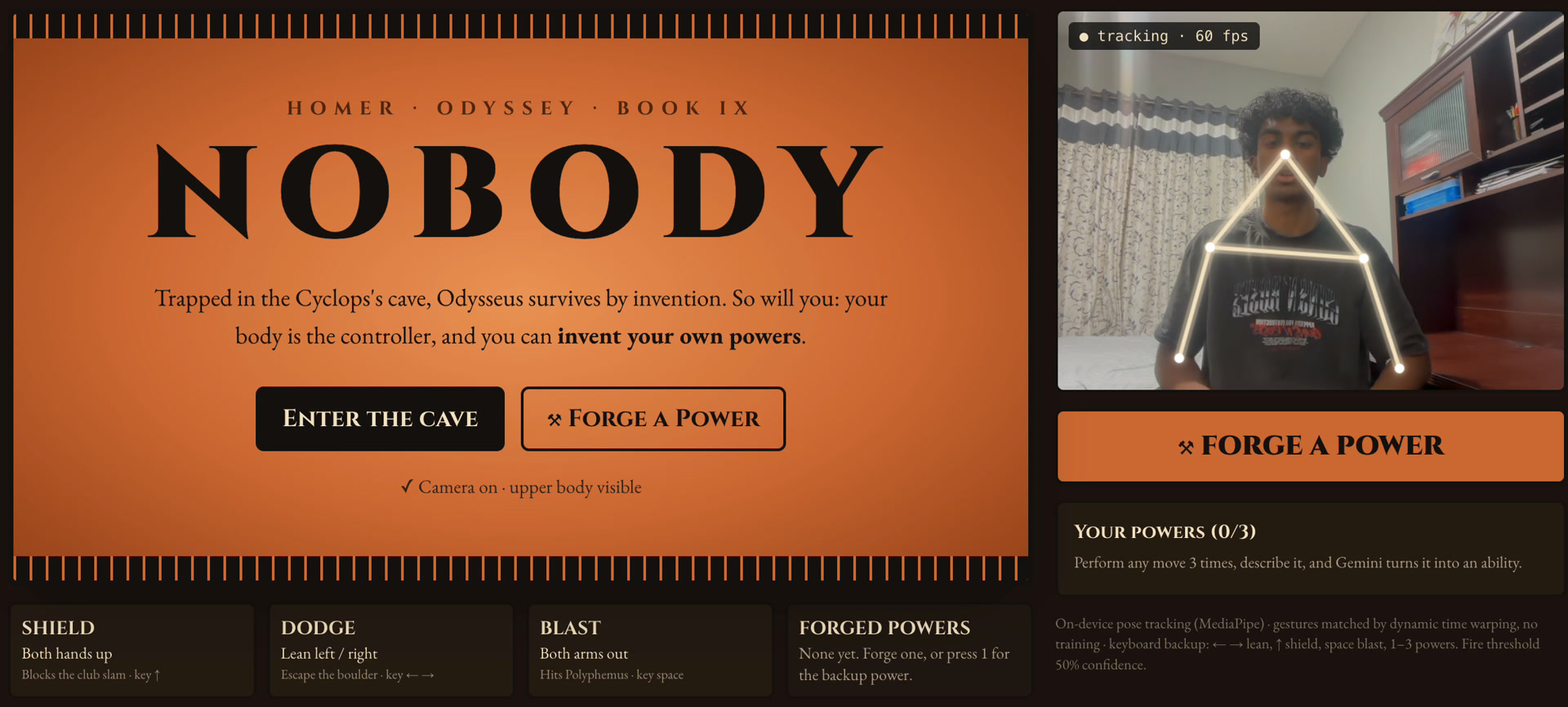
In Book 9 of Homer's Odyssey, Odysseus is trapped in the cave of Polyphemus, a one-eyed giant who eats his men two at a time. He can't win by strength: the boulder sealing the door is too heavy for any mortal. He wins by inventing. He tells the Cyclops his name is "Nobody", so when the blinded giant screams "Nobody is hurting me!", his brothers shrug and leave.
We wanted a game where the player survives the same way: by inventing the move nobody expected.
What it does
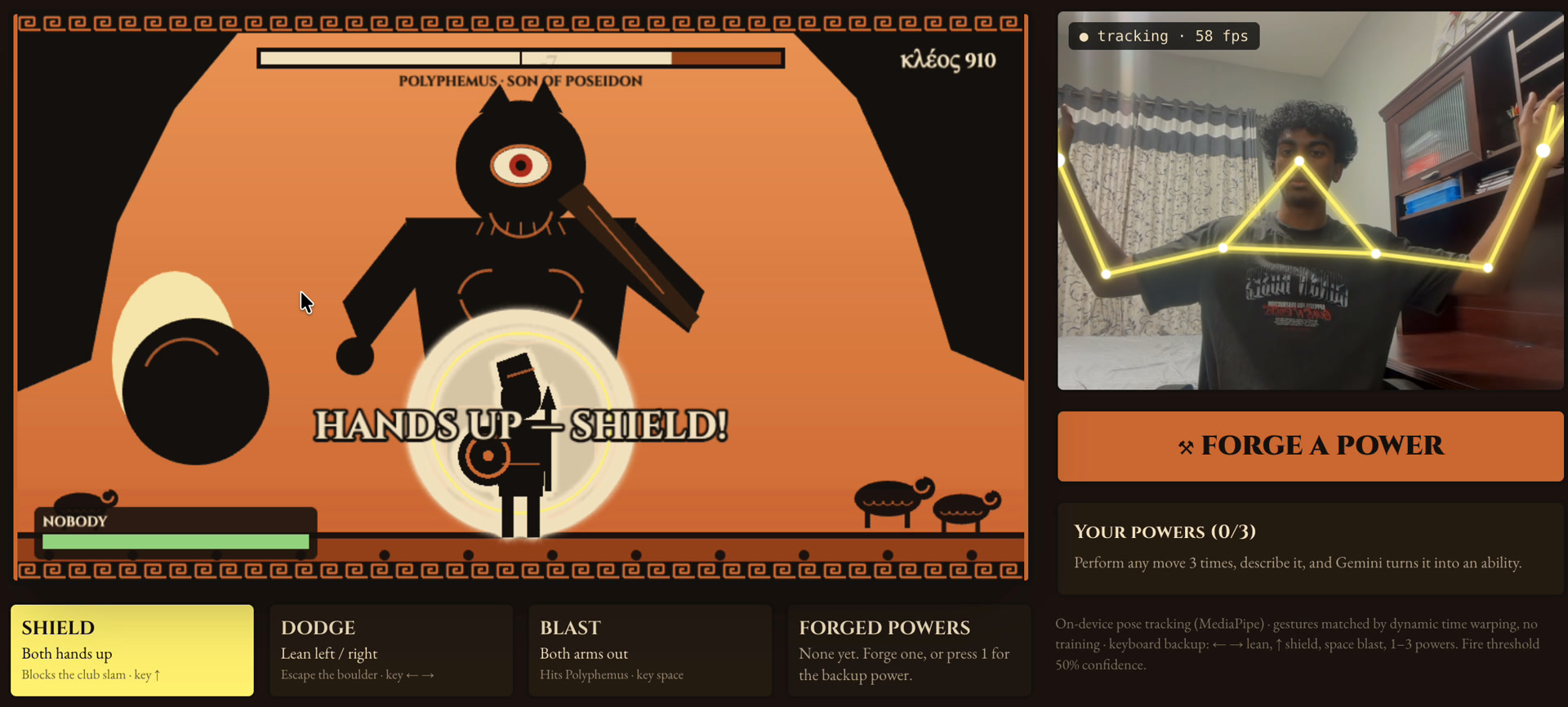
- Your body is the controller, seated. Raise both hands to block the club slam. Lean left or right to escape the boulder. Hold both arms out to fire a blast.
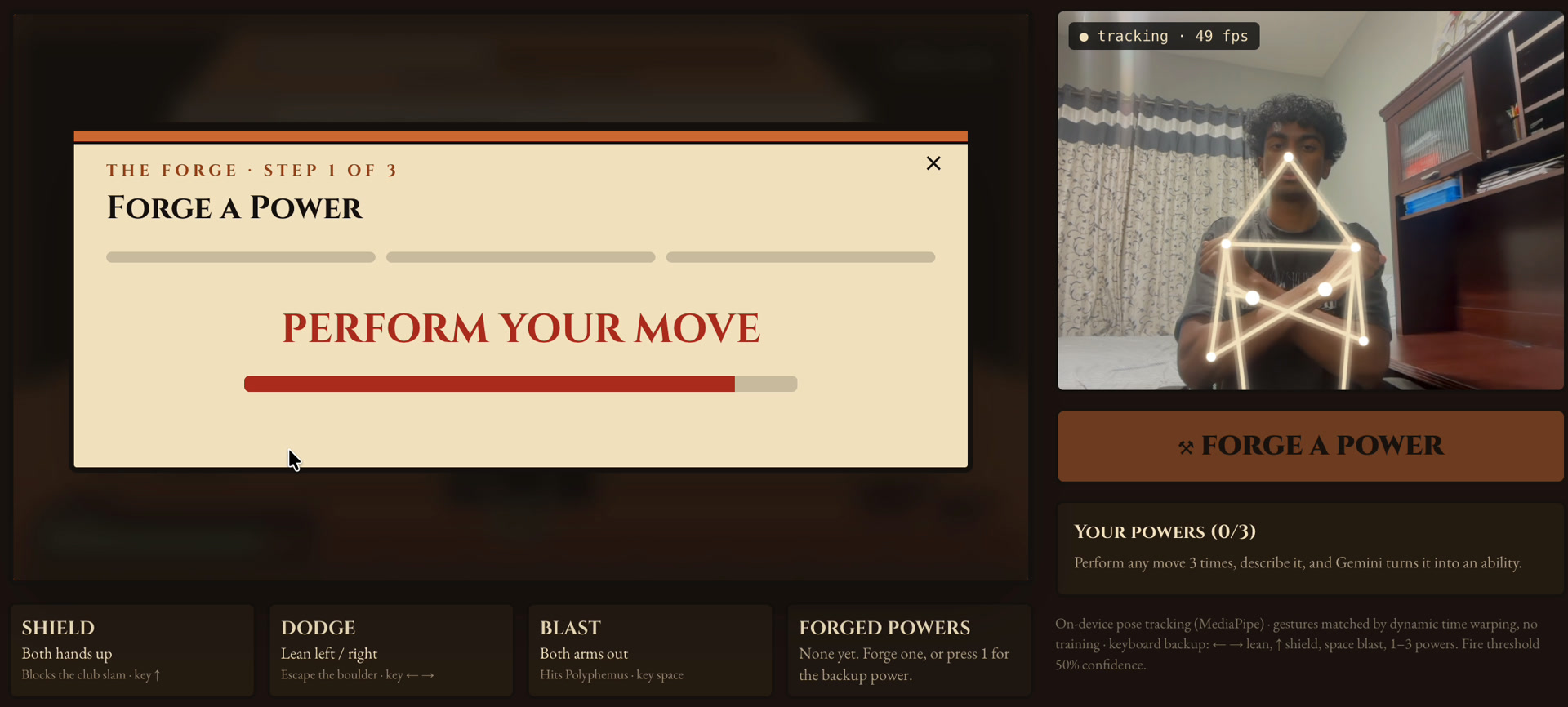
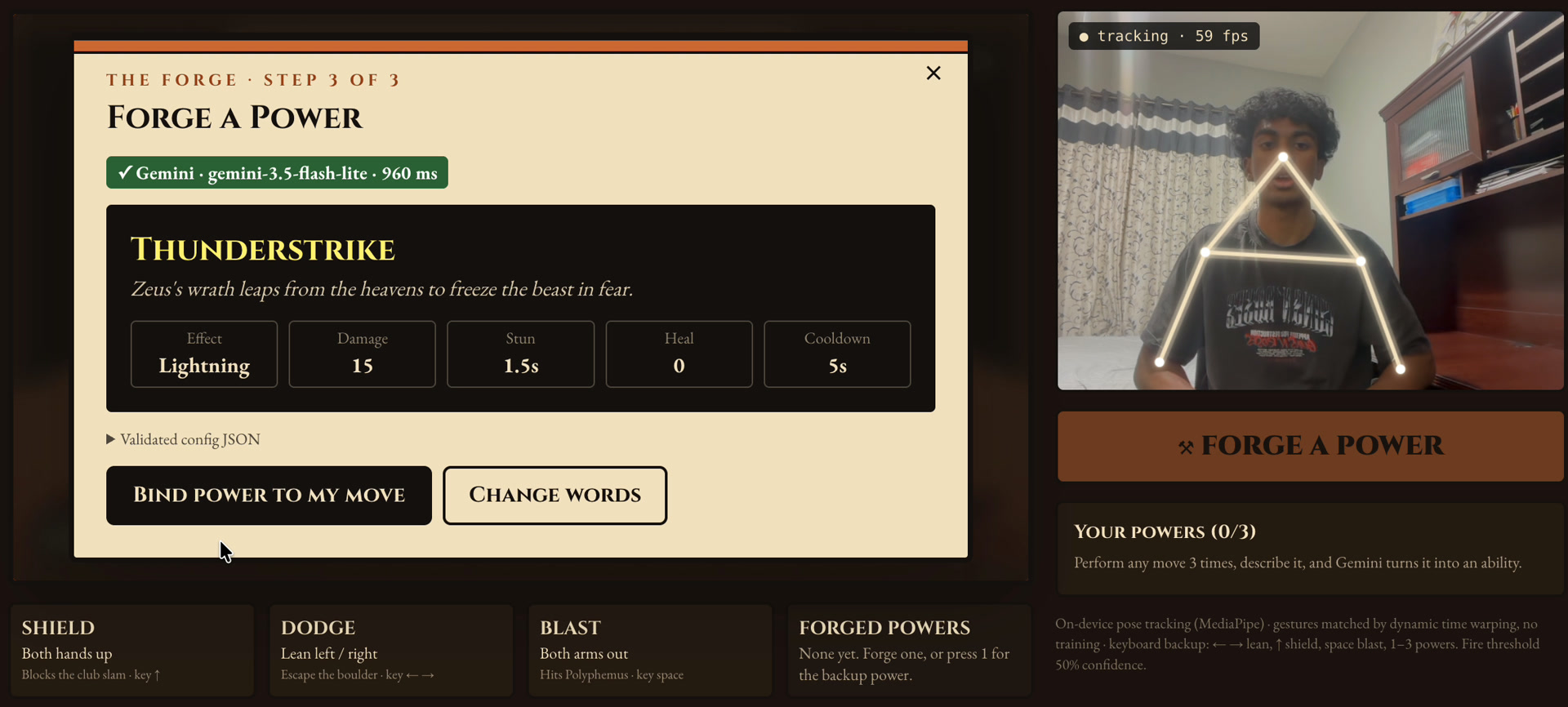
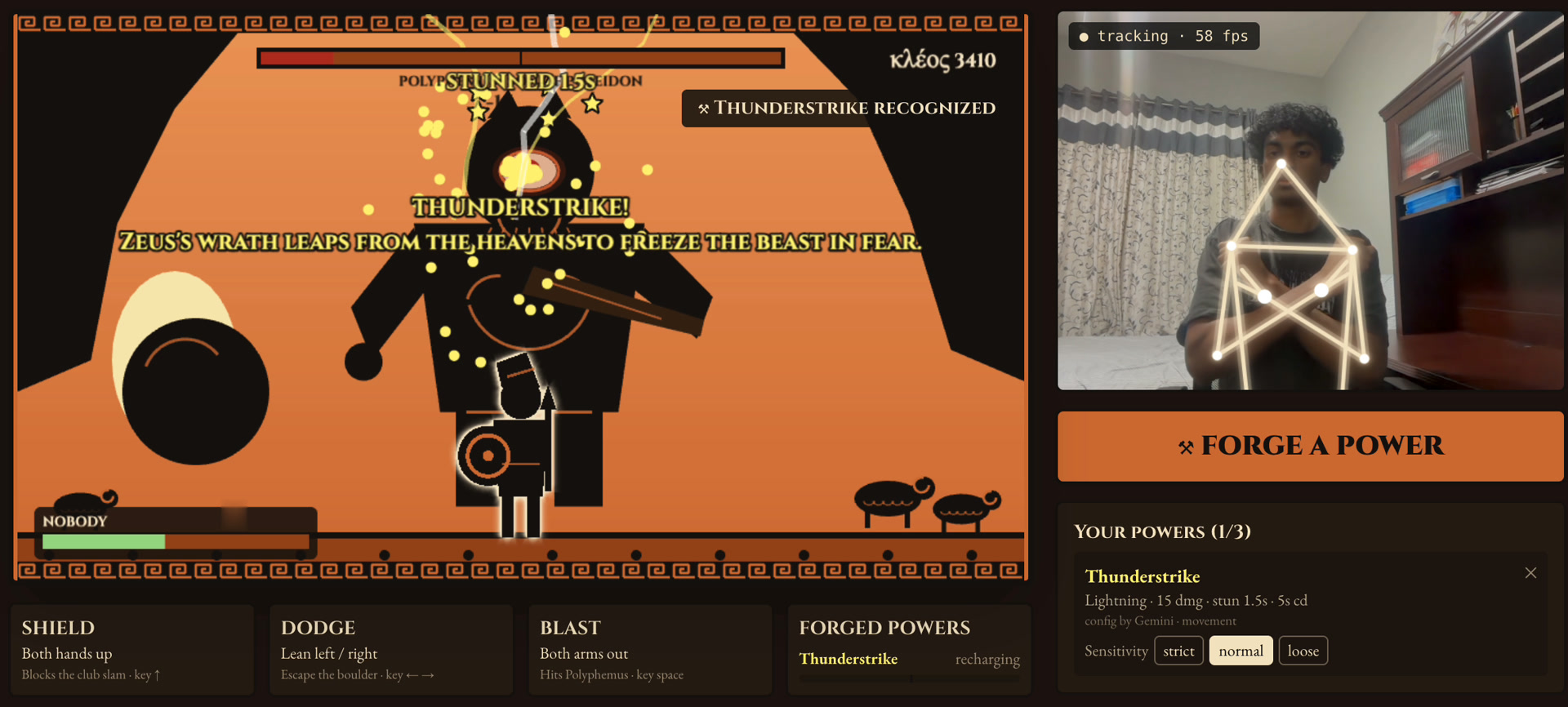
- Forge a Power. Perform any upper-body movement three times, name it, and describe it in plain words, like "Thunderstrike: summon lightning and briefly stun enemies." Gemini turns your words into a game ability. From then on, performing that movement casts it in combat. No model training.
- The Nobody story is in the game, not just the title:
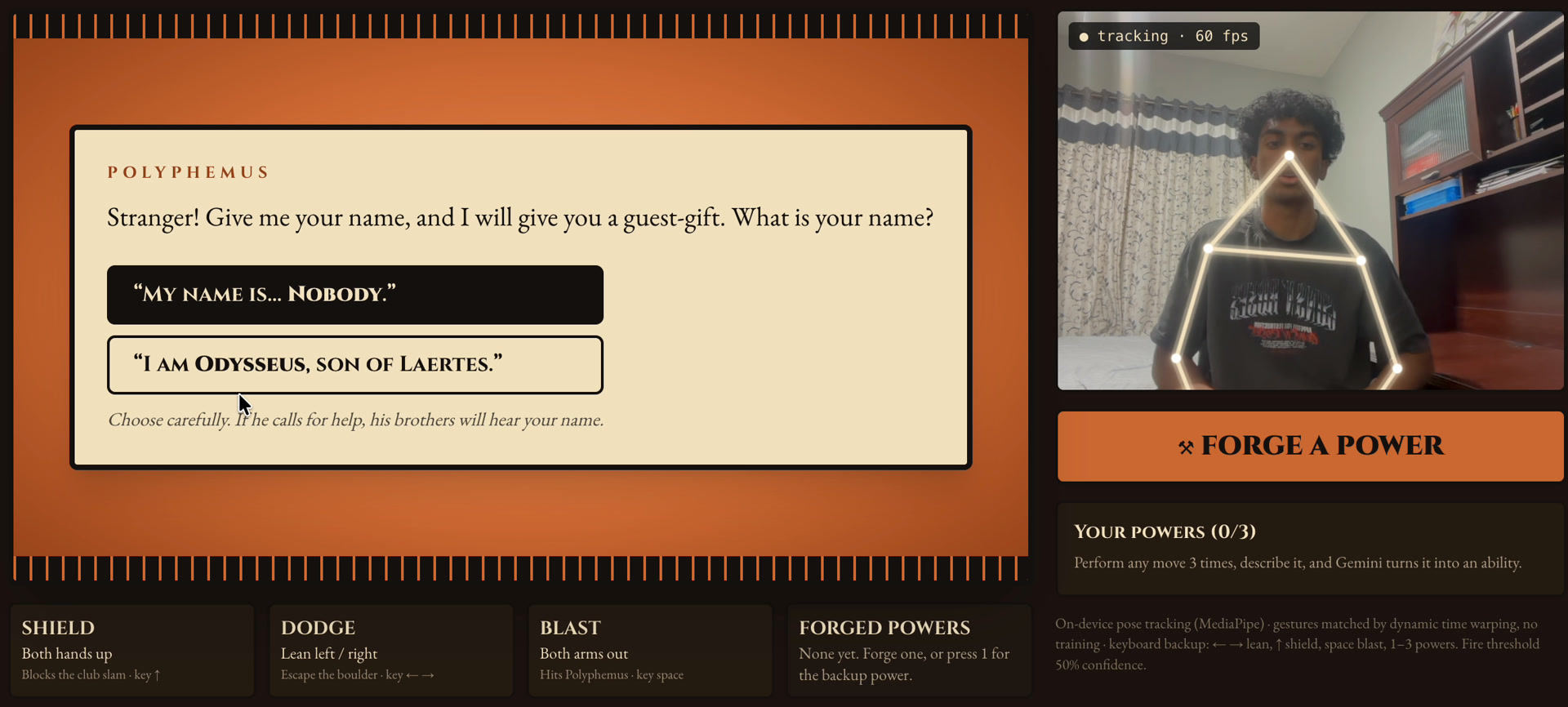
- Polyphemus asks your name. You choose: lie ("Nobody") or tell the truth ("Odysseus").
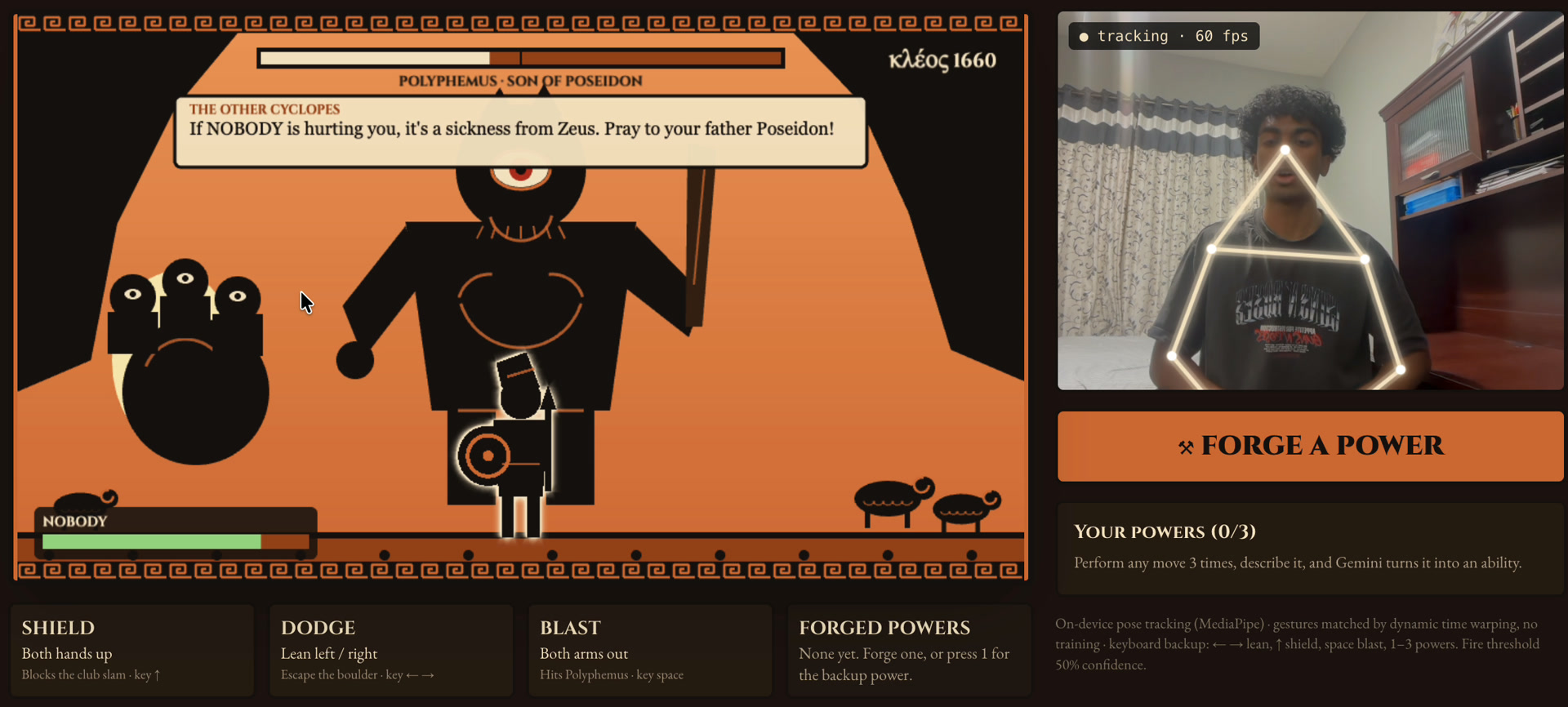
- Say Nobody, and at half health he cries "NOBODY IS HURTING ME!" Three Cyclopes appear at the cave mouth, laugh, and leave: "Reinforcements cancelled: no one comes for Nobody."
- Say Odysseus, and his brothers stay and throw boulders with him, so two lanes are deadly on every throw. The end card points you back to Homer's lie.
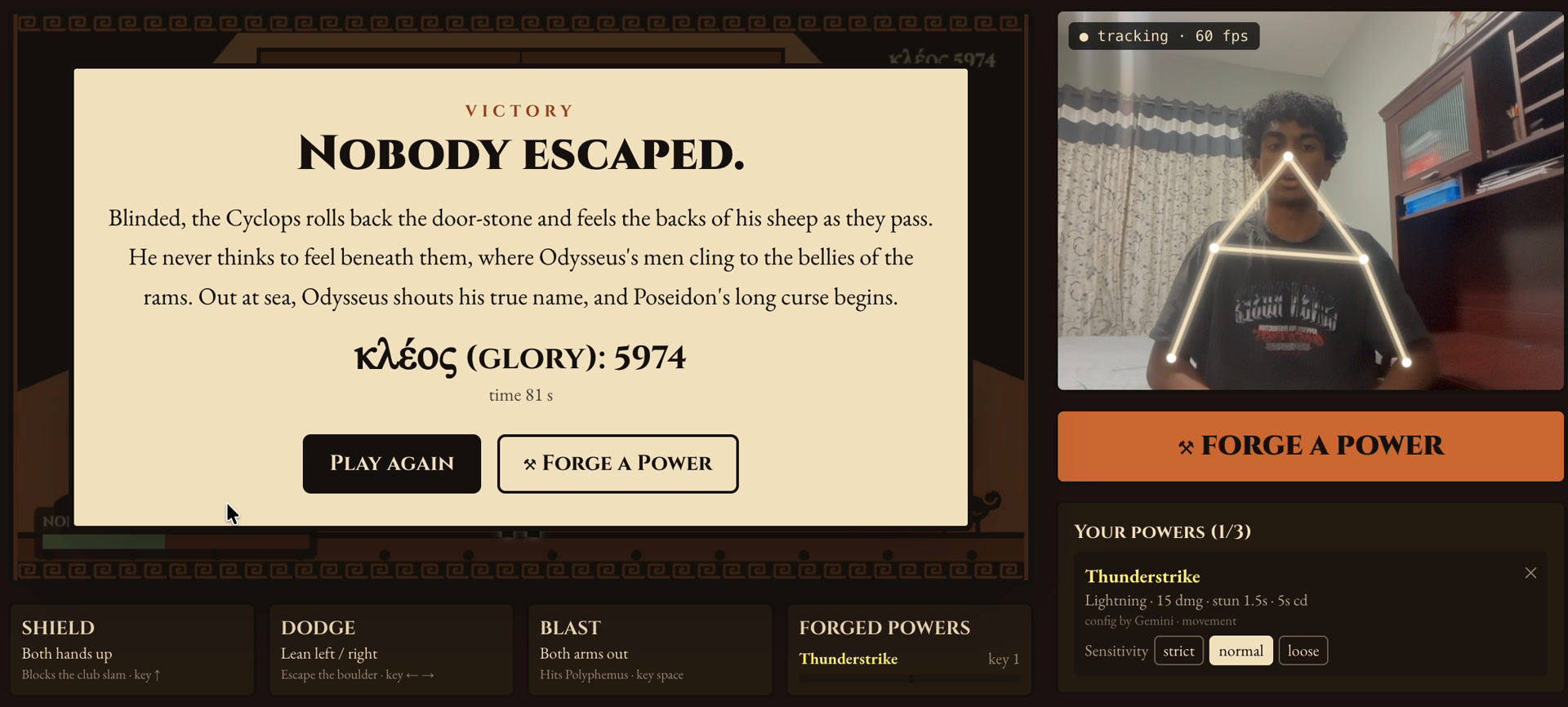
- You finish him with the olive stake ("NOBODY HAS BLINDED ME!") and escape beneath the rams.
- Win, lose, and restart. Boss and player health, a score shown as κλέος (glory), and an instant restart.
How we built it
- Stack: Next.js, React, TypeScript, Tailwind CSS, and Phaser 3. The whole game is drawn in code in Greek black-figure vase style, with sound synthesized in WebAudio.
- Pose: MediaPipe Pose Landmarker runs in the browser, on device. We self-host the model and WASM, so tracking never depends on venue Wi-Fi.
- Features: each frame becomes a 14-D vector: elbow and shoulder joint angles, wrist and elbow positions relative to the shoulder midpoint (divided by shoulder width), shoulder tilt, and head offset. No raw pixels.
- Presets: rule-based detectors with hysteresis. Lean is calibration-free: absolute shoulder tilt plus head offset from the shoulders.
- Forge, no training:
- Each of the 3 samples has its idle start and end trimmed (noise-aware) and is resampled to 32 frames.
- We merge them into one template with DTW barycenter averaging.
- Live recognition uses dynamic time warping. With frame cost $c(i,j) = \lVert w \odot (x_i - y_j) \rVert$:
$$D(i,j) = c(i,j) + \min{D(i-1,j-1),\ D(i-1,j),\ D(i,j-1)}, \qquad d = \frac{D(n,m)}{(n+m)/2}$$
- The tolerance comes from the player's own three samples, where $d_k$ is each sample's distance to the template:
$$\tau = \operatorname{clamp}!\left(1.3 \max_k d_k + 0.02,\ 0.045,\ 0.12\right), \qquad \text{conf} = 1 - \frac{d}{2\tau}$$
- A power fires at $\text{conf} \ge 0.5$ on two consecutive frames, then a cooldown starts.
- A window must also pass gates for enough motion, the same direction (so returning to rest doesn't fire), a similar path length, and rhythm: direction reversals in the most-varying joints, so a wave isn't mistaken for a plain arm raise.
- Gemini has exactly one job. One server route turns the description into
{name, effect, damage, stunSeconds, cooldownSeconds, heal, flavor}:
- Gemini has exactly one job. One server route turns the description into
- The effect comes from an 8-item allowlist.
- The server clamps every number for balance.
- It's called once per Forge, never per frame.
- If Gemini is unavailable, an offline keyword oracle takes over, and the Forge shows which oracle answered.
- Testing: a synthetic-skeleton harness generates noisy upper-body movements, so we can test recognition and false fires without a camera.
Challenges we ran into
- Live tests broke what synthetic tests passed.
- Round one: dodge was unreliable, because the "neutral posture" baseline slowly absorbed a natural lean.
- Round two: dodge was inverted, because the baseline was captured while the player was still reaching for the trackpad.
- We replaced it with a calibration-free lean score.
- Forged powers fired on the return-to-rest motion. Our DTW distance was normalized by warping-path length, so a reversed movement could find a cheap path through the middle frames. We switched to sequence-length normalization and added a direction check.
- Idle trimming silently failed under real webcam jitter, which made templates too loose. We made the threshold noise-aware.
- A wave overhead matched a plain arm raise. The big arm path is identical, and averaging across joints drowned out the hand motion. A rhythm check that counts direction reversals in the most-varying joints separated them.
Accomplishments that we're proud of
- Gesture recognition from three examples, with no training. In our synthetic harness, 8 forged moves are each recognized 6/6, with zero false fires on 18 performed movements, including the presets, near misses, and reverse motions.
- The game never needs the API to be playable. We verified the no-key path in a production build.
- One trial, polished end to end, with the Odyssey's central trick as a real choice inside the fight.
What we learned
Synthetic data proves the logic, but only a real body in front of a real camera finds the bugs that matter. Two of our three live test rounds found real problems that thousands of clean synthetic frames never showed.
What's next
- More live testing with first-time players. So far only one person has tested recognition live.
- Negative samples: let players record a "this is NOT my move" sample, to tune their power's boundary.
- Public deploy.
- The next trial: the Sirens, where you must not move toward the song.
Built With
- cursor
- dyanmic-time-warping
- google-gemini
- grokbot
- mediapipe
- next.js
- phaser.js
- react
- tailwind-css
- typescript
- webaudio


