-
-
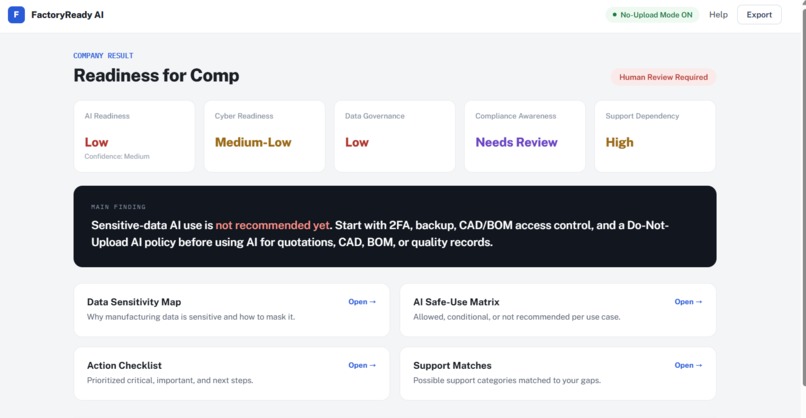
Demo
-
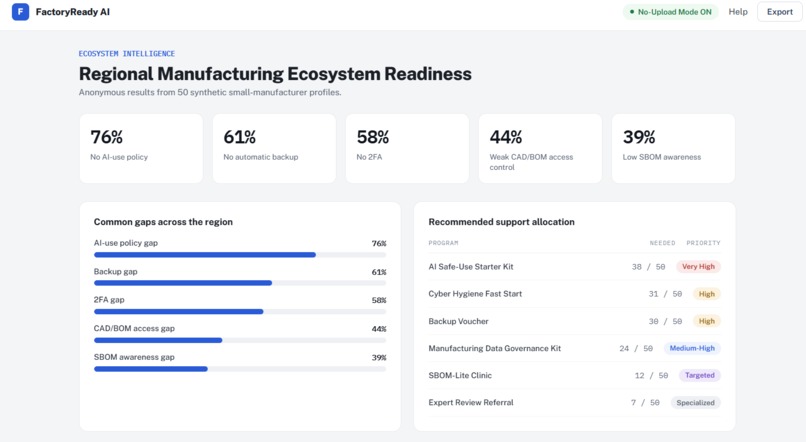
-
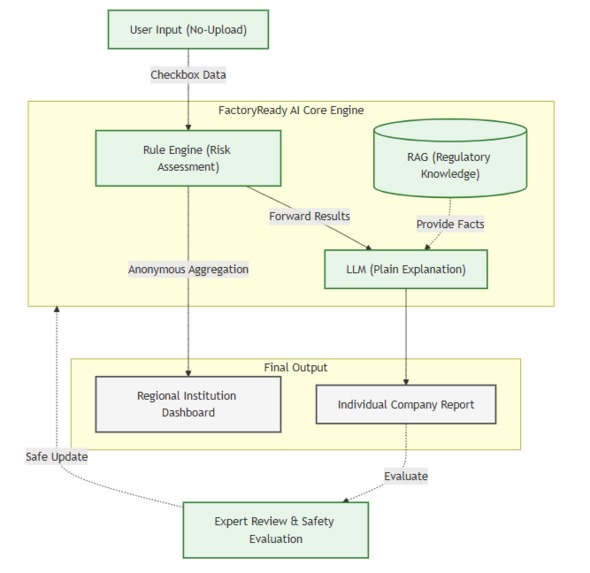
Architecture
-
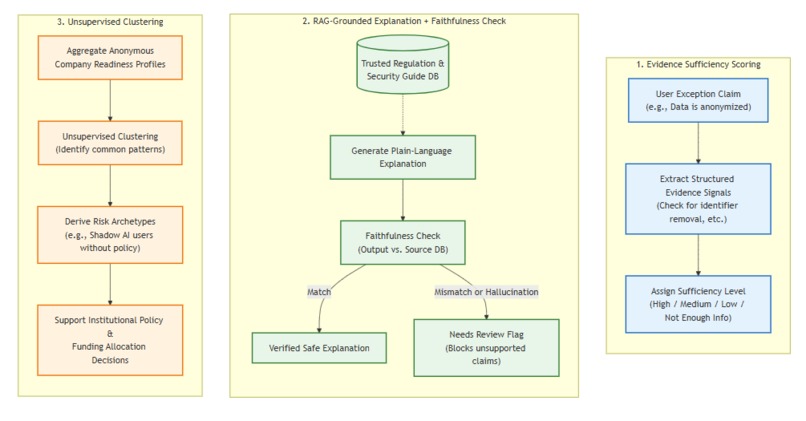
Safety Architecture
Inspiration
The inspiration for FactoryReady AI came from my internship experience in a Vietnamese manufacturing company. During the internship, I saw how much operational work still depended on manual reporting. Staff had to prepare many reports for managers, customers and larger supply-chain partners but the process was slow and often confusing.
The company had useful data but it was scattered across the platform. Even when the data existed, it was not always clear where it was stored, who owned it whether it was sensitive or how it could be safely used. At the same time, the company wanted to use AI because AI could help draft reports and make daily operations more efficient.
However, I also realized a serious risk: manufacturing data is not ordinary data. Quotations, price tables, CAD drawings, BOMs, supplier information, customer details, production schedules and quality records can be dangerous if revealed. This created the core question behind FactoryReady AI: how can small manufacturers benefit from AI without exposing the very data they need to protect?
What it does
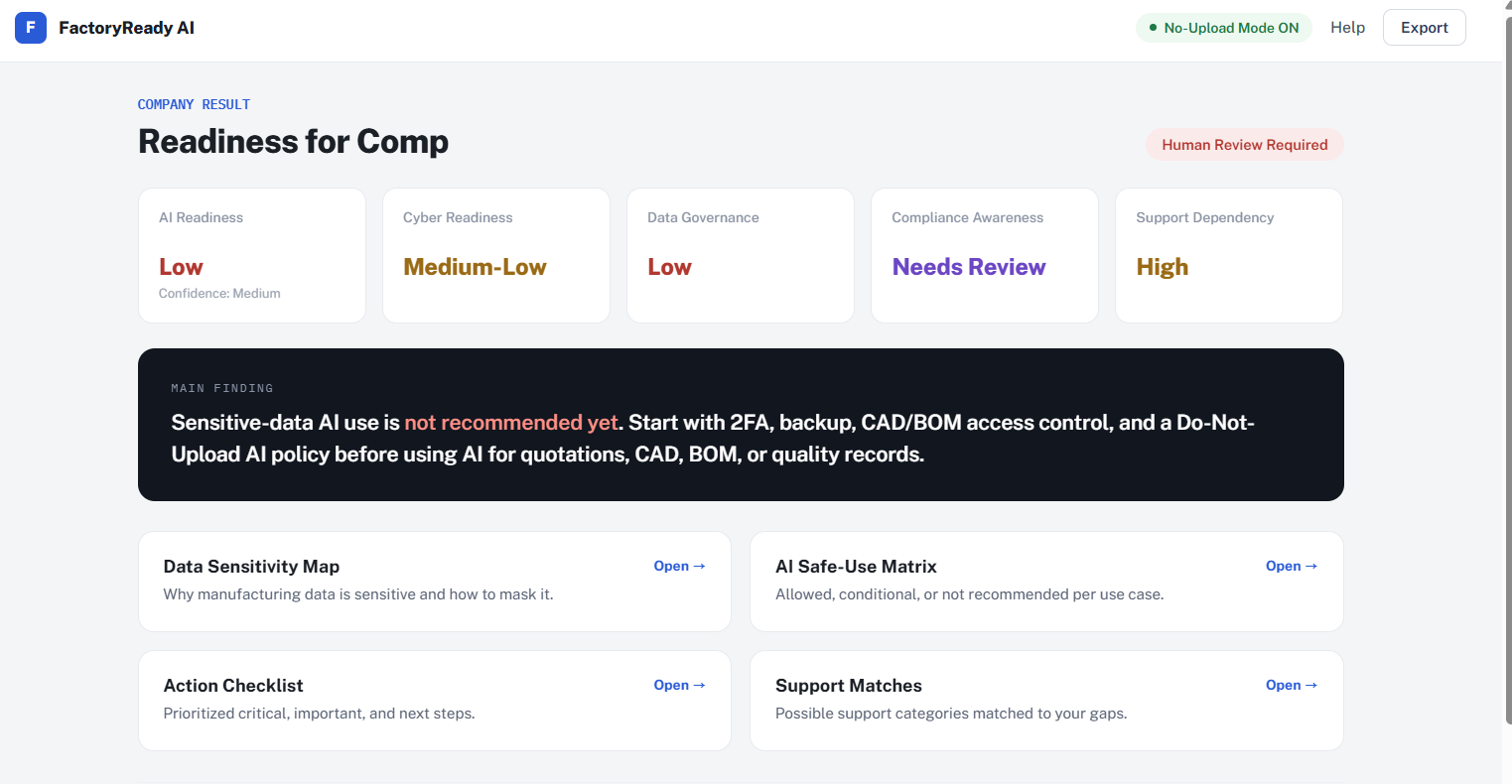
FactoryReady AI is a no-upload AI readiness blueprint for small manufacturing communities. It helps small manufacturers understand what AI use is safe, what data must be protected, what basic cybersecurity or governance gaps exist and what actions they should take first.
For manufacturing companies Instead of asking companies to upload sensitive files, FactoryReady AI uses
- a short checklist with only categories of companies : for a more specific rule base
- ranges and yes-or-no answers for precise data and company status
Based on those answers, it generates
- a data sensitivity map
- a do-not-upload list
- an AI safe-use matrix
- prioritized action checklist.
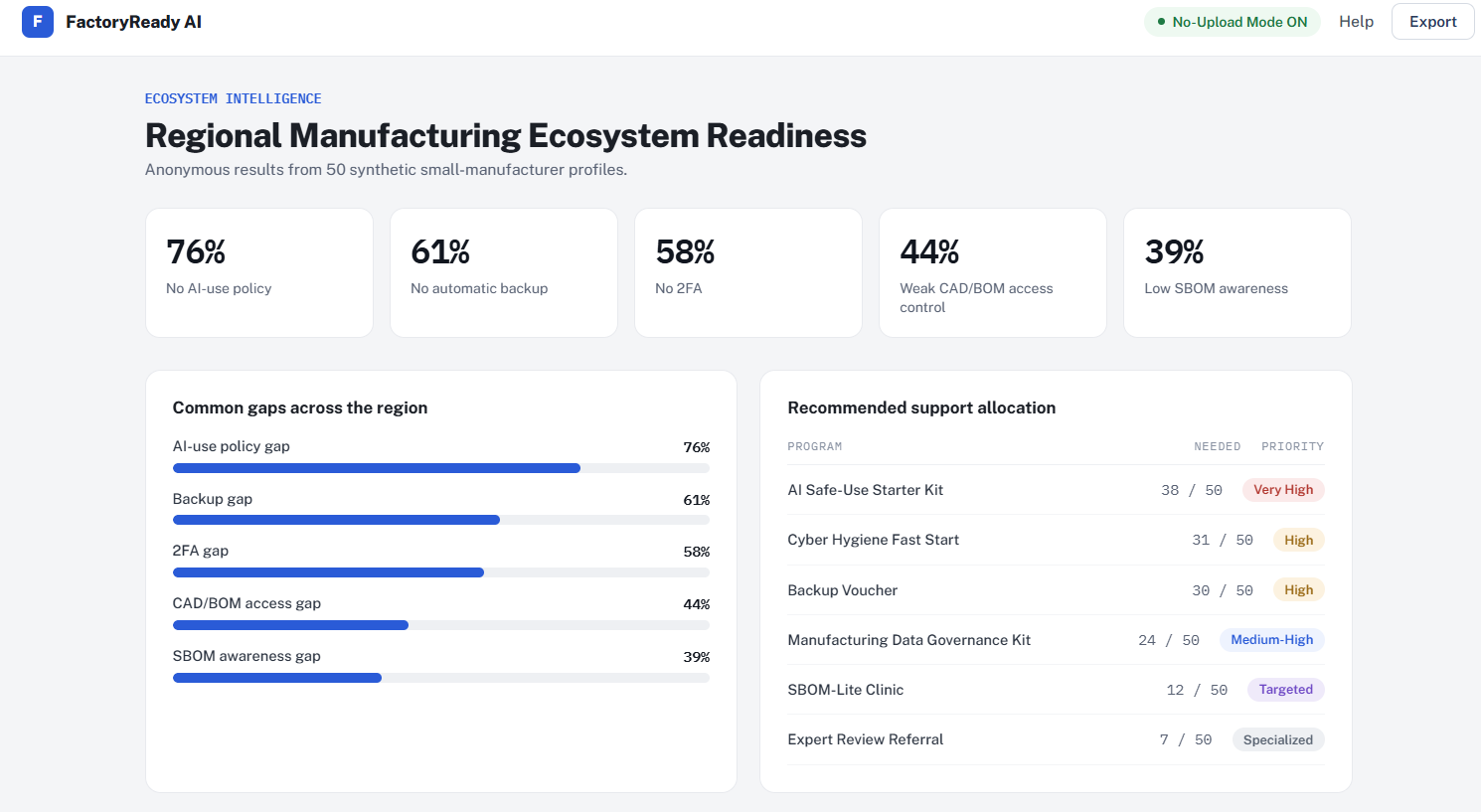
For regional institutions FactoryReady AI is not just a tool for one company. It becomes a readiness map of the local manufacturing ecosystem. By aggregating anonymous, no-upload assessment results from multiple small manufacturers, the system shows where the community is collectively underprepared.
The dashboard does not expose or rank individual companies. Instead, it identifies common readiness gaps and groups firms into practical support archetypes. This helps local governments support agencies decide which support programs should be funded first.
Rather than offering the same generic AI training to everyone, institutions can target resources more intelligently
How we built it
How we built it
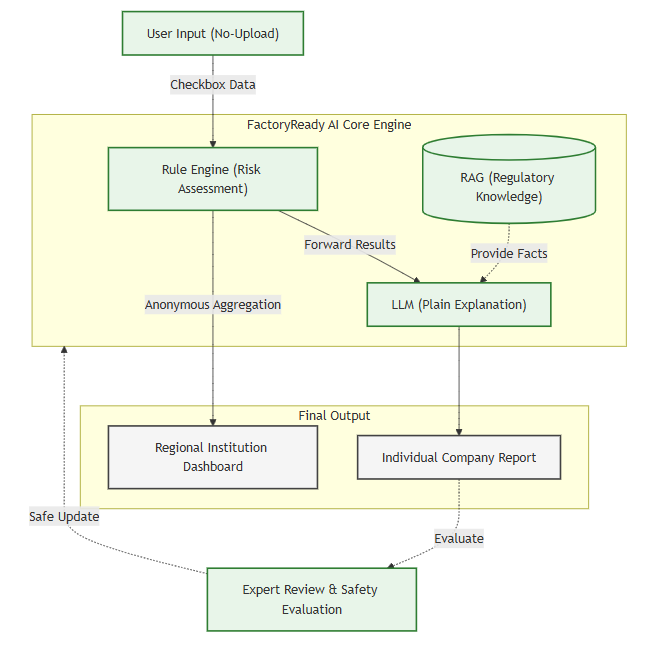
We built FactoryReady AI as a hybrid AI decision-support workflow, not a file-upload platform.
1. No-upload assessment layer We first designed a short readiness questionnaire for small manufacturers. It collects only non-sensitive information, such as company size, industry, current digital tools, data types handled, planned AI use cases, and basic cybersecurity controls. The system does not ask users to upload quotations, CAD drawings, BOMs, contracts, production records, or quality data.
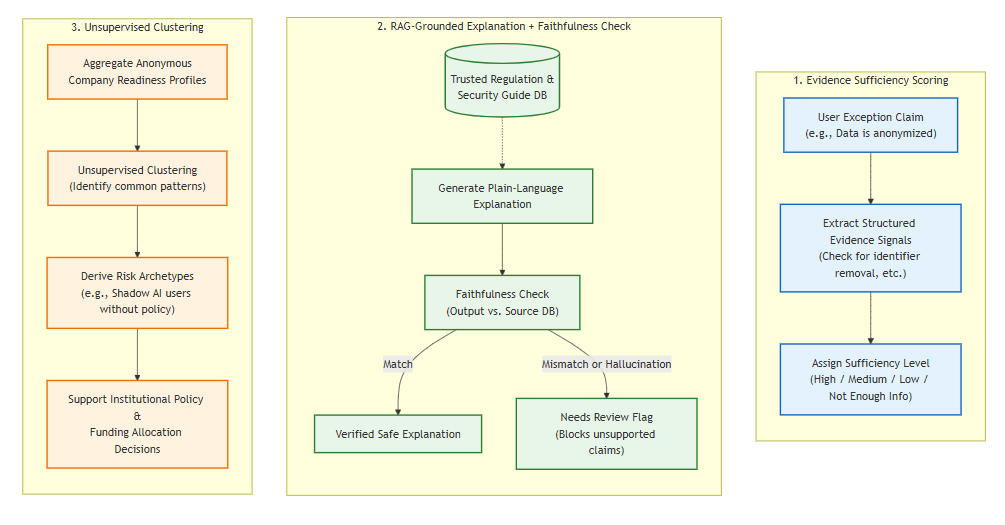
2. AI-assisted safety analysis layer The core AI function is to analyze whether a manufacturer’s planned AI use is safe, risky, conditional, or requires human review. The system uses company context, selected data types, AI use cases, security controls, and exception notes to generate structured risk signals. For example, if a company wants to use AI for quotation drafting, the system checks whether price tables, customer names, margins, and external AI tools are involved. If a company says its case is different, the AI extracts non-sensitive exception details, such as whether data is anonymized, aggregated, or processed through an enterprise AI tool.
3. Rule-based guardrail layer Because some decisions are high-risk, we do not let the LLM freely approve sensitive AI use. A transparent rule engine validates the AI-generated risk signals and classifies each use case as allowed, conditional, not recommended or human-review required. This makes the system explainable and safer than relying on an LLM alone.
4. Action and support recommendation layer The system turns risk findings into practical next steps. It may recommend enabling 2FA, setting up backups, restricting CAD/BOM folder access, creating a do-not-upload AI policy, preparing anonymized quality-data workflows or building an SBOM-lite checklist. It also maps these needs to support categories such as AI safe-use training, cyber hygiene support, data-governance kits, or SBOM-lite clinics.
5. RAG-supported explanation layer A RAG-supported explanation layer helps users understand technical concepts such as data governance, SBOM, cybersecurity hygiene, and safe AI use. The LLM explains why a use case is risky, what assumptions were used and what evidence or human review is still needed. It does not make legal, funding or compliance decisions.
6. Scenario and regional intelligence layer Finally, we designed a regional dashboard using synthetic small-manufacturer profiles. The system aggregates anonymous readiness results, clusters firms into support archetypes and shows which programs should be funded first. It also compares scenarios such as immediate action, delayed action and no action, using readiness bands rather than deterministic predictions.
Together, these layers allow FactoryReady AI to perform AI safety analysis while keeping high-stakes decisions transparent, reviewable, and human-controlled.
Challenges we ran into
We had to make sure FactoryReady AI was not just a single-company assistant. Since the challenge focuses on community decision-making, we expanded the design into a regional manufacturing ecosystem dashboard that aggregates anonymous readiness results and helps institutions prioritize support programs.
Another challenge was balancing AI flexibility with safety. We wanted the system to analyze company-specific context and exceptions, but we did not want an LLM to freely approve high-risk AI use. To solve this, we designed a hybrid structure: AI helps extract structured risk signals and explain results, while rule-based guardrails validate high-risk judgments.
Accomplishments that we're proud of
We are proud of the regional dashboard concept. Individual company assessments become anonymous ecosystem-level intelligence, helping local governments, chambers of commerce, industrial-zone managers, and SME support agencies understand which support programs should be funded first.
What we learned
We learned that the problem is not simply whether small manufacturers should use AI. The real question is how they can use AI safely when their data, staff capacity, and governance structures are not ready yet. Most importantly, we learned that responsible AI does not mean removing AI from the system. It means designing AI with boundaries. In FactoryReady AI, the AI helps analyze context, explain risks, and support decision-making, but high-risk compliance, funding, and adoption decisions remain transparent, reviewable, and human-controlled.
What's next for No-Upload FactoryReady AI
we would expand the questionnaire and rule engine with feedback from small manufacturers, cybersecurity experts, legal/compliance advisors, and regional support institutions. This would help us improve the accuracy of the safe-use matrix, compliance relevance flags, and action recommendations.
Built With
- api
- figma
- python


Log in or sign up for Devpost to join the conversation.