-
Greenfield
Inspiration
The transition to a greener world is not being held back by a lack of solutions. Billions of dollars in rebates, grants, energy programs, and financing already exist but they are buried behind fragmented websites, changing eligibility rules, confusing paperwork, and bureaucratic processes. We built Greenlight because sustainable progress should not depend on how much time, money, or policy knowledge someone has. Our vision is larger than a rebate finder: Greenlight is the sustainability intelligence layer accelerating the world’s transition to a greener future.
What it does
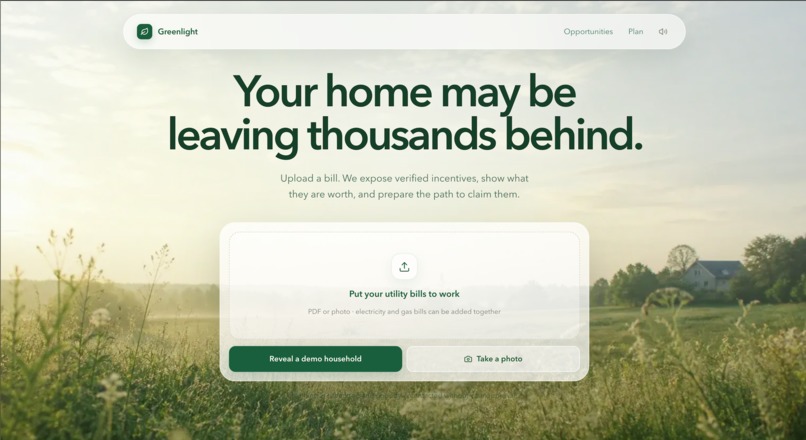
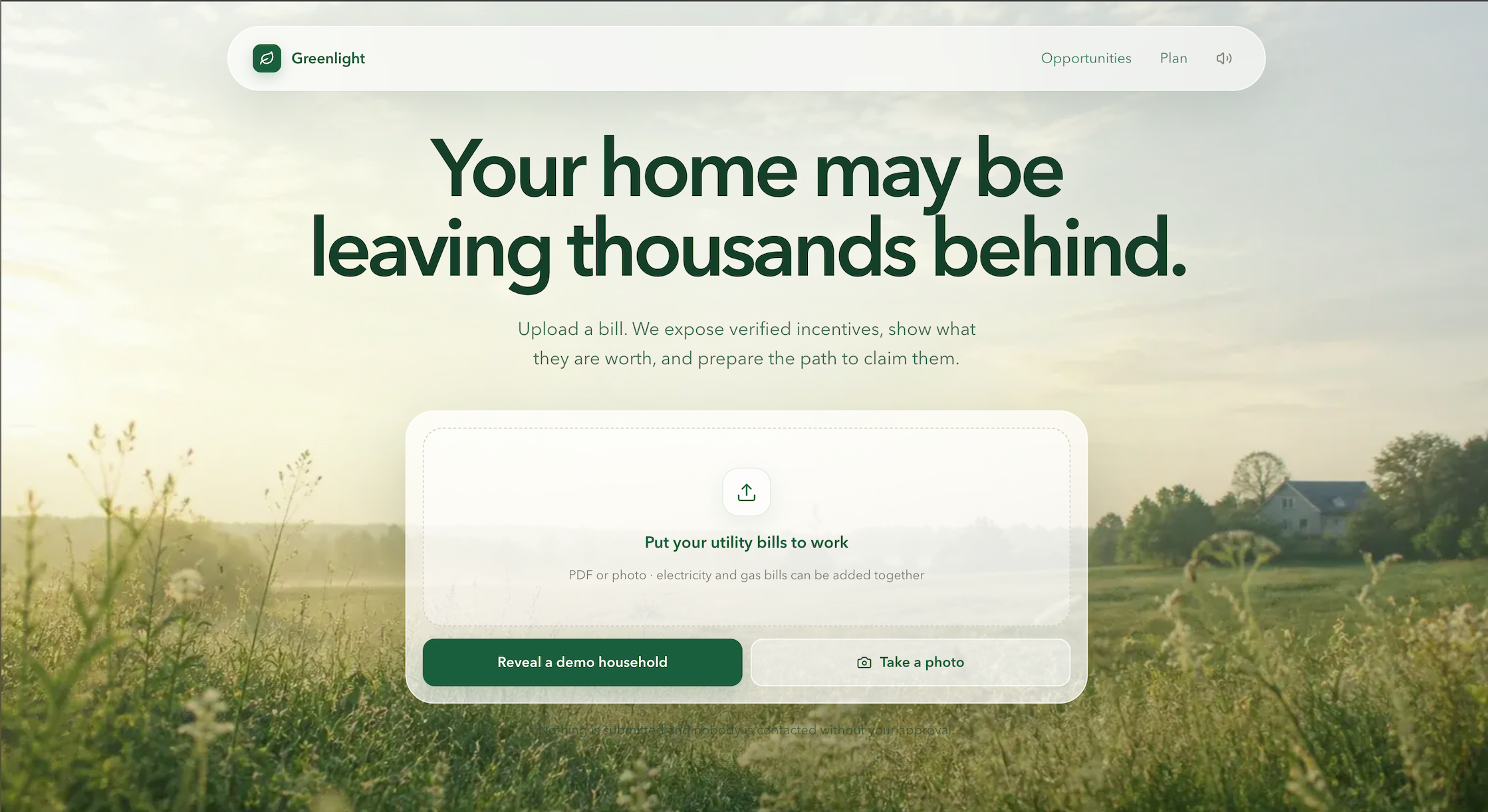
Greenlight transforms an ordinary utility bill into a personalized path toward lower costs and a more sustainable home. A user uploads a bill, and Greenlight extracts the relevant household and energy information, investigates available programs, verifies eligibility against official evidence, calculates the potential financial value, and identifies the correct route for taking action. Instead of returning a generic list of links, Greenlight explains why each opportunity matches, exposes unresolved requirements, asks only the questions that materially change the outcome, and prepares the information needed for the next step. The user always remains in control: Greenlight never submits an application or contacts an organization without explicit approval. Its core operating principle is simple: AI interprets. Evidence decides. Code calculates. Humans approve.
How we built it
We built Greenlight as a full-stack TypeScript application using Next.js, React, and the App Router. The interface uses responsive components, cinematic motion, interactive evidence views, sound cues, and presentation controls to transform a traditionally bureaucratic process into an understandable journey.
The intelligence pipeline follows four stages:
Extract: Utility documents are securely uploaded and analyzed using private Amazon S3 storage and Amazon Textract.
Verify: Extracted facts are normalized and compared with reviewed official program sources. Calculate: Deterministic TypeScript engines evaluate eligibility and financial value so an AI model can never invent qualification results or dollar amounts.
Act: Greenlight resolves the verified administrator and application route, then prepares an approval-ready action packet.
Official-source snapshots and structured program information are designed for PostgreSQL retrieval, while language models assist with document interpretation and clear explanations. Financial value is calculated transparently:
Potential First-Year Value = Verified Incentives + Estimated Annual Savings - Required Upfront Cost
We also created an interactive what-if engine that allows users to test different budgets, priorities, or household circumstances without altering their verified information.
Challenges we ran into
Challenges we ran into
Our greatest challenge was building an AI experience people could actually trust. A confident but incorrect rebate, eligibility decision, dollar amount, or application link could waste someone’s time or cause real financial harm. We therefore created strict boundaries between interpretation and decision-making: AI can explain evidence, but deterministic code owns eligibility and financial calculations.
Utility bills also vary dramatically between providers and formats. Important facts can be incomplete, ambiguous, or absent entirely. Instead of guessing, Greenlight preserves uncertainty, shows where every fact came from, and pauses when a human answer is genuinely required.
Another major challenge was turning a complex multi-stage system into an experience that feels immediate and intuitive. We had to make document extraction, program filtering, evidence verification, administrator discovery, and application preparation visible without overwhelming the user.
Coordinating parallel frontend, OCR, data, infrastructure, and backend work on a shared codebase also required careful ownership boundaries and continuous integration.
Accomplishments that we're proud of
We are proud that Greenlight goes beyond identifying possibilities—it helps convert them into action. The prototype can take a household from a utility bill to evidence-backed opportunities, explain why those opportunities matter, identify what could block them, resolve the correct administrator, and prepare an application packet for review. We are especially proud of Greenlight’s trust architecture. Unknown information remains unknown, every meaningful conclusion has an evidence trail, financing is not misleadingly presented as savings, and no external action occurs without approval. We also built a deterministic scenario engine that can visibly recalculate and reorder recommendations based on what matters most to the user. This makes Greenlight more than a static results page: it becomes a personal sustainability negotiator.
What we learned
We learned that the hardest part of climate technology is often not inventing another solution—it is connecting people to the solutions that already exist. Information alone is not enough. People need verified answers, financial clarity, understandable trade-offs, and a direct path through the final bureaucratic mile.
We also learned that trustworthy AI systems become more powerful when they acknowledge their limits. Separating AI interpretation from deterministic decisions did not weaken Greenlight; it made the product more credible, explainable, and useful. Most importantly, we learned that sustainability can be presented as an opportunity rather than a sacrifice. When environmental progress is connected to affordability, confidence, and immediate action, the greener choice can become the obvious choice.
What's next for Greenlight
Greenlight begins with Ontario utility bills, but the larger vision is a universal intelligence layer connecting people, homes, businesses, and communities with every sustainability opportunity available to them.
Next, we plan to expand across provinces and countries, incorporate additional household documents and real-time energy data, support more types of grants and infrastructure programs, and create proactive monitoring that alerts users whenever policies or eligibility conditions change.
We also envision Greenlight coordinating trusted contractors, financing, timelines, and verified application workflows from one place.
Greenlight could become the interface through which anyone can understand their environmental impact, discover the resources available to improve it, and move from intention to measurable progress at planetary scale.
Built With
- amazon
- apis
- claude
- codex
- css
- framer
- gemini
- html
- next.js
- node.js
- ocr
- openrouter
- postgresql
- railway
- react-native
- retrieval-augmented
- s3
- sdk
- tailwind
- textract
- typescript
- vercel

Log in or sign up for Devpost to join the conversation.