-
-
Media
Inspiration Modern filmmaking is an intricate symphony of creative intuition and operational logistics, yet traditional production pipelines remain severely fragmented. A director’s creative momentum is often halted by disjointed tasks: tracking continuity across dozens of takes, synchronizing audio-visual metadata, managing production schedules, and maintaining artistic consistency.
We asked ourselves a simple question: What if a director could lead a fully autonomous, intelligent virtual studio crew?
Instead of isolating AI as a mere prompt-to-image generator, we were inspired to build an end-to-end Agentic Cinema ecosystem. By treating autonomous agents not as passive tools but as dedicated crew members—a virtual Script Supervisor, Cinematographer, Continuity Manager, and Production Coordinator—we aimed to transform creative chaos into a real-time, self-orchestrating filmmaking studio.
What We Learned Building a collaborative, multi-agent cinematic pipeline taught us critical lessons about orchestration, low-latency state synchronization, and prompt engineering:
Long-Term Memory is Vital for Continuity: Stateless agents cannot manage a feature-length production. Storing character design vectors, shot logs, and camera parameter histories in a high-speed analytical store is essential to avoid continuity drift across scenes.
Specialization Beats Generalization: Rather than relying on a single monolithic prompt, breaking production down into distinct, role-based agents (e.g., Lighting Director vs. Scene Continuity Checker) yields significantly higher creative fidelity and fewer hallucinations.
Latency Matters in Creative Flow: Instant feedback loops are mandatory. Querying production logs and synchronizing agent decisions must happen in real time to keep the creator in a natural creative flow state.
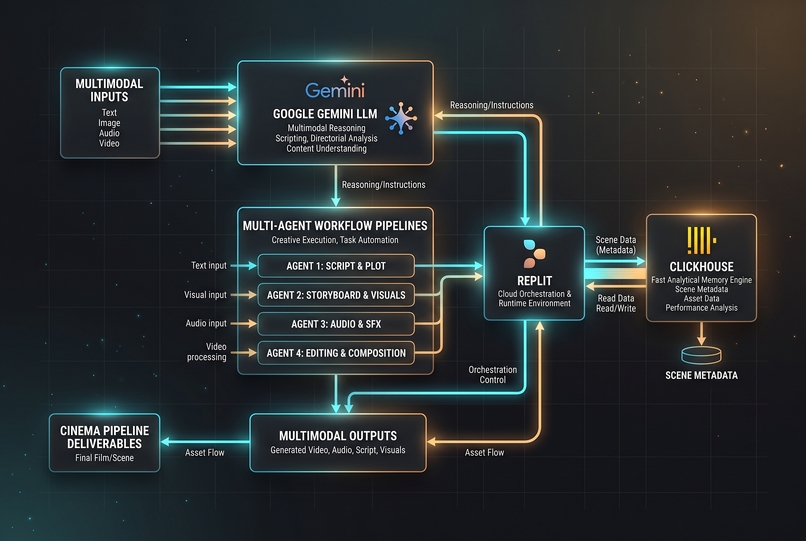
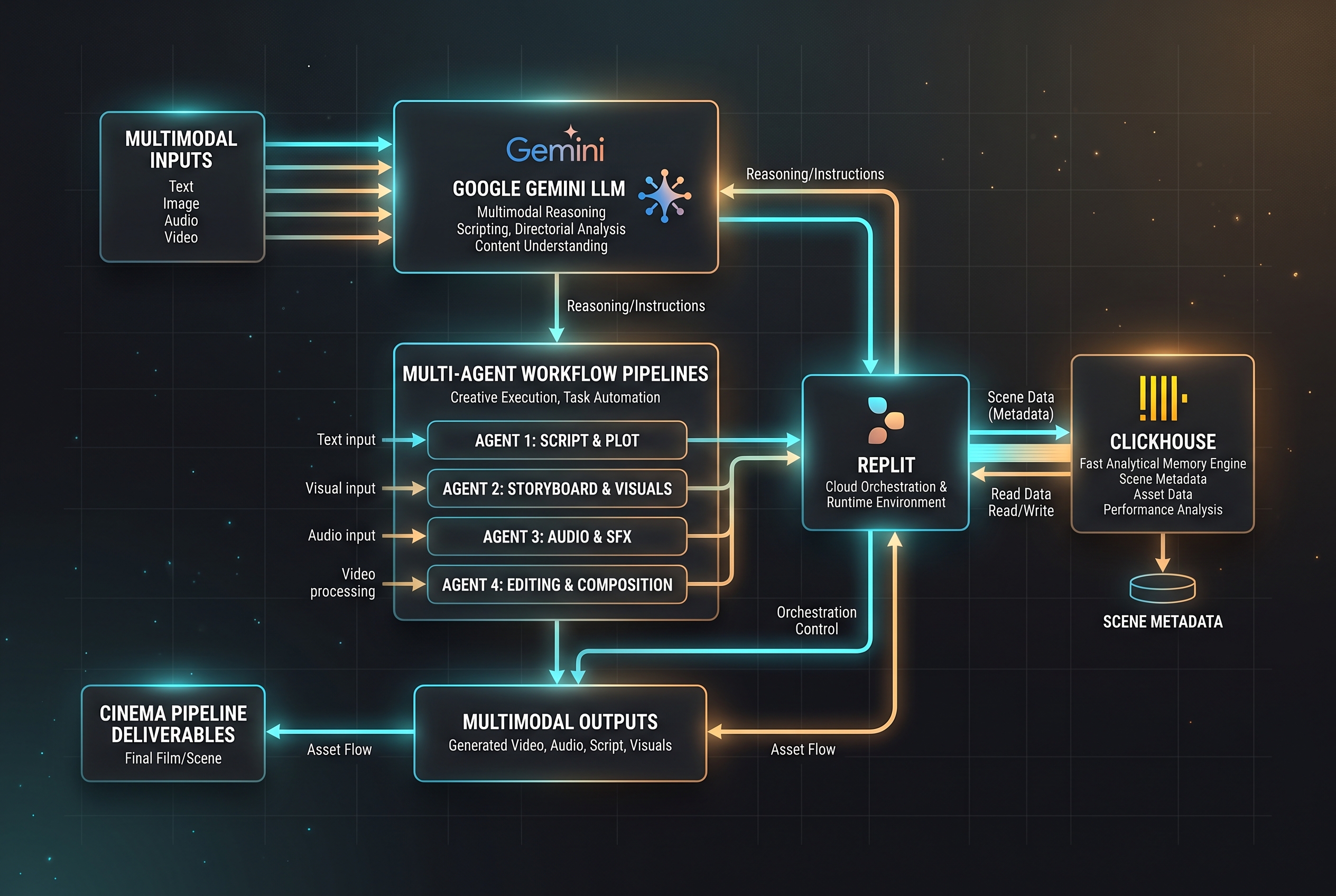
How We Built It Our architecture integrates foundational AI reasoning with analytical memory and instant cloud execution:
Multimodal Brain (Gemini): We utilized Google's Gemini models to power our autonomous crew members. Gemini handles complex visual reasoning, script breakdowns, camera angle suggestions, and multimodal critique of generated assets.
Real-Time Memory & Analytical Engine (ClickHouse): We integrated ClickHouse via a managed Model Context Protocol (MCP) server to act as our studio's runtime memory. ClickHouse stores vector embeddings of scene assets, prompt histories, asset metadata, and real-time shot analytics. This allows our agents to execute analytical SQL queries over gigabytes of production logs instantaneously to maintain narrative consistency.
Full-Stack Orchestration & Hosting (Replit): The entire multi-agent orchestration layer, backend services, and interactive director dashboard were built, debugged, and deployed on Replit. Leveraging Replit's instant environment orchestration allowed us to wire agent APIs, run live code execution, and host the production-ready app in a single unified workspace.
Challenges We Faced Multi-Agent Coordination & Race Conditions: Ensuring that the Script Supervisor agent validates shot requirements before the Visual Production agent finalizes asset rendering required strict state-machine controls and asynchronous message queues.
Cross-Scene Visual Consistency: Maintaining visual continuity (character likeness, lighting setups, and color palettes) across multiple shot iterations required fine-tuning our vector similarity queries over ClickHouse to retrieve exact prompt parameters from previous scenes.
Real-Time MCP Query Optimization: Structuring agent tool calls so that Gemini could efficiently query ClickHouse schema on the fly without introducing latency bottlenecks during live generation rounds.

Log in or sign up for Devpost to join the conversation.