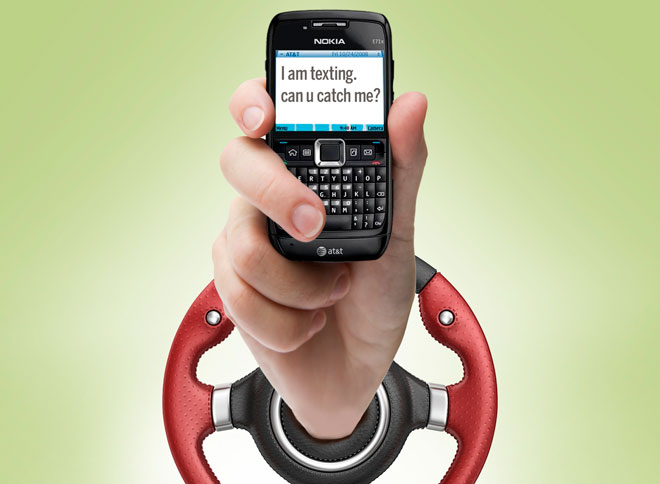
With the aim of improving driver safety, the federal government, state governments, counties and various corporations have issued cell phone usage bans. These bans differ in the range of which behaviors are limited (Hand held calls, all calls, only text messages, web access, emails, etc.). One means to ensure the effectiveness of these bans is to develop a technological solution which prevents drivers from performing functions limited by the applicable ban. Several current and developing technologies have offered solutions which can be used to block or filter cell phone calls/messages; however, none of these solutions have achieved mainstream acceptance due to various reasons. Therefore, to reduce cell phone based distracted driving a new technology is needed that has the following attributes: It automatically blocks calls and/or text messages from being sent/received while a driver is in motion. It automatically allows calls/text messages in situations where a driver is not driving (on a train, bus, bike, ferry, while running, while a passenger in a private vehicle). It allows passengers to use their mobile device while a vehicle is in motion. It can be used to maintain compliance for federal workers with President Obama's Executive Order 13513 (Federal Leadership on Reducing Text Messaging While Driving). It complies with FCC regulations, statutes and rules (e.g., allows 911 calls). It is customizable such that the technology solution could maintain compliance with various federal, state and corporate bans. It does not reduce battery life below levels of customer acceptance. It can be implemented on a feature phone which does not require a data plan (75-80% of the phones in use today do not require a data plan). It can be implemented with no or little infrastructure changes to public transportation Tomahawk Systems has patents pending on a technology which solves these issues. The core component of the Tomahawk technology disables texting while driving by passing information such as vehicle speed directly from a vehicle to a mobile device over various wireless protocols. Once the vehicle is in motion, phone functionality, such as texting, IM, and internet access, can be disabled via an application on the phone. The application on the phone gathers a stream of data over the wireless protocol from the vehicle, and then disables phone functionality based on user-controlled admin settings on the phone. Since the trigger for phone disablement is the vehicle itself, and not a GPS application on the phone, the result is a solution which is more reliable, utilizes an industry standard protocol, is more efficient on the driver’s phone battery, and more usable than current technologies on the market today. Our development efforts in this area have focused on using the Bluetooth protocol to accomplish the connection between the phone and the vehicle. Bluetooth is being integrated in optional infotainment packages in some new vehicles, and most phones have a Bluetooth option as well. The major shortcoming of the Bluetooth version is that Bluetooth has not been retrofitted to vehicles currently on the road today. We have worked around this in early versions of the technology by requiring proprietary hardware equipped with Bluetooth be plugged into the OBD port on the vehicle to pass vehicle speed to the phone. If the Dedicated Short Range Communications technology (DSRC) will ultimately: Be retrofitted into current vehicles Be made accessible via mobile devices, and Allows API’s to be exposed which allow access to vehicle data such as speed, It could replace Bluetooth to become the primary method of data transmission used by Tomahawk-licensed applications to limit mobile phone functionality (IM, texting, web access, voice) while a vehicle is in motion. A by-product of pushing vehicle data to a phone application would be that vehicle data could be stored in a session database on the phone, and then pushed over the phone’s network to a central repository. Uses for this type of information could be everything from vehicle maintenance information (last oil change, vehicle error codes, etc.) to emergency data (airbags deployed, etc.). Potential Customers: We feel that there is a market for a driving while texting (DWT) prevention application in the parents of young drivers, and fleet managers. We expect that a discount might be offered by insurance providers for the data from the DWT application (proof that a driver does not have the ability to text). And, if other vehicle data can be made accessible via DSRC, then we feel that there may be a market for vehicle service organizations, fleet service companies, and emergency responders. Limitations: Since a retrofit would be a costly undertaking, before we’d be willing to retrofit the DSRC into our technology, we’d need assurances that there was a roadmap which solves for the three limitation bullet points above.
No Driving While Texting (DWT) by Tomahawk Systems, LLC.
Updates

Leave feedback in the comments!
Log in or sign up for Devpost to join the conversation.