

Inspiration
A biologically-inspired stateful memory system for LLM agents. NMAFC gives conversational AI the ability to remember, forget, and prioritize information the way biological memory does — using exponential decay, spaced repetition, override suppression, and active pruning.
Unlike context-window stuffing or naive vector stores that grow without bound, NMAFC maintains a bounded, high-signal memory that improves with use. Frequently accessed facts become permanent. Contradicted facts are immediately suppressed. Stale information naturally decays away.
Why NMAFC
| Problem | Current Approaches | NMAFC Solution |
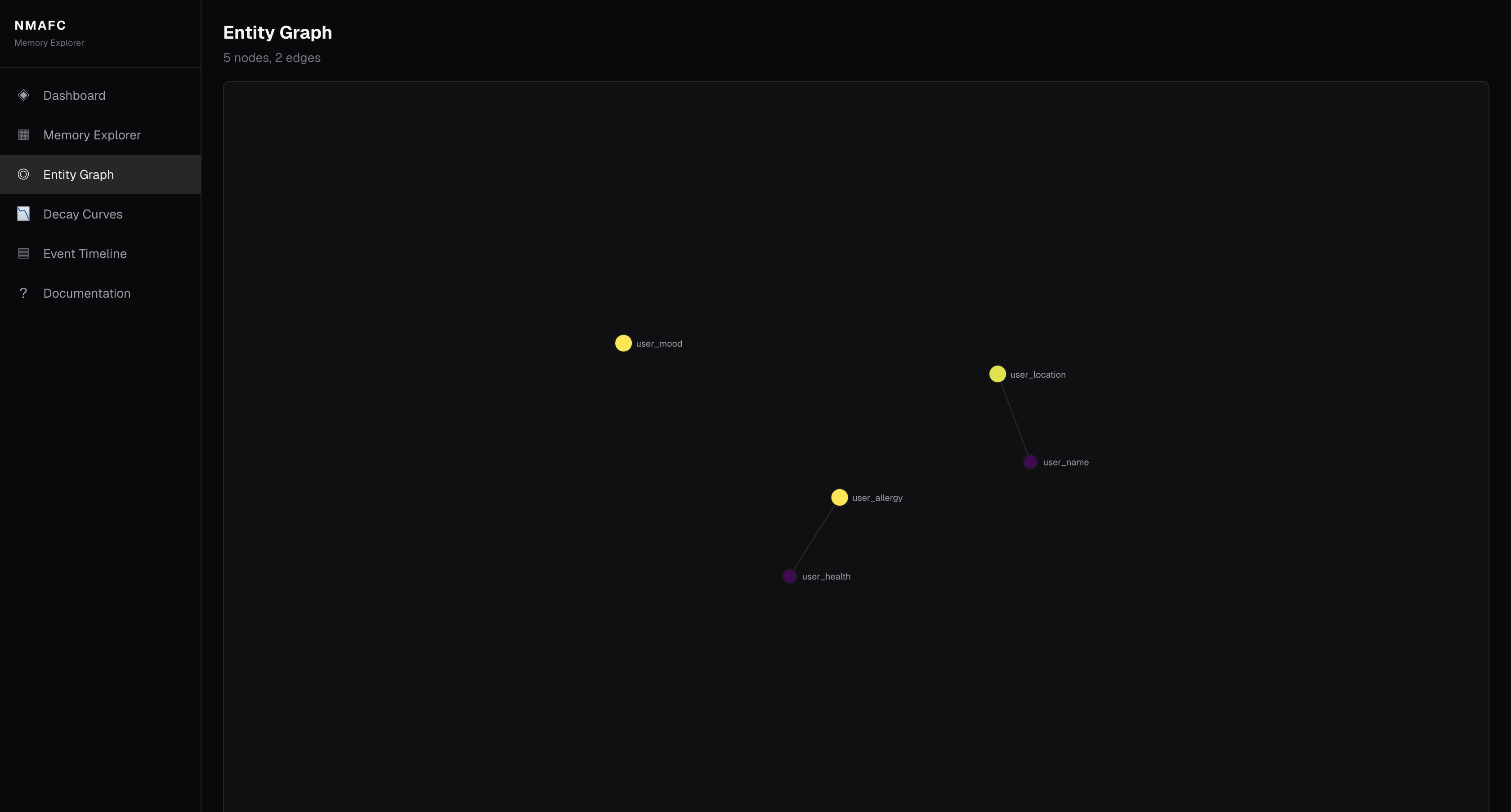
|---|---|---|
| Context windows overflow | Truncate oldest messages | Hot RAM with bounded record count via cognitive decay |
| Contradictions persist | Old facts coexist with new ones | Override detection + gamma suppression (instant eviction) |
| Everything treated equally | Flat vector stores | Three-tier typing: CoreAnchor (permanent), ActiveContext (moderate decay), EphemeralState (aggressive decay) |
| No concept of importance | Retrieval count ignored | Spaced repetition — each retrieval strengthens retention (LTP) |
| Retrieval misses related facts | Single-hop vector search | Spreading Activation graph traversal (multi-hop entity linking) |
| No recoverability | Mutable state only | Dual-track: Hot RAM (fast, mutable) + Cold ROM (append-only event log, full rollback) |
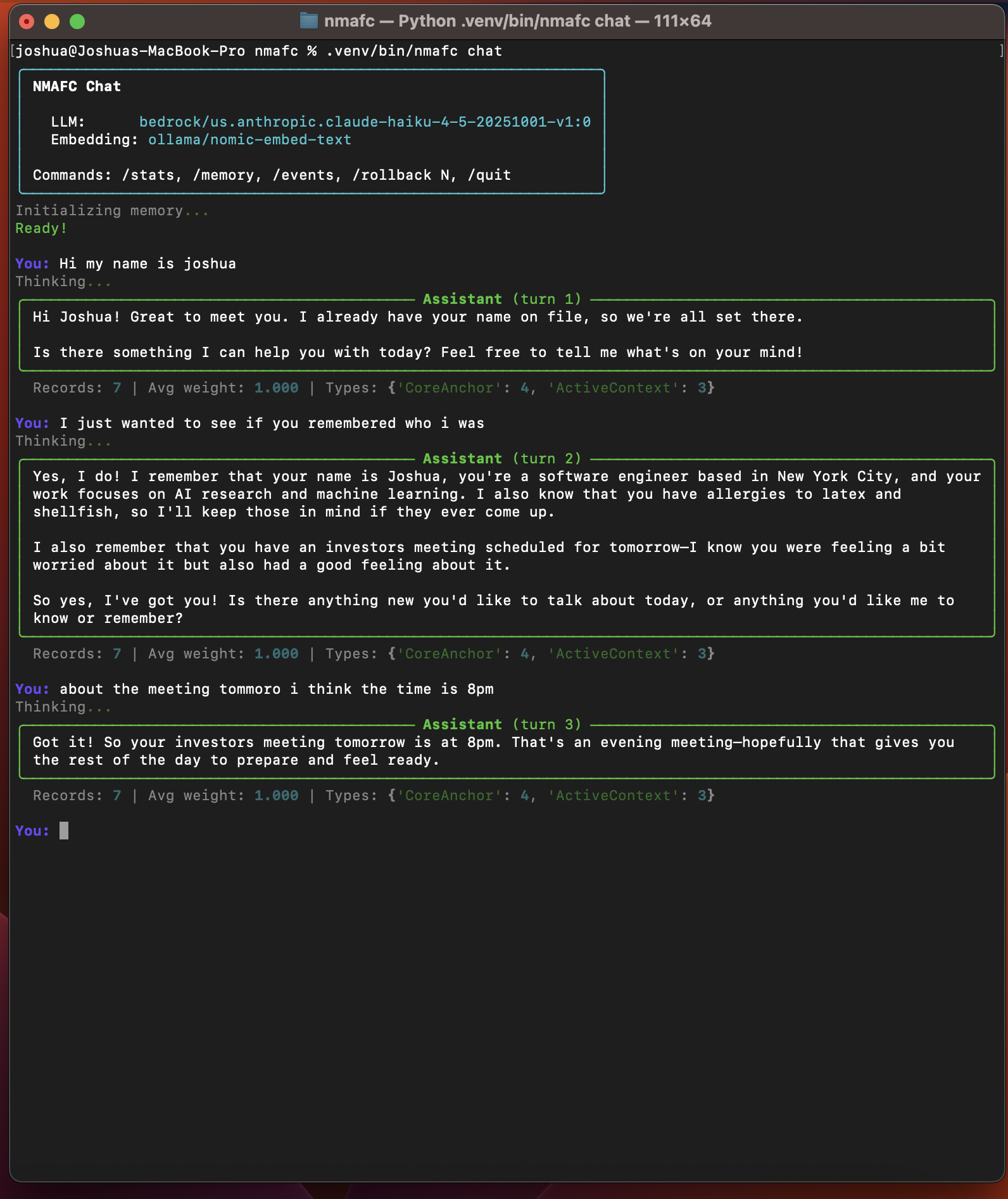
| Expensive per-turn overhead | Separate extraction + response calls | Single LLM call with tool-use for simultaneous response + extraction |
What it does
1. Three-Tier Memory Classification
Every extracted fact is classified by the LLM into one of three tiers, each with distinct decay behavior:
| Tier | Decay Rate (lambda) | Half-life | Examples |
|---|---|---|---|
| CoreAnchor | 0.0 (never decays) | Infinite | Name, allergies, identity, relationships |
| ActiveContext | 0.05 per turn | ~14 turns | Current goals, schedules, projects |
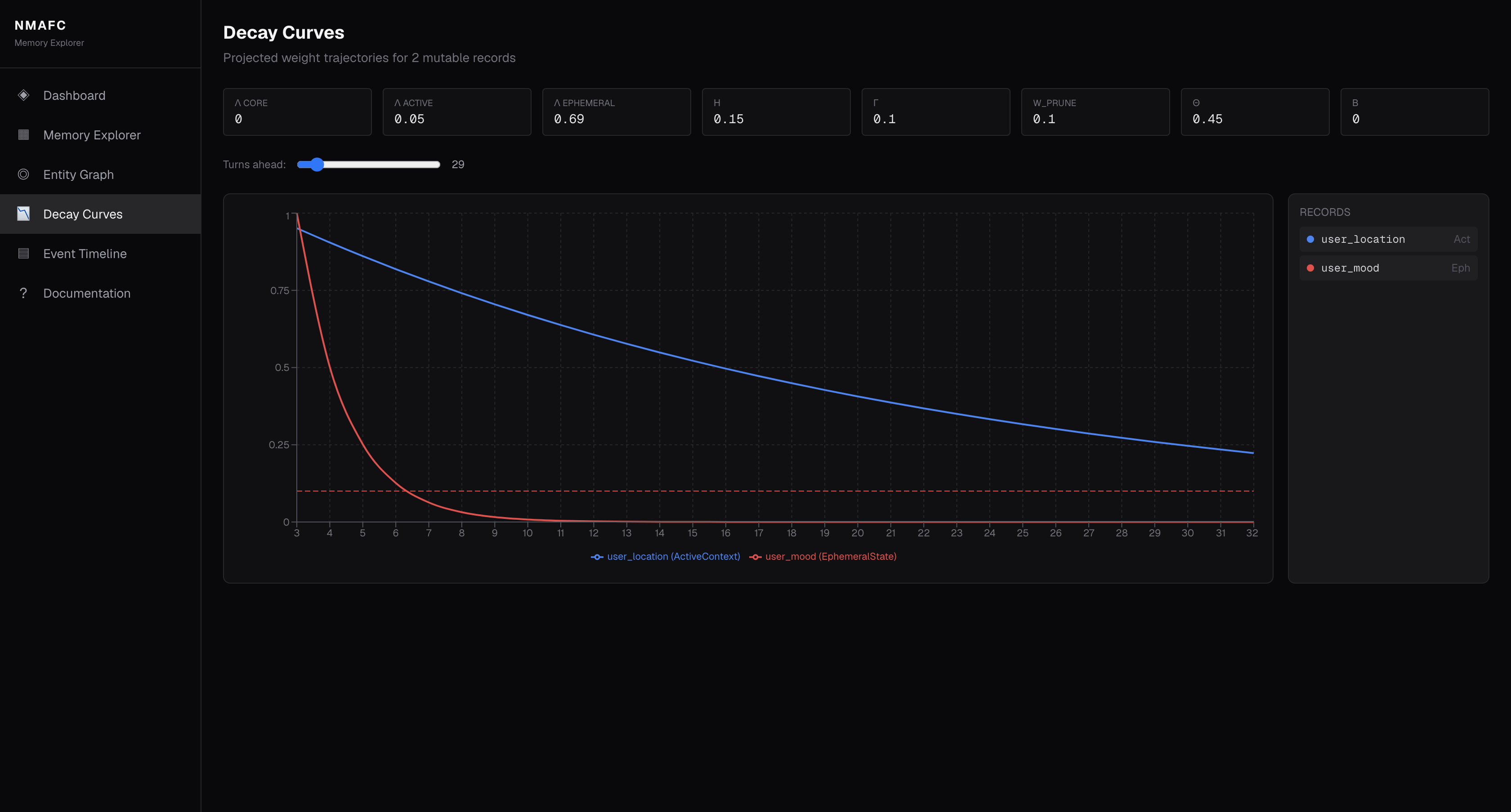
| EphemeralState | 0.69 per turn | ~1 turn | Mood, passing comments, transient state |
2. Cognitive Decay (Ebbinghaus Forgetting Curve)
Each memory's synaptic weight decays exponentially over time:
w(t) = w(t_0) * e^(-lambda * delta_t)
Where delta_t = current_turn - last_reinforced_turn and lambda is the tier-specific decay rate modified by the consolidation coefficient.
3. Spaced Repetition (Long-Term Potentiation)
When a memory is retrieved during a query, it receives LTP reinforcement:
- Weight resets to 1.0 (full strength)
- Consolidation index
kincrements - Future decay rate slows:
effective_lambda = lambda_base * e^(-eta * k)whereeta = 0.15
A fact retrieved 10 times retains 80% weight after 20 turns vs. 37% for a never-retrieved fact. This naturally surfaces important information.
4. Override Detection & Suppression
When the LLM detects a contradicting fact (e.g., "I moved to Berlin" contradicts "I live in Paris"):
- New fact specifies
overrides_entitypointing to the old record - Old record's weight is multiplied by
gamma = 0.1(instant suppression) - Next prune cycle evicts the old record (weight 0.1 <= prune threshold 0.1)
Zero hallucination for contradictions — suppressed facts cannot be retrieved.
5. Spreading Activation (Graph Traversal)
Retrieval goes beyond single-hop vector search:
- Hop 0: Vector similarity search returns
top_k=10results - Hop 1: Each result's
related_entitiesare fetched from Hot RAM - Hop 2: Their
related_entitiesare fetched (BFS continues tomax_hops=2)
6. REM Sleep Consolidation
Every 5 turns (configurable), a consolidation pass runs:
- Elevation: ActiveContext records with
consolidation_index >= 10are promoted to CoreAnchor (permanent protection). Frequently-accessed facts earn immortality. - Dead pointer cleanup: Removes
related_entitiesreferences to entities that no longer exist in Hot RAM.
7. Dual-Track Storage
| Layer | Technology | Remote Option | Purpose | Mutability |
|---|---|---|---|---|
| Hot RAM | LanceDB (embedded vector DB) | AWS S3 storage | Fast retrieval, vector search, weight updates | Mutable (decay, reinforce, delete) |
| Cold ROM | SQLite (WAL mode, FTS5) | Cockroach db PostgreSQL (tsvector + GIN) | Complete event log, keyword fallback, rollback source | Append-only |
How we built it
                    ┌─────────────────────────────────────────────┐
                    │           NeuromorphicMemory                 │
                    │              (wrapper.py)                    │
                    └────────┬──────────┬──────────┬──────────────┘
                             │          │          │
                    ┌────────▼──┐  ┌────▼────┐  ┌─▼──────────────┐
                    │  Extract  │  │  Query  │  │    Engine       │
                    │  (LLM +   │  │  Router │  │  ┌───────────┐  │
                    │   Tool)   │  │         │  │  │   Decay   │  │
                    └───────────┘  │ Vector  │  │  │  Reinforce│  │
                                   │ Search  │  │  │   Prune   │  │
                                   │ + Graph │  │  │  Consol.  │  │
                                   │ + Cold  │  │  │  Rollback │  │
                                   │ Fallback│  │  └───────────┘  │
                                   └────┬────┘  └────────────────┘
                                        │
                         ┌──────────────┼──────────────┐
                         │              │              │
                    ┌────▼────┐    ┌────▼────┐    ┌───▼───┐
                    │ Hot RAM │    │Cold ROM │    │Embedder│
                    │(LanceDB)│    │(SQLite) │    │        │
                    └─────────┘    └─────────┘    └────────┘
Challenges we ran into
Designing the dual-track storage system (mutable Hot RAM + append-only Cold ROM) was the biggest architectural challenge. Getting the math right for the Ebbinghaus decay curves making sure the three tiers (CoreAnchor, ActiveContext, EphemeralState) decay at biologically-plausible rates while remaining tunable required extensive iterative testing. We also had to solve the override detection problem: when a user contradicts a previously stored fact, suppressing the old record immediately without false positives. Another major hurdle was building the Spreading Activation multi-hop retrieval system that traverses the entity graph up to 2 hops while staying performant at scale. Finally, running academic benchmarks (LoCoMo with 1986 QA pairs across 4 arms) taught us that naive neuromorphic memory without tuning actually underperforms RAG the tuned variant with adjusted lambda rates is what unlocked the breakthrough.
Accomplishments that we're proud of
- Built a complete cognitive memory architecture grounded in neuroscience (Ebbinghaus forgetting curve, Long-Term Potentiation, synaptic pruning, REM consolidation) not just a vector store with a wrapper
- Achieved within 2 points of full-context accuracy at 9x fewer context tokens (0.525 vs 0.545 judge accuracy) in our pilot benchmark
- Designed a biologically-inspired 3-tier memory classification (CoreAnchor / ActiveContext / EphemeralState) with configurable decay rates that actually works
- Shipped production-ready multi-tenancy with full isolation by agent + conversation
- Built support for 10+ LLM providers (OpenAI, Anthropic, Bedrock, Azure, Groq, OpenRouter, Together, Ollama, LM Studio, vLLM) with a clean provider abstraction
- Created a complete academic benchmark suite with LoCoMo + LongMemEval datasets, F1 + LLM-as-judge metrics, and ablation studies
- Full rollback capability rebuild memory state from Cold ROM to any previous turn
What we learned
- Memory management is not the same as RAG. Naive vector retrieval grows unbounded and degrades signal; bounded memory with decay and pruning maintains quality over time
- The forgetting curve is surprisingly effective as a first-class memory primitive. Ephemeral facts naturally die, while important facts compound through reinforcement no manual TTL or expiry logic needed
- The tuned variant (λ=0.005 for ActiveContext) outperforming both the default and raw RAG confirms that memory decay rates are critical hyperparameters, not afterthoughts
- A single LLM call with tool-use for simultaneous response generation + memory extraction cuts latency and cost in half vs. two separate calls
- Dual-track append-only Cold ROM is essential for trust and debuggability you can always reconstruct and audit what the system remembered
What's next for NMAFC
- Procedural memory — extend beyond episodic/semantic to track learned procedures and skills across conversations
- Emotional valence — attach sentiment scores to memories so emotionally significant facts decay slower
- Cross-conversation knowledge transfer — allow agents to share relevant memories across isolated conversations (with consent scoping)
- Streaming ingestion — real-time memory updates from live conversation streams instead of batch turns
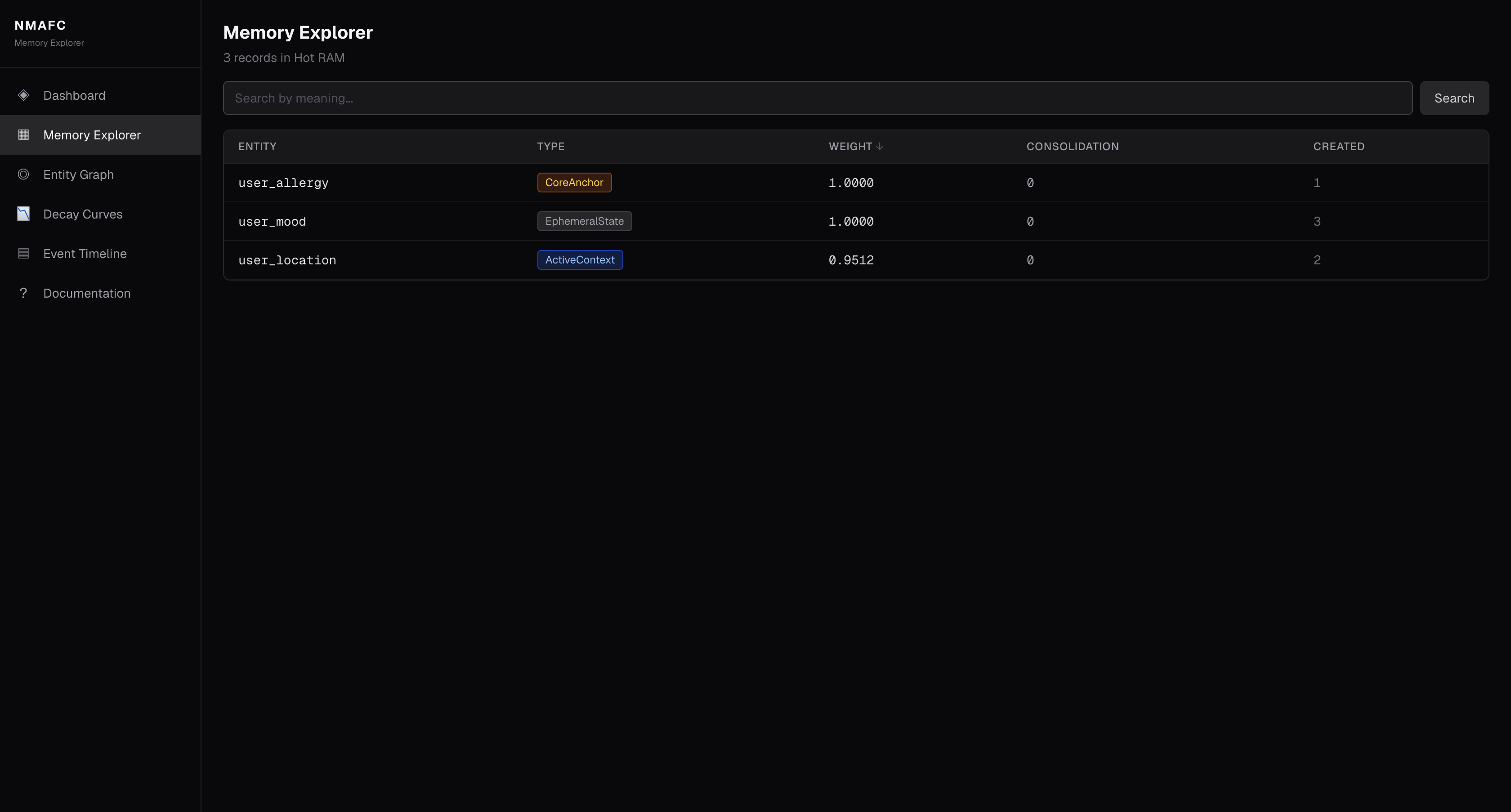
- Web UI — visual memory explorer showing the entity graph, decay curves, consolidation events, and suppression history
- Additional benchmarks — expand evaluation to include MemoryBank and∞Bench datasets
- REST API layer — wrap the library as a standalone service for teams that don't want to embed Python directly

Log in or sign up for Devpost to join the conversation.