-
-
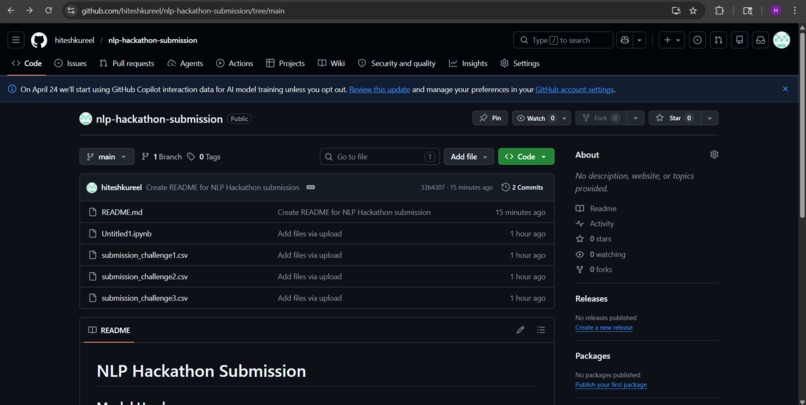
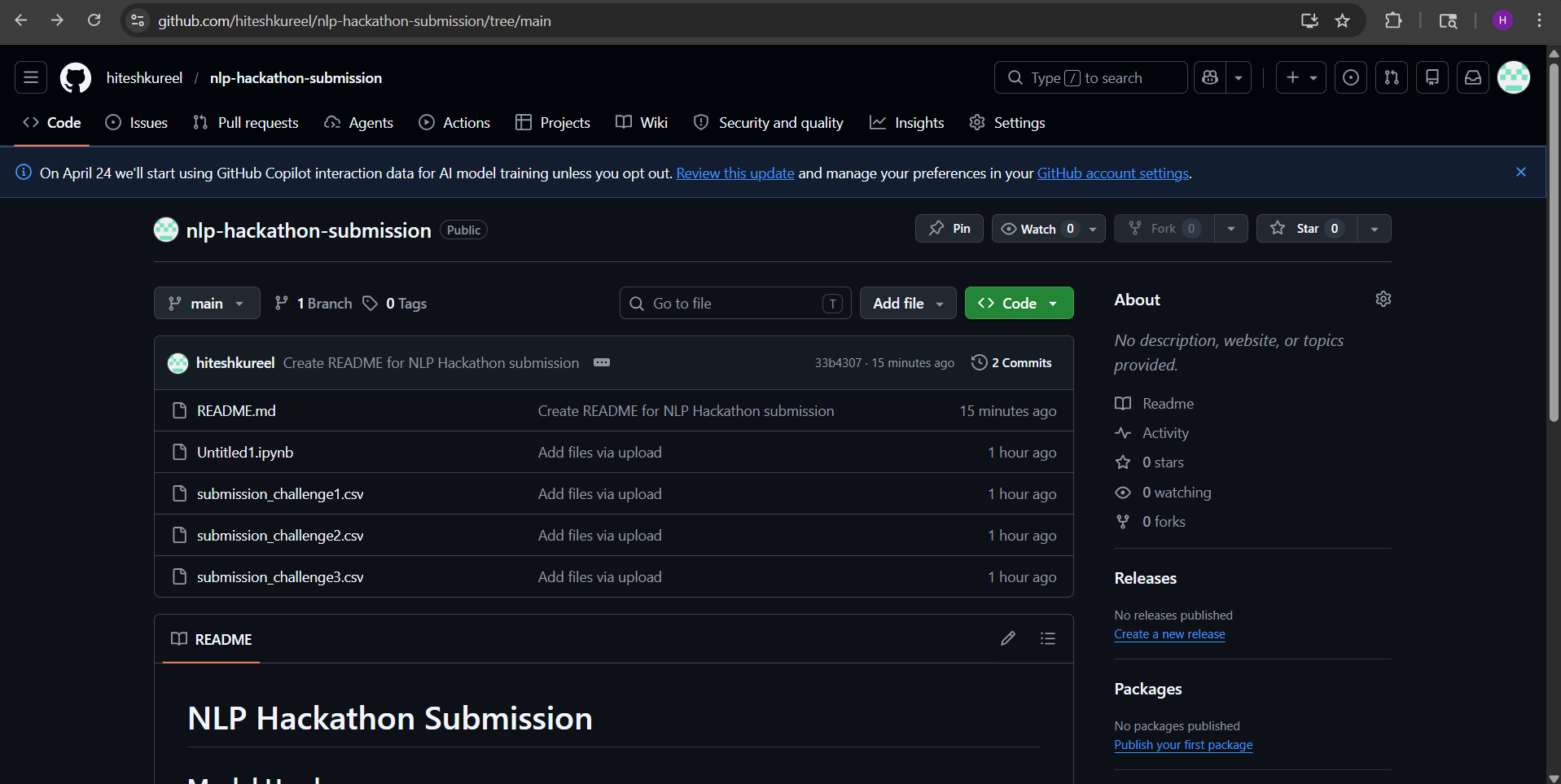
GitHub repository containing the complete NLP hackathon solution including code, README, and submission files for all three challenges.
Inspiration - The goal was to solve real-world NLP problems using a simple and effective machine learning approach. This hackathon provided an opportunity to learn how text data can be processed and classified efficiently, even with minimal prior experience.
What it does - This project performs text classification for three different challenges:
- Disaster tweet classification
- Fake news detection
- Toxic comment classification
It takes text input and predicts the correct label using a trained machine learning model.
How we built it - We used TF-IDF vectorization to convert text into numerical features and trained a Logistic Regression model for classification. The data was cleaned by handling missing values, fixing encoding issues, and ensuring correct label formatting.
The same pipeline was applied across all three challenges for consistency and reproducibility.

Log in or sign up for Devpost to join the conversation.