-
-
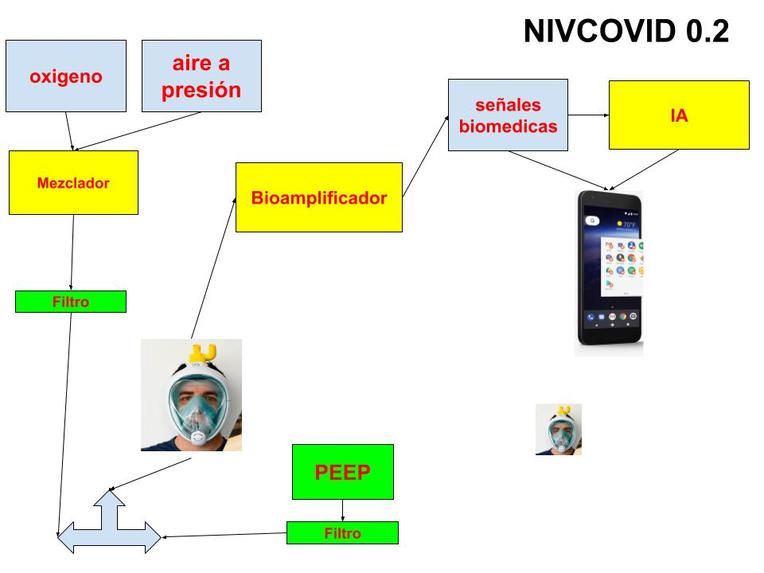
NIVCOVID block diagram
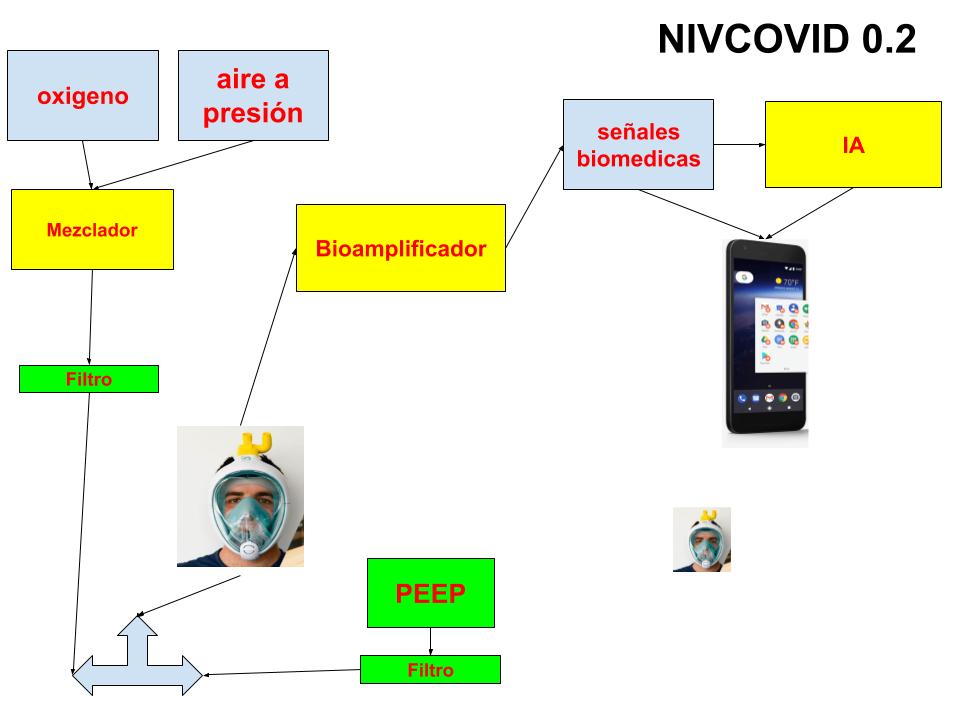
Inspiration
Hello, welcome to our presentation video for the NIVCOVID project, a safe and low-cost system for non-invasive ventilation in patients with COVID19.
As you know, treatment of some covid patient needs mechanical ventilation after intubation in ICUs, a difficult problem when many patients arrive at the same time at the hospital. And recent clinical data and italian experience suggests that these patients might improve if non-invasive ventilation is used in early phases of the disease.
During this pandemic event, the criteria for using invasive ventilation has evolutionated after clinical experience. As you see, the use of non-invasive ventilation is recommended in early and moderate stages of pulmonary involvement. Widespread use of the techniques could reduce the severity of symptoms and the necessity of invasive ventilation in UCI.
This year, the Italian company Issinova has presented a system for converting diving masks into non-invasive breathing systems. It is a non-conventional way of thinking that allows the administration of oxygen using a non standard mask, but has proven to be an effective way of working. The system combines a set of parts built with 3d-printers that are attached to the diving mask and the use of existing parts in the usual clinical environment that communicate the mask with the different ventilation devices. In the image we see an example of pieces printed by our group attached to a system in the ICU.
Therefore, we propose a solution based on monitoring brain, cardiac and respiratory activity with sensors included in a sealed and filtered respiratory mask and using artificial intelligence through a simple mobile app for optimization of treatment.
What it does
NIVCOVID aims to address three processes:
- optimization of oxygen and air pressure administration by IA algorithms using information derived of airflow sensors and cardio-respiratory biosignals;
- real-time wireless transmission and integration of multiple patients; 3. minimization of infectious risks.
How I built it
It is a small, non-invasive and easy to use system that is currently implemented in the design phase. For that, we are implementing the recording part using a platform already developed that we called Signalino, a powerful and low-cost, open-source bioamplifier able to recording EEG and EMG as a wearable device.
Associated we have an hybrid app which is built using Java. Its study panel is built to show saturation of oxygen, breathing and cardiac rate, movement of patient. An artificial inlligence system analyze the data and suggest modification of air and oxygen rates and produces statistics about the changes of physiological parameters in the last hour. In addition, the development of all the connector pieces is developed through 3D printing.
Challenges I ran into
During this hackathon we achieve an innovative product in for COVID-19 patients students in order to improve adaptation to mask. In addition, we created a multidisciplinary team, made up of a phycologist, medical doctor, software and hardware developers and 3D printed experts.
What's next for Studyboost
The next step of NIVCOVID is to develop a functional app, adapt the biosignal amplifier we have, signalino, and develop a working system. Finally, in the near future and with the current status of this project, we know that in 6 months, approximately, it will be ready to be in the market with a price between 250€ and 500€.


Log in or sign up for Devpost to join the conversation.