-
-
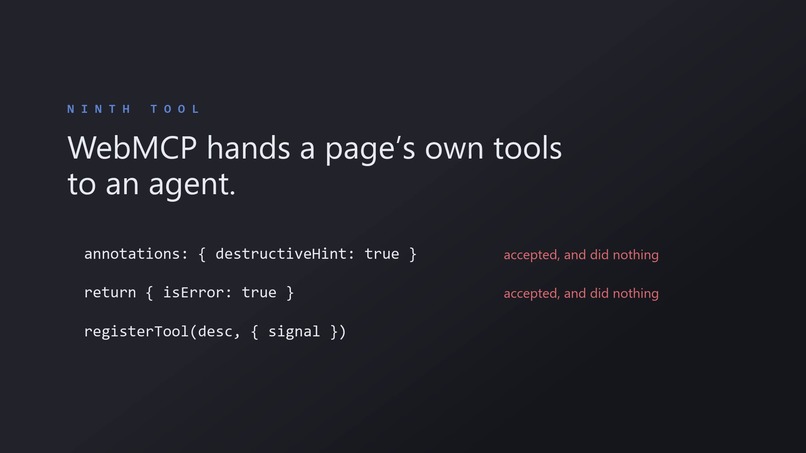
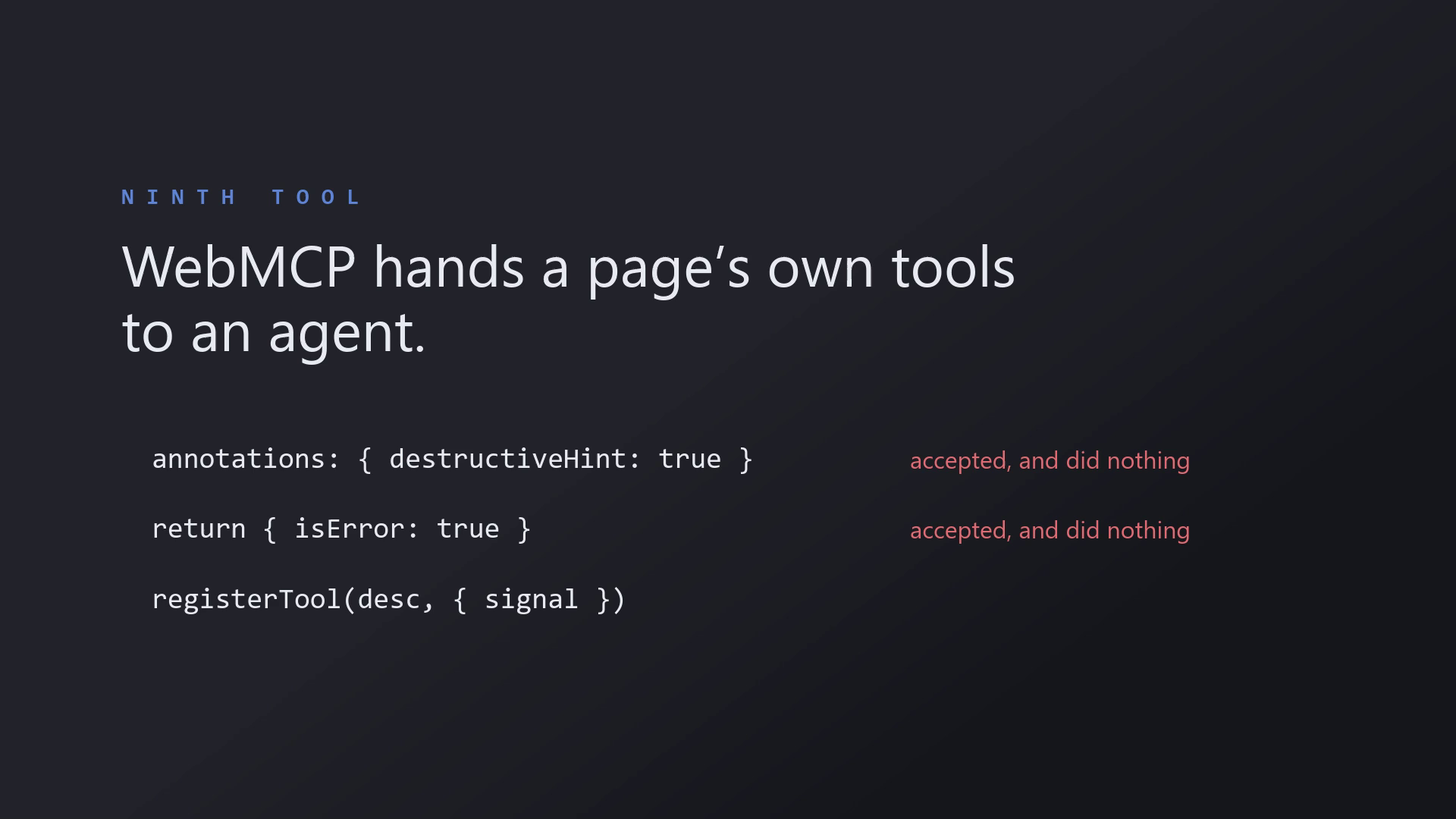
The Silent Drop Problem: Demonstrating how browser engines silently drop destructiveHint, error envelopes and signals.
-
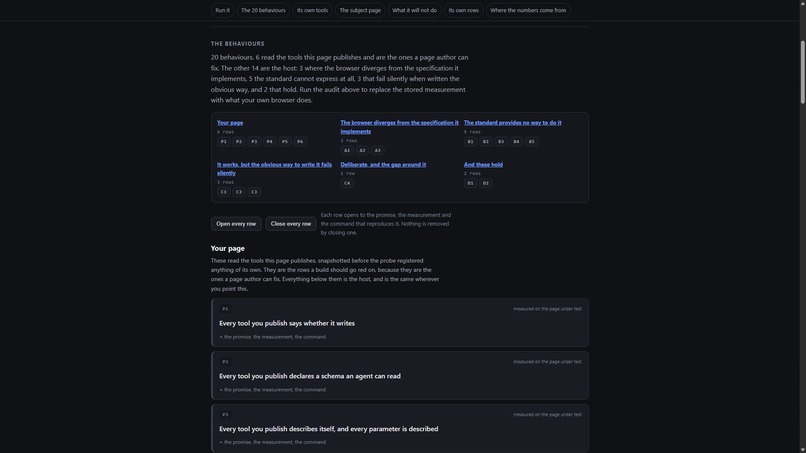
Live 20-Behaviour Catalogue: all six groups, from the six rows a page author can act on to the fourteen that are facts about the host.
-
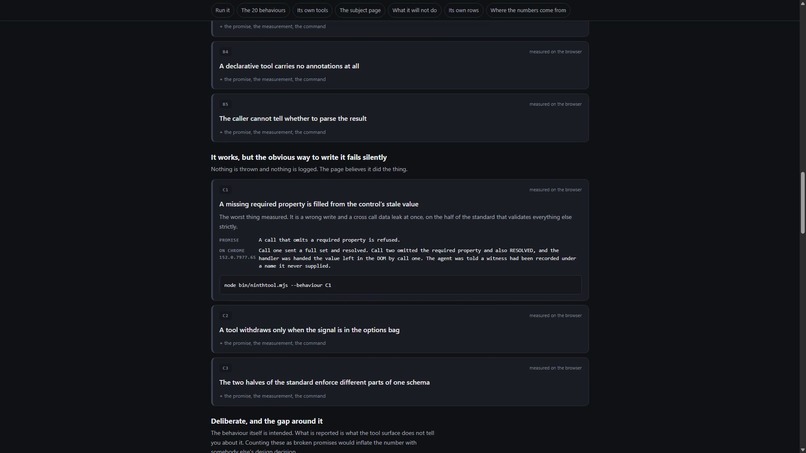
Defect Inspection & Remediation: Exact reproduction command and standard gap analysis per behaviour row.
-
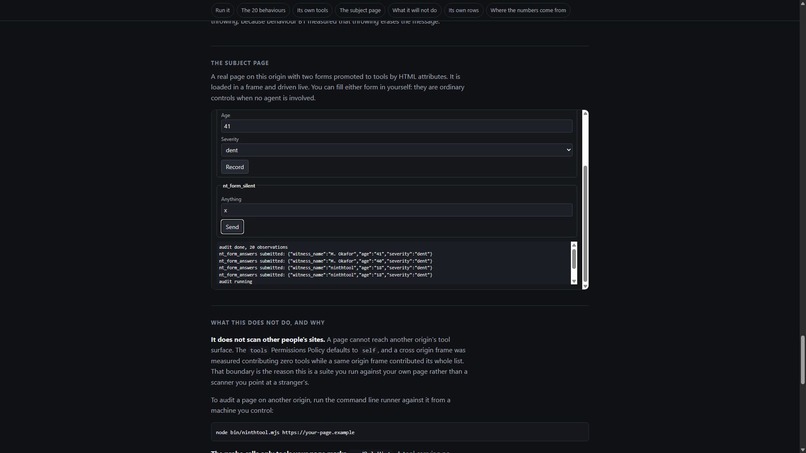
Live In-Browser Audit: Running all 20 probes in Chrome with WebMCP enabled, scoring 13 broken, 5 kept, 1 by design, 1 unsettled.
-
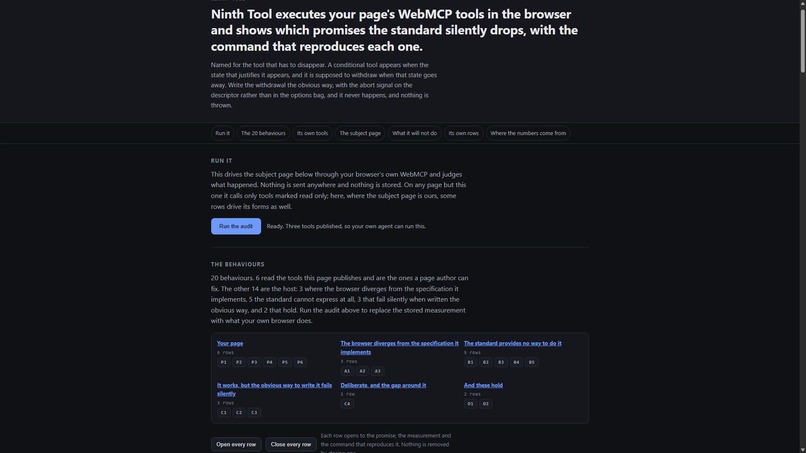
Dynamic Tool Mutation: The nt_get_findings tool appears only when findings exist and is withdrawn when cleared.
-
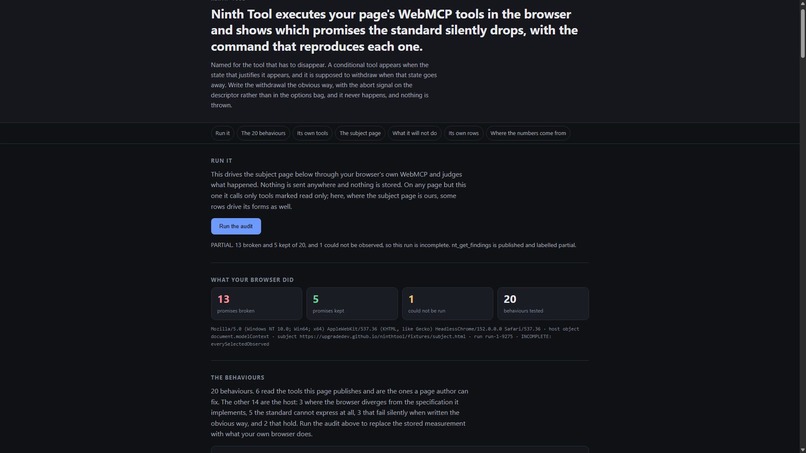
Headless DevTools CLI Runner: Running the same twenty behaviour probes from a terminal, with zero dependencies.
-
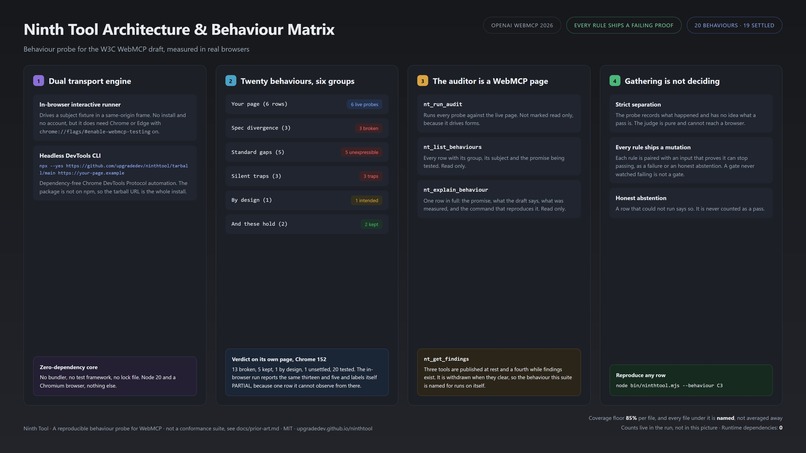
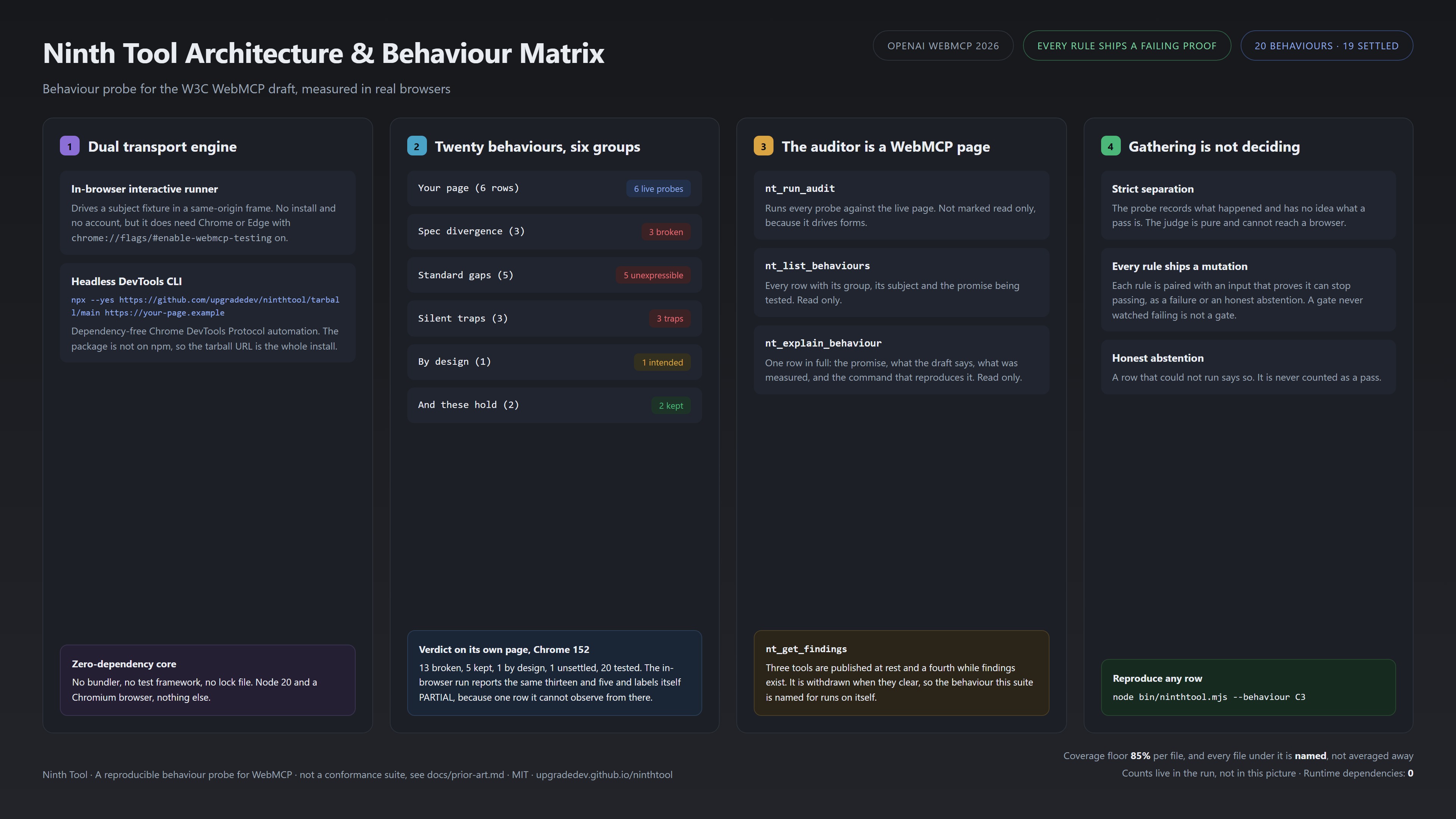
Architecture and behaviour matrix: two transports, twenty rows in six groups, and the tools the page publishes to an agent.
Ninth Tool: A Reproducible Behaviour Probe for WebMCP
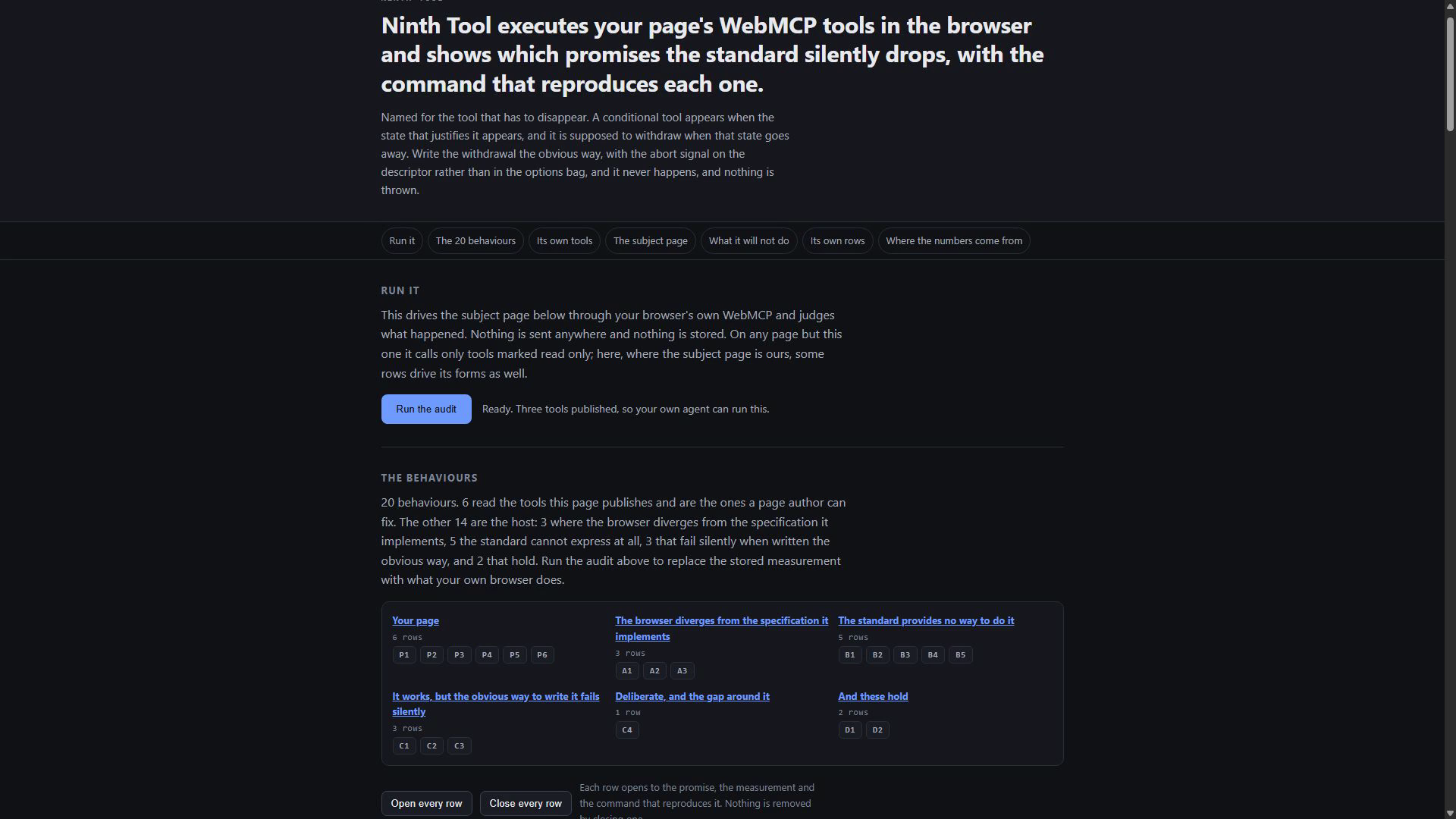
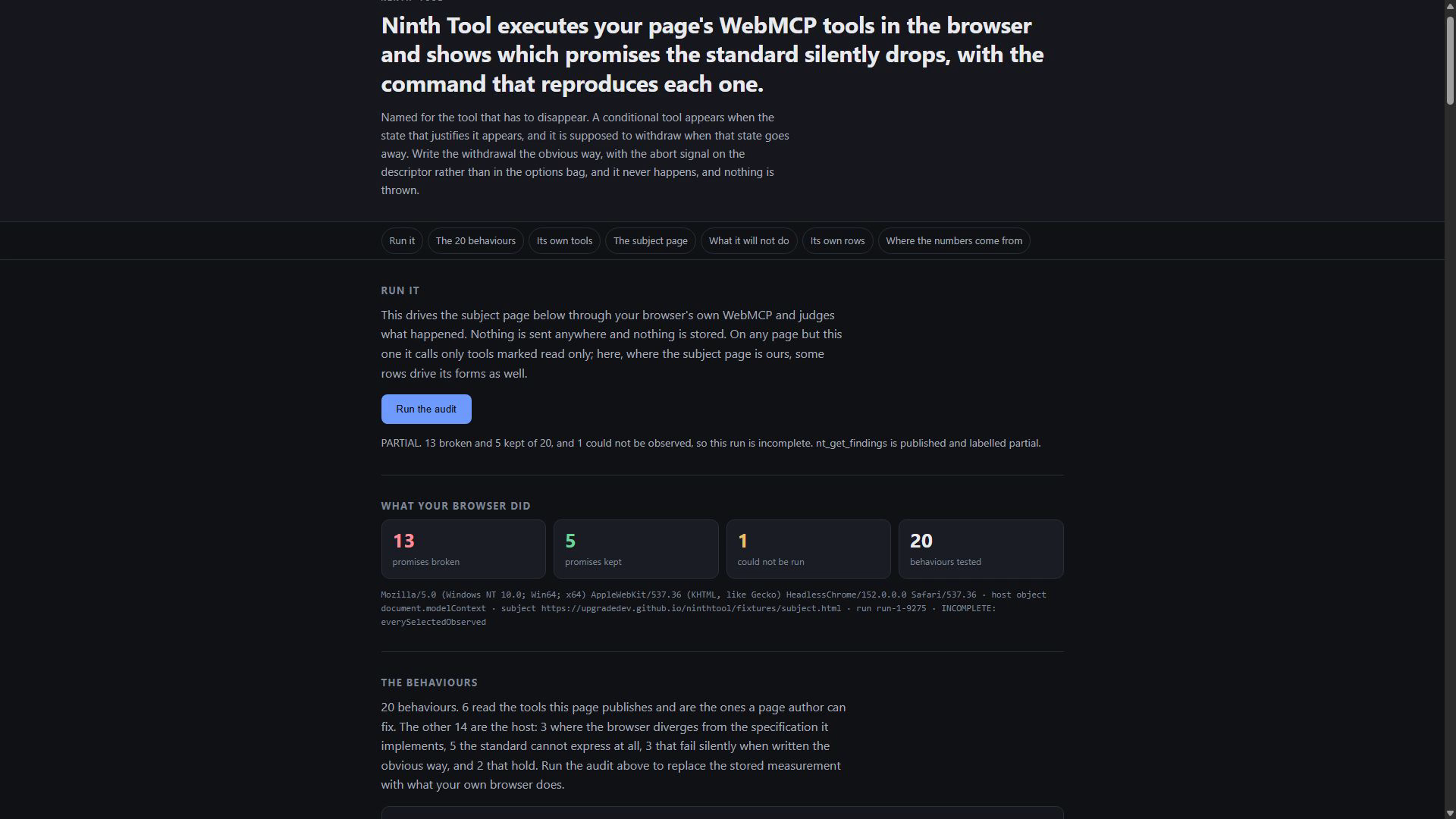
Ninth Tool executes your page's WebMCP tools in the browser and shows which promises the browser silently drops, with the command that reproduces each one.
- Live, no account: https://upgradedev.github.io/ninthtool/
- Code (MIT): https://github.com/upgradedev/ninthtool
- Compatibility: Chrome or Edge with
chrome://flags/#enable-webmcp-testing.
Inspiration
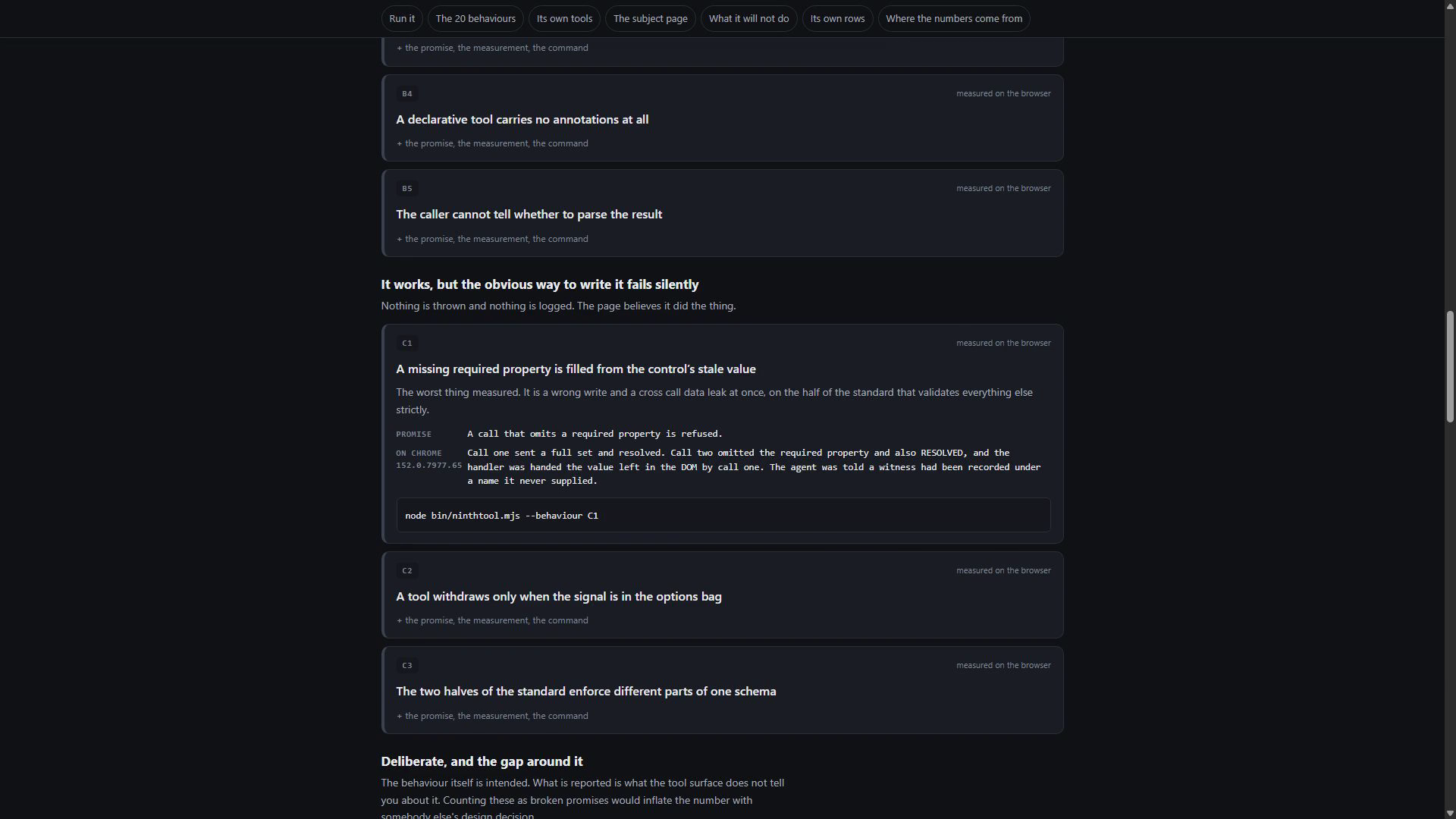
I was adding WebMCP to a page, writing the shape I knew from building MCP servers. I marked a tool destructiveHint. I returned { isError: true } when it refused. I passed a signal on the descriptor so it would withdraw. All three were accepted without complaint and none of them did anything. Nothing threw, nothing reached the console, and the tool list carried no warning.
Existing checkers read the declarations a page publishes and told me the page was fine, because by the only thing they look at, it was. The gap is not in what a page declares. It is in what the browser does with the declaration, and reading cannot see that.
What it does
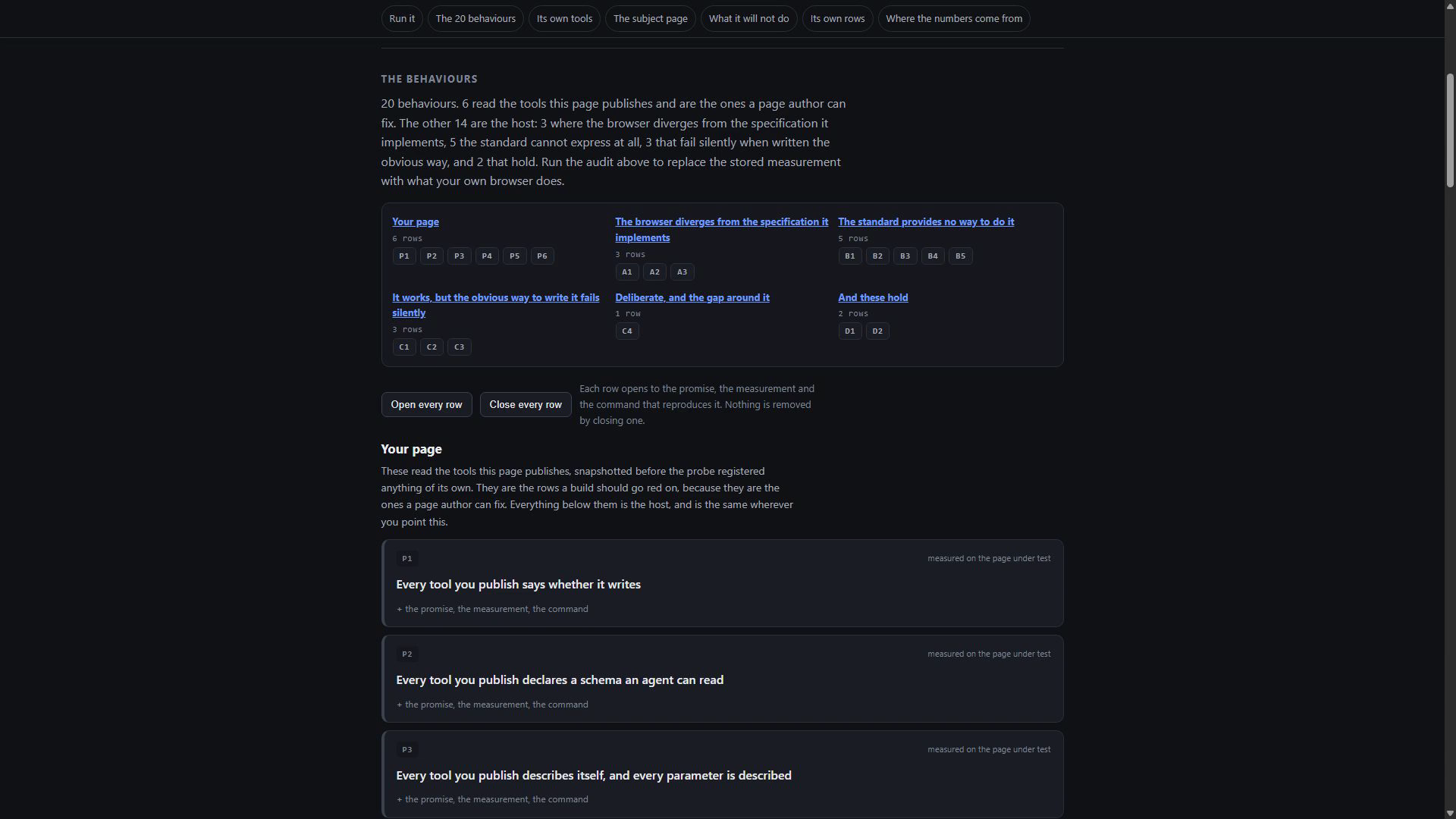
It runs twenty behaviours against a live WebMCP tool surface and reports each one with the exact command that reproduces it.
- Six rows read the tools the page publishes, snapshotted before the probe registers anything of its own.
- Fourteen rows are facts about the host: 3 where the browser diverges from the W3C draft, 5 the draft cannot express, 3 silent traps, 1 by design, 2 that hold.
On its own page, in Chrome 152 with WebMCP enabled, the reading is 13 broken, 5 kept, 1 by design, 1 unsettled, 20 tested. It labels that run PARTIAL rather than rounding the unsettled row up.
Why your use case is a strong fit for WebMCP
The subject being tested is WebMCP itself. Whether a host honours destructiveHint, whether a refusal survives the boundary, whether a tool registered with a signal actually withdraws: none of it is visible from outside a browser, and none of it can be read off a declaration.
This is not a page that uses WebMCP to deliver something else. WebMCP is the thing under test, so the only place the work can happen is inside a page that speaks it.
How it creates a better user experience
A page author gets what their browser actually did, next to the one command that reproduces it, instead of a linter's reading of their source.
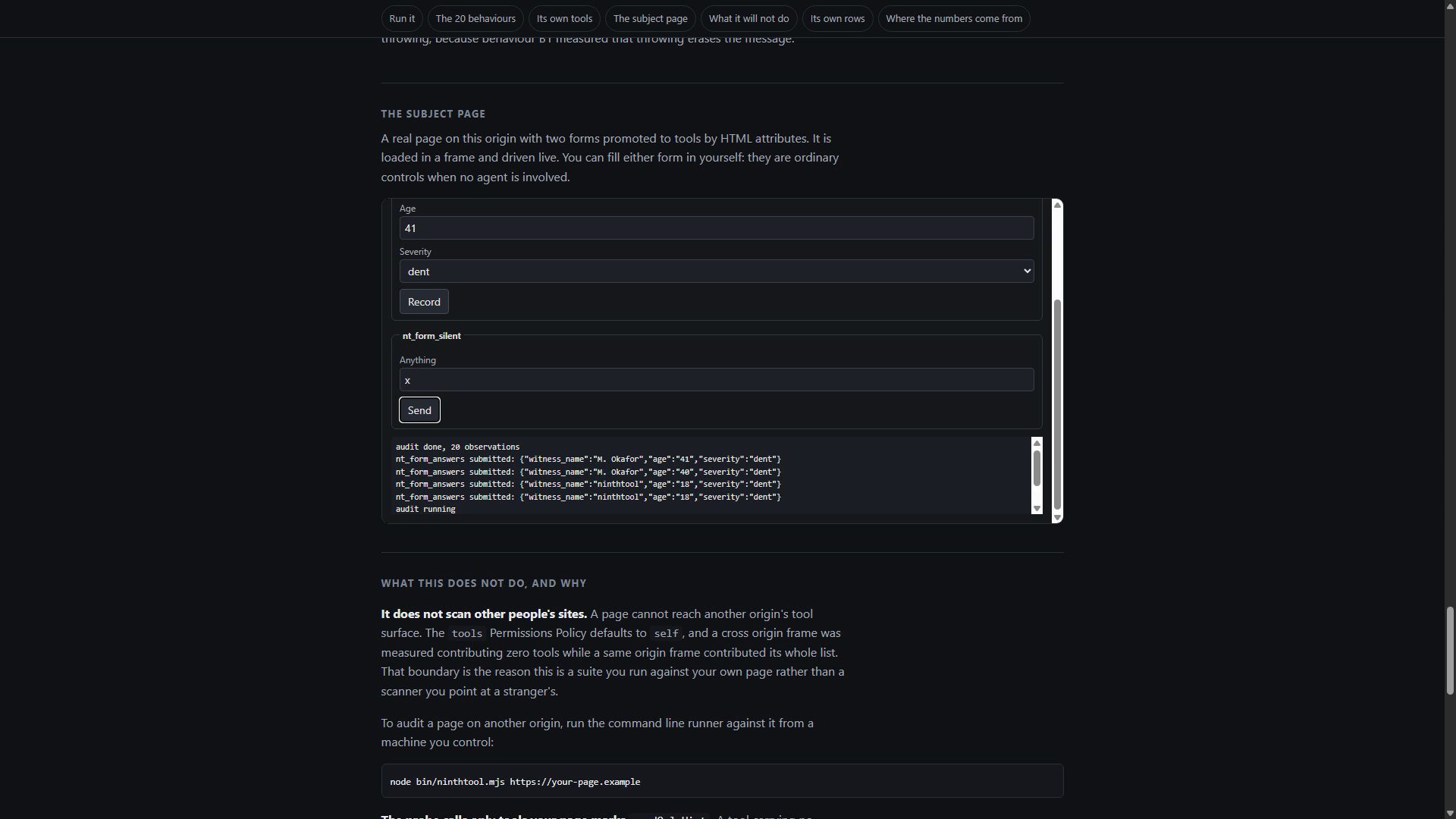
No account, no install, and nothing about their page is uploaded anywhere. The audit runs in the tab they already have open, against a subject document in a same-origin frame.
Every row that could not be run says so, with the reason, rather than counting as a pass. A run with one unobserved row reports PARTIAL. That is the difference between a result you can act on and a green tick you have to trust.
What people and agents can do together that was difficult or impossible before
This page publishes its own WebMCP tools, so an agent can run the audit, list the twenty behaviours, explain one row in full and read the findings without touching the screen, while a person watches the same rows fill in beside it.
The nt_get_findings tool does not exist until a run has produced findings, and it is withdrawn when they are cleared. An agent that asks for findings which are not there is answered by the tool surface itself rather than left to guess.
That is the behaviour this suite is named for, demonstrated on itself rather than described. The auditor is a WebMCP page, so it is also a subject.
How WebMCP was implemented
document.modelContext.registerTool publishes three tools from this page at rest and a fourth while findings exist. Three carry readOnlyHint. The one that runs the audit deliberately does not, because it drives forms.
The subject page it drives is a separate document in a same-origin frame that promotes two ordinary forms to tools through the declarative HTML attributes, so both halves of the standard sit on one surface.
The probe registers its own throwaway tools with a signal in the options bag and withdraws them when it is finished, which is how the withdrawal row gets measured at all.
How I built it
- Gathering is not deciding. The probe runs inside a document and records what happened, with no opinion about what a pass is. The judge is pure, runs deterministically, and cannot reach a browser.
- 533 unit tests and 97.95% line coverage across 57 files at commit
231c45f, counting each file once against an 85% floor for lines, branches and functions. Eleven below-floor metrics occur across six files, and the gate names every file instead of averaging it away. Reproduce it withnode --experimental-test-coverage --test tests/unit | tee coverage.txtthennode tests/unit/coverage_gate.mjs coverage.txt --per-file --threshold=85. - Dual transports. The in-browser runner, plus a zero-dependency headless Chrome DevTools Protocol client. No bundler, no test framework, no lock file, no runtime dependencies.
Run it against any page from a terminal:
npx --yes https://github.com/upgradedev/ninthtool/tarball/main https://your-page.example
The package is not published to npm, so the tarball URL is the whole install.
Safety
By default it calls no tool of yours and submits no form. Calling your read-only tools needs an explicit flag you pass yourself. Submitting a form runs only against the fixture this tool serves itself.
It is not invisible, and that is stated rather than hidden: registering a probe tool is a document-level event that your page can see.
Honest limits
A preregistered study on thirteen independently authored WebMCP pages has run, and its hypothesis failed. Five of twenty rows told those pages apart, and every one of them was already readable from the tool list. Taking it apart afterwards showed why: at most two rows could ever have told one of those pages from another, against a threshold of three fixed before anyone looked, and both were switched off by the run's own read-only default. The bar could not be cleared by any result. That is a defect in the protocol, not a measurement of what this tool reaches.
Two findings it did report about strangers' pages were checked against their own source and retracted as defects in this tool, with the handler lines cited. One page had rejected the missing argument at its first line. On the other, this tool's own control call was as malformed as the one it meant to break.
That is the thing worth reading. Any suite that runs against pages it does not own will produce false findings. The useful question is whether it catches them and publishes the retraction beside the claim, in the same generated file. It did.
One of the two study-specific oracle weaknesses behind those retractions is now closed. The other stays open on purpose: the obvious fix was built, measured against a copy of the tree, and it turned this suite's own flagship true positive into an abstention. That measurement is published rather than the fix.
The protocol was written and committed before any page ran, the failure is published in evidence/impact/results.md, and the primary metric was not changed afterwards to make it read better.
Five rows have known fail-open paths, and P2 is only partially closed. They were found by external review and reproduced before publishing:
- P4 treats unreadable provenance as local because it filters only
fromThisDocument === false. - P3 walks only top-level
schema.properties, so an undescribed nested parameter passes. - D1 accepts any
toolchangeevent without proving that the target tool caused it. - P5 removes only
required[0], always uses the same good/bad/bad/good order, and later resolves the snapshotted tool by name. Later required keys, position-dependent behaviour, or a same-name replacement can produce a false pass or misbound call. - P6 also resolves by name, stringifies answers, is order-sensitive, and counts every resolved value, including an error envelope, as an answer. A replacement writer can be called, distinct structured states can collapse to the same text, and a resolved refusal can satisfy the control.
P2 is partially closed. It now rejects a non-object properties container; it does not recursively validate nested schema structure.
The demo video was recorded earlier and two figures have since moved. It says 97.8% line coverage and four below the floor; both were true at its frozen commit. At 231c45f, CI reports 97.95% across 57 files, with eleven below-floor metrics across six files. The video remains unchanged; this dated correction and the README carry the exact command.
What was reused
The same author has a second entry in this hackathon, ClaimReady. Exactly one file is shared: src/probe/cdp.mjs, a 200-line Chrome DevTools Protocol client with no dependencies. The README names it with its source commit. Everything else here was written for this entry.
Where to start
Open https://upgradedev.github.io/ninthtool/ and press Run the audit. Nothing to install, nothing to sign into. Devpost lists the same two links below.
Built With
- browser-agents
- github
- javascript
- node.js
- webmcp

Log in or sign up for Devpost to join the conversation.