-
-
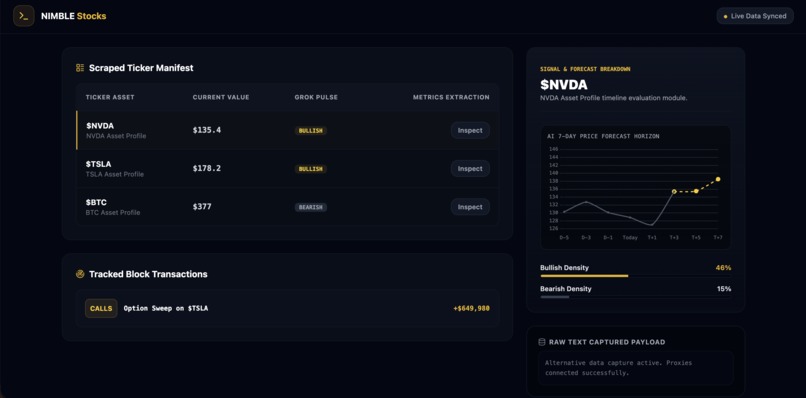
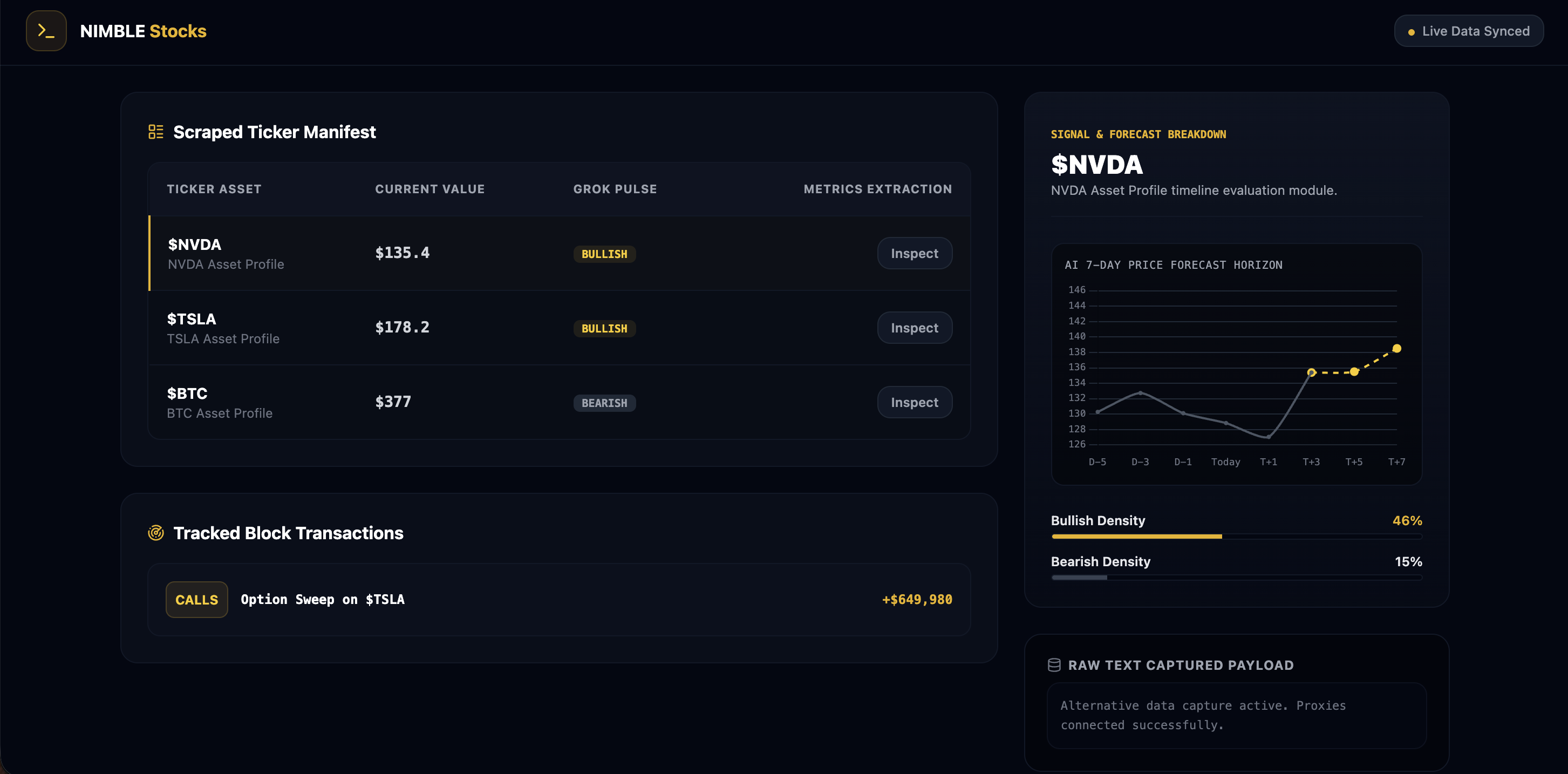
main page
-
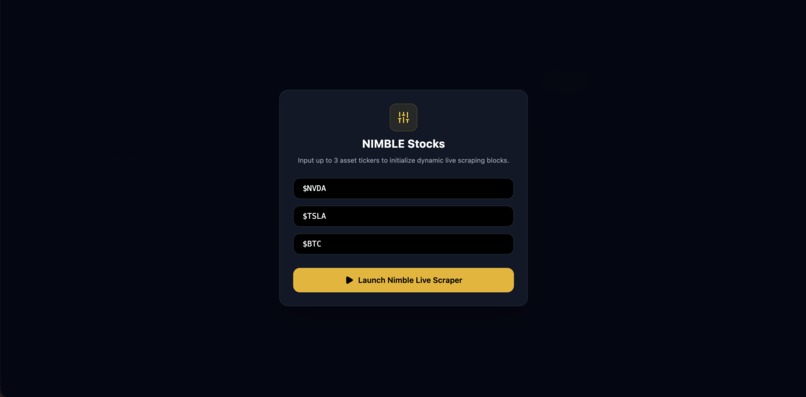
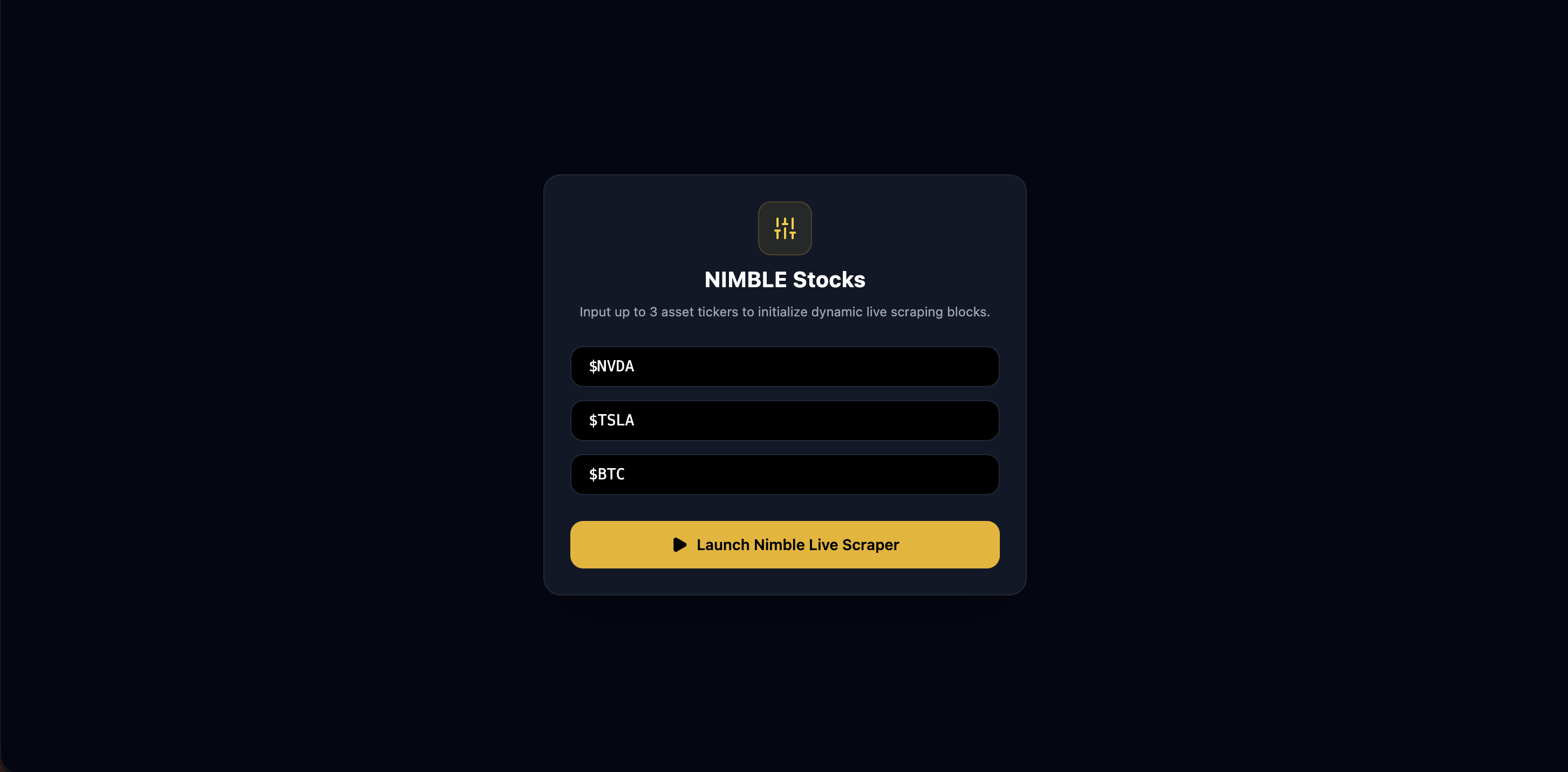
starting page
Inspiration
Retail trading communities on X (Twitter) and Reddit move faster than traditional financial news. By the time a mainstream outlet reports a spike in interest, the opportunity has already sailed. We wanted to build a real-time terminal that cuts out the institutional middleman, bypassing curated summaries to ingest unformatted, raw alternative data straight from the digital town square—interpreting market-moving crowd sentiment before it hits the charts.
What it does
Nimble Stocks is an automated web-intelligence and predictive terminal. Users input up to three asset tickers, which triggers a localized, multi-agent pipeline.
- Live Terminal Status Console: A dynamic loading overlay streams exact step-by-step proxy and scraper tracking status before unlocking the main layout.
- Grok-2 Sentiment Matrix: It continuously maps social chatter density to isolate crowd emotion, scoring assets on a Bullish/Bearish scale and exposing unusual block options alerts.
- AI Price Horizon Forecast: It processes raw conversational buffers through a simulated drift model to chart an interactive, forward-looking 7-day asset projection.
How we built it
The platform is engineered using an agentic, event-driven Node.js and Express architecture hosted securely on Render: The Infrastructure Core (Nimble): We integrated the Nimble Browser API (vx10 driver) paired with dynamic residential proxy routing to safely tunnel past platform scrapewall blocks, harvesting raw text payloads on demand. Multi-Agent Pipeline: The backend isolates responsibilities into an Ingestor Agent (handling the browser pipeline and data parsing rules) and a Quant Agent (running keyword density models and predictive mathematics). The Handshake & Frontend: Server-Sent Events (SSE) keep the client and server synced in real time, streaming terminal logs to the interface before Chart.js paints the predictive trends. Security is tightly managed using decoupled cloud environment variables (process.env.NIMBLE_API).
Challenges we ran into
The single biggest roadblock was anti-bot infrastructure. Social networks aggressively block basic automated requests using CAPTCHAs, cookie handshakes, and rate limits. Initially, our server IPs were blacklisted within minutes. Overcoming this meant leaning heavily into Nimble's advanced fingerprinting configurations, allowing our structural requests to accurately mirror natural human interaction profiles. Handling vanilla frontend states without blocking the single-threaded Node loop during multi-ticker scrapings also forced us to pivot to an asynchronous, stream-based handshake model.
Accomplishments that we're proud of
We successfully transformed unstructured text chaos into clean, mathematical vectors. Building a zero-downtime streaming architecture where a user can actually watch the backend agents "think" line-by-line via the loading screen terminal felt incredibly rewarding. Furthermore, keeping the entire platform architecture cleanly modularized—hiding private keys securely while maintaining fully dynamic endpoint handling—proves the codebase is highly scalable.
What we learned
We learned the massive value of leveraging robust data-gathering infrastructure like Nimble instead of trying to write brittle, bespoke scraping configurations from scratch. We also deepened our knowledge of Server-Sent Events, managing environment variable structures between local testing environments and cloud hosting instances, and designing asynchronous, sequential agent logic.
What's next for NIMBLE Stocks
- Deeper Agent Autonomy: Transitioning our internal logical blocks into a wider pool of custom-trained LLMs to understand complex trading nuances, sarcasm, and slang (like HODL or paper hands).
- Persistent Memory Database: Integrating a live historical timeline layer to score our AI engine's predictive accuracy over time.
- Multi-Source Expansion: Expanding the Nimble extraction matrix to ingest real-time contextual data from Discord servers, Telegram alpha channels, and financial documentation.
Built With
- grok
- javascript
- nimble

Log in or sign up for Devpost to join the conversation.