-
Bringing the most sophisticated tech and fundamental tech NEAR

Inspiration
The inspiration for this project comes from one of our friends. She suffers from Hydrocephalus and must be attended to at all times. We are saddened by how little freedom she had as she always have to have someone near to make sure her medical condition would not flare up.
What it does
Ideally, post-hospital care would require little attention from professionals. However, chronic conditions require constant attention to prevent symptoms from flaring at poor times. Even though the patient has left the hospital, there still must be manpower devoted to the patient’s health constantly. This problem can be alleviated by NEAR technology. By connecting to a cellular network, if a relapse or serious condition arises, emergency response can be dispatched quickly to the patient’s location. This will allow patients less risk when traveling outside of Wi-Fi range, as well as more independence as they do not need a chaperone with them to watch for their well being.Ideally, post-hospital care would require little attention from professionals. However, chronic conditions require constant attention to prevent symptoms from flaring at poor times. Even though the patient has left the hospital, there still must be manpower devoted to the patient’s health constantly. This problem can be alleviated by NEAR technology. By connecting to a cellular network, if a relapse or serious condition arises, emergency response can be dispatched quickly to the patient’s location. This will allow patients less risk when traveling outside of Wi-Fi range, as well as more independence as they do not need a chaperone with them to watch for their well being.
How we built it
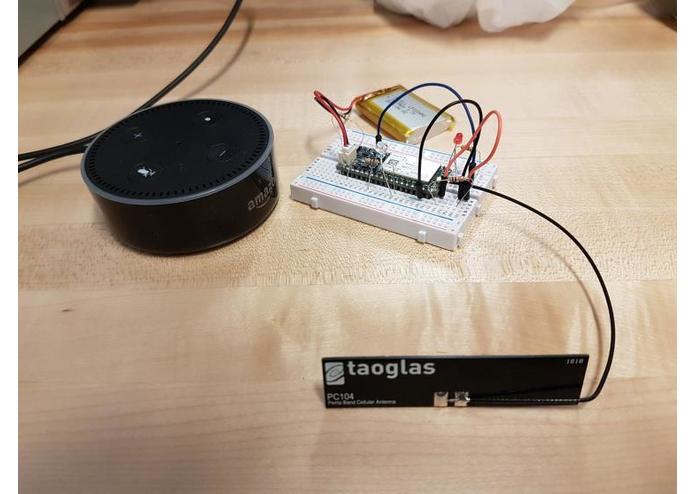
The device integrates the Particle electron with an Echo dot, as well as combining a database and sensors.
Challenges we ran into
Over the course of this hackathon, we encountered challenges revolving around learning new experiences. Many of our team members were comfortable with conventional programming langugages but none had had experience interfacing with newer, higher-level APIs, including the Amazon Alexa, and the Particle Electron board. Our solution to dealing with this came through perseverance, ingenuity, and of course, a lot of of googling. The Particle Board encountered several issues, which was resolved through clever use of the publishing tool as a debugger and a discovery in the fault in the hardware. We started with tutorials that gave us only the simple pieces but expanded into complex devices that interface with other members over cellular data.
Accomplishments that we're proud of
Our greatest achievement was being able to connect two seemingly foreign pieces of technology together. The major breakthrough was making use of the universal HTTP format to move data in an elegant matter, connecting one of the most sophisticated user-friendly levels down to one of the most fundamental levels. Moreover, moving data was not so impresesive as it was moving meaningful information, proving that high-end thought can tie in with pure hardware in a meaningful and simple way.
What we learned
We learned lots about how to upload firmware to a chip over the internet, as well as the do's and don't of setting up embedded circuits. We also learned about the Alexa API and how that worked. Furthermore, we learned more about databases. We learned how to creatively discuss and evaluate different ideas. Lastly, we discovered much about how hilarious a text to speech device can be, especially when you can interact with it.
What's next for NEAR (Nimble Emergency Assistance & Responder)
Team Octothorpe want to take NEAR beyond its stage of infancy as only a proof of concept into a full-fledged project with powers to connect patients, doctors, medical clinics and hospitals together through revolutionary analytics and real-time responsiveness. With ideas to expand and implement a larger medical database, tied together with AI software to interpret data from wearable electronics, NEAR defies the idea that sick means being bedridden. The world is for everybody, and it is always nearby.

Log in or sign up for Devpost to join the conversation.