Inspiration
In India, about 1 in 39 babies doesn't live to see a first birthday (25.8 deaths per 1,000 live births, 2024). Much of the danger in that first year is ordinary, it happens at home, and it often happens when nobody is watching:
- She rolls onto her front, pulls herself up on the cot rail, or reaches for a cable while the parent is asleep or in the next room.
- She cries, and keeps crying. Normal infant crying is the most common trigger for a caregiver crisis, and it comes when the household is most exhausted. A quarter of mothers have no one else in the house to turn to.
- The first signs of illness are slow. A nappy that gets a little paler, eye whites turning yellow, a mark that is slightly bigger each day. Every day looks like the one before, so parents notice late, when noticing early is what counts.
Help exists, but most families can't afford it. A smart baby monitor costs $200–380 plus a monthly subscription. A camera monitor with no AI at all still costs ₹5,000–18,000. Every smart monitor sends the nursery to the maker's servers: 1.1 million Wi-Fi baby monitors in 118 countries were found reachable through a single extracted key. And when something happens, they all do the same thing: they notify the parent, and that's it. None of them tries to help the baby.
Yet the family already owns a phone with a microphone, a camera, a speaker, a light and a chip that can run AI. We built Nila to turn that phone into the baby's ears, eyes and memory.
What it does
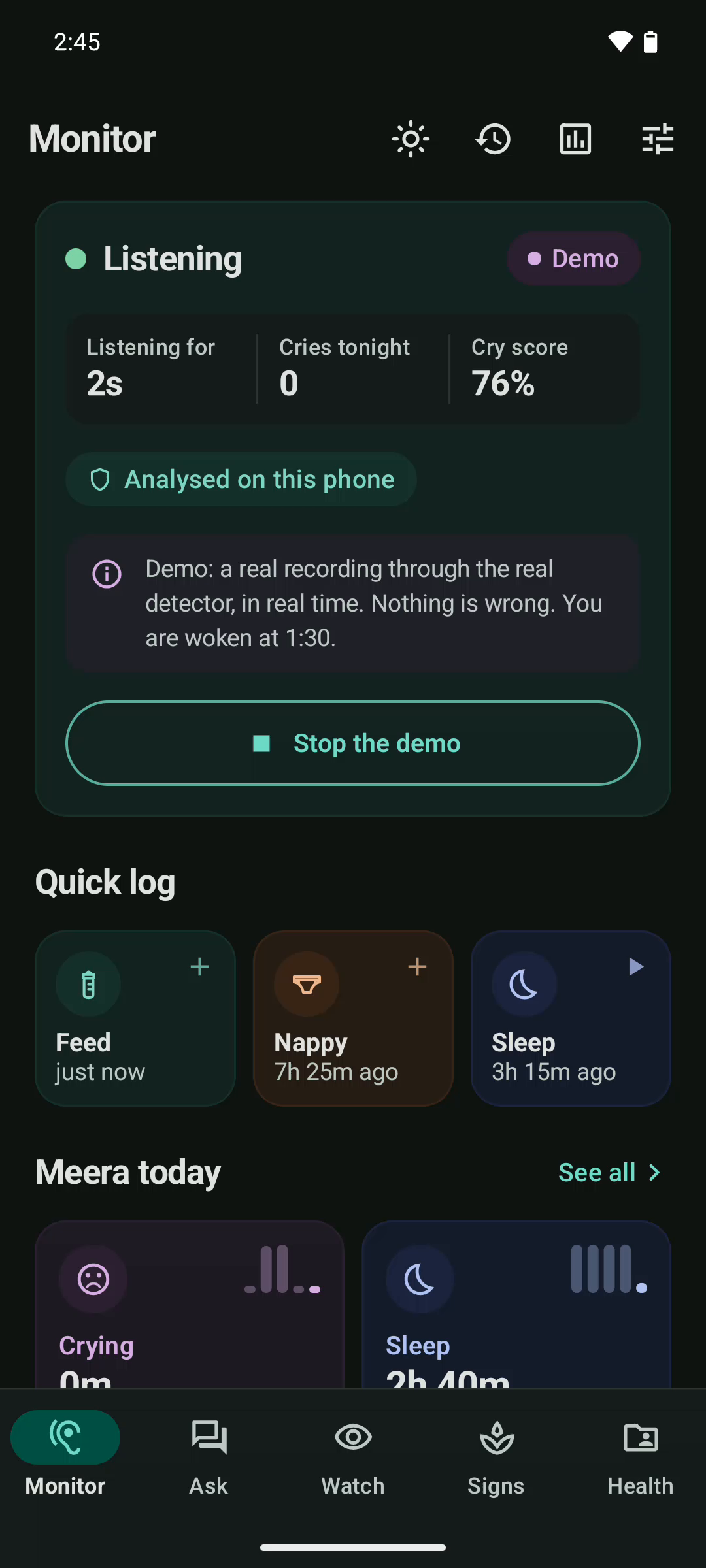
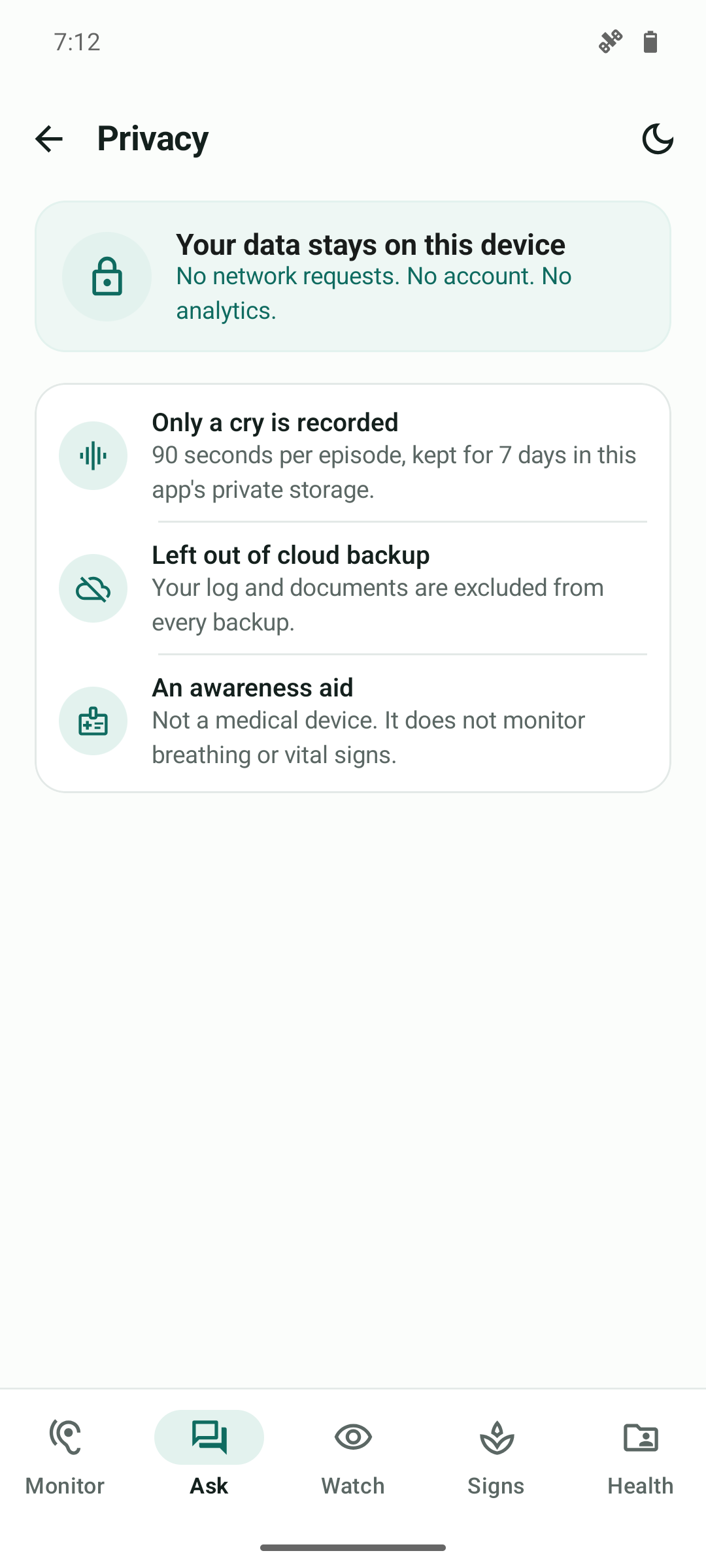
Nila is a complete baby monitor on the Android phone the family already has. There's nothing to buy and no account or subscription, and nothing about the baby leaves the phone.
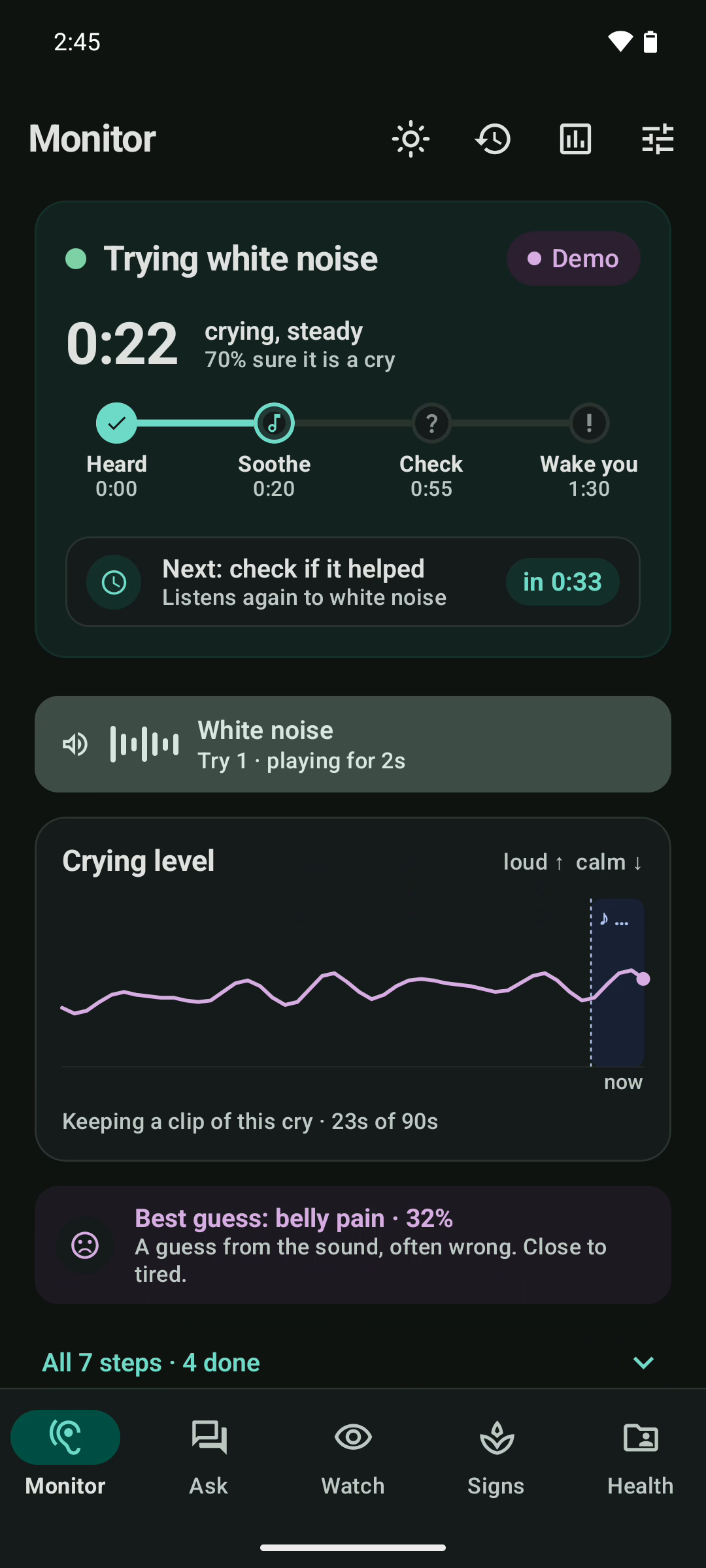
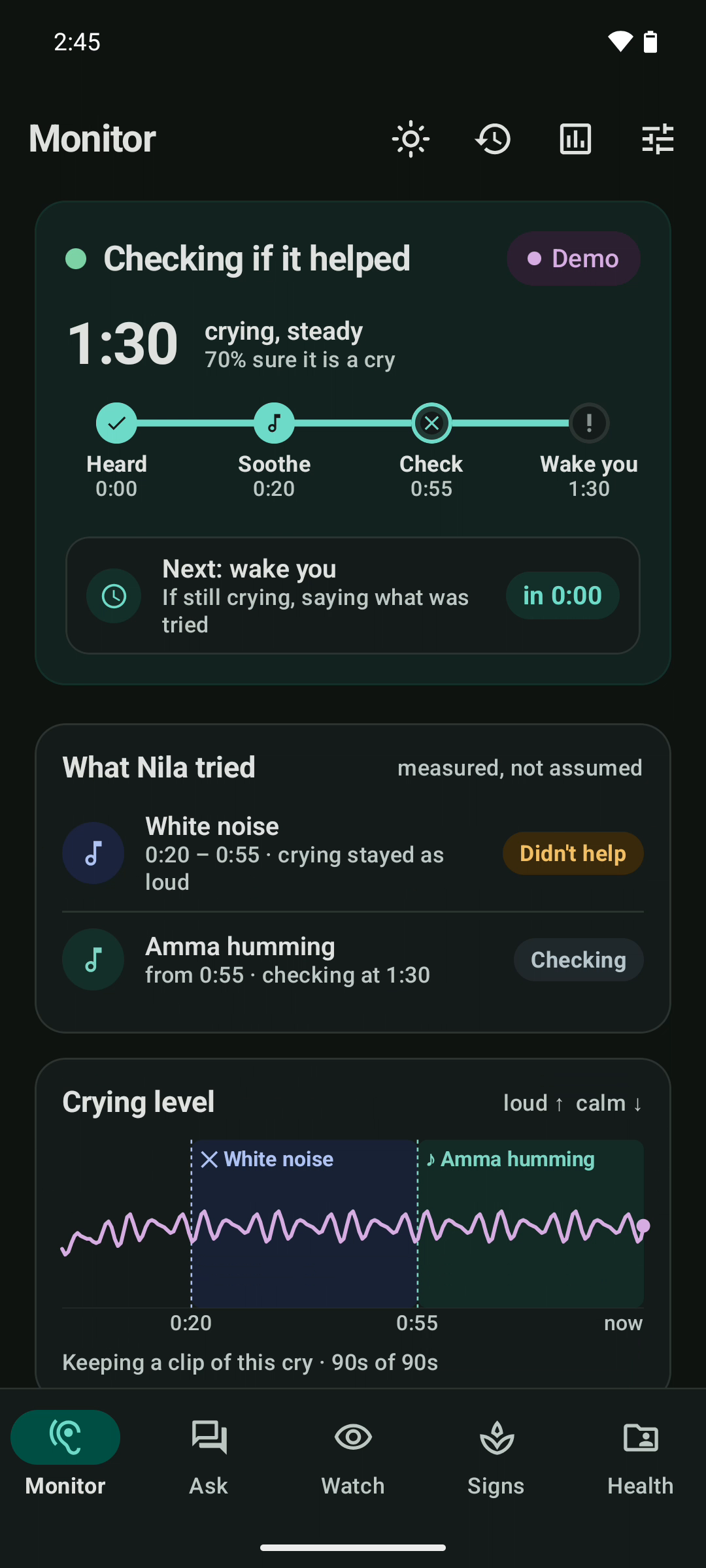
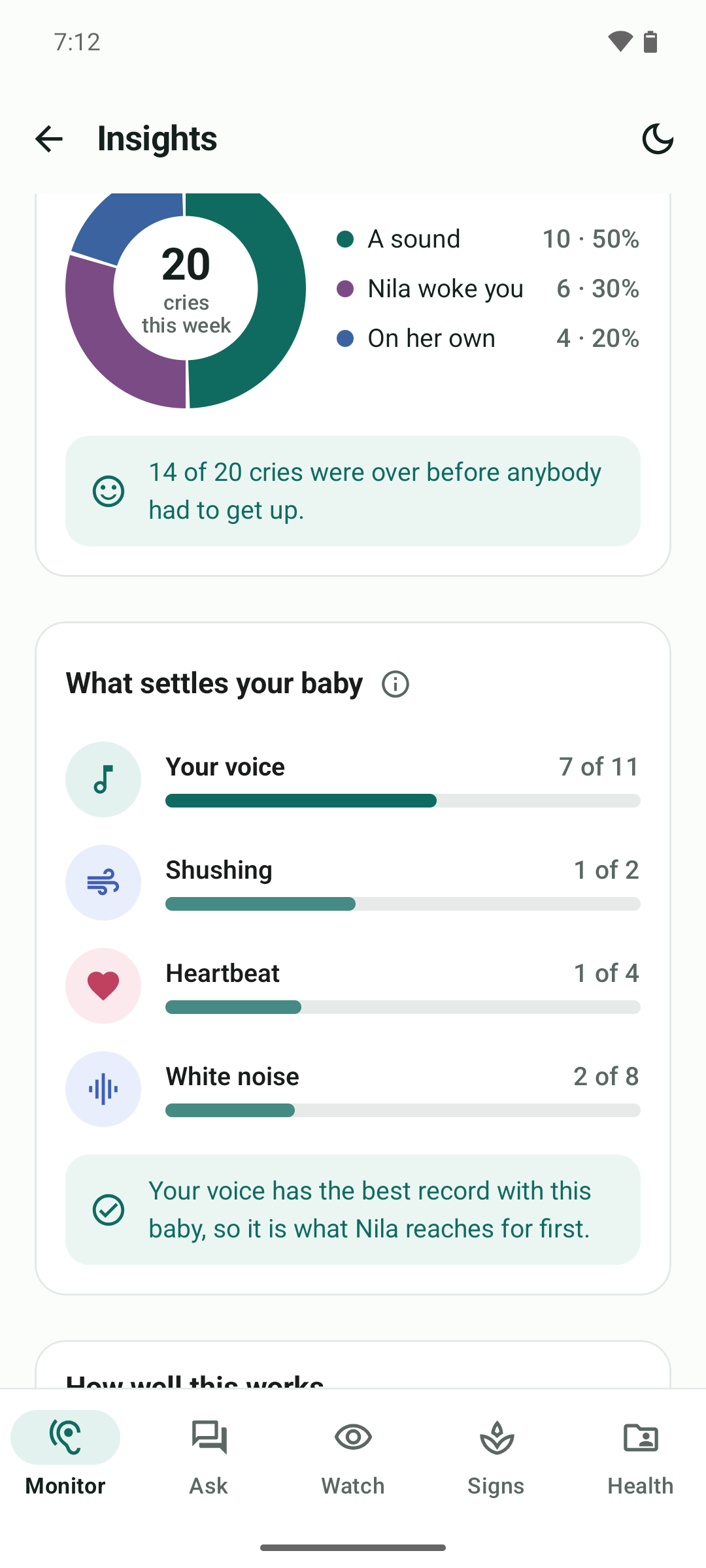
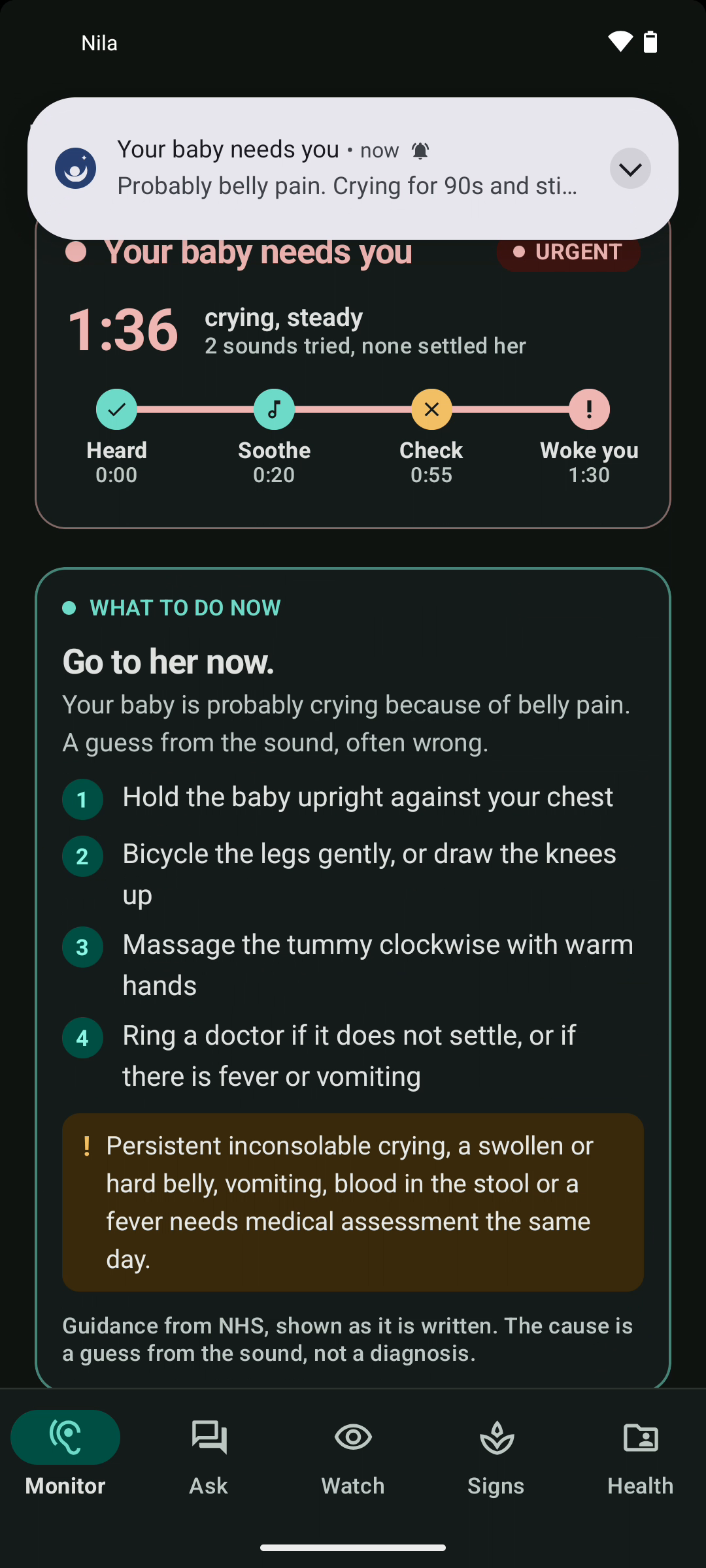
Ears: it tries to settle her before it wakes you. When she cries, Nila plays a soothing sound: white noise, shushing, a heartbeat, or the parent's own recorded voice. Then it listens again and checks whether the sound actually helped. If it didn't, Nila tries another one. The parent is woken only if she is still crying, and the alert says what Nila already tried and the likely reason. Every night Nila learns which sound works for this baby, and tries that one first next time.
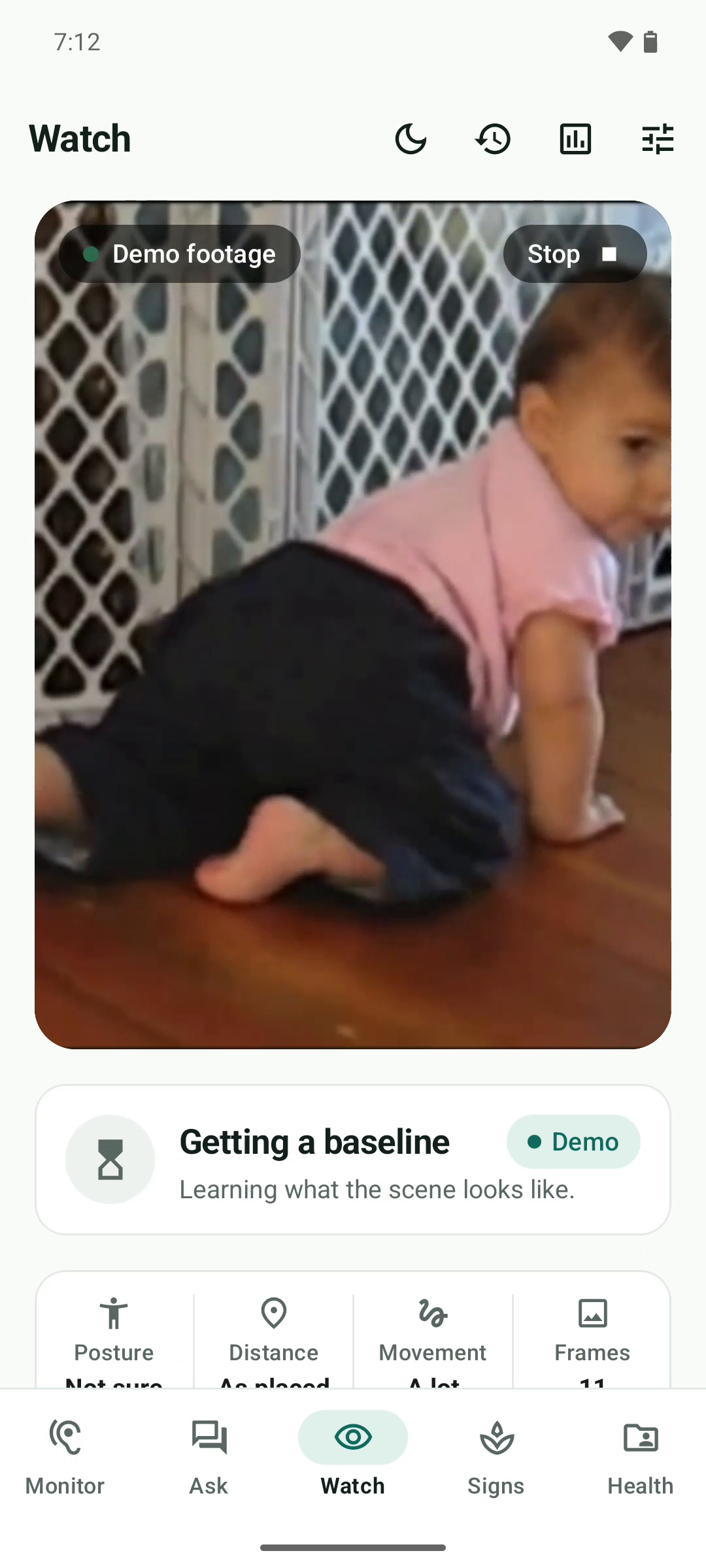
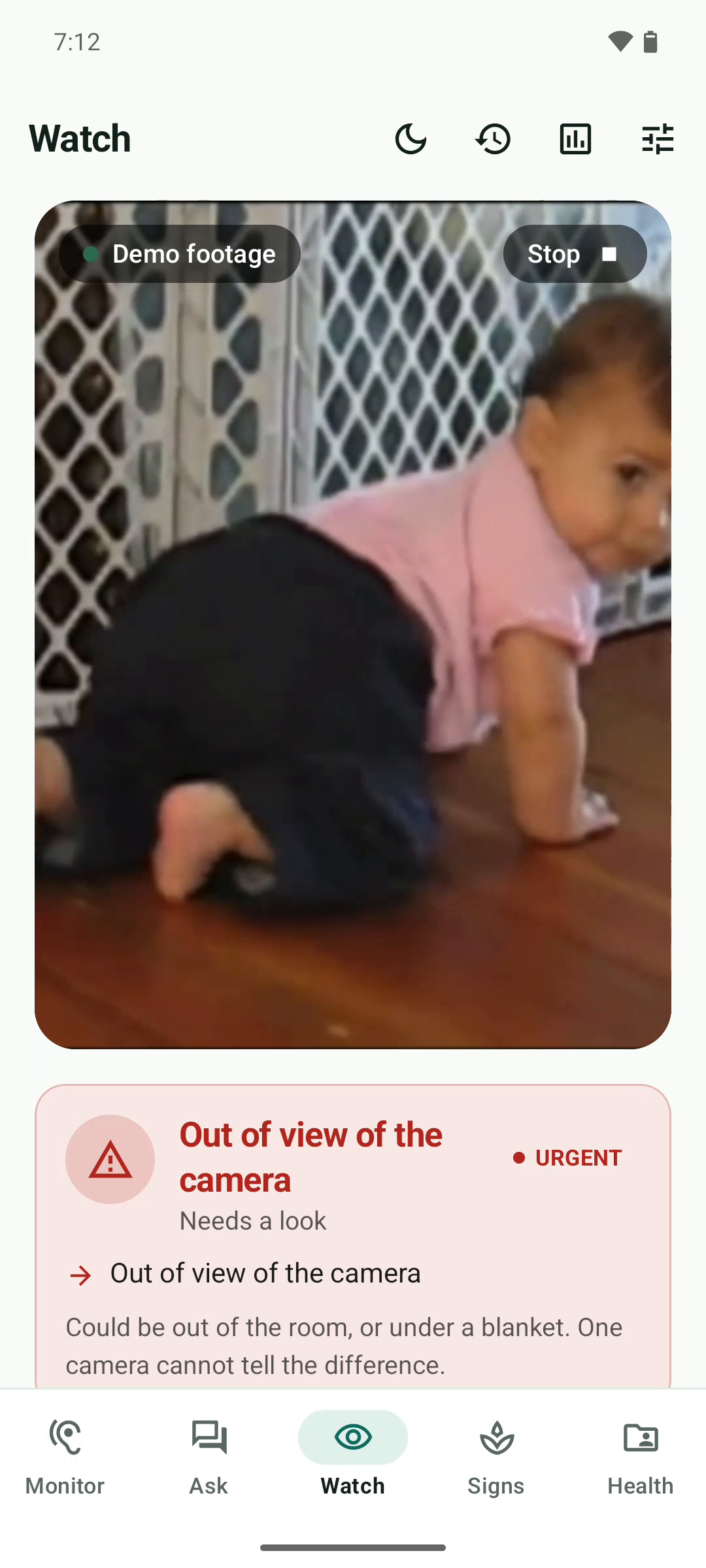
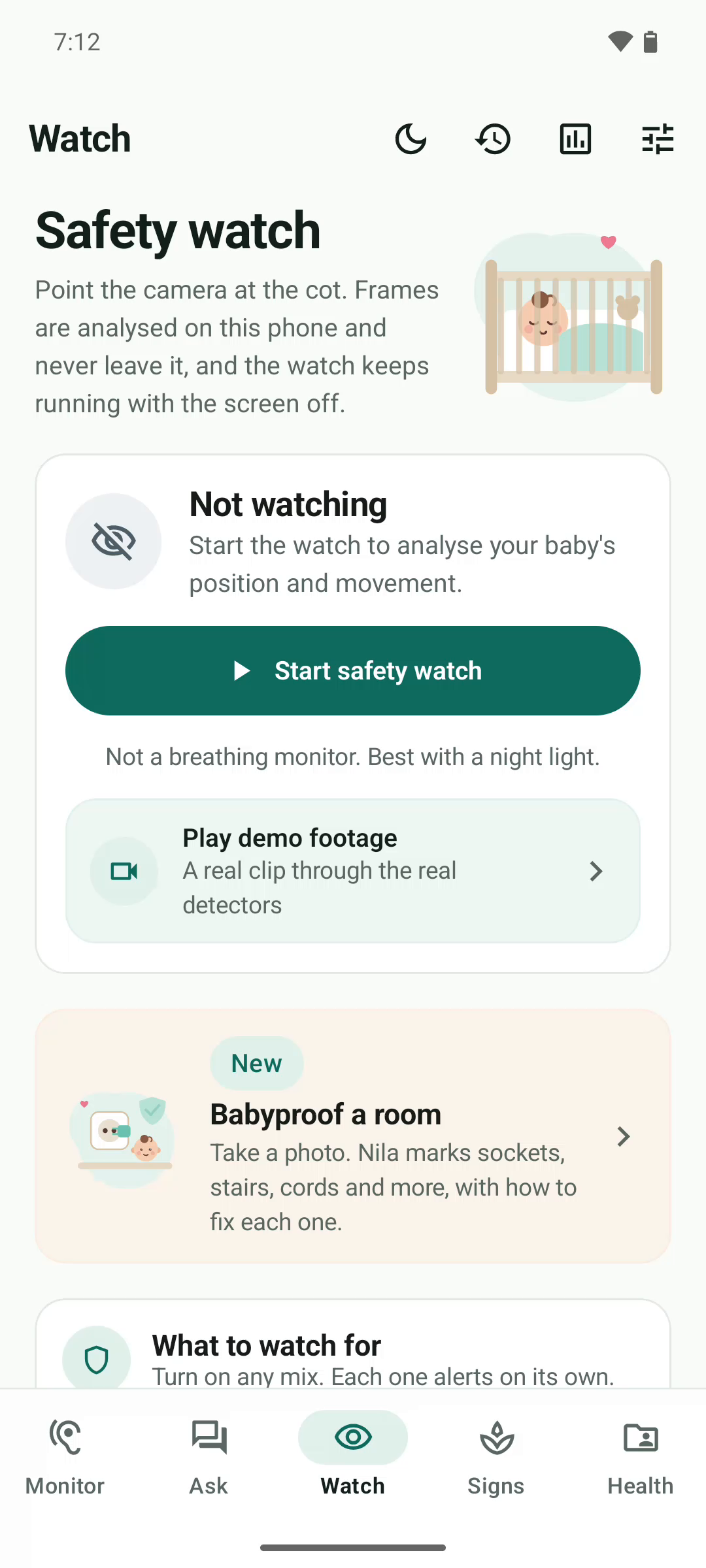
Eyes: a safety net that steps in. Point the phone, or the home CCTV camera the family already has, at the cot. Nila watches for the moments that matter:
- rolling onto her front, crawling or standing up;
- leaving the safe zone, or slipping out of view;
- something in the cot that shouldn't be there, like a cable.
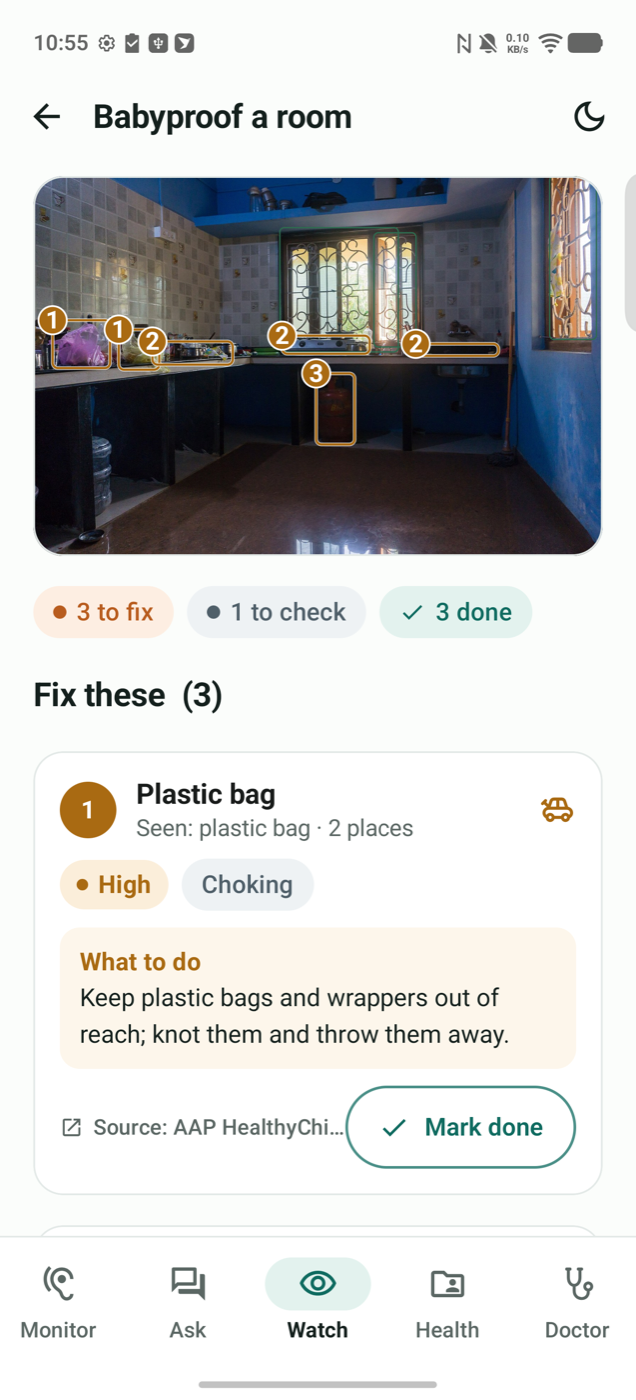
Nila alerts the parent, and it can also distract the baby with a soft lullaby and the ring light, for the seconds it takes the parent to reach her. It sees in the dark without switching on a light. The ears and eyes work together: a roll-over is a notification, but a roll-over followed by crying may be a fall, so Nila treats it as more serious. To babyproof a room, take one photo and Nila marks what to cover, lock, anchor or move.
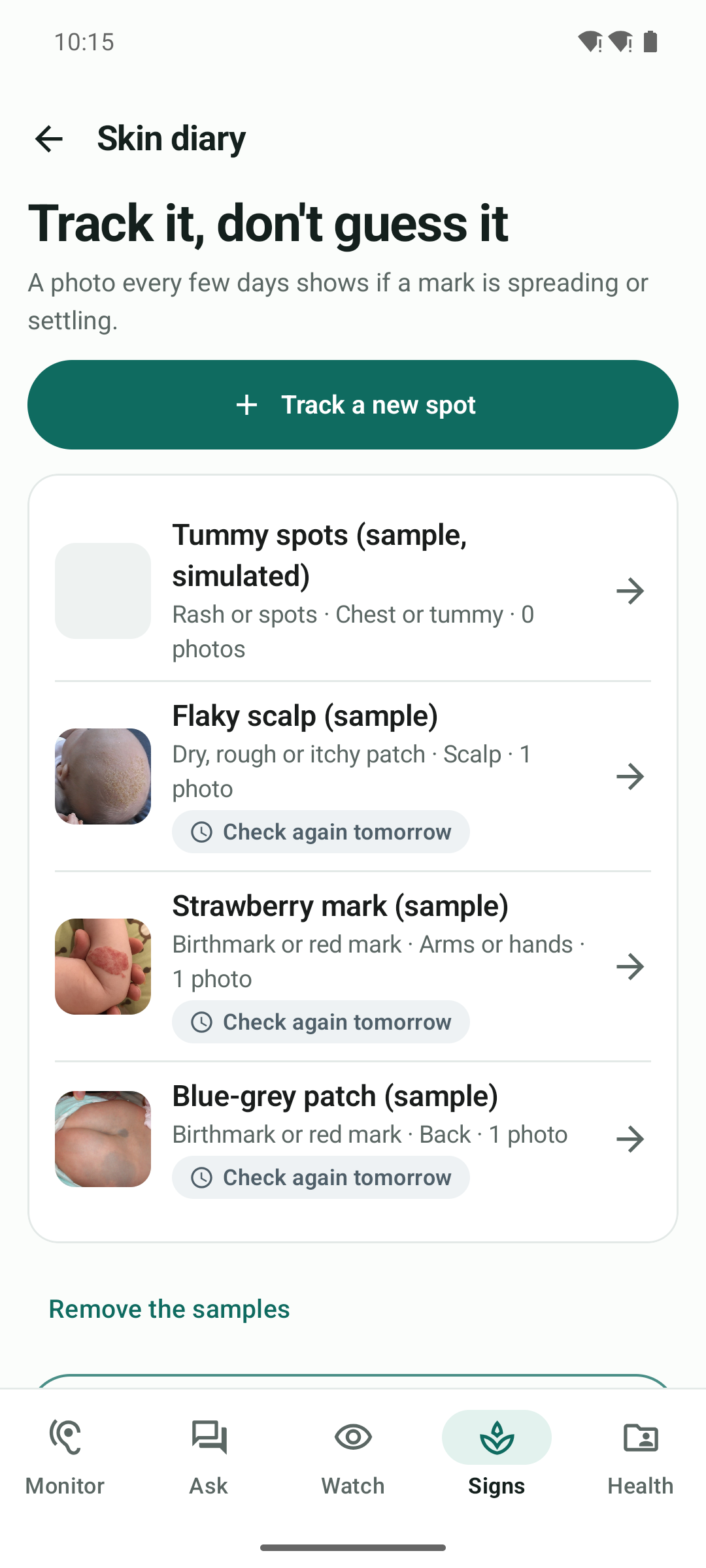
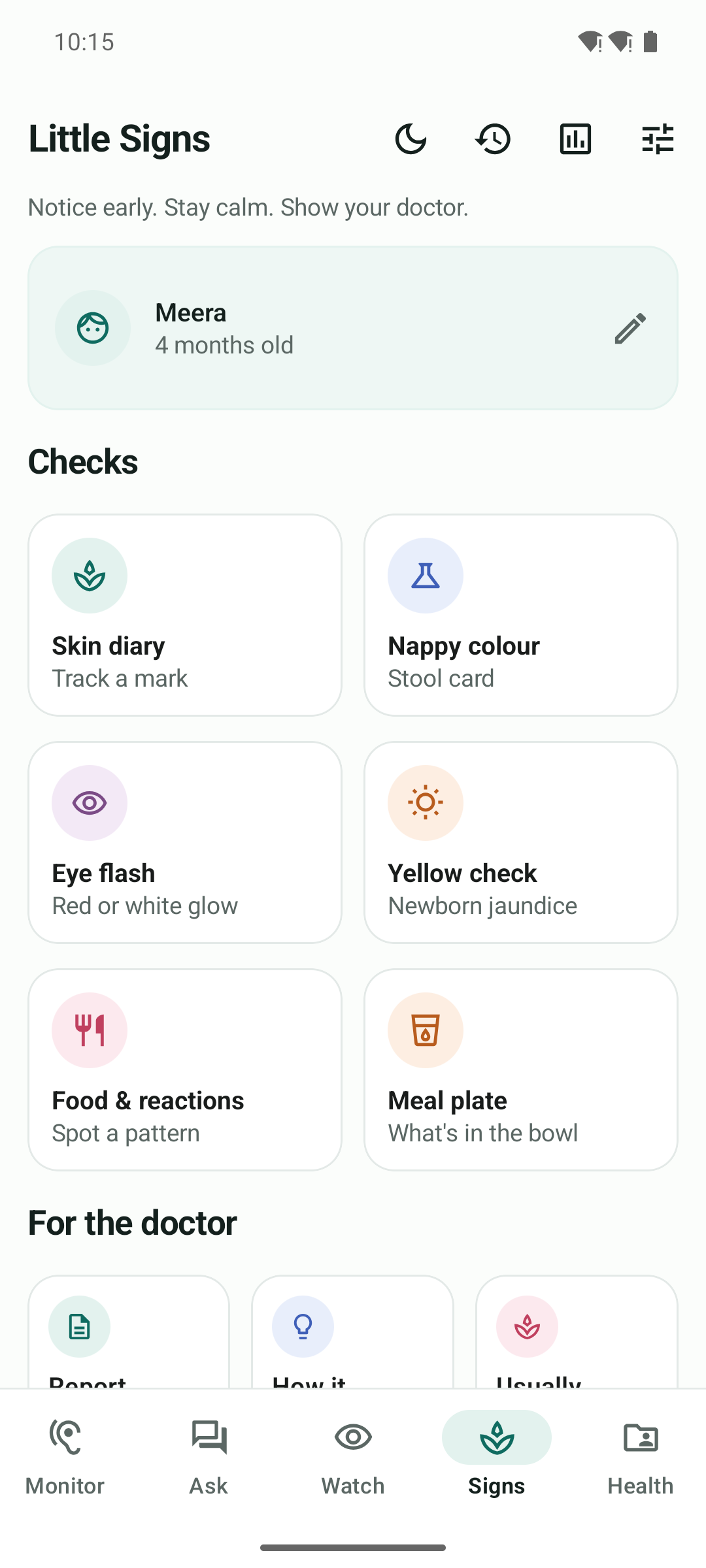
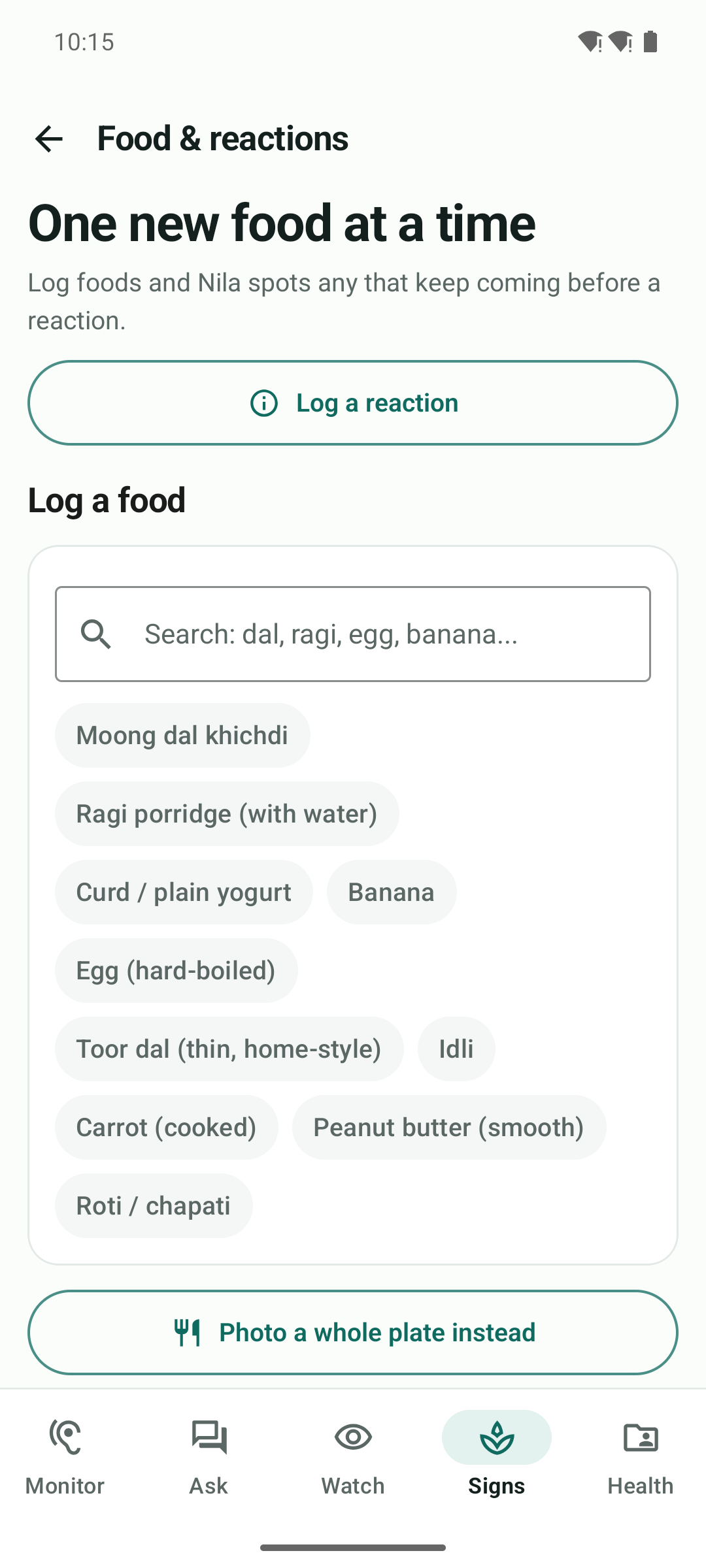
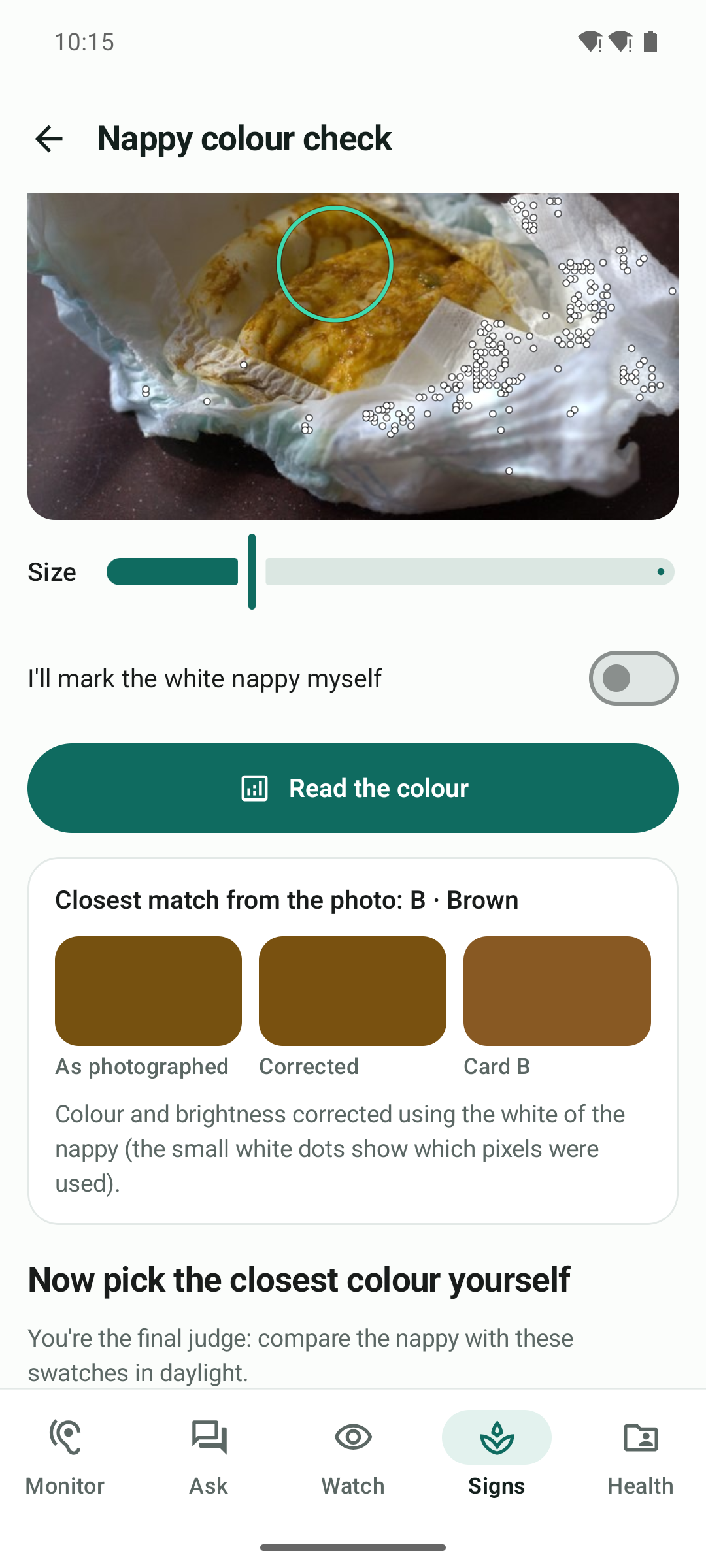
Memory: Little Signs catches slow changes early. Take a photo of the nappy, a mark or her eyes, or log what she ate. Nila measures these instead of guessing:
- colour, against her own skin and something white in the same photo;
- the size of a mark, day after day;
- a white glow in a flash photo of the eyes;
- which food keeps coming before a reaction.
Nila tracks the trend. When a sign crosses a line in the checklists doctors use (WHO, NICE, NHS and AAP), it tells the parent the next step, including when to call the doctor. Changes that parents can miss for weeks show up as a clear trend within days.
Around all this:
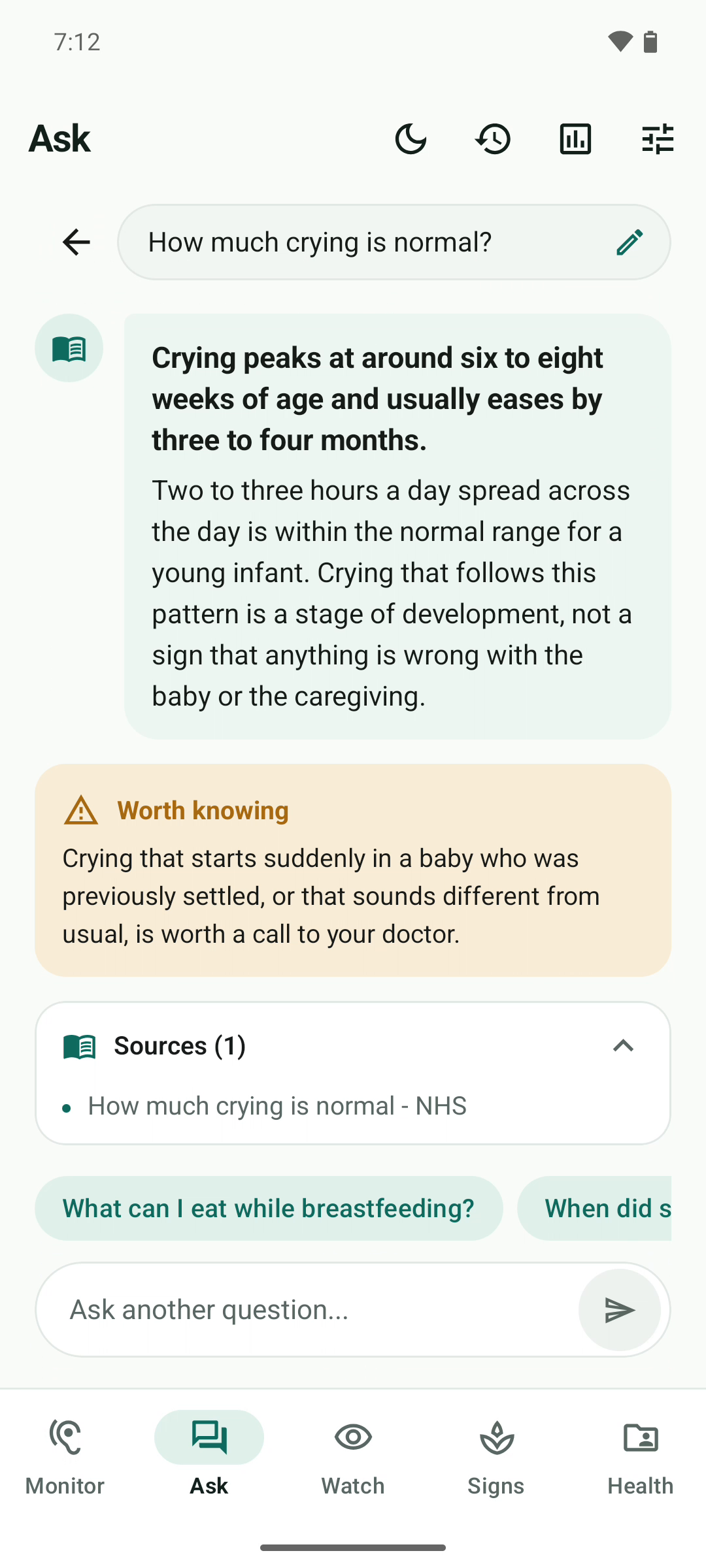
- sourced answers for the baby and the breastfeeding mother, with the source shown;
- a medicine safety check;
- the doctor's visit, written down as reminders;
- health records.
All of it runs on the phone.
How we built it
- App: Kotlin and Jetpack Compose, with Room for the care log on the phone.
- Ears: audio is turned into a log-mel spectrogram and fed to a 38 KB TensorFlow Lite cry detector. A small state machine runs the soothe → check → alert ladder, and keeps a learning score for each sound.
- Eyes:
- MediaPipe pose and face landmarks, plus an object detector for the safe zone;
- an on-device vision-language model (Intern3.5-VL-2B, running on the phone's NPU) that describes what is in the cot, with guard rails between its answer and the parent's phone;
- home CCTV support over ONVIF and RTSP.
- Memory: colour measurement and simple statistics (robust trends, Fisher's exact test). The clinical checklists are written in by hand from published guidance, never generated by a model. AI describes, maths measures, guidelines decide.
- On-device AI stack: TensorFlow Lite, MediaPipe, ONNX Runtime and LiteRT-LM, with Python for training and export.
- Process: we used the Devpost Learn Skill Pack in Claude Code to go scope → PRD → spec → build checklist → ship. The documents are in
devpost/in the repo.
Challenges we ran into
Fifteen AI models on one phone. Everything the monitor needs ships inside the app, and the cry detector is just 38 KB. The large language, vision and speech models are optional one-tap downloads, and nothing on the core path depends on them. We split the build by chip architecture to keep the install small.
Every phone, not just flagships. Phones differ wildly: an AI accelerator can load fine and then fail on its first real frame. So Nila:
- tests each model with a real inference on the device itself, and falls back NPU → GPU → CPU;
- rebuilds the camera on the CPU if the GPU drops out mid-night, instead of going dark;
- falls back in Ask from the large model, to a smaller one, to the sourced answer itself.
As a result, Nila runs on any 64-bit Android phone from Android 8.1 (2017) onwards.
Never crying wolf. A small vision model fails by raising a confident false alarm. We put guard rails between the model and the alert, so a parent is only woken for something real.
Seeing in the dark without waking her. A torch or lamp would wake the baby. Instead, Nila brightens the picture in software, averaging frames to remove noise and then opening up the shadows. It keeps the colour, so a red cable still reads as red.
Reading colour honestly on a phone camera. Room light changes everything. Little Signs reads colour against the baby's own skin and a white reference in the same photo, so the same patch gives the same answer under different lights and across skin tones.
All night, on a battery. Quiet audio is skipped before any model runs. The big vision model is consulted only when something happens (a cry, a change in posture, rising movement), not on every frame.
Accomplishments that we're proud of
- Fifteen AI models running together on one ordinary phone. They hear, see, read, answer and transcribe.
- Zero network calls while it watches the baby. There's no account, no cloud and no analytics, so Nila works the same in a city flat and in a village with no signal.
- A monitor that acts before it alerts. Every monitor we found stops at "notify". Nila tries to settle the baby, and checks whether that worked.
- A safety net that steps in. It distracts the baby while the alert reaches the parent.
- Early signs measured, not guessed, and tied to published clinical checklists.
- ₹0 for the family. The phone they already have is the device.
What we learned
- The best device is the one people already own. Designing for the cheapest phone first made the whole app better.
- Put rules between the AI and the parent. Models describe, measurements decide, and published guidelines say what to do.
- Plan before you build. Writing the scope, PRD and spec first kept us focused on one loop that works end to end, before adding anything else.
What's next for Nila
- Pilots with families, measuring how many night wake-ups the soothing ladder saves.
- Community health workers (ASHAs) and paediatricians, to bring Little Signs to families who rarely see a doctor.
- A Play Store release, so any family can install Nila in a minute.
Built With
- android
- hugging-face
- javascript
- kotlin
- librosa
- mediapipe
- ml-kit
- numpy
- onnx
- pandas
- python
- pytorch
- qualcomm
- qwen
- scikit-learn
- scipy
- sqlite
- tensorflow-lite
- whisper

Log in or sign up for Devpost to join the conversation.