-
-
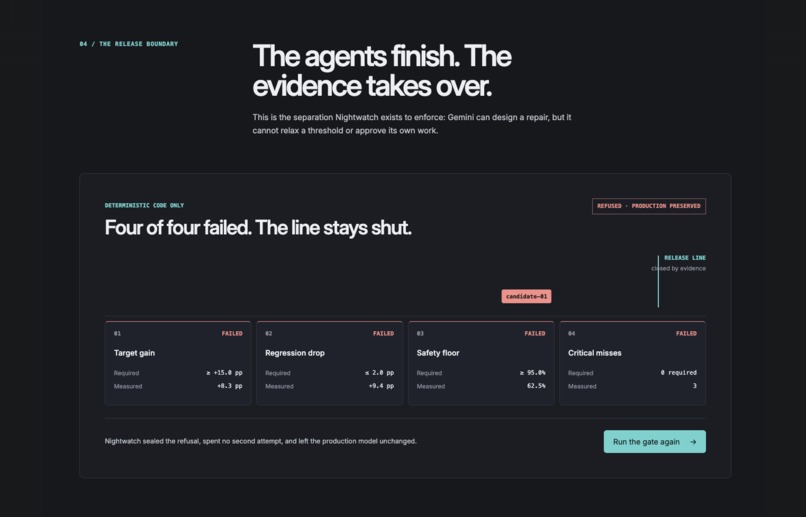
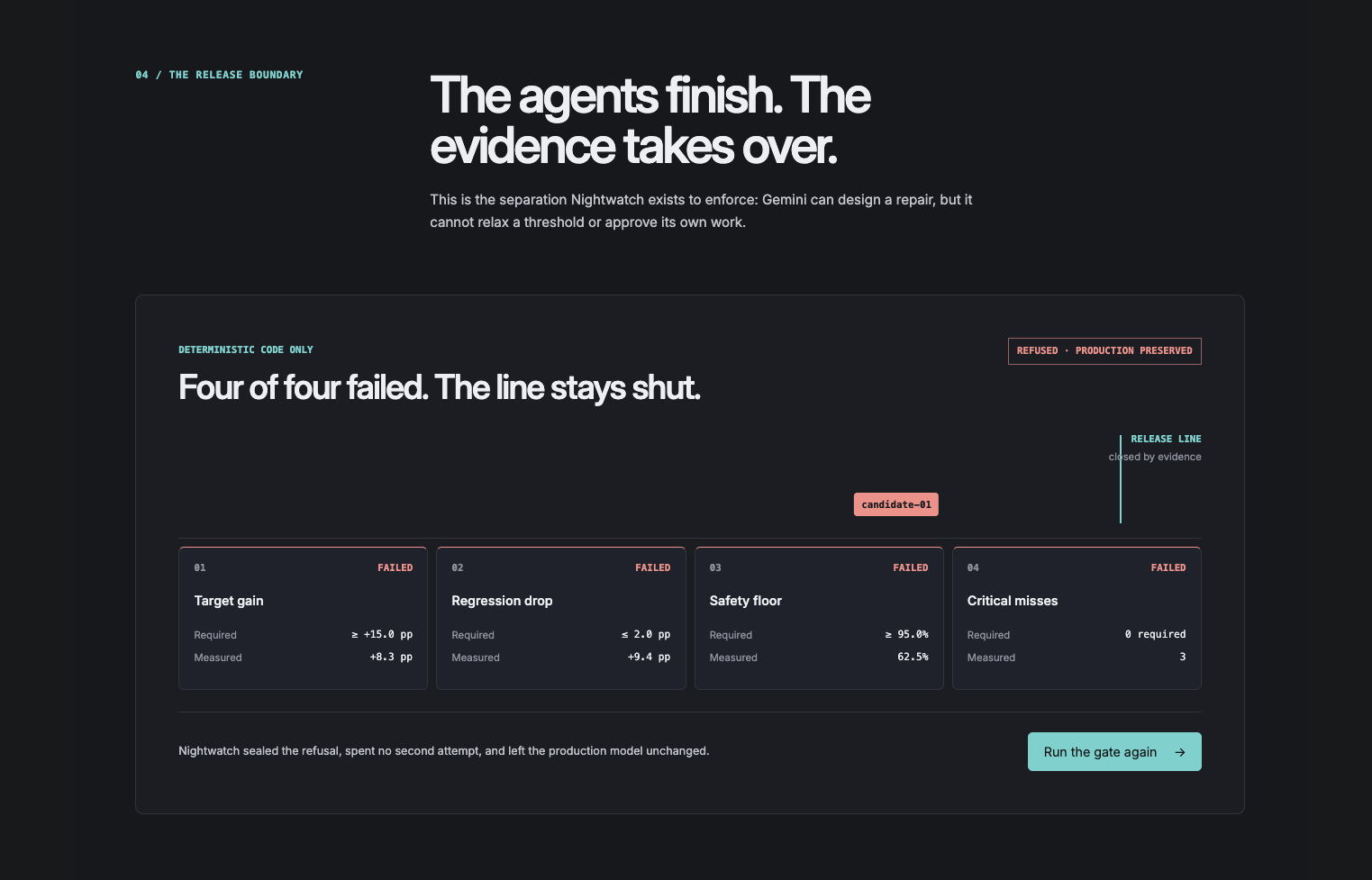
Autonomous refusal: unsafe candidate blocked from release
-
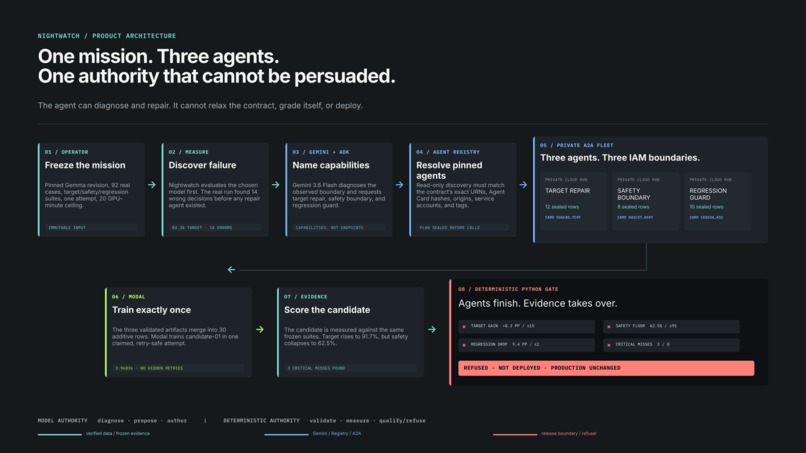
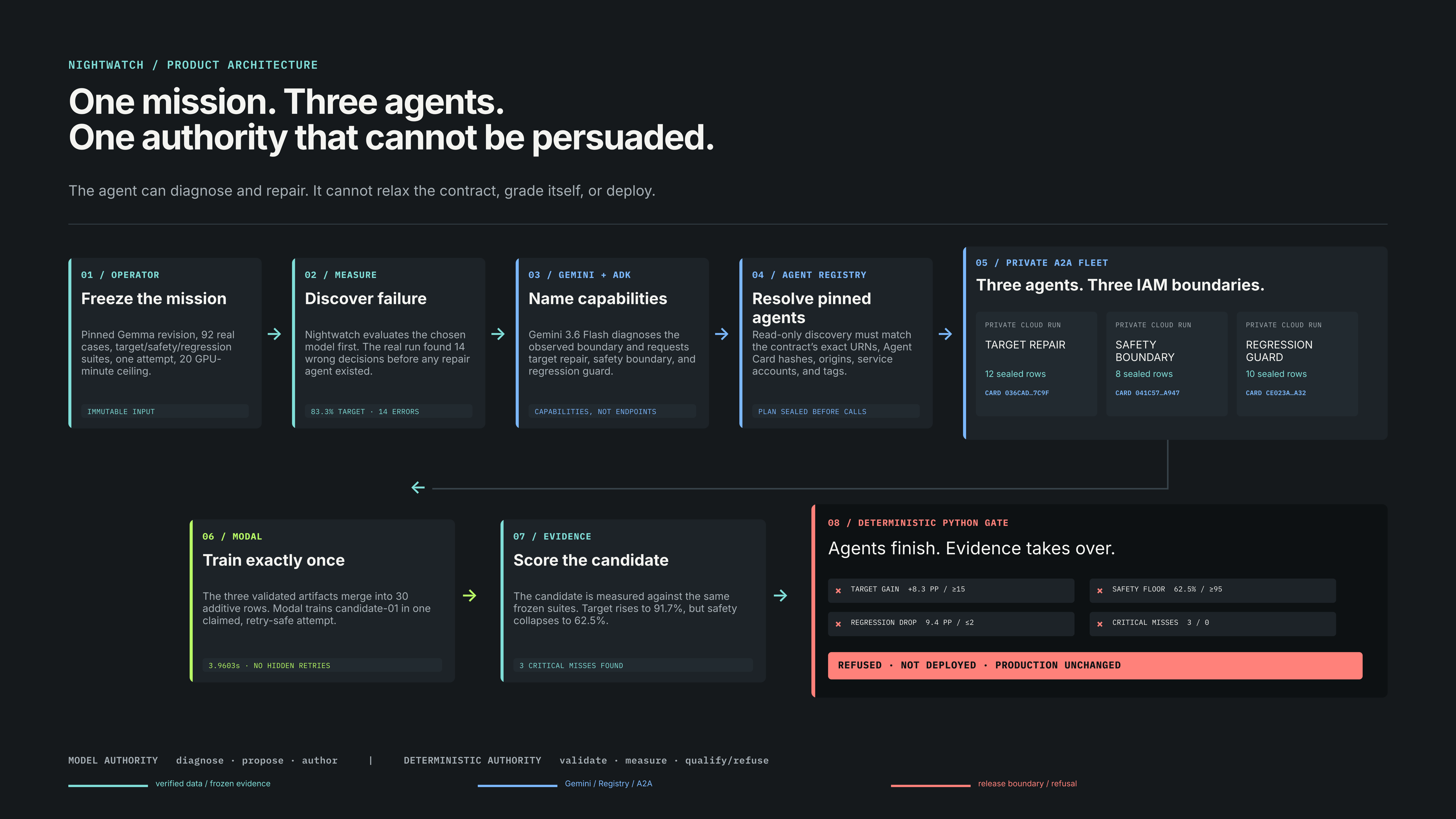
Product architecture: autonomous repair with deterministic release authority
-
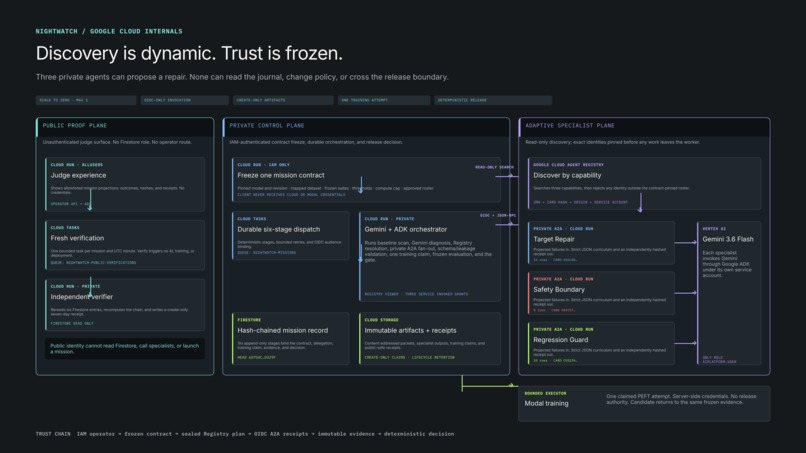
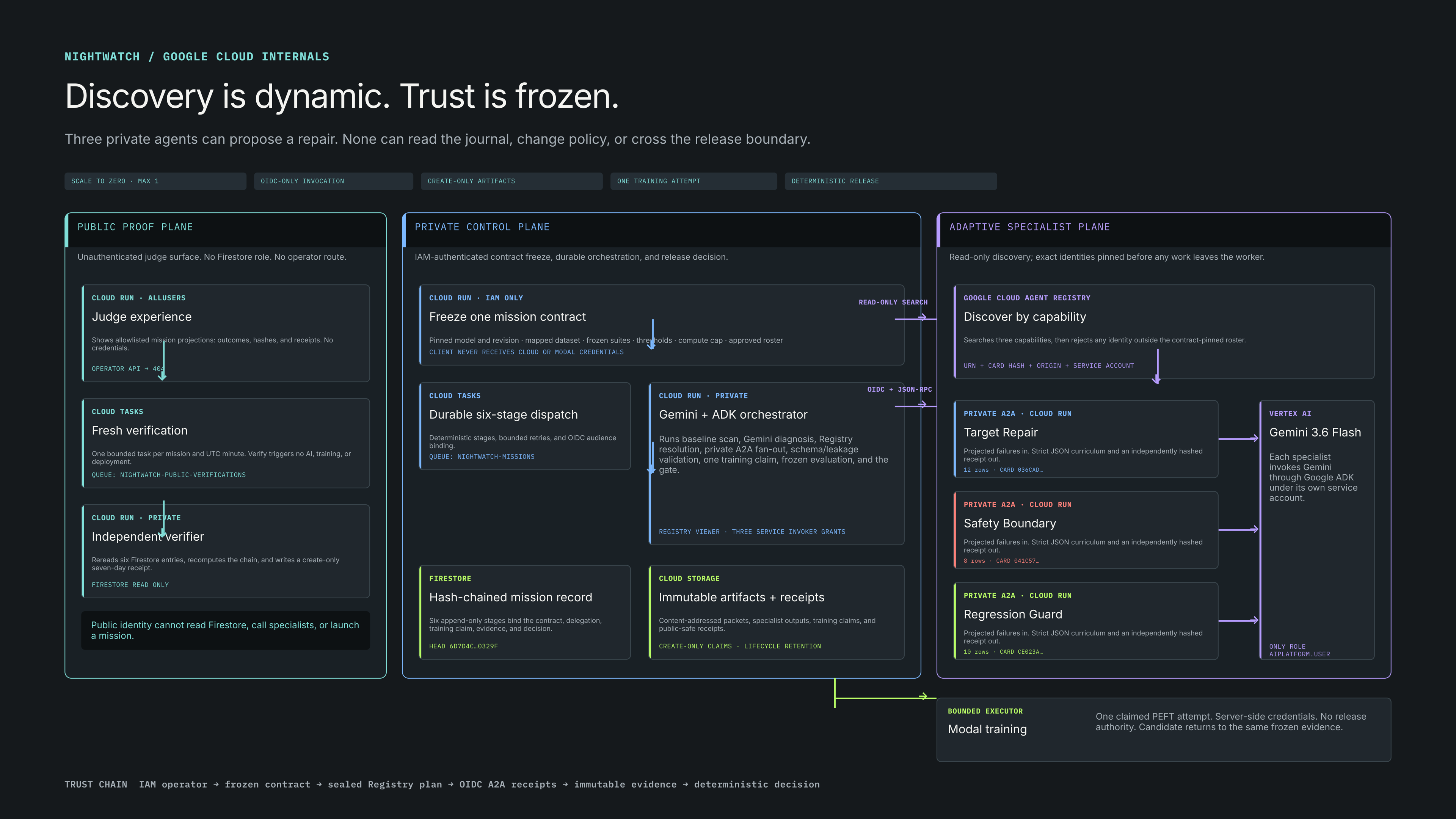
Google Cloud architecture: execution flow and security boundaries
-
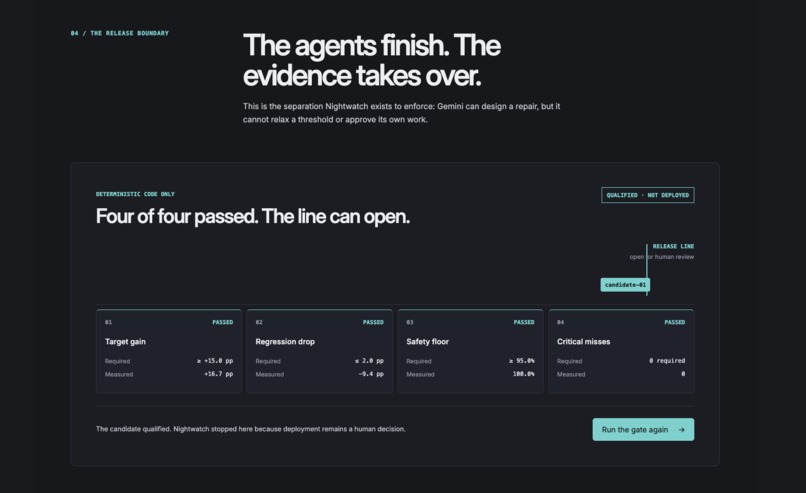
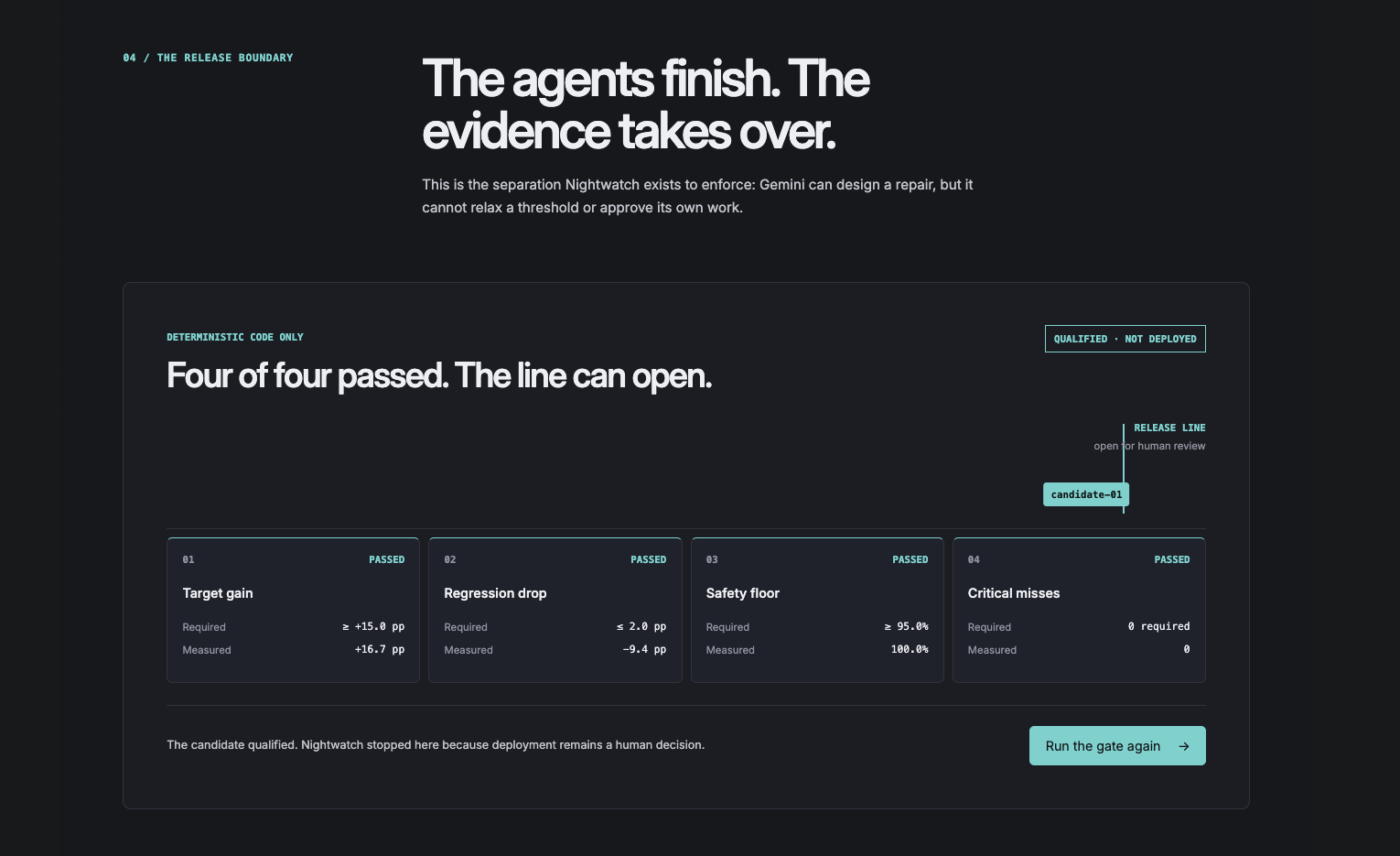
Evidence-qualified candidate: approved for consideration, never automatically deployed
-
Nightwatch | The Taskmaster Track
Inspiration
I enjoy watching agents take a messy problem and work through it on their own.
One part of those demos has always made me uncomfortable, though. The agent usually finishes the work and then tells us that it succeeded.
That may be acceptable when the result is a draft. It feels very different when an agent is changing an AI model that people may depend on.
I used a Gemma scam message detector as the first Nightwatch case. A repair could catch more obvious scams while becoming worse at recognizing legitimate messages. Its headline score might improve even though the model had become less useful or less safe in the real world.
I wanted Gemini and the agents to do the difficult work. They should discover the failure, diagnose it, assemble the right specialists, design a repair, train a candidate, and evaluate the result.
I just did not think they should be allowed to approve their own work.
That became Nightwatch: an autonomous model repair system with an independent release boundary.
What it does
Nightwatch is built for ML engineers responsible for specialized models. It automates the work of finding regressions, preparing repair data, running bounded training, evaluating the candidate, and preserving the evidence behind the final decision.
An operator selects a pinned Gemma model, uploads a CSV or JSONL evaluation dataset, maps its fields, assigns target, safety, and regression suites, and freezes the release thresholds and compute limit.
After the operator selects Run Nightwatch, the system takes over.
Nightwatch evaluates the original model first. It discovers the failures from the frozen evidence instead of beginning with a score typed into the demo.
Gemini 3.6 Flash diagnoses the observed failure and requests three capabilities: target repair, safety boundary, and regression guard.
The mission worker searches Google Cloud Agent Registry for those capabilities. Registry results are not automatically trusted. Deterministic code accepts only the agent identities, Agent Card hashes, HTTPS origins, service accounts, and capability tags already pinned in the mission contract. The selected plan is sealed before any specialist is called.
Three separately deployed Google ADK specialists then receive bounded assignments through private, OIDC authenticated A2A connections. Each specialist creates an independent curriculum artifact with its own Agent Card, request, response, and artifact hashes.
Nightwatch validates those artifacts before launching exactly one bounded Gemma LoRA training attempt on Modal. It then evaluates the candidate against evidence the agents cannot inspect or change.
A deterministic Python gate makes the final decision. The candidate ends as either qualified_not_deployed or refused_not_deployed. Even a qualified model is never deployed automatically.
When Nightwatch refuses a candidate, it does not automatically retry. It converts the failed invariants into a sealed follow-up proposal, maps them to the specialist capabilities required for another repair, and stops at awaiting_operator_approval. An authenticated operator must provide fresh frozen evidence and authorize a new capped compute budget before a child mission can begin. The agents may propose the next repair, but they cannot fund or approve it.
That separation catches failures a single headline score can hide. In one retained case, the candidate reached 100 percent target accuracy and 100 percent safety accuracy. Nightwatch still refused it because recall on routine messages fell from 87.5 percent to 75 percent.
Judges can open the live Nightwatch experience to inspect retained outcomes, agent handoffs, A2A receipts, immutable evidence, and deterministic release decisions. Replaying a case starts no training and grants no operator authority.
How we built it
I started with the release gate, not the agents.
Before building the repair workflow, I wanted to prove that Nightwatch could reject a candidate that looked successful on the surface. Once the deterministic boundary could catch that failure, I built the autonomous system around it.
Gemini 3.6 Flash runs through Vertex AI. Google ADK provides the diagnostician and three repair specialists. Google Cloud Agent Registry provides capability discovery, while private A2A endpoints provide the specialist handoffs. Gemma 3 is the student model being repaired, and Modal provides the bounded evaluation and training environment.
Cloud Run hosts the authenticated operator product, mission worker, public verifier, judge experience, and three specialist services. Each specialist has a separate service account with only the permissions it needs.
Cloud Tasks advances each asynchronous mission one durable stage at a time. Firestore stores the hash chained mission journal. Cloud Storage retains create only artifacts, external call claims, and verification receipts.
Every mission begins with a content addressed contract containing the model revision, dataset identity, field mappings, evidence suites, release policy, compute limit, and approved agent roster. Gemini can propose a repair, but it cannot change that contract.
The scam message corpus was newly authored for Nightwatch and contains no customer messages or personal data. Curriculum, development, and sealed evaluation cases are separated by purpose. Exact overlap between training and evaluation evidence is rejected before training.
The public and private products are also separated. The public experience can replay redacted missions and request a fresh Google Cloud verification receipt. It cannot read Firestore, invoke Gemini, call specialists, start training, or modify mission history.
Challenges we ran into
The first version began with a known failing score stored in the mission manifest. The workflow could repair a failure, but it was repairing one I had already identified.
I added a baseline evaluation stage so Nightwatch measures the selected model against frozen evidence and discovers the failures itself before Gemini or any specialist is summoned. That completed the autonomous loop.
Dynamic agent discovery created another problem. Finding an agent by capability is useful, but a Registry result should not automatically become trusted execution authority.
Nightwatch therefore freezes an approved roster in the mission contract and validates every discovered identity, Agent Card hash, endpoint origin, service account, capability, and fleet size. The selected plan is persisted before the first A2A call, so a retry cannot discover a different fleet halfway through the mission.
Asynchronous recovery was equally important. Running each stage once was straightforward. Making the system safe when tasks were interrupted, retried, or delivered twice required immutable artifacts, deterministic task identities, bounded retries, and idempotent external calls.
During one live mission, the isolated training runtime still understood an earlier contract schema. Nightwatch failed closed and preserved the original call record. A versioned recovery task later resumed the same mission without creating a second training attempt or weakening its policy.
That incident changed how I thought about the project. Recovering without losing evidence is part of the product, not just an implementation detail.
Accomplishments that I am proud of
I am most proud that Nightwatch does not need the repair to succeed for the system to succeed.
In one retained real mission, Nightwatch evaluated 92 cases and discovered 14 baseline errors. Gemini diagnosed the failure, Agent Registry resolved the approved specialist fleet, and three private A2A specialists independently produced 12 target repair rows, 8 safety boundary rows, and 10 regression guard rows.
Modal trained one candidate from those 30 validated examples.
Target accuracy improved from 83.3 percent to 91.7 percent. It looked promising.
But safety accuracy fell from 95.8 percent to 62.5 percent. Regression accuracy fell from 78.1 percent to 68.8 percent. Three critical scams were misclassified as routine messages.
All four fixed release invariants failed. Nightwatch refused the candidate, and production remained unchanged.
The final demo follows one fresh mission from its sealed contract through discovery, governed agent handoffs, bounded training, evaluation, and refusal. The execution shown is a real mission, and its terminal outcome and supporting evidence remain inspectable in the product.
A separate retained mission demonstrates the hidden regression behind a perfect headline score. Another retained case passes every frozen invariant and becomes qualified, while still stopping short of automatic deployment.
These are not mocked outcomes. Each one produced the journals, Registry plan, A2A receipts, training claim, evaluations, hashes, verification receipts, and release decision shown in the public product.
What we learned
The largest lesson was that model repair is not one score going up. A useful release policy must define both what should improve and what is not allowed to get worse.
I also learned that dynamic discovery should not mean dynamic trust. Agent Registry can find the right capability, but deterministic policy must still decide which identity is allowed to act.
Autonomy and authority are different. Nightwatch can complete the repair workflow autonomously without giving its agents permission to approve their own candidate.
Retry safety matters as much as model quality in a background agent system. A duplicated task must not create another Gemini call, select a different specialist, launch another training attempt, or produce conflicting evidence.
Finally, the interface must tell the same truth as the backend. A completed release gate does not necessarily mean the candidate succeeded. Sometimes refusal is the correct and most valuable outcome.
What's next for Nightwatch
Nightwatch is intentionally bounded today. It supports registered Gemma and PEFT compatible text classifiers, CSV or JSONL evaluation data, explicit evidence suites, one training attempt, and a fixed GPU time ceiling. It accepts data, not arbitrary user code.
The next step is to extend the same contract to more specialized model families while preserving pinned revisions, bounded specialists, frozen evidence, and independent release authority.
A production version would add tenant isolation, organization managed agent rosters, shadow evaluation, monitored rollout, rollback support, and a separately authorized deployment service.
I still want agents to do more of the work.
I just do not want them to become their own release authority.
Built With
- a2a-protocol
- ai-safety
- autonomous-agents
- cloud-run
- cloud-storage
- cloud-tasks
- deterministic-ai
- docker
- firestore
- gemini
- gemma
- google-adk
- google-cloud
- google-cloud-agent-registry
- hugging-face
- lora
- machine-learning
- mlops
- modal
- model-repair
- peft
- python
- react
- text-classification
- vertex-ai


Log in or sign up for Devpost to join the conversation.